2026: A pivotal year for Russia’s wartime regime-society relations
17.09.2026




by Dr. Ilya Matveev, Public Sociology Laboratory
The year 2026 is marked by an accumulation of difficulties in Russians’ everyday lives. Wartime economic engine is grinding to a halt: after two years of strong growth, the GDP grew by 1% in 2025 and just 0,6% in the first half of 2026. Behind these figures is the asymmetry between the military and the civilian sector: while the government keeps pouring resources into the military, the civilian economy has been in decline for a significant period of time (according to some calculations, for over a year and a half).
This is combined with new restrictions on mobile internet use and a new wave of successful long-range Ukrainian attacks, which have led to a fuel crisis and the destruction of hundreds of billions of rubles’ worth of goods in bombed Wildberries and Ozon storage facilities. Finally, there has been increased activity surrounding a potential new wave of mobilization, despite the authorities vehemently denying the possibility of mobilization itself.
Since 2026, regular conscription has been conducted all year round instead of in spring and autumn as before, and the process has been digitized with new restrictions for draft dodgers. Men are increasingly being summoned to military commissariats to “update the records”.
Taken together, these developments shatter the image of wartime “normality” that was painstakingly constructed by the Kremlin. As a result, they are gradually undermining societal support for the regime, although not to the point of a deep political crisis.
“Normality” amid chaos: Sources of wartime loyalty for the Kremlin
The years since 2022 have seen increased Putin’s approval and trust in government institutions including but not limited to the presidency. While opinion polling initially seemed to be hopelessly biased in the conditions of wartime repression, subsequent research has shown that there was no dramatic increase in bias; for example, response rates remained broadly similar to those in the pre-war period.
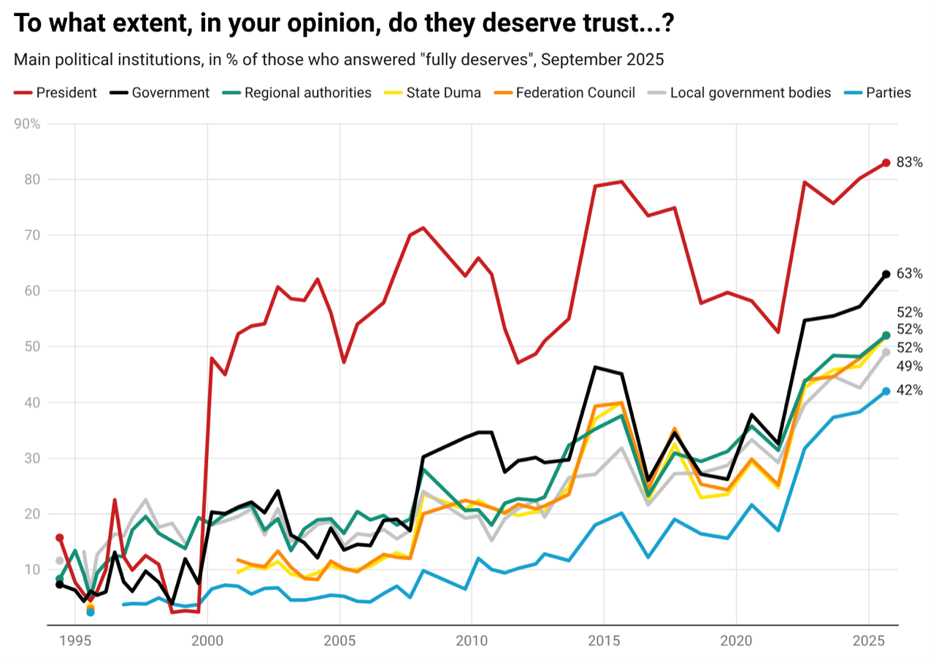
Although Putin’s approval ratings and levels of institutional trust have been quite high, the war itself has not been popular among the Russian population. Yes, according to the Levada Center, support for “the actions of the Russian military forces in Ukraine” has been in the 70s, only recently declining to the 60s. However, when asked a differently worded question, respondents gave different answers. The Chronicles agency asked whether respondents supported “Russia’s military operation on Ukrainian territory”. When phrased this way, i.e. support for the military operation itself rather than Russian troops in Ukraine, the question produced only 50–55% approval throughout the war years. Furthermore, Levada’s own data indicates that the majority of respondents have consistently favored peace talks over continuing military action. As of August 2026, only 33% of respondents opted for continuing military action, with 58% supporting peace talks. Among those who support continuing the war, an even smaller minority do so for ideological reasons, e.g. “we need to crush fascism, Nazism and banderites” or “we need to return our ancestral lands”. By contrast, the majority of pro-war respondents chose the vague option “we need to finish what we started and achieve our aims”. In effect, wartime support for the regime does not stem from enthusiastic support for the war itself, nor from widespread imperialist attitudes in Russian society.
Instead, support for the regime draws on multiple other sources. There are certainly elements of the “rally-round-the-flag” effect, that is, unwillingness to criticize the country’s leadership when Russia is facing such a tremendous challenge. However, another source of support is the image of wartime “normality”. Here I am drawing on my ongoing research with the other members of the Public Sociology Laboratory, especially my colleague Oleg Zhuravlev. “Normality” itself involves two components: (1) relative insulation from the direct effects of the war and other disturbances to everyday life, and (2) economic stability and rising standards of living. Until recently, the Kremlin had managed to achieve both. For example, as recently as August 2026, 37% of respondents said that the war “has not affected them at all” while only 19% said it “has affected them strongly”. Furthermore, wartime economic mobilization has resulted in full employment and rising incomes. Between 2022 and 2025, real (inflation-adjusted) incomes in Russia rose by as much as 30%. Polling shows high approval of the government’s handling of the economy in particular. Qualitative data collected by the Public Sociology Laboratory (through interviews, focus groups and ethnographic observation) reveals a similar pattern of approval regarding economic performance.
However, as Samuel Huntington noted in his classic study The Third Wave: Democratization in the Late Twentieth Century (1991), dictatorships that seek social support through economic performance rather the masses’ deep ideological commitment face a “performance dilemma”: once the economic situation deteriorates and the everyday life becomes more difficult, support for the regime quickly declines as well. What we are witnessing in Russia right now is indeed Huntington’s “performance dilemma” in action.
New challenges, declining approval
The recent disturbances to everyday life have affected most Russians. According to Levada, 68% of respondents had problems with mobile internet in August 2026, 63% faced difficulties with messenger apps and 65% experienced fuel shortages and closed gas stations. Fuel shortages in particular proved to be a serious challenge, with 32% of respondents claiming that they made life “significantly more difficult”. Another pollster, the Public Opinion Foundation, publishes weekly monitoring of opinion shifts. This includes an open question prompting respondents to name the week’s news stories that caught their attention. In August 2026, the reports were full of references to Ukrainian attacks and fuel shortages. Recent developments have clearly had a negative effect on ordinary people’s lives. Accumulating economic problems are also reflected in the polling data. For instance, the consumer sentiment index (a composite of questions about material well-being) declined from 117 in June 2025 to 99 in August 2026, which is roughly equivalent to pre-war levels. The movement of the consumer sentiment index shows that the success of military Keynesianism was real yet temporary; the economic optimism of 2023-2025 has largely disappeared.
As a result, the mood in the country is souring. Levada’s headline indicator (the question whether Russia “is on the right track” or “moving in the wrong direction”) is a case in point: similar to the consumer sentiment index, the wartime premium is gone.
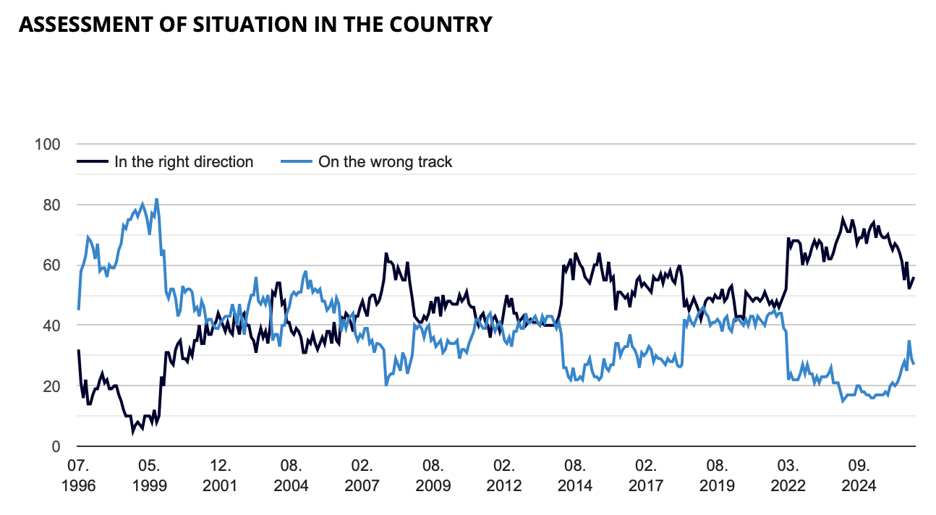
Putin’s approval is also affected, although not as strongly: the rating has declined from the mid-80s in 2022-2025 to the low 70s in 2026. While not yet existential, the threat to the regime’s popularity is real and will probably increase in future.
Looking ahead
The situation remains manageable for the regime. Although frustration and protest have crystallized around the September Duma elections — as reflected in the sudden popularity of the Yabloko party, which adopted the simple slogan “For peace and freedom” — any threat posed by the elections could easily be crushed through a combination of repression and voter fraud. Nevertheless, the outlook for the regime is negative. As this article shows, the accumulation of difficulties in the everyday lives of Russians is undermining the wartime model of regime-society relations, which was based on the vaunted “normality”.
Furthermore, in addition to the “performance dilemma”, the regime is facing what could be termed a “war dilemma”. Although the war itself is becoming increasingly unpopular, many people are still reluctant to criticize the Kremlin while the country is at war. However, when the war ends, questions will inevitably arise: What was it for? What was the point of our sacrifice? Putin’s popularity could plummet as he will be held accountable for a war that public opinion perceives as being inextricably linked to his decisions and leadership. To make matters worse, there is very little that Putin could present as a Russian victory. At the same time, continuing the war in the hope of extracting better terms from Ukraine, which could then be presented as a Russian victory, would come at the cost of growing frustration among the Russian people. The regime is boxed in, with few good options available.
Added at the author’s request: This article is based on research funded by the Research Council of Norway through the WARPUT project (Ideological Production, Policy Outcomes and Practices of Wartime Putinism), project number 356315.