Before Elections: Kursk Region
07.08.2026





Kursk (in Russian: Kurskaya oblast') is the only Russian region entering the 2026 elections after months of fighting, partial occupation, and the mass evacuation of civilians. Following Ukraine’s incursion in August 2024, the war stopped being a distant reality and became the defining event shaping the region. Fighting, mass displacement of people, and the destruction of border communities deeply transformed the security environment in the region, along with its economy, governance, information landscape, and public attitudes.
As the election campaign unfolds, life in the region is gradually returning to normal. Federal authorities have declared the territory fully recaptured, reconstruction is underway, and a new regional administration is in place. Yet the consequences of the incursion continue to shape virtually every major aspect of life in Kursk Oblast. They also explain why the region’s political environment — and the 2026 elections themselves — will differ markedly from those elsewhere in Russia.
The Incursion
On the morning of 6 August 2024, Ukrainian forces crossed the Russian-Ukrainian border and seized part of Kursk Oblast, including the town of Sudzha. Within days, the authorities introduced both a counterterrorism regime and a federal-level state of emergency in the region.
It was the first time since World War II that foreign troops had established control over part of Russian territory. Sudzha remained under Ukrainian control for roughly seven months before Russian forces retook the town in the spring of 2025. Federal authorities subsequently declared the region fully liberated.
The recapture of the territory, however, did not mean a return to pre-war life. Although the ground fighting shifted beyond Kursk Oblast, but drone attacks continued, while border districts were left facing extensive destruction, mass displacement, and a reconstruction process expected to last for years.
The Economic Cost
Kursk Oblast avoided systemic economic collapse following the Ukrainian incursion, but its priorities changed dramatically. Before 2024, the region’s economic policy had focused on major investment projects and the development of border districts. Once the fighting began, the priorities shifted sharply toward security, reconstruction, and support for the affected communities.
Kursk’s regional economy proved resilient largely because of its structure. Major mining, nuclear energy, and agricultural enterprises are located outside the areas directly affected by the fighting and continued operating even during the incursion. This helped preserve industrial output and the region’s main sources of budget revenue.
The border districts, however, suffered extensive damage. Homes, roads, and municipal infrastructure were destroyed, some agricultural businesses ceased operations, and economic activity in occupied areas effectively came to a halt.
Regional authorities estimate the total damage to the border districts at more than 750 billion rubles ($9.2 billion) — several times Kursk Oblast’s annual budget. By early 2026, the federal government had allocated more than 190 billion rubles for reconstruction, turning the rebuilding of the region into one of Russia’s largest infrastructure projects in recent years.
The Displacement Crisis
The most significant social consequence of the incursion has been the displacement of residents from the border districts. By various estimates, more than 150,000 people were forced to leave their homes. Their plight has become the main source of public discontent in Kursk Oblast, prompting open criticism of the regional authorities from residents who had never previously engaged in any protest activity.
Many border communities were destroyed or severely damaged, while reconstruction deadlines have repeatedly been pushed back. Although the authorities introduced housing certificates and compensation payments, many displaced residents have complained about the size of the payments, conditions in temporary accommodation, and the lack of a clear timetable for returning home.
The frustration quickly moved beyond private complaints and into the public sphere. Residents recorded collective appeals to federal authorities, organized meetings with officials, and openly criticized the regional administration. Remarkably, the protests came not from the political opposition but from loyal citizens whom the state itself portrayed primarily as victims of the war.
The authorities’ response only deepened the confrontation. One of the governor’s advisers publicly criticized residents of the border districts for failing to “fight back” against advancing Ukrainian troops. Ahead of a protest planned for March 2026, activists were summoned to the prosecutor’s office and threatened with possible repercussions.
Today, displaced residents represent the region’s only sustained source of grassroots protest. The authorities have sought to contain the protest through a combination of compensation payments and administrative pressure.
Overhauling Regional Governance
The displacement crisis became an enormous domestic political challenge for the regional authorities. Against this backdrop, Moscow began a sweeping overhaul of the regional administration, effectively assuming direct control over decisions related to reconstruction as well as preparations for the 2026 elections.
The first step in this process was the replacement of the governor. In December 2024, Vladimir Putin dismissed Alexei Smirnov, who had taken office shortly before the Ukrainian incursion, and appointed State Duma deputy Alexander Khinshtein as acting governor. Before that, Khinshtein’s work in the parliament had focused on information policy and cooperation with Russia’s security agencies.
Officially, the appointment was presented as an effort to improve the region’s management amid the continuing crisis. But in the spring of 2025, Smirnov was arrested on fraud charges related to the construction of defensive fortifications in Kursk Oblast. In April 2026, he was sentenced to 14 years in prison. In effect, Moscow placed part of the responsibility for the failures in the border region on its former leadership.
The investigation did not stop with Smirnov. It even reached his predecessor, Roman Starovoit, who governed Kursk Oblast from 2019 to 2024 before becoming Russia’s transport minister. Following reports that he could face corruption charges relating to the construction of border defenses, Starovoit was dismissed. Later that day, he was found dead in his car with a gunshot wound. The authorities reported that he had taken his own life.
Thus, the Ukrainian incursion and the crisis it triggered led not only to the incumbent governor’s resignation, but also to the effective dismantling of the region’s governing team by the Kremlin. At the same time, Khinshtein’s appointment was not merely another routine gubernatorial rotation. Unlike his predecessors, Khinshtein was tasked with crisis management and the reconstruction of the devastated border districts. This has further reduced the autonomy of the regional authorities, making key decisions on reconstruction and preparations for the 2026 elections increasingly dependent on Moscow.
Changes in Information Landscape
The war has not only transformed the governance structure of the Kursk Oblast. It has also changed the established patterns of information consumption among Kursk residents, including how they learn about regional news.
One of the most prominent examples is Pepel (means “ashes” in Russian), a media that emerged after the Ukrainian incursion and focused heavily on developments in Kursk Oblast. Unlike state media, Pepel regularly reported on the situation in the border districts, the problems of internally displaced population, and developments on the battlefield. For many Kursk residents, media like this became an alternative source of information about the events unfolding around them.
As a result, Kursk Oblast’s information landscape now differs noticeably from that of most Russian regions. The state continues to dominate traditional media, but the war has created space for new outlets capable of shaping public debate. During the 2026 election campaign, these non-state media — including some that remain broadly loyal to the authorities — are likely to play a major role in setting the regional agenda, in some cases displacing traditional media as the primary source of political information.
Elections After the Incursion
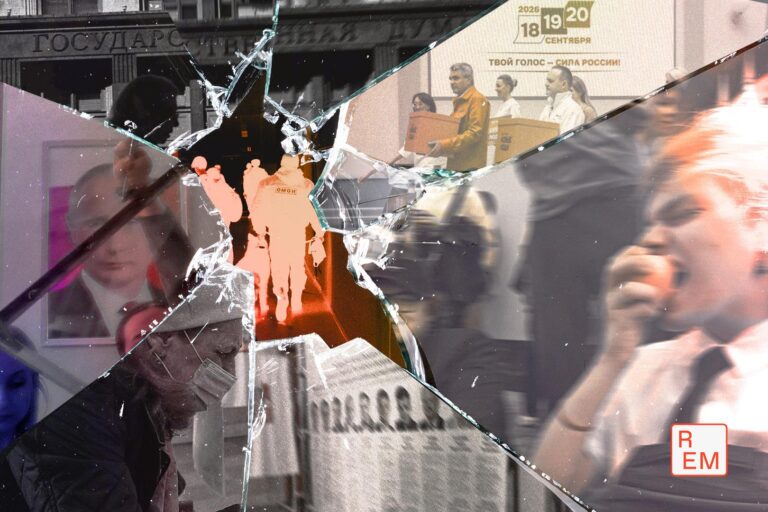
Despite the unprecedented negative impact of the Ukrainian operation on the regime’s stability in the Kursk region, the 2026 elections are unlikely to produce major changes in the balance of power. What makes this campaign exceptional is not the unexpectable outcome but the conditions under which the vote will take place. Elections to the Kursk Regional Duma will be held alongside the State Duma vote, raising the stakes for the regional authorities.
Before the Ukrainian incursion, Kursk Oblast was not considered one of United Russia’s strongholds. Putin’s party won only 51.7 percent of the vote in the 2016 State Duma elections and 43.5 percent in 2021. Its result in 2026 is likely to be considerably higher.
A higher result, however, would be unlikely to indicate growing support for the ruling party. Rather, it would reflect the transformed political environment: the replacement of the regional leadership, tighter federal control, fewer opportunities for public criticism, and the Kremlin’s determination to prevent any signs of electoral instability in a strategically important border region.
The logistical arrangements for the election will also differ from those in most of Russia. Following the mass evacuation, many residents of the border districts remain displaced from their permanent homes. For those voters, the authorities will have to provide special voting arrangements, including extraterritorial polling stations and other mechanisms that allow displaced residents to participate.
At the same time, the region’s electorate has continued to shrink. The number of registered voters fell from approximately 996,000 in 2015 to around 860,000 by early 2026, reflecting both Russia’s broader demographic decline and the consequences of the war.
The central question of the current campaign is not how the seats will be distributed, but what the result will signify politically. Kursk enters the campaign with a new system of regional governance, an unresolved displacement crisis, and a transformed information environment.
The election outcome will therefore reveal less about voters’ political preferences than about how successfully the federal center has restored political stability in the region. For Moscow, the elections are meant to demonstrate that even after the most severe regional crisis in decades, Kursk Oblast has once again been brought firmly under control.