2026 State Duma Elections: Candidate Registration
23.08.2026





The Election Atlas project reviews the nomination and registration of candidates for the State Duma elections. The registration process is formally not yet complete, but all party lists have already been registered. The only outstanding questions concern a small number of self-nominated candidates, the overwhelming majority of whom are unlikely to be registered. REM is publishing an abridged version of the report.
Introduction
The 2026 State Duma elections are the first to be held since the start of Russia's full-scale war against Ukraine. Since February 2022, Russia's political and party systems have operated under even more severe constraints, including wartime censorship, repressive pressure from the security apparatus, and pervasive state control over political actors.
It is clear that the organizers of the current elections have designed them primarily as a demonstration that the political status quo remains intact despite the dramatic challenges confronting the system.
The carefully constructed appearance of electoral normality can apparently be disrupted — and a measure of political uncertainty introduced — only by regional and local elections, which remain subject to somewhat less comprehensive control.
Key findings
1. Further erosion of political competition
The elections have seen a further increase in campaign control and a chilling effect on political activity — not only opposition activity. Compared with the 2021 elections, the number of party lists nominated has fallen by a quarter, from 15 to 11. The number of candidates running in single-member constituencies has also declined by 25% over the past five years, while the number of self-nominated candidates has more than halved — and is four times lower than in the 2016 elections.
Citizens' willingness to engage in political competition is further undermined by the entrenched practice of collusion among the largest political parties, which agree in advance on the winners in single-member constituencies, denying voters a meaningful opportunity to express their genuine preferences.
The collection of voter signatures remains one of the artificial barriers to political competition. It has now effectively ceased to be a mechanism for qualifying candidates for the ballot and instead become a politically controlled hurdle, underpinned by the arbitrary exercise of power by election commissions and the Interior Ministry, pseudo-legal formalism, and bureaucratic hair-splitting. The resulting candidate-registration system squeezes out new and smaller parties and contributes to their eventual elimination. As a result, 2026 marks the first election in which not a single party without an exemption from the signature-collection requirement even attempted to submit a candidate list.
2. Erosion of the independence of regional election commissions
The actions of many election commissions in rejecting candidates and party lists on spurious grounds in regional and local elections affect public perceptions of the election-commission system as a whole, including its role in elections to the State Duma. At the same time, there are positive examples of election commissions in several regions demonstrating how such conflicts can be avoided. For instance, the practice of publicly accepting candidates' registration documents deserves wider adoption. It helps eliminate at least some potential disputes, particularly over whether a candidate or party actually submitted certain documents.
3. Preventive purging of opposition candidates
Many opposition candidates who could have posed a challenge to pro-Kremlin candidates, boosted the ratings of opposition parties, or raised politically sensitive issues during the campaign were barred from running before the State Duma campaign even began — or at its very outset. The authorities' actions are consistent with a strategy developed for the forthcoming elections: to make them as uneventful and predictable as possible and to eliminate any possibility of surprises. Against the backdrop of the social and political strain currently facing the regime, the elections are expected to proceed in the most routine, low-key and tightly controlled manner.
The campaign's apparent lack of conflict and the absence of major scandals involving candidates — with the exception of Boris Nadezhdin's case — or parties at the registration stage are largely explained by the fact that potential risks to the Kremlin were neutralized well before the official start of the campaign. A combination of new "legal" mechanisms — including the designation of individuals and organisations as "foreign agents", prosecutions under "extremism" laws, and criminal cases involving "military fakes" and "discrediting the army" — has been used selectively to deprive politicians of the right to stand for election. Both smaller parties and the major parliamentary parties have faced such coercive pressure, while the case of Boris Nadezhdin demonstrates how quickly and easily a candidate's participation in an election can be blocked.
***
The following chapters present the key findings in greater detail.
1. Nomination and registration of party lists: Further erosion of competition
Eleven of the 17 political parties registered by the Ministry of Justice and eligible to participate in the elections submitted party lists: United Russia, the Communist Party (CPRF), the Liberal Democratic Party (LDPR), Just Russia, New People, Yabloko, the Pensioners' Party, Rodina, Communists of Russia, the Greens, and the Party of Direct Democracy. All 11 of these parties are exempt from the requirement to collect voter signatures. None of the six parties without this exemption — the Democratic Party of Russia [DPR], the Party of Progress, the Party of Freedom and Justice, the Party for Justice!, the Cossack Party of the Russian Federation, and the Party of Russia's Rebirth — submitted a party list. As a result, every party that submitted a list was registered.
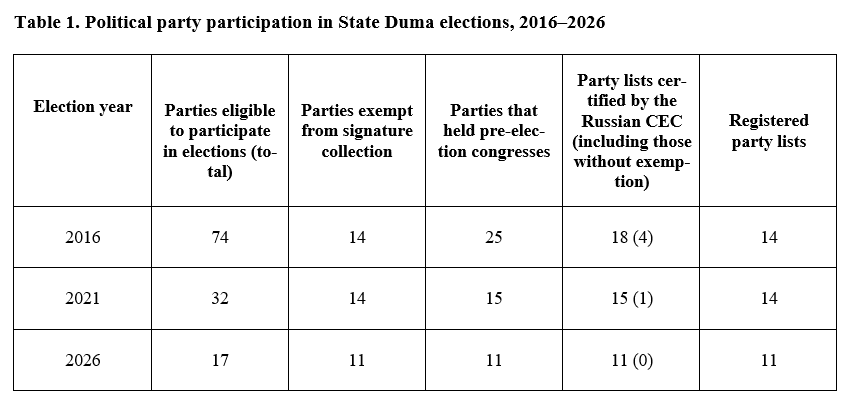
In 2016, four parties without the signature-collection exemption submitted lists to the Central Election Commission (CEC), which certified them. Several other parties held party congresses but failed to have their lists certified by the CEC. Ultimately, however, not a single list submitted by a party without the exemption was registered. In 2021, once again, all parties benefiting from the exemption — 14 out of 32 — submitted lists, and all were registered. Unlike in the current campaign, one party without the exemption, the Russian All-People's Union, attempted to collect the required signatures, but failed. In 2026, for the first time, not a single party without the exemption even attempted to submit a candidate list. Also striking is the fact that the number of registered political parties in Russia has fallen from 74 to 17 over the past decade — a decline of more than fourfold.
The consolidated data are presented in Table 1.
2. Nomination of candidates in single-member constituencies: Declining competition and abuse of authority by election commissions
2.1. Abuse of authority by election commissions
The authorities have turned the candidate-nomination process in single-member constituencies into an administrative and political barrier for opposition parties and candidates. In some regions, election commissions have systematically abused their powers. Such cases should be regarded as direct interference with citizens' right to stand for election.
During the 2026 election campaign, election commissions in St Petersburg once again distinguished themselves in this regard. According to the Yabloko party, Just Russia and various media reports, commissions conducting elections to the St Petersburg Legislative Assembly "lost" documents submitted by several candidates. Proving that such "losses" were deliberate is almost impossible. At least one candidate, however, managed to do so. Yabloko candidate Dmitry Khorzov filmed the submission of his documents to the election commission. After he was denied registration, he published the footage. The documents were subsequently found, and Khorzov was registered as a candidate.
2.2. Results of candidate nomination in single-member constituencies
The 2026 elections have seen a marked decline in competition in single-member constituencies. A total of 1,723 candidates notified district election commissions of their intention to run in 2026, compared with 2,296 in 2021. Thus, competition was already 25% lower at this stage, with the average number of candidates per constituency falling from 10.2 to 7.7.
This is partly explained by the smaller number of parties participating in the elections. However, even among the participating parties, the number of candidates nominated in single-member constituencies has often declined significantly (see Table 2).
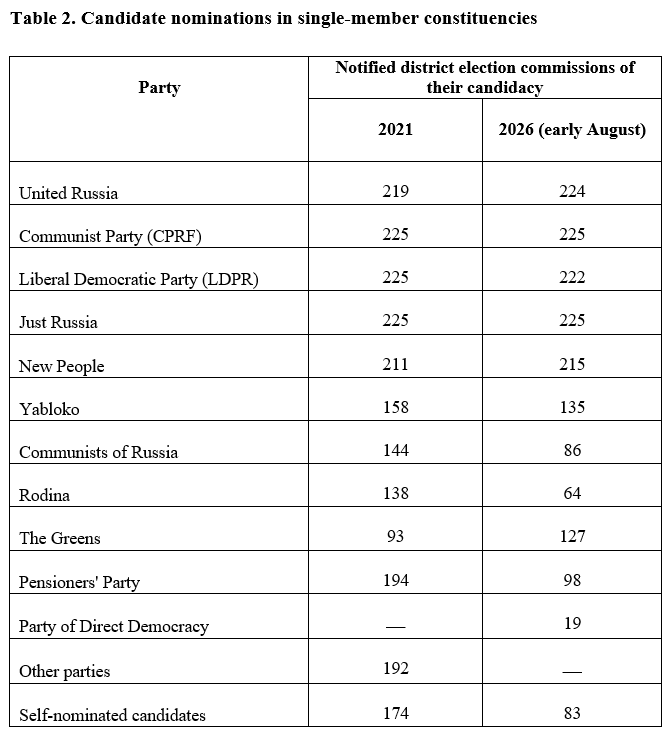
While the major parliamentary parties are seeking to field candidates in almost every constituency, the smaller parties have suffered a marked decline. Yabloko has nominated 15% fewer single-member constituency candidates, Communists of Russia 40% fewer, Rodina 54% fewer, and the Pensioners' Party almost 50% fewer. The only party to field more candidates is the Greens, probably because the party merged with the Green Alternative party shortly before the elections (REM). The number of self-nominated candidates has also more than halved.
The rejection rate this year is likely to be very low, since more than 95% of single-member constituency candidates have been nominated by parties exempt from the requirement to collect voter signatures. For these candidates, the only major obstacle to registration is arbitrary action by election commissions. The situation is fundamentally different for self-nominated candidates: unless they have reached a prior agreement with the authorities, their chances of being registered are extremely slim.
Self-nominated candidates often cluster in particular regions and even in specific constituencies. Of the 83 self-nominated candidates, 11 are running in Moscow. Five are running in Chelyabinsk Region and seven in Moscow Region. Several constituencies have three self-nominated candidates each: Syktyvkar in the Komi Republic, Khakassia, Yaroslavl, and the Tushino and Central constituencies in Moscow. At this stage, however, there is little visible campaigning by these candidates.
Formally, the most competitive constituencies at the nomination stage are Angarsk in Irkutsk Region and the Tushino and Central constituencies in Moscow, with 12 nominated candidates each. Another 11 constituencies have 11 candidates each. The lowest level of competition is in the Ingush and Nenets single-member constituencies, with just four candidates each.
The Communist Party (CPRF) and Just Russia have nominated candidates in every constituency. United Russia has left constituencies uncontested in Tatarstan and Arkhangelsk Region. The LDPR, meanwhile, has not nominated candidates in three constituencies, all of them in Stavropol Krai. New People has failed to field candidates in 35 constituencies.
The media, citing sources in the Russian presidential administration and United Russia, report that the "party of power" is prepared to allow candidates from other parties to win in at least 16 constituencies.
Such political horse-trading is damaging because it disregards voters' preferences — the very purpose for which elections exist. Backroom deals between party leaders and senior government officials turn elections into a political charade.
3. Pressure on potential candidates and obstruction of their nomination
Restrictions introduced several years ago barring politicians designated as "foreign agents" from standing for election, as well as politicians who have received criminal or even administrative penalties under "extremism"-related provisions, have become one of the key mechanisms for selectively depriving Russian citizens of their right to stand for election.
3.1. Yabloko
- Administrative disqualification: A series of fines for displaying "extremist symbols" — including photographs of late Alexei Navalny — has barred the party's leadership and key regional figures from standing for election for one year. Those affected include Nikolai Rybakov (Moscow), Emilia Slabunova and Dmitry Rybakov (Karelia), Alexander Shishlov and Olga Shtannikova (St Petersburg), Artur Gaiduk (Pskov Region), and Anton Kostryukov (Novgorod Region).
- Use of the "foreign agent" designation: Yabloko deputy chairman Boris Vishnevsky (St Petersburg) was barred from standing for election after being added to the "foreign agent" register in 2024. In 2026, a collection of his articles was also designated as extremist material.
- Criminal prosecution: Yabloko deputy chairman Maxim Kruglov (Moscow) was sentenced to seven years in prison under Article 207.3 of the Russian Criminal Code ("fake news about the army"). Former deputy chairman Lev Shlosberg (Pskov Region) has not only been added on the "extremist" and "foreign agent" registers, but has also been placed in pre-trial detention in criminal cases involving "fake news" and "discrediting the army".
3.2. Communist Party (CPRF)
- Criminal cases in regions with strong local party organisations: A wave of searches, detentions and criminal cases has targeted regional Communist Party deputies and officials in Altai Krai, including Lyudmila Klyushnikova, Svetlana Kerber, Yury Kropotin, Andrei Chernobai and others.
- Disqualification over "extremist" social-media posts: Fines imposed over archived references to, or logos of, social-media platforms operated by Meta (designated an "extremist organisation" in Russia) have deprived deputies in Omsk Region (Ivan Fedin, Vladimir Vinichenko), Orenburg Region (Nurlan Munzhasarova, Vladimir Gudomarov) and Leningrad Region (Ivan Apostolevsky, who was sentenced to 10 days' administrative detention) of the right to stand for election.
- Targeted cases and restrictions: Viktor Vorobyov (Komi Republic) was designated a "foreign agent", while Oksana Bagirova (Komi Republic) was arrested on charges of "justifying terrorism".
3.3. Liberal Democratic Party (LDPR)
- Criminal crackdown on the regional branch in Krasnoyarsk Krai: Former State Duma deputy Sergei Natarov was sentenced to 14 years in prison. The regional party leader, Alexander Gliskov, was prosecuted and sentenced to 10 years in prison; the verdict was later overturned and he was transferred to house arrest. Regional faction leader Alexei Boikov was placed on a wanted list, and his property was seized.
- Pressure in Lipetsk Region: A criminal case against regional party leader Anatoly Yemelyanov, involving 42 alleged counts of fraud, resulted in the loss of opposition activity by the regional branch and its subsequent takeover by the regional administration.
3.4. Boris Nadezhdin
The case of Boris Nadezhdin stands apart. The former Russian presidential candidate and former State Duma deputy entered the race in the Mytishchi single-member constituency in Moscow Region and began collecting signatures in support of his self-nomination. On July 10, 2026, the Ministry of Justice added Nadezhdin to the "foreign agent" register, thereby rendering him ineligible to stand for election. The candidate nevertheless said he would continue collecting voter signatures.
Three days later, authorities filed an administrative case against him for displaying "extremist symbols", based on a link to a video containing a photograph of Alexei Navalny. This provided another potential legal basis for barring him from the election, although the court's decision had not yet entered into force. On July 16, it emerged that Nadezhdin had been subject to a travel ban due to enforcement proceedings over a debt of more than 1.4 million roubles. On August 3, it became known that the politician had nevertheless managed to leave the Russian Federation.