Altai Region
01.06.2026
The Altai Region is the largest agricultural region of Siberia, whose political culture has been shaped by the ideological migration of Old Believers, traditions of Cossack self-organization, and its frontier position bordering Kazakhstan, Mongolia, and China. The region’s specificity lies in deeply rooted political pluralism and the phenomenon of the “Altai anomaly”: despite consistently low socio-economic indicators, voters tend to express dissatisfaction not through radical non-systemic protest, but through support for left-wing forces. Although the region has retained features of the “red belt”, the internal geography of this support has transformed: the rural periphery has become a stronghold of the “ruling party” due to a paternalistic style of governance, while major cities have shifted toward the Communist Party of the Russian Federation, perceiving it as an instrument of change and political de-monopolization. As a result, support for Vladimir Putin in the region consistently remains below the national average, while support for left-wing forces is anomalously high by Russian standards.
By 2026, the political landscape is defined by a complex balance between the technocratic administration of Viktor Tomenko and a powerful regional branch of the CPRF led by Maria Prusakova. At the same time, a specific culture of electoral malpractice has developed in the region: rather than relying on large-scale falsification of protocols, authorities prioritize voter bribery and intense pressure during the voting process, allowing them to maintain control while preserving the appearance of electoral legitimacy. However, in 2025–2026, the political climate has significantly hardened, and the “Altai anomaly” has become the target of strict correction. Amid preparations for the State Duma elections, authorities have shifted from tactical maneuvering to a strategy of direct coercive suppression of opponents and neutralization of urban protest potential. The regional branch of the CPRF has faced systematic administrative and legal pressure, including criminal prosecution of active deputies, restrictions on their public activity, and the stripping of mandates under the pretext of reporting violations. This culminated in increased pressure on Maria Prusakova aimed at preventing her from effective participation in the Duma campaign. The governor’s team, relying on federal law enforcement resources, is implementing a scenario of transforming a once dynamic party branch into a demoralized structure.
1. Basic characteristics
The region is located in the south of Western Siberia and borders Kazakhstan. The capital is Barnaul with approximately 623,000 residents. The region population is 2.13 million people (~1.46% of Russia’s total population).
According to the official data, the Altai Region has approximately 1.76 million voters, which is about 1.57% of Russia’s electorate.
2. Political representation
2024 Presidential Election
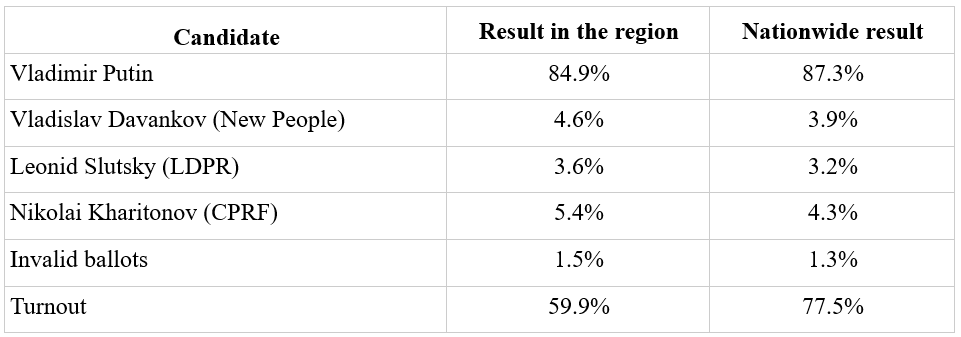
The region recorded a historic high level of support for Vladimir Putin; however, turnout remained among the lowest in Siberia, highlighting passive skepticism among part of the population.
Gubernatorial elections
In the 2023 election, Viktor Tomenko (United Russia) won with 76.2% of the vote on a turnout of 31%. Other candidates included Yevgenia Borovikova (Just Russia) with 9.5%, Sergey Bulayev (LDPR) with 8%, and Sergey Malinkovich (Communists of Russia) with 4.2%.
Altai Region Legislative Assembly (8th convocation, 2021–2026)
The electoral system is mixed, with 34 members elected by party lists and 34 members elected in single-member districts (68 seats it total).
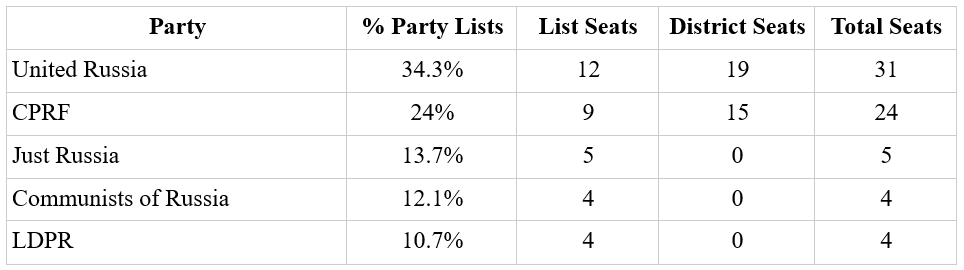
The results of the 2021 elections to the Legislative Assembly became one of the key electoral anomalies of the cycle: United Russia not only showed a weak performance on party lists, but also, for the first time in many years, lost a significant number of single-member districts to candidates from the CPRF (especially in Barnaul and Rubtsovsk). This deprived the ruling party of a constitutional majority and turned the Assembly into one of the most competitive and debate-driven platforms in Siberia. The presence of the Communists of Russia faction reflects a classic spoiler strategy aimed at diluting support for the main communist party, which in this case still allowed the spoiler to enter parliament.
Barnaul City Duma (8th convocation, 2022–2027)
The electoral system is mixed, with 20 members elected by party lists and 20 members elected in single-member districts (40 seats in total). The 2022 municipal elections marked the restoration of administrative control over the regional capital following the “shock of 2021”.
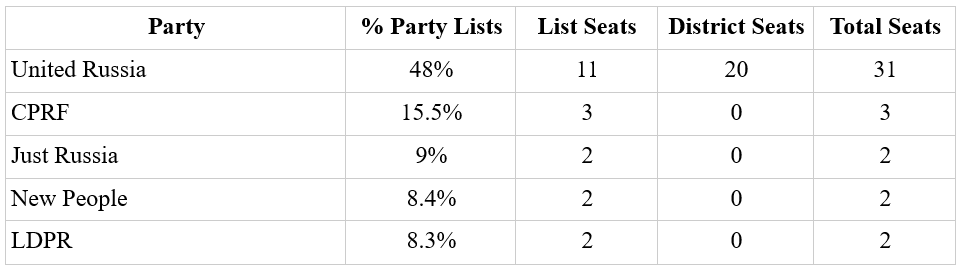
Unlike the regional legislature, in the Barnaul City Duma the United Russia maintains total control, having secured all 20 single-member districts. This allows the Barnaul mayor’s office to pass any initiatives without obstruction and effectively blocks opposition influence at the municipal level.
3. Local self-government and municipal reform
The period of 2022–2026 became a turning point for the system of local self-government in the Altai region. Historically having the largest number of municipalities in the country, the region entered an active phase of transition to a single-tier model of governance. By early 2026, the reform had reached a decisive stage: following the first “pioneers,” new territories joined the transformation into municipal districts. As of spring 2026, only two municipalities—Rubtsovsky and Novichikhinsky districts—continue to resist the reform.
This measure has effectively completed the regional power vertical: heads of districts are now appointed through selection processes fully controlled by the governor’s administration, thereby preventing the emergence of independent or opposition figures at the local level.
In practice, the reform led to the liquidation of rural councils as legal entities with their own elected heads, councils of deputies, and budgets. Local administrations were transformed into territorial branches of district administrations, deprived of any financial or personnel autonomy. Politically, this resulted in the “sterilization” of the grassroots level of governance: authority over land resources and budget flows has been consolidated in the hands of a narrow circle of appointed managers. Such centralization simplifies interaction with large agro-industrial holdings, whose interests previously could clash with independent rural deputies or local communities.
One of the most significant outcomes of the reform has been the drastic reduction of representative government. The total number of municipal deputies in the region—which traditionally constituted the largest body of its kind in the country (over 7,000 seats)—has been cut by more than five times. This means that more than 5,700 local politicians are losing their status and powers. Such “selection” allows the regional administration to almost completely eliminate protest activity at the grassroots level. The sharp reduction in mandates is also critical for the functioning of the “municipal filter”: in the new system, it becomes technically impossible for opposition gubernatorial candidates to collect the required signatures without direct approval from the “ruling party,” as independent rural deputies have virtually disappeared as a class.
A distinctive feature of the Altai region remains the persistence of latent social tension in rural areas. Unlike the Altai republic, where similar processes in 2025 resulted in mass street protests, the authorities in the region have proceeded through gradual administrative absorption. Nevertheless, the risk of “distancing the government from the people” remains highly relevant: the closure of local administrations in remote villages and the transfer of governance functions to district centers generates quiet discontent among voters, creating long-term threats for the stability of the agrarian hierarchy.
4. History of regional governance
Vladimir Rayfikesh (1991–1994)
The first head of the regional administration, appointed by Boris Yeltsin in October 1991. A state farm director and People’s Deputy of the RSFSR, Rayfikesh was seen as a “face of democratic change” and served as Yeltsin’s trusted representative in the 1991 election. His tenure was marked by a sharp conflict with the Regional Council led by Alexander Surikov. The regional administration under Rayfikesh was among the few that failed to dissolve the opposition-controlled council in 1993. His political defeat became evident in December 1993, when his allies lost the Federation Council elections to Surikov, after which he resigned “at his own request”.
Lev Korshunov (1994–1996)
Appointed after Rayfikesh’s resignation as a more bureaucratically oriented “pragmatic manager,” Korshunov sought to distance himself from party conflicts but failed to gain the support of the influential agrarian lobby. His governorship coincided with a severe economic crisis and prolonged wage arrears. He is remembered for initiating a case in the Constitutional Court regarding the regional charter, which provided the election of the governor by deputies. His legal victory in 1996 paved the way for the first direct gubernatorial elections, which he ultimately lost in the second round to his main rival, Surikov.
Alexander Surikov (1996–2004)
A representative of the “red belt” and former speaker of the Regional Council, Surikov became a symbol of stability for rural populations and agrarian elites. His rule was characterized by a balanced governance style, completion of major long-term infrastructure projects, and strengthened regional paternalism. Later, he faced accusations of using heavy administrative pressure and involvement in “alcohol wars” (competition over the liquor market). His dominance seemed unshakable until 2004, when the unexpected candidacy of Mikhail Evdokimov and campaign tactical missteps (including the registration of Vitaly Surikov as a spoiler candidate) led to his sensational defeat.
Mikhail Evdokimov (2004–2005)
A Russian comedian and actor, known as the “people’s governor,” whose rise marked the triumph of populism over the administrative vertical. Evdokimov capitalized on the image of “an honest, ordinary man”, securing victory on a wave of demand for change. However, the lack of a professional team and governing experience led to administrative chaos and renewed conflict with the Regional Council. Deputies aligned with Surikov passed a vote of no confidence (46 out of 52 votes). His tragic death in a car accident in August 2005 created a martyr-like image and fueled numerous conspiracy theories about a “contract killing”.
Alexander Karlin (2005–2018)
A former official of the Prosecutor General’s Office and the Presidential Administration, sent to “stabilize” the region. Karlin established a rigid prosecutorial-style vertical of power. His era is associated with increasing authoritarianism, the abolition of direct mayoral elections, and the introduction of one of the strictest “municipal filters” in Russia (7%). He personally oversaw key decisions and was highly sensitive to criticism. Despite political stagnation, he ensured the region’s stable integration into federal programs. His resignation in 2018 was seen by elites as the end of a “patriarchal” style of governance.
Viktor Tomenko (since 2018)
Appointed from the government of Krasnoyarsk region as a “technocratic mediator.” Initially adopting a softer style focused on investment, he faced a setback with United Russia in the 2021 regional parliamentary elections. This forced his team to adjust its strategy. By 2025–2026, Tomenko had shifted toward a more coercive approach to restructuring the political field. His key objective in the current cycle is to weaken the CPRF and reduce the political influence of State Duma deputy Maria Prusakova. Tomenko acts as an effective administrator whose primary loyalty is directed toward Moscow, with governance increasingly relying on the consolidation of control and the reduction of grassroots opposition through municipal reform.