Krasnoyarsk Region
17.06.2026
The Krasnoyarsk region is a strategic resource giant with a tradition of “Siberian free spirit”, historically developed as a center of extractive industries and a place of exile. This has shaped an independent, dissent-prone electorate with strong traditions of self-organization. A defining feature of the region for many years was electoral pluralism with a distinctly personalist character: surges in party popularity were consistently tied to strong individual figures such as General Alexander Lebed, economist Sergey Glazyev, or “criminal” businessman Anatoly Bykov. This resulted in waves of support shifting from the LDPR to the Rodina bloc, and later to the CPRF.
However, the transition from elite conflicts of the 1990s to a rigid federal power vertical was driven by systemic changes, with a key milestone being the enlargement of the region in 2005–2007. The merger of the region with the Taymyr and Evenk autonomous districts created a “super-region,” consolidating a model in which the interests of northern territories are subordinated to large-scale development projects (such as “Vostok Oil” and the modernization of Norilsk), while local authorities have largely lost real influence over the distribution of natural resource rents.
By 2026, “mavericks” like Anatoly Bykov have been fully neutralized, and the elite pluralism of the past has been replaced by a system of partnership between federal financial-industrial groups and a technocratic governor. The political landscape is now defined by a balance of interests among major corporations: Interros (Norilsk Nickel), which dominates the north, Rusal of Oleg Deripaska, as well as RusHydro and Rosneft.
The transition to a model of “federal technocratism” under the current governor Mikhail Kotyukov has been accompanied by the weakening of what was once one of the strongest and most independent opposition branches in the country—the LDPR. Since 2021, the party has faced systematic pressure, including the arrests of Legislative Assembly vice-speaker Sergey Natarov and faction leader Alexander Gliskov, which experts describe as a “political purge” of the regional field. The criminal prosecution of its leaders has turned a once combative organization into a demoralized structure aligned with the administrative mainstream, enabling the neutralization of Krasnoyarsk’s dissent and ensuring the unchallenged dominance of United Russia in the interests of major industrial actors.
1. Basic characteristics
The region is located in Central Siberia and occupies nearly 14% of Russia’s territory.
The capital, Krasnoyarsk (~1.2 million residents), is the largest economic, educational, and cultural center of Eastern Siberia. The region is also home to Norilsk—one of the northernmost cities in the world, a base of Norilsk Nickel and a major center of non-ferrous metallurgy.
Population: ~2.84 million people (about 1.96% of Russia’s total population).
According to the official data, the Krasnoyarsk region has approximately 2,04 million voters, which is 1.85% of the Russia’s electorate.
2. Political representation
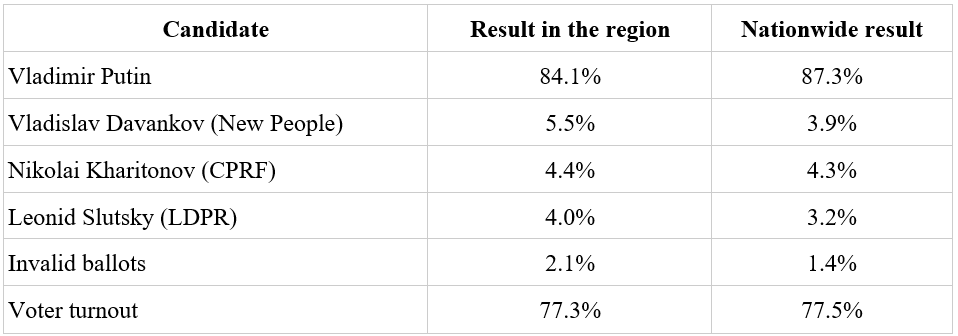
2024 Presidential Election
Gubernatorial elections
In the 2023 election, Mikhail Kotyukov (United Russia) won with 70.2% of the vote on a turnout of 35.54%. Other candidates included Alexander Gliskov (LDPR) with 11.3%, Irina Ivanova (Russian Ecological Party “The Greens”) with 8.2%, Andrey Novak (CPRF) with 6%, and Maksim Markert (Just Russia) with 1.7%.
Legislative Assembly of the Krasnoyarsk region (4th convocation, 2021–2026)
The electoral system is mixed, with 26 members elected by party lists and 26 members elected in single-member districts (52 seats in total).
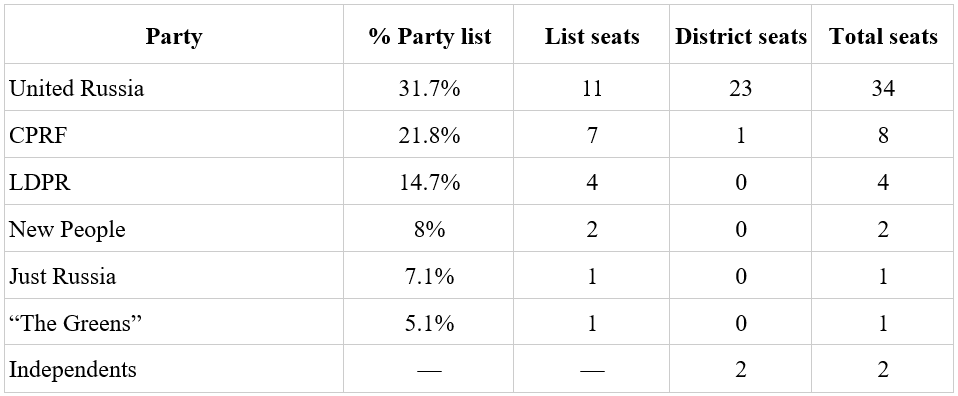
The “26+26” system allows the authorities to compensate for United Russia’s relatively modest performance on party lists by securing near-total control in single-member districts. The presence of a Russian Ecological Party “The Greens” faction is a regional peculiarity, driven by a strong environmental agenda in Krasnoyarsk and Norilsk.
Krasnoyarsk City Council (7th convocation, 2023–2028)
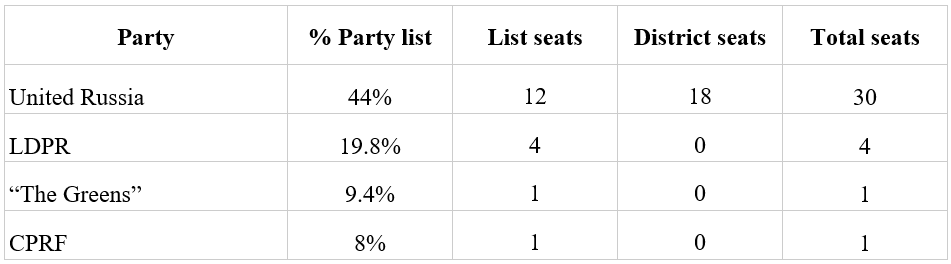
The electoral system is mixed, with 18 members elected by party lists and 18 members elected in single-member districts (36 seats in total).
The 2023 municipal elections confirmed total control of United Russia over the regional capital.
3. Local self-government and municipal reform
The period of 2024–2025 marked a turning point for the system of local self-government in the Krasnoyarsk region. As part of the nationwide trend toward formation of a unified system of public authority, the region completed a large-scale transition to a single-tier model of governance. In 2025, 33 municipal districts and 6 urban districts were created, replacing 472 previously existing municipalities. This measure effectively finalized the executive power vertical: heads of districts are now appointed through competitive selection procedures fully controlled by the regional administration, thereby eliminating the possibility of accidental or non-system politicians at the local level.
In practice, the reform led to the abolition of rural settlements with elected heads and councils, their own budgets, and authority over land management. Local administrations were transformed into territorial branches of district administrations, deprived of financial autonomy. Politically, this resulted in the “sterilization” of the grassroots level of governance: powers and financial flows have been consolidated in the hands of a narrow circle of appointed managers. Such centralization simplifies the administration of large infrastructure projects and land management, particularly in resource-rich areas where business interests previously clashed with the positions of local rural deputies.
One of the most significant outcomes of the reform has been the drastic reduction in local representative government. The total number of municipal deputies in the region is estimated to decrease by about four times—from roughly 4,500 to a more compact corps of around 1,200 deputies (in 2025, the first elections in the new districts were already held: 935 mandates were filled across 31 municipal and four urban districts). Such “selection” will allow the regional administration to almost completely eliminate protest activity at the grassroots level. The sharp reduction in mandates is also critical for the functioning of the “municipal filter.” In the new system, it will be technically impossible for opposition gubernatorial candidates to collect the required signatures without direct approval from the “ruling party,” as independent rural deputies have virtually disappeared as a class.
A distinctive feature of the Krasnoyarsk region remains the administration of the former autonomous districts—Taimyr and Evenkia. Despite losing their status as separate administrative entities back in 2007, they have retained their position as administrative-territorial units with special privileges under the current reform. Within the municipal districts, they have been granted expanded powers regarding support for the indigenous small-numbered peoples of the North and the preservation of traditional land use. This arrangement helps maintain a fragile balance between the interests of federal corporations developing the Arctic and local populations, while preserving strong administrative integration of the northern territories with Krasnoyarsk.
4. History of regional governance
Valery Zubov (1993–1998)
Zubov embodied a new type of post-Soviet leader. A Doctor of Economics and the youngest dean in the country, he combined an academic background with business experience. His election in 1993 took place over two rounds amid low turnout (only 12% in Norilsk) and fierce competition with representatives of the old nomenklatura. Zubov enjoyed overwhelming support from urban and female voters thanks to his image as an educated and intelligent “democrat.”
However, behind this public image and emphasis on high-profile projects (such as Asia-Pacific festivals and wrestling championships) lay deep economic problems. His tenure marked the beginning of large-scale and highly controversial privatization of key industrial assets in the region, which drew sharp criticism from the opposition. The Krasnoyarsk Metro project became a symbol of the administrative failures of that time. In 1998, amid the economic crisis, Zubov lost his position to Alexander Lebed.
Alexander Lebed (1998–2002)
The election of Lebed, a charismatic military general and former presidential candidate, turned the Krasnoyarsk region into the scene of the country’s most intense political confrontation. As an “outsider,” he launched an open conflict with local elites, primarily targeting Anatoly Bykov, who controlled the Krasnoyarsk Aluminum Plant (KrAZ). His tenure was marked by a series of information wars, searches, and forceful redistribution of property in the metallurgical and energy sectors.
Lebed attempted to impose military discipline and strict centralized command on civilian governance, which led to conflicts with virtually all centers of influence in the region. Despite his authoritarian style, he retained significant support among parts of the population who saw him as a “strong hand.” His death in a helicopter crash in April 2002 marked the end of the most turbulent period in the region’s history, leaving behind a territory deeply divided by corporate conflicts but partially cleared of entrenched criminal structures.
Alexander Khloponin (2002–2010)
A protégé of the Interros financial-industrial group and former head of Taymyr, Khloponin won the 2002 election in a highly competitive race. He became the architect of the transition from a “politics of conflict” to a “politics of governance.” It was under his leadership that the strategic project of regional enlargement was implemented: in 2005–2007, the Krasnoyarsk region absorbed the Taymyr and Evenk autonomous districts. This allowed for the consolidation of the tax base of major corporations within a single regional budget and eliminated the political autonomy of the northern territories in favor of the regional center.
Khloponin established a model of Siberia’s “investment showcase,” actively attracting federal funding and turning the region into a platform for major economic forums, including the Krasnoyarsk Economic Forum. His tenure is regarded as a period of stabilization, during which the interests of major financial-industrial groups were fully balanced within the regional administration. In 2010, he was promoted to the North Caucasus Federal District as one of the most effective first-wave technocratic governors and leaving the region in a state of relative elite consensus.
Alexander Uss (2017–2023)
A long-serving speaker of the regional Legislative Assembly, Uss became the first governor in many years drawn from the local political elite. His appointment was seen as the locals' comeback against the outsiders. Uss relied on traditional regional power groups and sought to pursue policies accommodating local business interests. However, his tenure coincided with a period of intensified centralization and growing federal control over environmental and resource management.
A key challenge for Uss was the environmental disaster in Norilsk (the 2020 fuel spill), which triggered an open conflict with Norilsk Nickel and weakened his standing in Moscow. Despite delivering several high-profile projects (including the 2019 Universiade), he faced increasing pressure from security agencies and criticism for insufficient oversight of the region amid sanctions. His resignation in 2023 marked the final decline of the era of regional “patriarchal” governance and the transition to direct management by federal technocrats.
Mikhail Kotyukov (since 2023)
Kotyukov returned to his home region with an extensive background in the federal government (former Minister of Science, Deputy Finance Minister). This allowed him to position himself as a “local outsider”—someone familiar with the region’s specifics yet free from obligations to local elite groups.
In the September 2023 gubernatorial election, Kotyukov won in the first round with 70.2% of the vote. His main opponent was Alexander Gliskov from the LDPR (11.3%), who was soon after detained on bribery charges and placed in pre-trial detention. As of April 2026, his conviction (10 years in a strict-regime penal colony) was overturned on appeal, the case returned to the prosecutor, and the politician placed under house arrest.
Kotyukov’s task in 2026 is to transform Krasnoyarsk into the “capital of Eastern Siberia,” focusing on major infrastructure projects such as completing the metrotram system, expanding gasification, and developing the Arctic. Politically, he maintains distance from corporate conflicts, acting as an arbiter whose loyalty is directed exclusively toward the federal center. He has successfully implemented municipal reform, eliminating grassroots dissent, and ensured the “sterilization” of the political field through the neutralization of the LDPR. By early 2026, Kotyukov had firmly established himself as an effective representative of federal interests in Siberia, maintaining a high degree of control over the region.