Murmansk Region
01.06.2026
The Murmansk Region is one of the northernmost regions of Russia, bordering Norway and Finland. Economically, the region is characterised by the prevalence of single-industry towns. Russia's Northern Fleet, the largest of the country's four naval fleets, is headquartered in Severomorsk, a closed military town in the Murmansk Region. Historically, the region has been marked by a strong culture of political independence, shaped by its harsh climate, relatively recent territorial development, and high population mobility.
As of 2026, the Murmansk Region is strongly influenced by the naval sector and major town-forming mining and industrial enterprises. Prior to Russia's full-scale invasion of Ukraine in 2022, the region enjoyed a certain degree of autonomy from the federal authorities and exhibited persistent protest sentiment related to environmental issues and the federal underfunding of the Northern Fleet's closed military towns (ZATOs). Despite these grievances, as well as administrative pressure exerted through large enterprises and military garrisons, the United Russia party now maintains a strong grip on governance at nearly all levels.
The export-oriented resource economy reinforces the influence of federal corporate groups — including Severstal, Rusal, EuroChem, Rosenergoatom, Norilsk Nickel, and PhosAgro — through regional elites. The region also faces significant demographic challenges associated with ongoing outmigration.
1. Basic characteristics
The region has a state border with Norway and Finland, both NATO member states, and an ice-free port on the Arctic Ocean.
The capital is Murmansk with ~266,000 residents, which is ~40% of the region’s population. All other major settlements are either single-industry towns built around major enterprises (Kirovsk — PhosAgro; Monchegorsk, Zapolyarny, Pechenga — Norilsk Nickel; Olenegorsk — Severstal; Kovdor — EuroChem), or “closed” cities (ZATOs) of the Northern Fleet (>16% of the population, the highest share in Russia).
Region’s total population is ~656,000 people (share of Russia’s population: ~0.44%). The region's population has declined by approximately 45% from its peak of 1.19 million in 1990.
The Murmansk Region has approximately 539,000 voters, which is about 0.48% of Russia’s total electorate.
2. Political representation
2024 Presidential Election
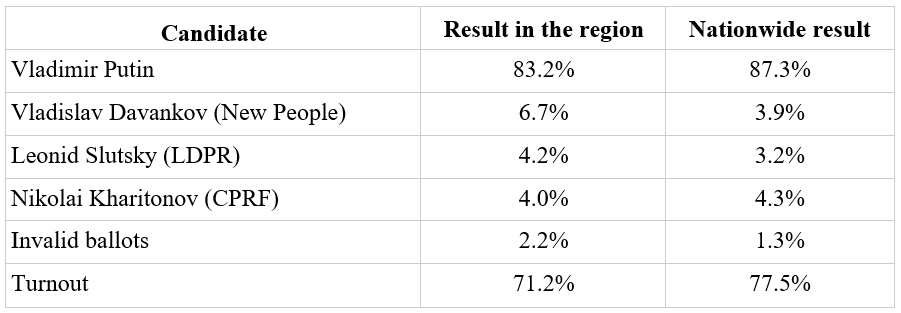
2024 Gubernatorial Election
Andrey Chibis (United Russia) was re-elected with 74% of the vote on a turnout of 41.6%; other candidates included Yury Vatalin (CPRF) with 14.5%, Stanislav Gontar’ (LDPR) with 6.9%, and Yury Klimchenko (Party of Pensioners) with 2.8%.
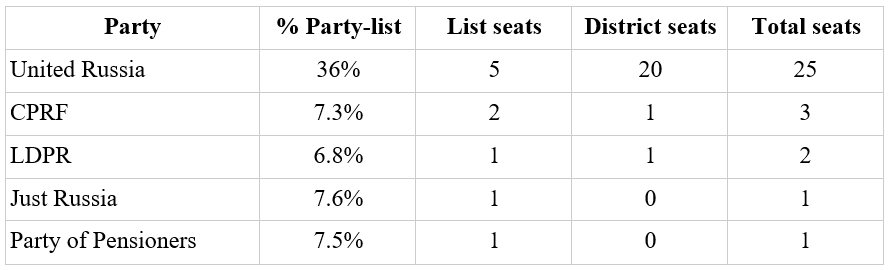
Regional parliament Murmansk Regional Duma (2021)
The electoral system is mixed, with 10 members elected via party lists and 22 members elected in single-member districts (32 deputies in total).
Murmansk City Council (2024)
The electoral system is fully majoritarian, with all 25 deputies elected in single-member districts, no party lists. All seats are held by the United Russia party.
3. Local self-government and municipal reform
The history of local self-government in Murmansk is closely tied to the struggle for influence between the regional authorities and the city-forming enterprises, around which local elite interests have traditionally coalesced. The mayor of the regional capital was long seen as a key political figure, shaping the agenda for single-industry towns and closed administrative-territorial formations (ZATOs).
The first direct mayoral election in 1991 was won by Oleg Naydenov, whose 12-year tenure (until his death in 2003) was marked by conflicts with Governors Komarov and Yevdokimov. He was succeeded by Mikhail Savchenko, but the real political drama unfolded under Mayor Sergey Subbotin — a protégé of Yevdokimov, elected in 2008 — who was removed by the new governor Dmitriyenko. The latter abolished direct mayoral elections and introduced a city manager model appointed through a competitive selection process.
Elite conflicts peaked under Mayor Yevgeny Veller (2014–2018), who controlled the city council and openly challenged Governor Marina Kovtun; under pressure, he left for the State Duma.
Since 2023, Murmansk has been headed by Yury Serdechkin. Conflicts with the regional level have ceased, marking the final integration of the municipality into Governor Andrey Chibis’s political team. Single-industry towns and ZATOs remain under strong pressure from major enterprises and the military, which continue to shape the region’s municipal governance model.
As of 1 January 2026, the transition to a single-tier system of local government in the region has been fully completed. The region now consists only of urban districts (Murmansk, ZATOs, Kirovsk, Apatity, etc., 10 in total) and municipal districts (7 in total). All urban and rural settlements (around 40) have been abolished, along with elected heads of settlements and local councils (around 600 positions). Districts have been transformed into municipal districts, reducing the number of municipal deputies by more than half, to fewer than 300.
4. History of regional governance
Yevgeny Komarov (1991–1996)
Former secretary of the Murmansk regional committee of the CPSU and chairman of the RSFSR State Committee for the Socio-Economic Development of the North. Appointed as the first head of the regional administration on 7 November 1991, with the support of the federal center and the command of the Northern Fleet. In an effort to reduce protest sentiment ahead of the 1996 elections, he dismissed several controversial deputies, but lost in the second round on 1 December 1996, to Yury Yevdokimov — 40.7% to 43.5%.
Yury Yevdokimov (1996–2009)
Former chairman of the regional council of people’s deputies, later CEO of the Murmansk branch of AFK Sistema. One of the most successful governors of the 1990s, he managed to balance the interests of major federal industrial groups: initially Norilsk Nickel (Kola Mining and Metallurgical Company), and later Apatit (PhosAgro). Elected three times — in 1996 (43.5% in the second round), 2000 (86.6%), and 2004 (77%). In 2007, he joined United Russia but later fell out with the federal center over the Murmansk mayoral election (he backed his deputy instead of the United Russia candidate). He resigned voluntarily on 21 March 2009.
Dmitry Dmitriyenko (2009–2012)
An outsider from the Federal Agency for Fisheries. Appointed acting governor on 21 March 2009, and confirmed on 25 March 2009. He failed to gain popularity: abolished the election of the Murmansk mayor and triggered scandals in the city council (including arrests of deputies for “bribery aimed at disrupting the appointment of a city manager”). Dismissed on 4 April 2012, following poor results for United Russia in the 2011 elections: in Murmansk Region, the party recorded one of its lowest results nationwide in the State Duma elections — 32.02% (significantly below the national average of 49.32%) — and 33.2% in the regional Duma elections.
Marina Kovtun (2012–2019)
First deputy speaker of the regional Duma, previously deputy CEO of the Kola Mining and Metallurgical Company (Interros / Norilsk Nickel). Appointed acting governor on 4 April 2012, and became full governor on 13 April. Elected in 2014 with 64.69% (turnout 31%). Known for a hardline governing style: initiated criminal prosecutions against regional elites — including the arrest of “utilities oligarch” Gennady Shubin and regional Duma speaker Vasily Shambir — dismantling his political bloc. Following a conflict with Murmansk mayor Yevgeny Veller, the latter was forced to resign (later elected to the State Duma in 2018). She resigned voluntarily on 21 March 2019.
Andrey Chibis (2019 — present)
Deputy Minister of Housing and Utilities of the Russian Federation (2013–2019). Appointed acting governor on 21 March 2019; elected with 60.1% (8 September 2019), and re-elected in 2024 with 74%. Secretary of United Russia’s Murmansk branch since November 2019. On 4 April 2024, he survived an assassination attempt in Apatity — a stabbing attack by a local resident.