Republic of Tyva
06.09.2026
The Republic of Tyva (also spelled Tuva) is Russia's most geographically and culturally isolated ethnic republic. Ringed by mountains, with no rail connection to the rest of the country, it joined the USSR only in 1944 after more than two decades as the nominally independent Tuvan People's Republic. Tuvans make up over 80% of the population, the local language remains dominant in daily life, and the republic is also Russia's poorest by most standard measures, with child poverty and unemployment far above the national average. Despite this poverty, Tyva has been one of the most loyal to the federal government regions in Russia since the 1990s, delivering anomalously high vote results for whichever party holds power in Moscow and correspondingly low support for opposition parties.
Politics in Tyva has been dominated since the 1990s by two long-serving leaders and their rival networks: Sherig-ool Oorzhak, president and then head of the republic from 1992 to 2007, and his successor Sholban Kara-ool, in office from 2007 to 2021. Both periods were marked by persistent clan-based patronage politics, a pattern with roots reaching back to the nearly unbroken 60-year rule of two Soviet-era leaders, Salchak Toka (to 1973) and Georgy Shirshin (to the late 1980s). The transition from Oorzhak to Kara-ool in 2006–2007 triggered the most serious political crisis in the republic's post-Soviet history, including annulled district election results, a months-long opposition boycott of the regional parliament, and direct intervention by federal authorities.
A second major crisis followed in 2010, when a referendum — held amid credible allegations that regional authorities had blocked and falsified opposition to it — abolished the upper, fully professional chamber of the republic's bicameral legislature, sharply reducing the parliament's capacity for independent oversight of the executive. Since then, Tyva's regional parliament has been steadily dominated by United Russia, though the 2024 election saw four parties clear the threshold for the first time in the republic's history. The republic's current head, Vladislav Khovalyg, took office in 2021 as a relative outsider to both the Oorzhak and Kara-ool patronage networks, though the rivalry between Kara-ool (now a State Duma deputy) and the current administration resurfaced publicly in 2024 over the treatment of war veterans in United Russia's candidate selection process.
1. Basic characteristics
Tyva lies in south-central Siberia and is part of the Siberian Federal District. It borders Mongolia to the south and east, while within Russia it adjoins Krasnoyarsk Region, the Republic of Khakassia, the Republic of Buryatia, and Irkutsk Region. Its only paved road connection to the rest of Russia runs north through Krasnoyarsk Region, as the republic has no railway.
The region's population is approximately 337,000 (2024), up from 313,000 in 2010, growing mainly due to a high birth rate — Tyva has Russia's third-highest natural population growth rate, after Chechnya and Ingushetia. The capital, Kyzyl, has a population of roughly 130,000. Population density is very low, at about 2.0 people per square kilometer (2024), reflecting the republic's mountainous terrain (roughly 82% of its territory) and continuing tradition of nomadic pastoralism, particularly sheep and horse herding, with reindeer herding persisting in Todzhinsky kozhuun.
According to the 2010 census — the most recent existing source — Tuvans made up about 82.0% of the population and Russians about 16.3%. The ethnic Russian population declined sharply after clashes provoked by the nationalist "Khostug Tyva" (Free Tyva) movement in 1992–1993; media estimates suggest that more than 20,000 Russians subsequently left the republic. Reports have also described informal local norms discouraging ethnic Russians from being outdoors after dark. The traditional religion of most Tuvans is Tibetan Buddhism, blended with elements of shamanism. The Dalai Lama visited the republic for three days in September 1992.
Tyva is one of Russia's poorest regions by most measures. In 2017, the poverty rate was 41.5%, with a particularly severe child poverty rate. Children account for about 35% of the population, while limited employment opportunities leave many families dependent on state benefits. The share of the population below the subsistence minimum was 34.7% in 2019, and unemployment measured by ILO-methodology was around 19%. The regional economy is dominated by mining (24.1% of output), public administration and social security (18.2%), education (11.5%), healthcare (11.1%), and trade (8.5%). The republic possesses substantial deposits of coal, asbestos, gold, and other mineral deposits, including the Ulug-Khem coal basin.
According to the Central Election Commission of Russia, as of 1 January 2026, the Republic of Tyva had 210,820 registered voters, or roughly 0.2% of Russia's electorate. Approximaly 37.1% of them are registered in the capital, Kyzyl.
2. Political representation
2024 Presidential Election
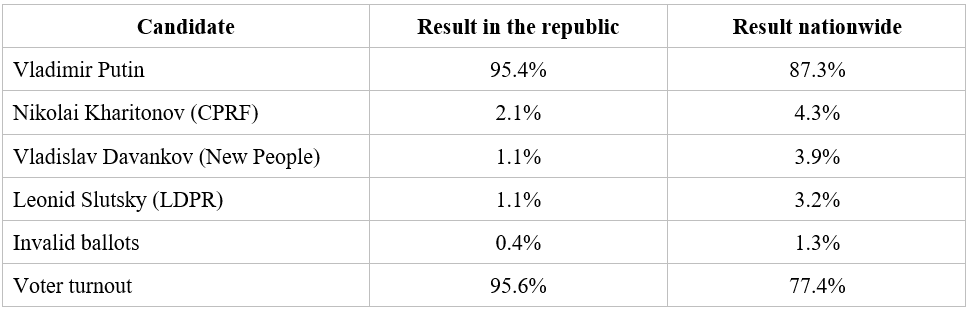
Tyva delivered one of Russia's highest regional vote shares for Putin and one of the highest turnout rates.
Gubernatorial elections
Vladislav Khovalyg (United Russia) was elected Head of the Republic on 19 September 2021 with 86.81% of the vote. He had served as acting head since April, following the resignation of his long-serving predecessor, Sholban Kara-ool. Four other candidates ran for the office: Choigana Seden-ool (CPRF) with 4.0%, Aylanmaa Kan-ool (Greens) with 3.4%, Vladimir Chesnokov (Communists of Russia) with 2.6%, and Andrei Sat (Party of Growth) with 2.0%.
Supreme Khural (4th convocation, 2024–2029)
The electoral system is mixed, with 16 deputies elected by party list and 16 in single-member districts (32 seats in total). In the most recent elections, held on 8 September 2024, four parties crossed the threshold to enter the parliament — for the first time in the republic's history.
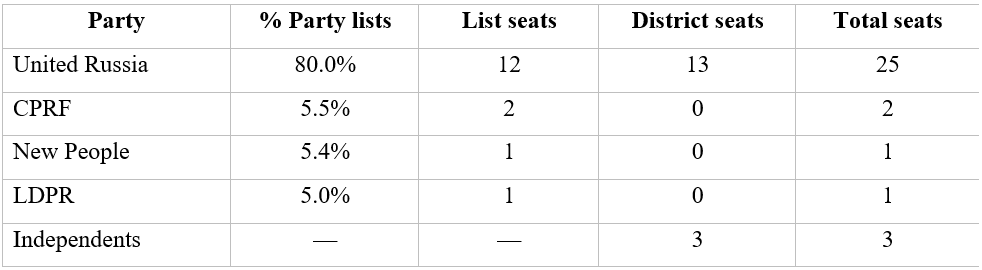
Municipal representation: Khural of Representatives of Kyzyl
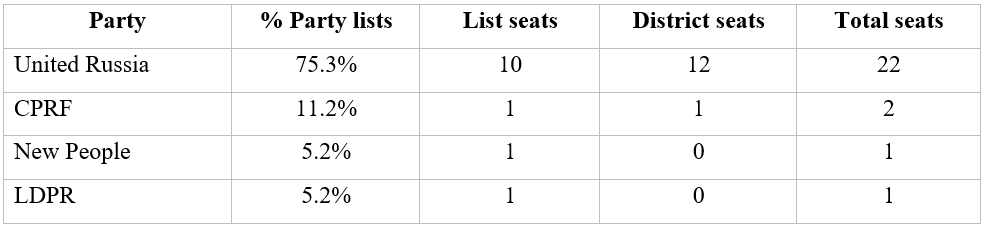
The city of Kyzyl does not have directly elected mayor; instead, the head of the city administration is hired under contract.
3. Local self-government and municipal reform
Under the federal municipal reform law signed on 20 March 2025, all Russian regions must transition to a one-tier system of local self-government by 2027, unless they formally justify retaining a two-tier structure on historical or socioeconomic grounds. Tyva has not yet completed this transition or announced a final decision on its 17 kozhuuns (districts). The republic's mountainous, sparsely populated terrain and reliance on nomadic pastoralism in some areas could provide grounds for preserving elements of the two-tier system, as has been argued in other geographically remote regions.
4. History of regional governance
Sherig-ool Oorzhak (1992–2007)
Then Chairman of the republic's Council of Ministers, Oorzhak won Tyva's first and only direct presidential election on 15 March 1992, taking 83.2% of the vote against a token opponent. He was re-elected in 1997 (70.9%) and again in 2002, after a 2001 constitutional reform replaced the presidency with the post of Chairman of the Government. The contest was far tighter: Oorzhak won 53.3% against 29.1% for his main rival.
Under Oorzhak, Tyva’s 1993 constitution asserted far-reaching claims of sovereignty that directly contradicted the Russian Constitution, including a clause permitting Tyva to suspend federal law during a crisis and even to secede. These provisions were only brought into compliance with federal law in the 2000s. By the mid-2000s, Oorzhak faced growing accusations of entrenched clan rule, nepotism, and corruption from a broad coalition of regional party branches and, eventually, members of his own party's regional leadership. He was not renominated when his term expired in March 2007.
Sholban Kara-ool (2007–2021)
A former chairman of the republic's parliament and Oorzhak's first deputy prime minister, Kara-ool also had close ties to Sergei Shoigu, the former Russian Minister of Emergency and Defense. Kara-ool was nominated by Vladimir Putin and confirmed by the republic's two chambers in March 2007. The transition followed a bitter succession crisis marked by annulled district election results, a months-long opposition boycott of parliament, and physical confrontations between political rivals.
Kara-ool's tenure was marked by the 2010 constitutional referendum, and by the near-total incorporation of the republic's political elite, including most former opposition "frondeurs", into his governing coalition. He resigned in May 2016, a year ahead of schedule, and was immediately reappointed acting head pending a September 2016 election, which he won with 85.7%. Facing increasing public criticism in his final years in office, Kara-ool resigned again in April 2021. He was elected to the State Duma later that year and became a deputy speaker.
Vladislav Khovalyg (since 2021)
A career regional civil servant with degrees in law and crisis management, Khovalyg served two terms as head of the Kyzyl city administration from 2008 to 2018, followed by a tenure as general director of a regional energy-supply company. Considered relatively independent of both the Oorzhak and Kara-ool patronage networks, he was appointed acting head of the republic in April 2021 and elected in his own right that September with 86.8%.
In 2024, a public dispute etween Kara-ool and the regional administration over the treatment of war-veteran candidates in United Russia's primaries was interpreted by some observers as evidence of a continuing rivalry between a Shoigu-aligned faction associated with Kara-ool and a faction more directly aligned with the presidential administration.