Saint-Petersburg
21.05.2026
Saint Petersburg is Russia’s second-largest metropolis and its second most important economic center, driven by high-tech industry, IT, and federal headquarters like Gazprom. Its unique political culture is shaped by an imperial legacy and dissident traditions, creating a persistent demand for liberal-democratic values among the intelligentsia and younger generations. A distinctive feature of the city’s character is a critical, often ironic, attitude toward authority, which makes it a challenging region for any governor.
The rise of Vladimir Putin fundamentally changed the local elite as Saint Petersburg figures took key national positions, while the relocation of the Constitutional Court reinforced the city's role as the “second capital”. However, because major federal groups (Gazprom, Rosneft, defense) are directly represented, local politics remains highly fragmented. It is extremely difficult for a governor to satisfy all stakeholders, as many have direct access to the Kremlin.
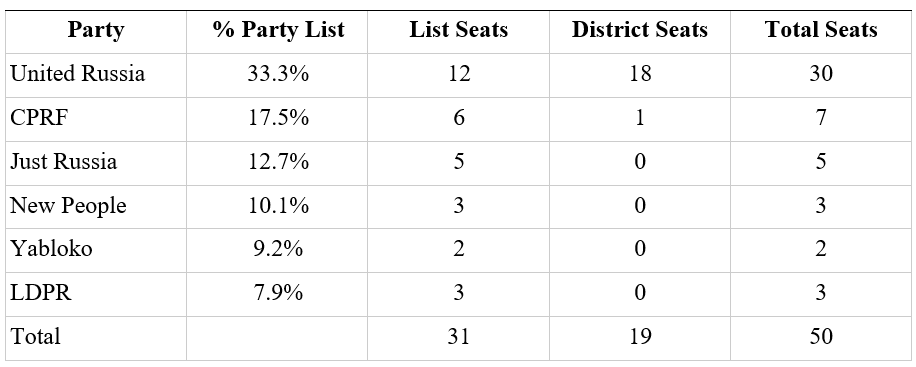
The political hierarchy is anchored by United Russia (holding 30 of 50 Legislative Assembly seats), though it must account for five other parliamentary parties. Historically, the city hosted the country’s strongest Yabloko branch. However, as of 2026, the party has suffered major setbacks: long-time leader Boris Vishnevsky was stripped of his mandate due to his foreign agent status, and both remaining Yabloko deputies were convicted under “extremism” charges for using images of Alexei Navalny. Together with the effective dismantling of the independent municipal movement after 2024, these actions effectively exclude the liberal opposition from the 2026 elections. By March 2026, the city became a national leader in criminal cases for spreading “fake news” and “discrediting” the army.
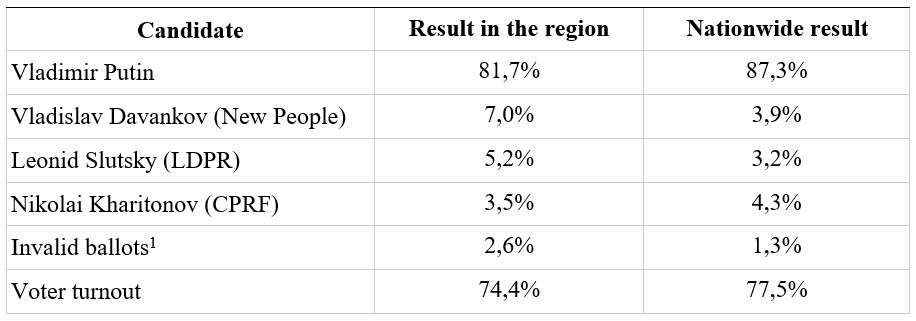
Electoral dynamics are defined by the persistent use of hardline techniques, such as black PR and spoiler candidates, which undermine trust. While federal campaigns see high engagement (Vladimir Putin received 81.65% in 2024), regional elections reflect a more critical stance toward local authorities. In 2024, incumbent governor Alexander Beglov received 59.8%, one of the lowest results among Kremlin-backed governors nationwide.
1. Basic characteristics
Located on the Gulf of Finland of the Baltic Sea, the city serves as Russia’s primary gateway to Northern Europe and Finland. However, this direct connection has been effectively severed since autumn 2023, when Finland fully closed all border crossing points.
The population of Saint Petersburg constitutes 5.6 million (share of Russia’s population: ~3.8%). According to official data, as of 1 January 2026, the number of registered voters in Saint Petersburg was 4.04 million, or approximately 3.63% of Russia’s total electorate.
The majority of voters are concentrated in large bedroom communities (residential suburbs), which are the primary places of residence for the economically active working-age population that has moved to St. Petersburg from other regions of Russia. These districts increasingly shape the city’s political and electoral agenda. They tend to be the most protest-oriented and liberal segments of the electorate, with a high concentration of white-collar workers and young families. It is in these areas that the highest support for alternative candidates (such as Vladislav Davankov of New People) and lower turnout levels were recorded in the 2024 elections, compared to the more “establishment-oriented” city center.
2. Political representation
2024 Presidential Election
The 2024 presidential election in the St.Petersburg confirmed the region’s status as a territory with a distinctive distribution of protest votes compared to national averages: Vladimir Putin received some 6% fewer votes than the countrywide average, while all opposition candidates (with the exception of CPRF candidate) performed better than their nationwide results. The share of invalid ballots was also significantly higher comparing to the country’s average.
Gubernatorial elections
Alexander Beglov was appointed acting governor on 3 October 2018; elected in 2019 with 64.5% and re-elected in 2024 with 59.8% — the lowest result among all governors elected on the 2024 unified election day. Other candidates included Maxim Yakovlev (LDPR) with 18.3%, Pavel Bragin (The Greens) with 11.8%, and Sergey Malinkovich (Communists of Russia) with 8.1%.
Regional parliament Legislative Assembly (7th convocation since 2021)
3. Local self-government and municipal reform
The history of local self-government in Saint Petersburg is a chronicle of the gradual absorption of grassroots democracy by the regional power vertical. In the 1990s, districts enjoyed significant budgetary autonomy, which led to constant conflicts between district “mayors” and the Smolny administration.
The era of “district barons” (1990s — mid-2000s)
Under Anatoly Sobchak and Vladimir Yakovlev, heads of district administrations were influential political figures controlling key local resources (housing and utilities, markets, construction). The conflict of interests peaked in 1997, when—under pressure from the federal center and the courts — the city was forced to divide its territory into 111 municipal entities. This created a uniquely over-fragmented system for Russia, where very small districts, sometimes consisting of just a few city blocks, received their own budgets and councils.
Elimination of municipal autonomy under Matvienko and Poltavchenko
Valentina Matvienko fundamentally changed the rules of the game, effectively turning district heads into appointed officials fully accountable to the governor. Under Georgy Poltavchenko, the municipal level became an arena of “quiet wars” between district administrations and the Legislative Assembly (led by Vyacheslav Makarov), who built his own network of loyal municipal actors. Arrests of district heads and municipal deputies during this period were often a result of struggles for control over financial flows in urban improvement and housing and utilities.
Beglov’s reform and the 2024 elections
By early 2026, the architecture of local self-government in Saint Petersburg has taken on a finalized, highly centralized form. On the one hand, the city has retained its 111 municipal entities. The authorities chose not to abolish municipal councils outright, instead opting to “sterilize” their composition. The 2024 municipal campaign became the final stage of this process: around 85% of all mandates (more than 1,300 out of 1,560) were won by United Russia. The opposition suffered heavy losses. CPRF got 43 seats, LDPR 25, Just Russia 22, New People 10. Yabloko was effectively crushed at the municipal level. While the party had around 80 deputies in 2019, in 2024–2026 its representation has been reduced to just a handful (isolated seats in the Central and Vasileostrovsky districts).
While the opposition remains present in a small number of districts, it is highly fragmented; the independent municipal movement was effectively dismantled through registration denials and the criminal prosecution of activists, cementing the Kremlin’s control over this decentralized administrative structure.
4. History of regional governance
The system of government in Saint Petersburg is unique: the governor simultaneously serves as both the head of the federal subject and the city’s mayor, creating constant tension between managerial responsibilities and political ambitions.
Anatoly Sobchak (1990–1996)
Anatoly Sobchak went down in history as the city’s chief “democratizer.” He restored the name Saint Petersburg to Leningrad; however, his years in power were marked by a sharp conflict with the legislative branch (the Lensovet), which was ultimately dissolved in 1993. This laid the foundation for a more personalist system of governance. Until 1997, the city effectively lacked local self-government, with power concentrated in the hands of the mayor.
The main scandal of the era was the 1996 election. Sobchak was challenged by his own deputy, Vladimir Yakovlev. The campaign turned into a “kompromat war.” Sobchak lost to his “chief administrator” by just 2%, after which he accused his inner circle of betrayal, refused to congratulate the winner, and soon left the city. This defeat prompted the “Sobchak team” (including Putin, Medvedev, and Kudrin) to move to Moscow, which later shaped Russia’s federal trajectory.
Vladimir Yakovlev (1996–2003)
Vladimir Yakovlev positioned himself as Sobchak’s opposite—a man of action rather than words. However, his tenure was marked by a constant struggle with the so-called “St. Petersburg Muscovites” (Muscovites with St. Petersburg roots.) After Vladimir Putin came to power in the Kremlin, Yakovlev’s resignation became only a matter of time. The federal center systematically weakened the governor, using allegations of corruption and ties to organized crime.
In 1999, Yakovlev attempted to reschedule elections to coincide with parliamentary elections but suffered a legal defeat in the Supreme Court following a lawsuit by the Yabloko party. By 2003, pressure had peaked: Yakovlev was effectively removed through an honorary resignation and appointed Deputy Prime Minister in charge of housing and utilities. Alexander Beglov briefly served as acting governor, facilitating a controlled transfer of power to the Kremlin’s new preferred candidate.
Valentina Matvienko (2003–2011)
Valentina Matvienko’s rise to power was accompanied by unprecedented administrative pressure. Her main rival was Anna Markova (a deputy of Yakovlev), who faced attempts to be removed from the race through the courts. The result was extremely low turnout (around 28%) and a high protest vote. Matvienko succeeded in consolidating the elites and launching major infrastructure projects, but her tenure is also remembered for its scandals involving public utilities. The most notable conflict was the public protest against the construction of the Okhta Center (Gazprom tower).
In 2011, Matvienko left her post following controversial municipal elections in the Krasnenkaya Rechka district, which were required as a legal formality for her transition to the Federation Council.
Georgy Poltavchenko (2011–2018)
Georgy Poltavchenko, a former KGB officer, brought a style of governance marked by secrecy and religious conservatism. He was often referred to as an “invisible governor,” avoiding publicity and open debate. Conflicts during this period were systemic in nature: the prolonged construction of the Zenit Arena stadium (accompanied by criminal cases) and the transfer of St. Isaac’s Cathedral to the Russian Orthodox Church, which sparked mass protests involving thousands of residents.
In 2014, Poltavchenko was re-elected amid a wave of political purges—his main opponent, Oksana Dmitrieva, was barred from running through the municipal filter. Despite his loyalty to the federal center, low approval ratings and an inability to resolve transportation issues led to his resignation in October 2018.
Alexander Beglov (2018 — present)
Alexander Beglov’s second tenure (now as full governor) has become one of the most challenging periods in the city’s recent history. After beginning with the forceful sidelining of influential Legislative Assembly speaker Vyacheslav Makarov, Beglov faced a systemic governance crisis, exacerbated by snow-related disruptions, the failure of the waste management reform, and harsh criticism in the media.
The most high-profile scandal of 2022–2023 was the open conflict with Yevgeny Prigozhin. The founder of the Wagner PMC used his media resources to accuse the governor of treason and corruption in the allocation of state contracts. In the 2024 elections, Beglov recorded the lowest result among all incumbent regional heads (59.8%), which political analysts attribute to accumulated negative ratings and the absence of real competition. As of 2026, his administration continues to operate under sustained criticism from urban activists and what is described as “quiet sabotage” by parts of the local elite.