Tomsk Region
20.06.2026
The Tomsk region is a unique Siberian territory that combines the role of a major resource base — dominated by Rosneft, Gazprom, and Rosatom — with the image of Tomsk as the “Siberian Athens”, reflecting its special status as Siberia’s cultural, educational, and scientific center. The region’s political culture historically rested on its powerful academic and research sector and traditions of university freethinking, which for decades gave Tomsk the reputation of being one of Russia’s most democratic cities. During the 1990s and 2000s, the region demonstrated unusually strong support for liberal parties such as Yabloko and the Union of Right Forces, as well as for charismatic local leaders capable of challenging the federal center.
By the mid-2020s, however, the region’s political landscape had undergone total “sterilization”. The turning point came in 2020, when Tomsk became the only regional capital where supporters of Alexei Navalny managed to win seats in the city council through legal elections, breaking the monopoly of United Russia. The system’s response was severe: between 2021 and 2025, the independent political infrastructure was completely dismantled. Key opposition figures, including Ksenia Fadeyeva and Andrei Fateev, faced criminal prosecution and were pushed out of politics. The closure of the legendary independent television channel TV2 back in 2015 had already foreshadowed this broader campaign to eliminate any independent information environment.
By 2026, Tomsk had definitively lost its status as an “island of freedom”. Direct mayoral elections were abolished, the opposition in the city council was crushed, and regional governance was shifted toward a model of “federal technocratism” under Governor Vladimir Mazur. Today, the region operates under a rigid administrative vertical in which former political dissent has been replaced by ritualized loyalty, while civic activism has been driven either underground or into emigration.
1. Basic characteristics
The region is part of the Siberian Federal District and has no external borders. The capital is Tomsk with appxominately 550,000 residents. The second major center is the closed city of Seversk, home to a highly enriched uranium and plutonium production facility (~106,000 residents).
The population of the region equals 1.04 million people (around 0.7% of Russia’s total population). Among them, 750,000 have voting rights, which constitutes about 0.67% of Russia’s electorate.
2. Political representation
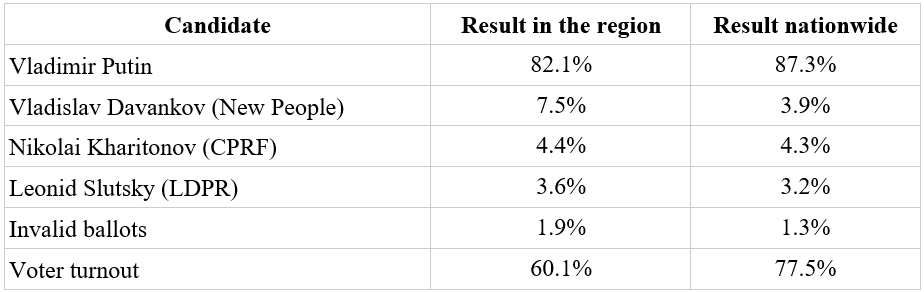
2024 Presidential Election
The region demonstrated one of the highest levels of latent protest in Siberia. Vladimir Putin received a result below the national average, while both the share of invalid ballots and the performance of the “liberal” candidate Vladislav Davankov were significantly higher, reflecting dissatisfaction among the urban intelligentsia.
Gubernatorial election
In the 2022 gubernatorial election, Vladimir Mazur (United Russia) won with 84.9% of the vote amid low turnout of 30.4%. Other candidates included Galina Nemtseva (Just Russia) with 6.1%, Andrei Petrov (CPRF) with 5.3%, and Viktor Grinev (Party of Pensioners) with 2.1%. This result was achieved by effectively eliminating strong candidates from the field and by low urban voter turnout.
Legislative Duma of Tomsk region (7th Convocation, 2021–2026)
The electoral system is mixed, with 21 depitues elected by party lists and 21 in single-member districts (42 seats in total).
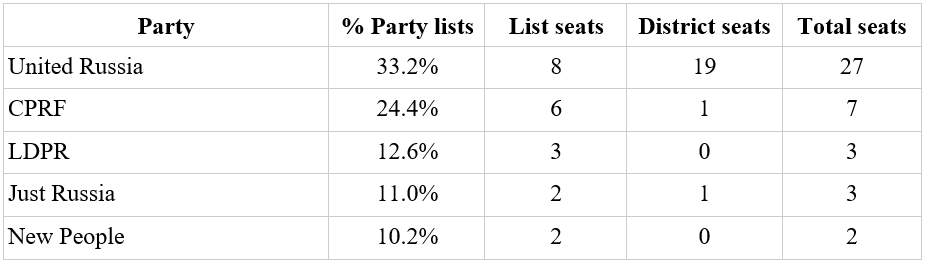
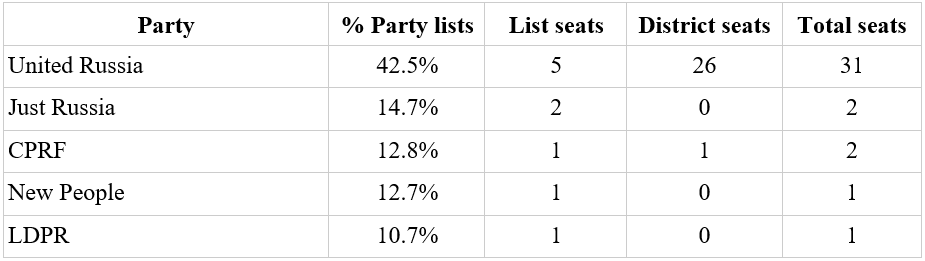
Tomsk City Duma (8th Convocation, 2025–2030)
The electoral system is mixed, with 27 deputies elected by party lists and 10 in single-member districts (37 seats in total).
After the anomaly of 2020, when the opposition secured a majority, the 2025 elections were held under conditions of harsh candidate filtering and the effective dismantling of meaningful political competition. United Russia regained full control over the city assembly.
3. Local self-government and municipal reform
Tomsk Region became a prominent example of the gradual dismantling of municipal autonomy. A key turning point was the abolition of direct mayoral elections in Tomsk in December 2022. Previously, the mayor of the regional capital had been considered the second most influential figure in the region, while the office itself had been directly elected since 1996. The decision to abolish elections was initiated by Governor Vladimir Mazur and approved by the regional legislature under the pretext of the “need for operational control during the SMO”.
A distinctive feature of Tomsk politics has been the “conveyor belt” of criminal cases against city leaders: the last three elected mayors — Alexander Makarov, Nikolai Nikolaychuk, and Ivan Klyain — all left office under arrest and later received criminal convictions. This created a lasting perception of the Tomsk mayor's office as a suicide mission and facilitated the transition to a competitive system for appointing city managers.
At the same time, unlike many regions in Northwestern and Central Russia, Tomsk Region as of 2026 remains one of the few federal subjects that still preserves the classic two-tier system of local self-government (districts and rural settlements). Despite the nationwide trend toward the creation of unified municipal districts, the regional leadership under Vladimir Mazur has adopted a cautious position. The governor has repeatedly argued that because of vast distances, difficult geography — including the Vasugan swamps and remote northern settlements — and weak transportation infrastructure, eliminating the lower tier of rural administration would be premature.
As a result, verticalization in Tomsk Region has proceeded not through the liquidation of rural councils, but through the deprivation of political subjectivity from the regional capital itself.
4. History of regional governance
Viktor Kress (1991–2012)
The architect of the so-called “Tomsk model” of governance. Kress successfully balanced the interests of oil companies — first Yukos and later Rosneft — with the ambitions of the region’s academic elites. Under his leadership, Tomsk Region gained a reputation as a showcase of regional democracy.
Sergey Zhvachkin (2012–2022)
Gazprom-backed governor. His tenure was marked by the gradual degradation of the political environment. Zhvachkin became known for his closed governing style, dismissive attitude toward urban protests, and the shutdown of the independent broadcaster TV2. He resigned after Tomsk turned into a “problem zone” on the federal electoral map.
Vladimir Mazur (since 2022)
Mazur was sent to the region from the Presidential Administration as a crisis manager. His principal achievement from the Kremlin’s perspective was the final abolition of direct mayoral elections and the dismantling of the independent Tomsk City Duma. Mazur established a system of “vertical administration” in which political life has been replaced by technocratic reporting and strict oversight of the state defense procurement.