Media monitoring: Before the elections
07.09.2024





On 8 September 2024, around 4,000 election campaigns are taking place across Russia — elections for governors, local and regional parliament deputies, municipal heads, as well as by-elections to the State Duma.
The authorities are conducting a promotional campaign on all popular social networks among Russians — VKontakte, Telegram, YouTube, and Odnoklassniki. On these platforms, public sector employees, officials, and controlled media are promoting electronic voting, supporting the candidacy of incumbent governors, and discussing the increased competition in the upcoming elections.
REM commissioned an independent team of analysts to monitor Russia's leading social networks, VKontakte, Odnoklassniki, Telegram and Youtube, to explore how the Kremlin's propaganda machine works on social media using actual data. We present the main observations below, as well as visualized data and graphs illustrating the findings.
Teachers and heads of administrations: Who's promoting the elections?
VKontakte is the most popular social network in Russia, with a monthly audience of over 100 million users. It is fully controlled by Russian authorities, who are actively using it.
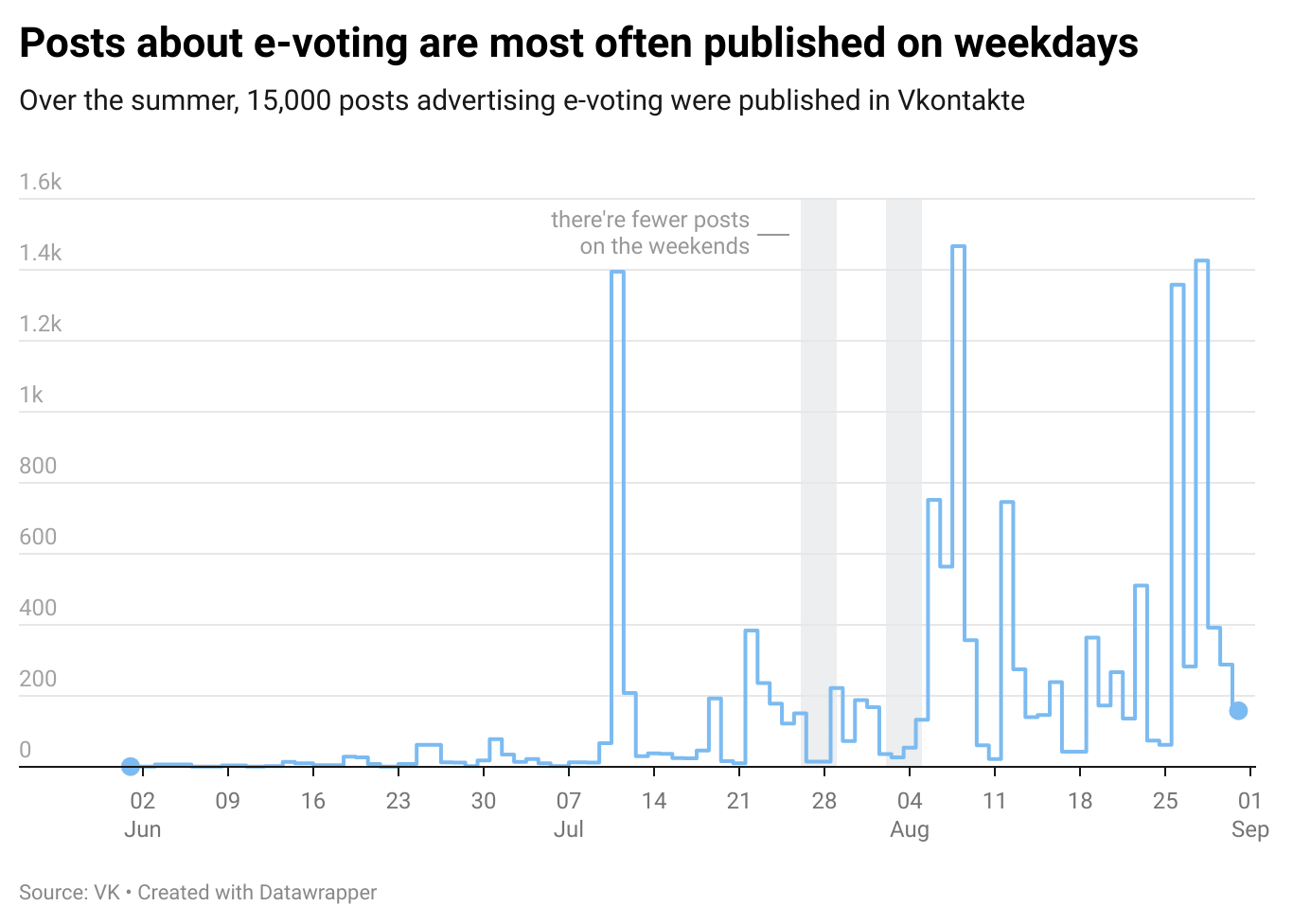
Since early June, 121.6 thousand posts about the upcoming elections have been published on the platform, collectively viewed by nearly 90 million users (here and below the figure may be overestimated due to potential audience overlap). This was a coordinated information campaign, evidence to which is an abrupt and systematic drop in the number of posts during weekends.
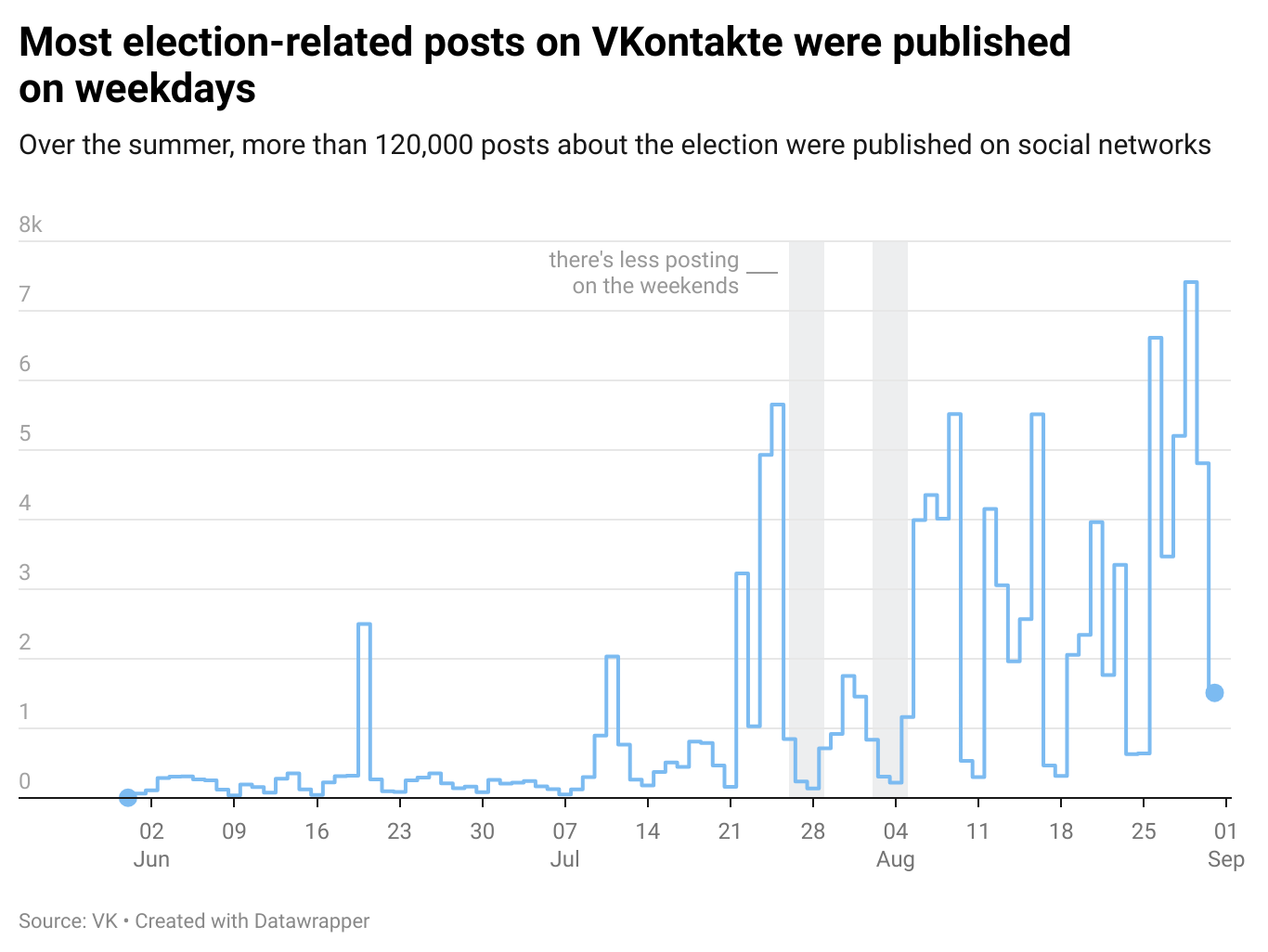
All state institutions in Russia, including schools, village councils, and city administrations, are required to have their own VKontakte pages. This has given the Kremlin a powerful tool to promote its narratives to a broad audience. Earlier, Novaya Gazeta Europe reported on how the authorities used the platform to spread war propaganda and support Vladimir Putin in presidential elections.
By 8 September 2024, public sector employees and officials have published at least 46.4 thousand posts about the elections—almost half of all such posts on VKontakte. Apart from election commissions, local administrations, schools, and kindergartens were the most actively involved in the PR campaign, responsible for 38.3 thousand posts.
Among media outlets, the most active were News of Kursk Today, News Feed of Vologda Z, and the Vologda-based GaZeta “Borba”( “The Fight”), while the most active educational institution was the Cherepovets Trade and Economic College (also in the Vologda region).
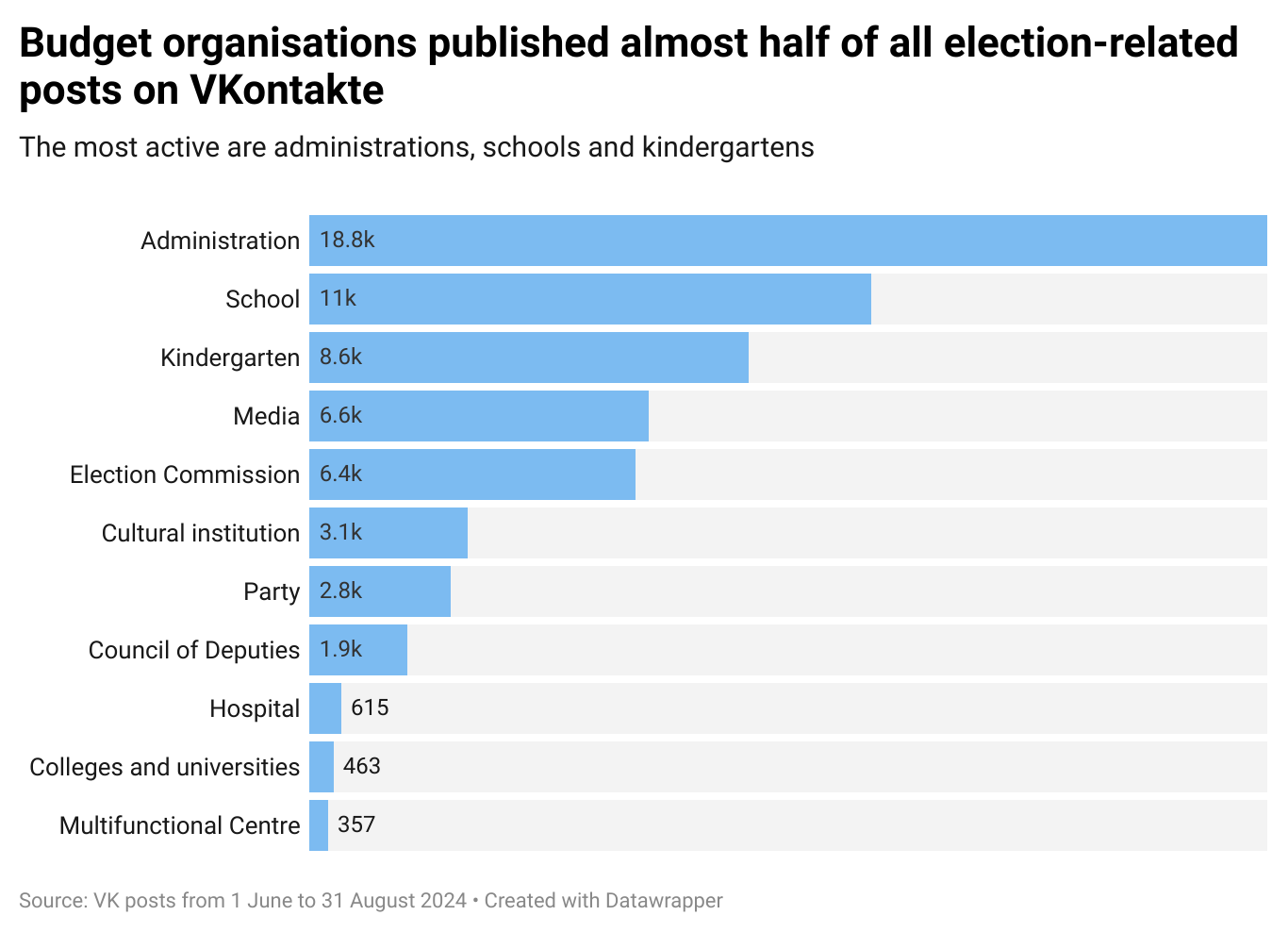
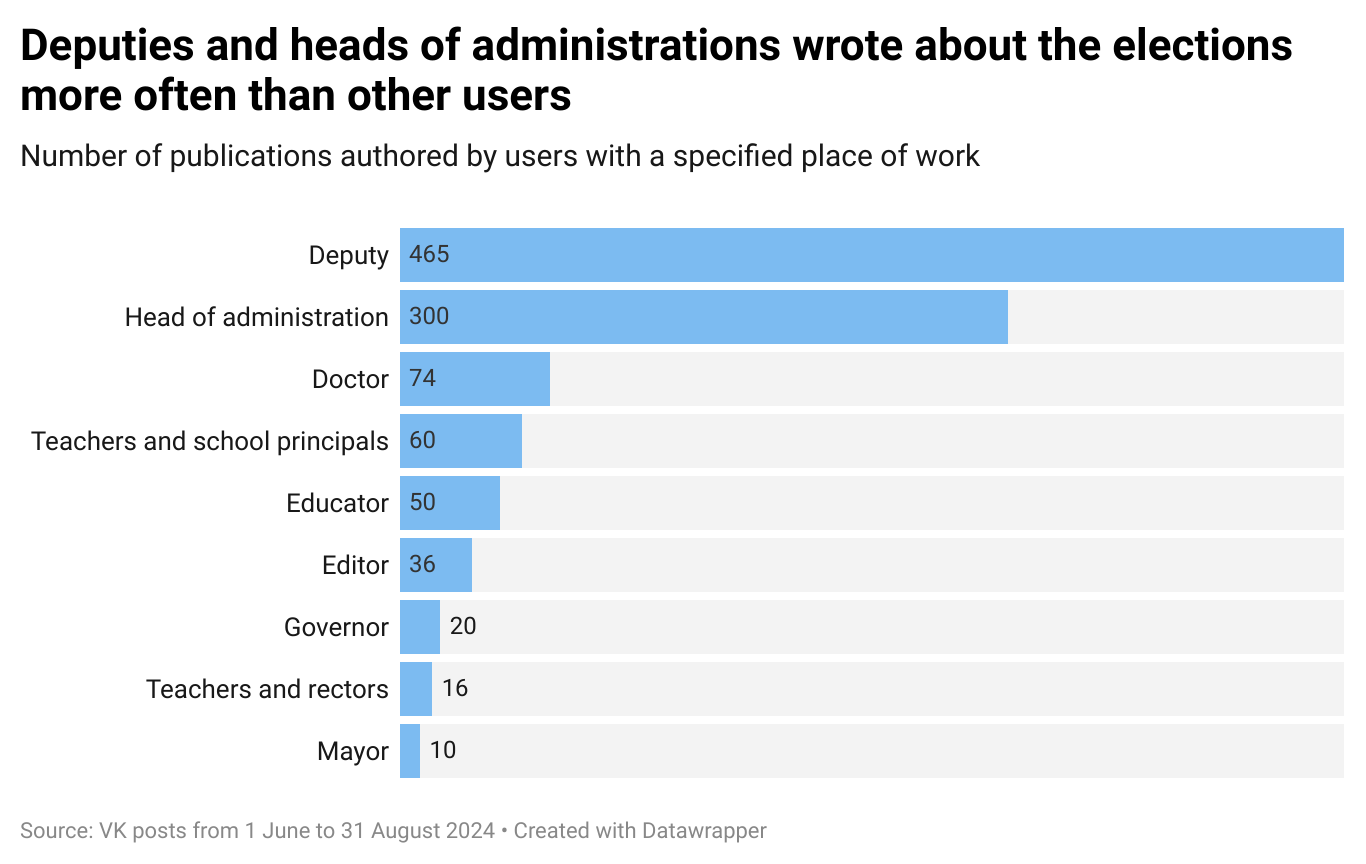
Among individual users, the most active election-related posts came from deputies, heads of administrations, and public sector workers—teachers at all levels of education and doctors. They published more than a thousand posts, accounting for half of all user posts with a stated workplace.
Who cares about elections? Overview of regional, independent, and state media
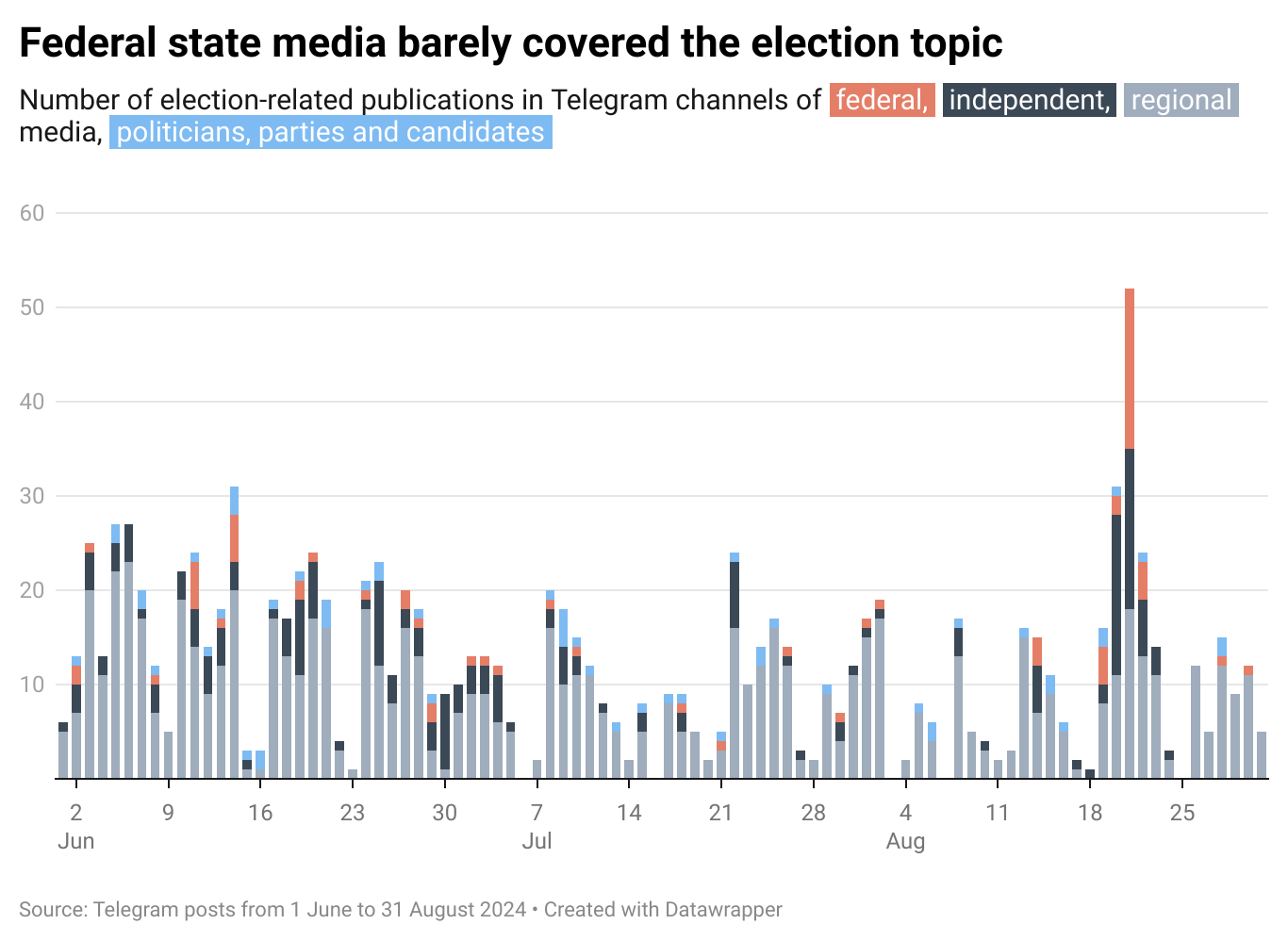
The September elections in Russia are attracting even less media attention than the presidential elections, which took place in March 2024. State-owned federal media published almost no news about the election campaigns over the summer.
Local media, however, were much more eager to cover the topic. Since June, 96 regional outlets have published nearly 800 news stories on Telegram, viewed by a total of 7.6 million users. Independent federal media were less active in covering the elections, while state media barely mentioned them at all.
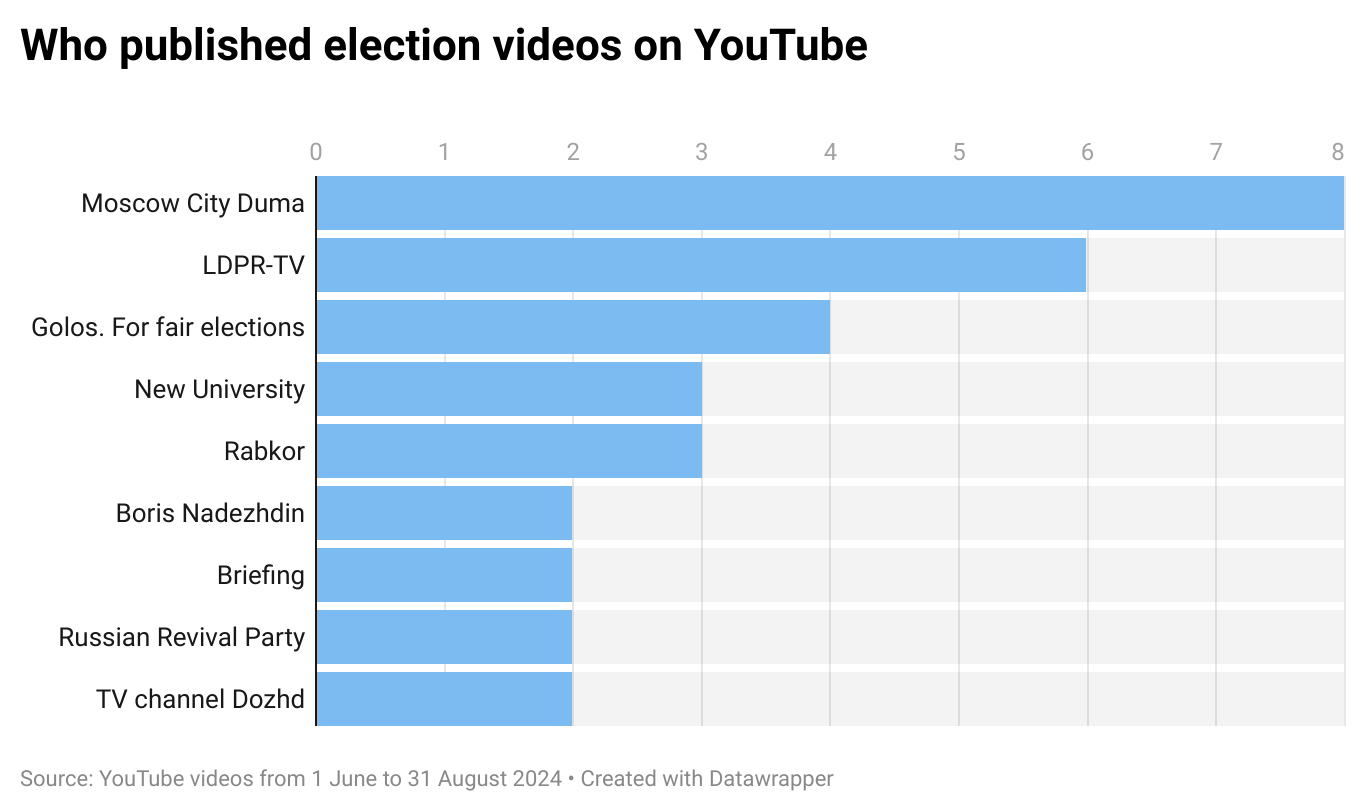
On YouTube, which the authorities began to slow down toward the end of the summer, the topic of the upcoming elections was even less popular—since June, fewer than 100 videos on this issue were uploaded. The most popular one, from TV channel Dozhd, titled "Putin’s New Elite: How SMO [special military operation - the term Russian authorities use to refer to the war in Ukraine] veterans are given power, positions, and privileges," garnered nearly 600,000 views. The next most popular video was a news analysis by Alexander Demchenko, discussing Vladimir Putin's decision not to cancel elections in border regions.
The Moscow City Duma channel published the most videos on the elections. Their content included videos about United Russia’s initiative to handle complaints from Moscow residents and about the advantages of the REV (Remote Electronic Voting), which, according to them, has evolved over the past five years from an experiment to a full-fledged voter tool. These videos gained 1,588 views.
Among political parties, the LDPR (Liberal Democratic Party of Russia) was the most active on YouTube, uploading six election-related videos—all featuring party leader Leonid Slutsky. The Russian Revival Party also posted two videos on their candidates running for the Moscow City Duma, which received 142 views in total.
Other election-related videos were posted by the Golos movement in defense of voters' rights, covering campaign issues in Kursk region, Moscow’s REV system, and other topics. Channels like New University, Boris Nadezhdin, Rabkor media, Briefing, and Dozhd also published videos on the subject.
REV, prizes, and competition rise: what social networks and media say about the elections
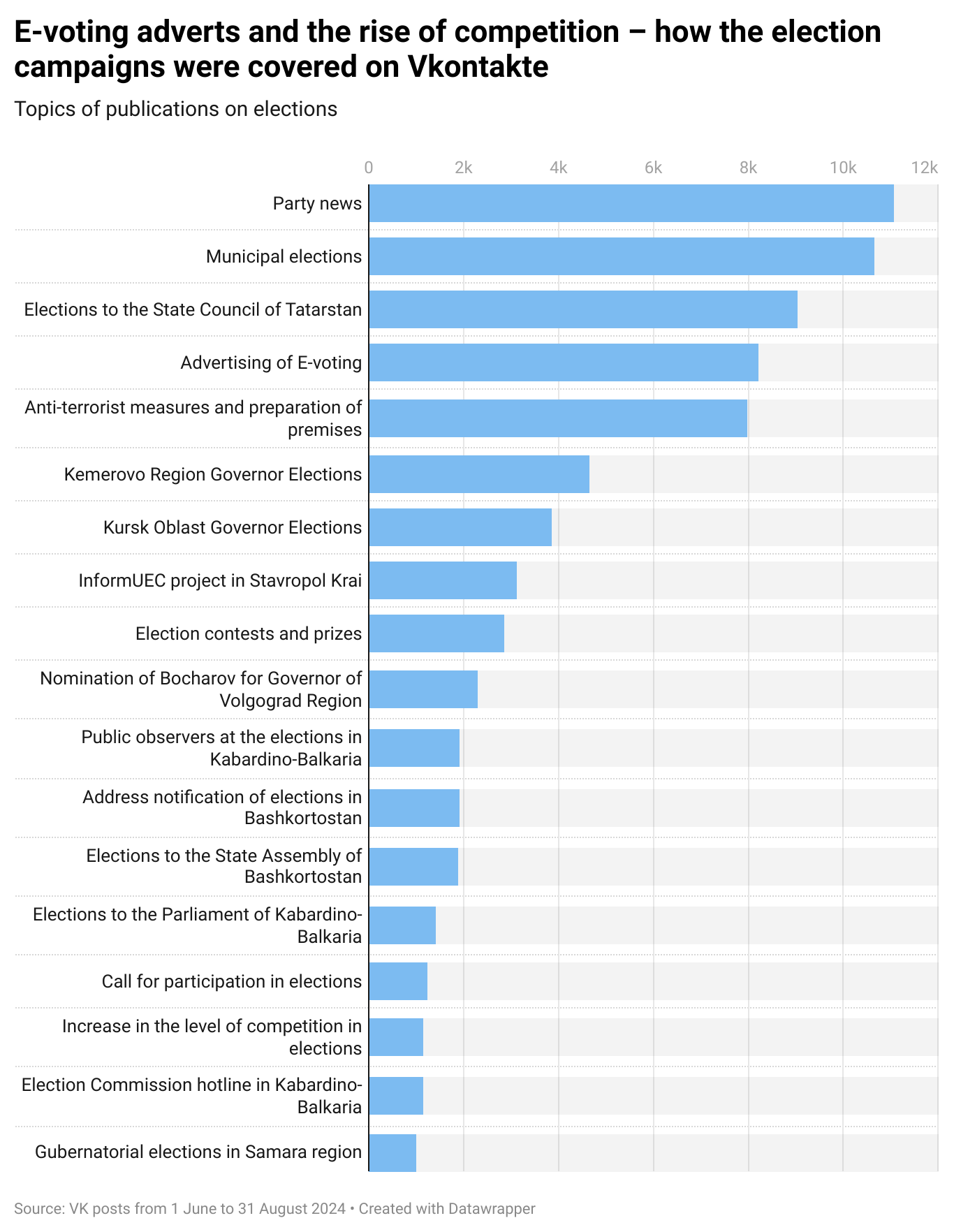
In addition to party news and posts about municipal elections, social media is actively covering regional elections across the country. Among the most popular regional campaigns is the election to the State Council of Tatarstan, often accompanied by the hashtag #МойТатарстанМойвыбор (#MyTatarstanMyChoice). In the regions where gubernatorial elections will be held, such as Kemerovo, Kursk, and Samara, election-related content is widely shared.
Another key theme on VKontakte is the promotion of Remote Electronic Voting (REV) and anti-terrorist measures, especially in Sevastopol (in annexed Crimea) and in the frontline Kursk region, part of which is under the control of Ukrainian forces.
The Central Election Commission's project “InformPollingStation” is also popular on social media. The project’s main aim is door-to-door voter outreach to provide information about elections. Public pages in the Stavropol region and Bashkortostan are the most active in promoting this project.
Regions are also trying to attract residents to polling stations through traditional means, such as advertising contests and prizes for voters. In Bashkortostan, authorities announced the “traditional Rakhmat-2024 event”. “All residents who come to polling stations during the voting days of 6, 7 and 8 September will receive QR tickets to participate in prize drawings. The prizes include ATVs, motorcycles, jet skis, bicycles, electric scooters, and household and office appliances—TVs, laptops, tablets, phones, and robot vacuum cleaners,” reported the republic government institutions in their social networks. Meanwhile, first-time voters in the Vologda region will receive souvenirs.
“Competition levels in the 2024 elections have significantly increased! The percentage of candidate registration refusals is declining, while elections are becoming more transparent.” — over a thousand similar posts can be found on VKontakte. The growing transparency and competitiveness of the upcoming elections is another popular topic. In Kabardino-Balkaria, a key theme has been the participation of over 700 independent public observers, along with the promotion of the election commission’s hotline.
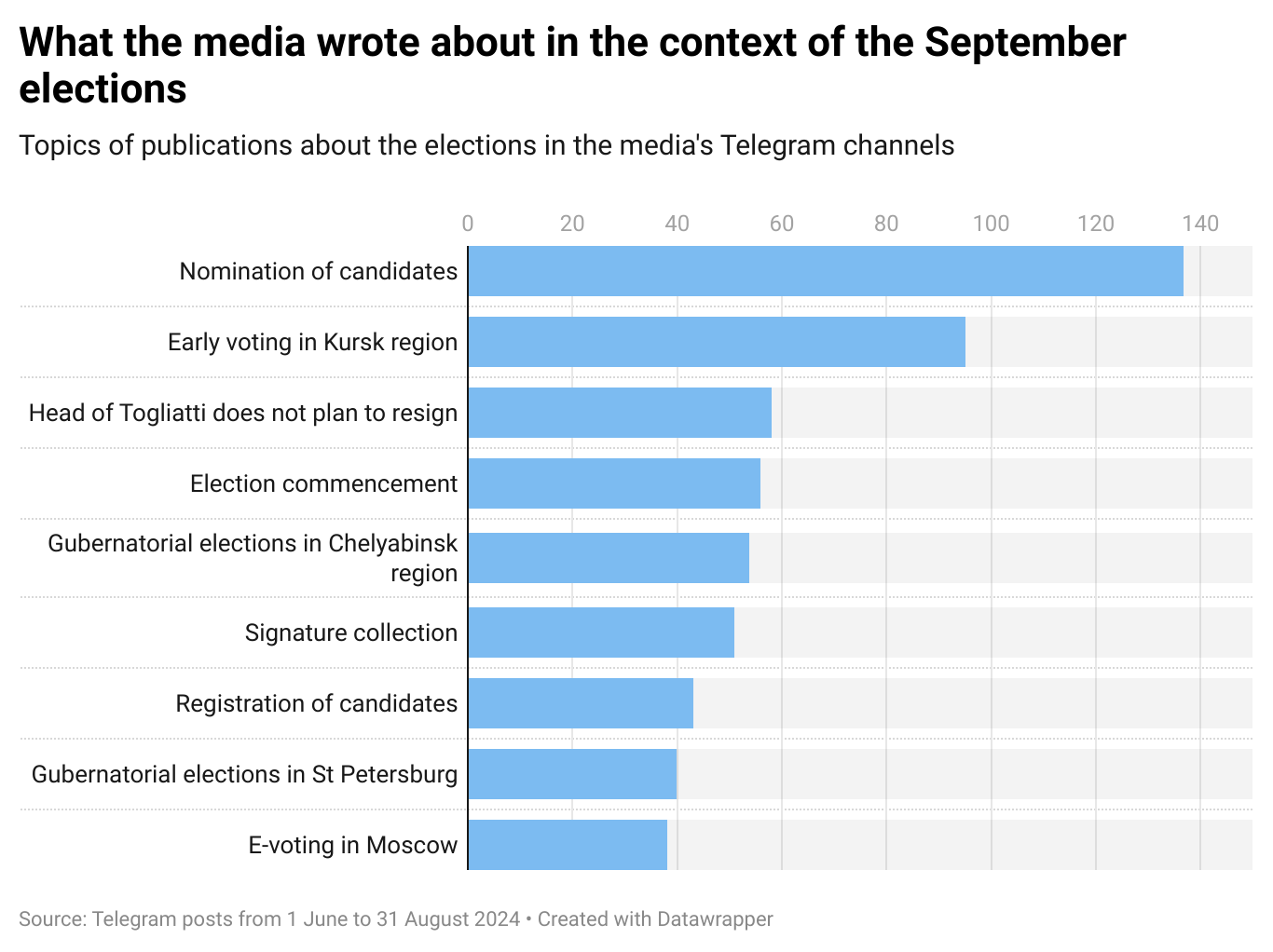
While election topics are less prominent in the media compared to government-backed VKontakte pages, most news focused on candidate nominations, signature collection, and registration. Media outlets also paid attention to early voting in the Kursk region, part of which has been captured by Ukrainian forces.
The media also reported on REV in Moscow, where City Duma elections will take place. Voting in the capital from 6 to 8 September 2024 will mainly be conducted online, with paper ballots only available upon special request, which must be submitted in advance.
Among regional elections, the gubernatorial races in Saint Petersburg and the Chelyabinsk region were the most actively covered by the media. Another top story was the decision of the mayor of Tolyatti not to resign.
Which parties are active in social networks?
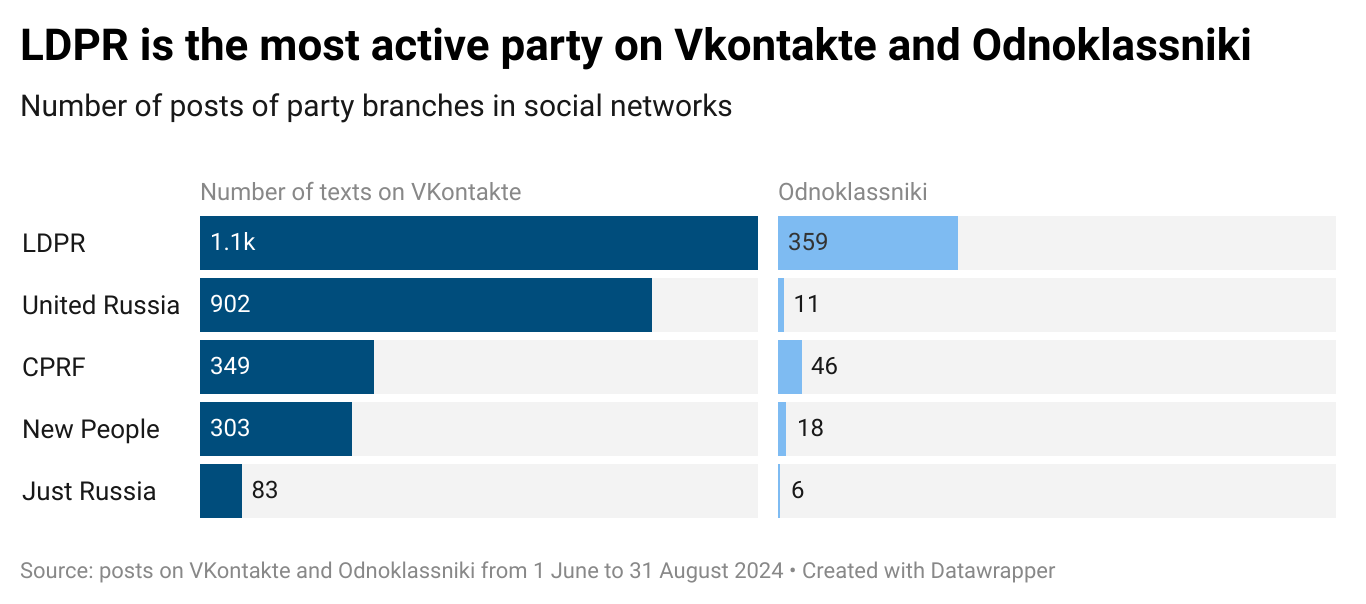
On June 14, dozens of LDPR branches in Chelyabinsk posted the same message on Odnoklassniki about the campaign “Tell Slutsky the Truth.” This social network is the third most popular in Russia (after VKontakte and Telegram). On 21 August, LDPR’s offices in Penza posted the party’s election program “LDPR’s Honest Plan” on VKontakte, and on 30 August, branches in the Krasnodar region posted about recruiting observers.
LDPR is the most active party on both platforms, with its branches publishing at least 359 posts on Odnoklassniki and 1,114 on VKontakte over the summer. The least active party is Just Russia — For Truth, with fewer than 100 posts on both platforms.
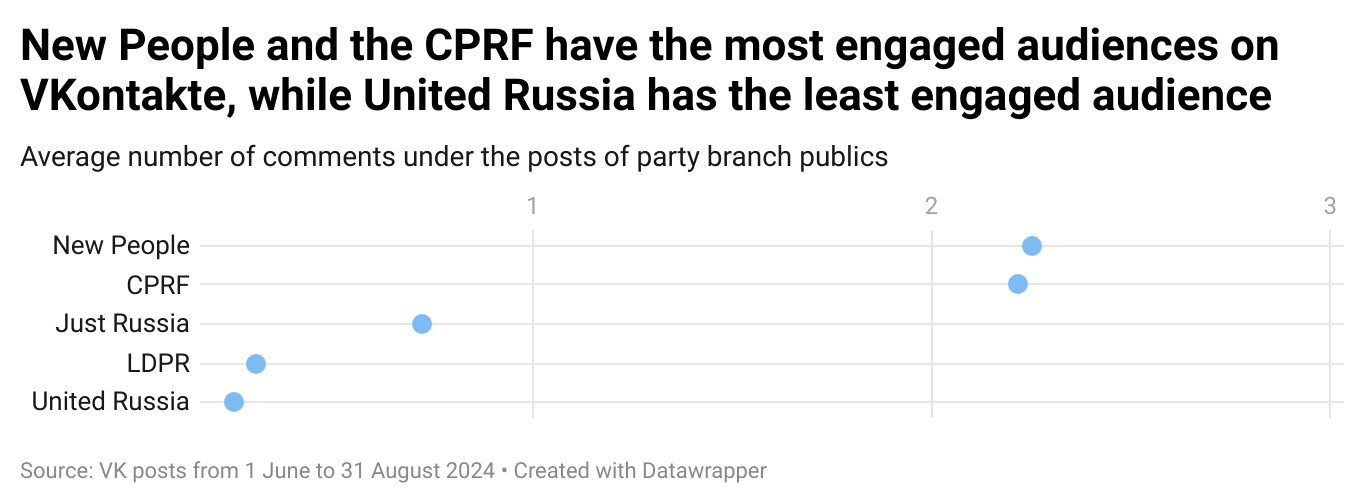
Among the most popular parties, New People and the Communist Party (CPRF) have the most engaged audiences — on average, users leave more than two comments per post. The most active party publics is of New People branch in Penza region, which has published 17 election-related posts since the summer, receiving 283 comments. Most of these posts are about candidates for the City Duma.
The least engaged audience belongs to United Russia, which published nearly 1,000 posts over the summer, but users left only 224 comments in total. It remains unknown what portion of these were written by bots.
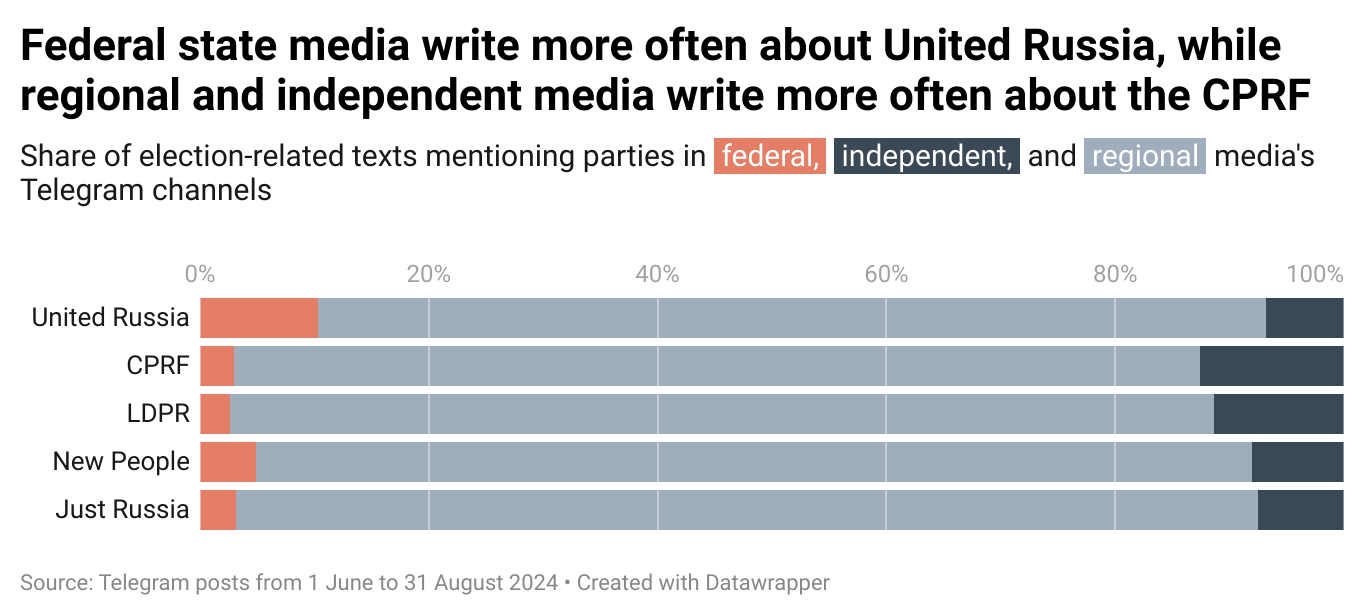
The most mentioned party in local election news was the Communist Party (СPRF), while the least popular was New People. Independent media more often wrote about the СPRF and the LDPR, while state media focused on United Russia. Federal state media featured news about the nominations of Andrey Chibis for governor of the Murmansk region, Alexander Beglov in Saint Petersburg, and Andrey Smirnov in the Kursk region.
Competition in the regions
From 6 to 8 September, during the Unified election day, approximately 4,000 electoral campaigns will take place across 83 regions of Russia. In addition to gubernatorial elections, there will be by-elections for State Duma deputies, and residents in 13 regions will elect deputies to regional parliaments. Other 21 regions will hold elections for representative bodies in administrative centers. Direct mayoral elections will also be held in Abakan and Anadyr. Other campaigns will be held at the level of district centers, municipal districts and rural settlements.
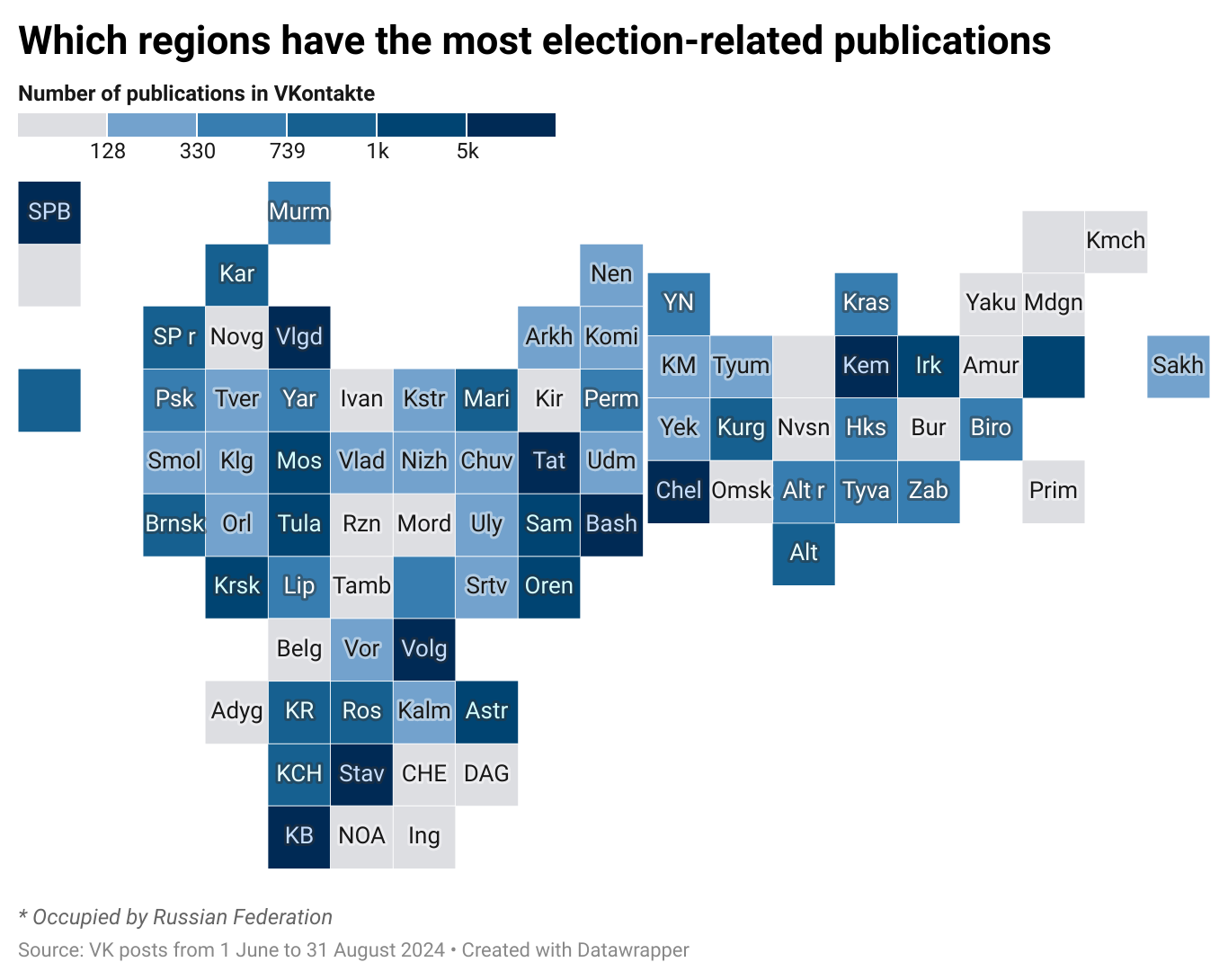
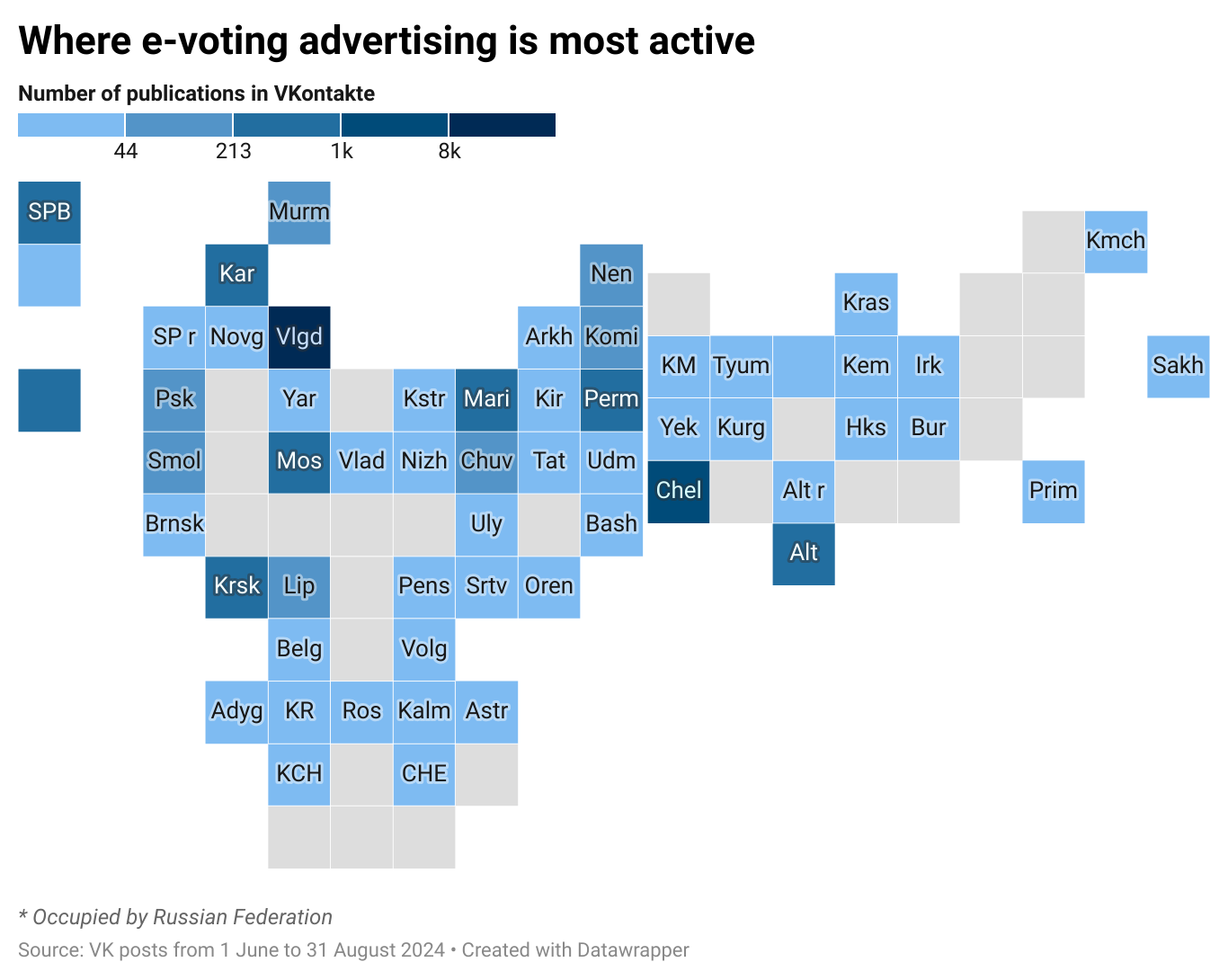
Regions where authorities are particularly active in promoting elections on VKontakte include the Vologda and Kirov regions, Bashkortostan, the Stavropol region (where gubernatorial elections will be held), and Tatarstan (where State Council deputies will be elected).
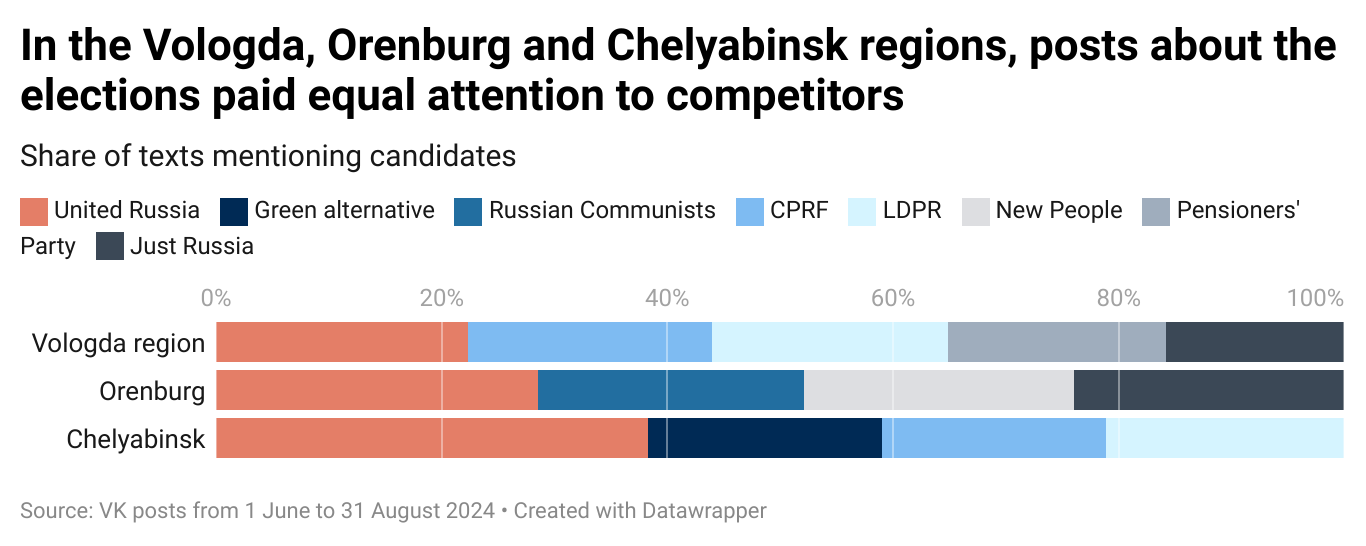
In some regions, where gubernatorial elections will be held, users, government institutions, and news media are giving equal attention in VKontakte to candidates from different parties. This is true for the Vologda, Orenburg, and Chelyabinsk regions. Posts from these regions more often mention candidates from United Russia (who are the incumbent governors at the same time) as well as their competitors from LDPR, CPRF, the Pensioners' Party, Just Russia — For Truth, Communists of Russia, and the Green alternative.
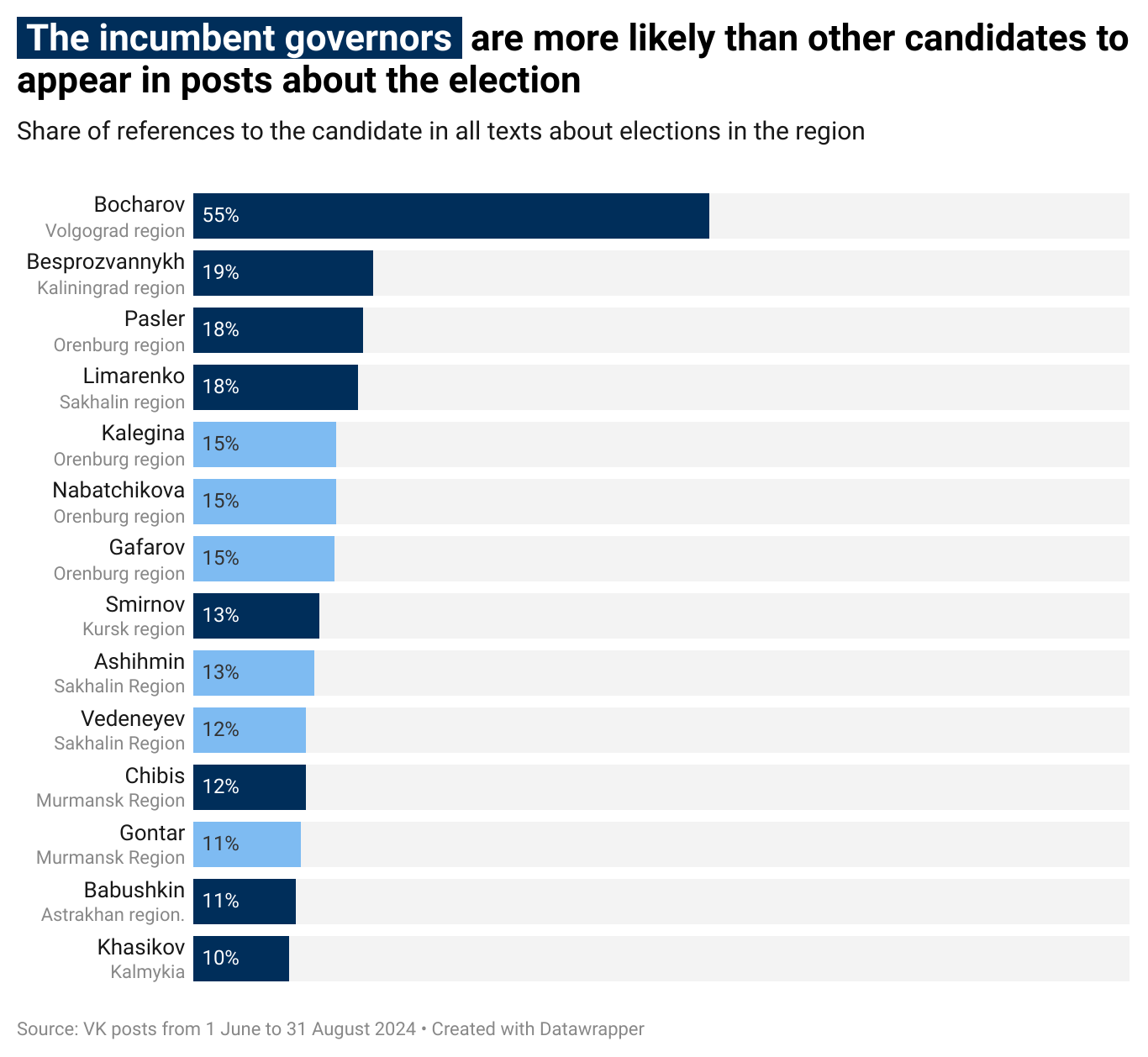
Some regions have launched campaigns in support of favored candidates, typically incumbent governors. Over half of all election-related posts in the Volgograd region mention the current governor, Andrey Bocharov. He has led the region since 2014 and played a key role in the 2021 State Duma elections for United Russia. In the last election, Bocharov won 76.8% of the vote and is running again.
Another official engaging in significant self-promotion is the acting governor of Kaliningrad, Alexey Besprozvannykh. He was the Deputy Minister of Industry and Trade from 2017 until May 2024, when he was appointed by Vladimir Putin to lead the region. One out of every five election-related posts in Kaliningrad mentions Besprozvannykh.
In the Orenburg region, authors of the posts are also actively writing about the incumbent governor, Denis Pasler. He was appointed by Putin in 2019 and won the previous election. The governor of the Sakhalin region, Valery Limarenko, with a similar career development, has also launched a self-promotion campaign.
Most of the frequently mentioned candidates in election-related posts are incumbent governors. These include Alexey Smirnov head of the Kursk region, Andrei Chibis, head of the Murmansk region, Igor Babushkin, head of the Astrakhan region, and Batu Khasikov, head of the Republic of Kalmykia.
Promotion of electronic voting
On 8 September, remote electronic voting (REV) will be available in 25 regions, covering 9.6 million voters. REV is a convenient tool for mass fraud, which is why the authorities are paying special attention to its promotion among voters. In some cases, citizens are being forced to use electronic voting. For example, the management of the Chelyabinsk subsidiary of Gazprom, Chelyabinskgorgaz, issued an order requiring employees to participate in the voting day. The order states that the priority method of voting is REV and that it’s best to vote namely on the first day, 7 September.
Over the summer, 15,000 posts promoting REV were published on VKontakte, with most posts appearing on weekdays. By August, the REV promotion campaign had picked up its steam, with the highest number of posts published on 8, 26 and 28 August 2024.
The most active REV promotion efforts are taking place in the Vologda region, where both gubernatorial and city council elections will be held. VKontakte is also seeing active participation from officials and public sector employees in the Chelyabinsk region, the republics of Mari El, Karelia, and Altai.
Methodology of counting
VKontakte
Using the API, we downloaded all posts from June 1 to August 31 with keywords related to the elections. From the downloaded posts, we filtered out only relevant ones, resulting in 121,631 posts about the elections. Additionally, we added data about users (region, position, age, number of views and comments, name of a VK public page or a person's name, etc.). From the posts, we identified mentions of candidates.
Odnoklassniki
Using the API, we downloaded all posts with election hashtags from 1 June to 29 August 2024. After filtering for relevance, we obtained 1,527 posts about the elections.
Telegram
Using the API, we downloaded posts from 267 media channels (independent, regional, and federal state), candidates, politicians, and parties from 1 June to 31 August. Posts related to elections were identified using keywords. Only 160 of the selected channels wrote on the topic, resulting in 1,100 texts. From media posts, we extracted mentions of parties.
YouTube
Using the API, we downloaded information about election-related videos from 1 June to 28 August and filtered for relevance using keywords. In the end, we obtained 109 videos.