On the death of the Wizard
29.03.2023





- You are almost a wizard. That's what some parties' leaders call you, - remarked the Russian president.
- I'm just learning, - the chief electoral official modestly replied.
This real-life exchange took place between Russian President Dmitriy Medvedev and the Chairman of the Central Election Commission of the Russian Federation on 6 December, two days after the Duma elections of 2011.
That was wizardry, indeed.
One of the fantastic facts was the demonstration on the main state TV channel of the voting results had a total sum of 146%.
That technical error caused an uproar.
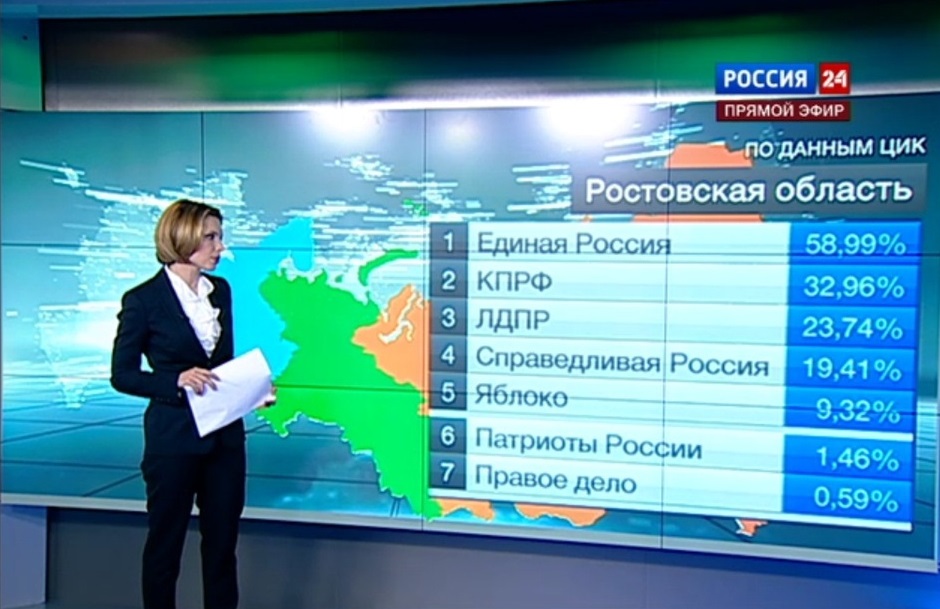 The voting results had a total sum of 146%, Russia 24 TV channel
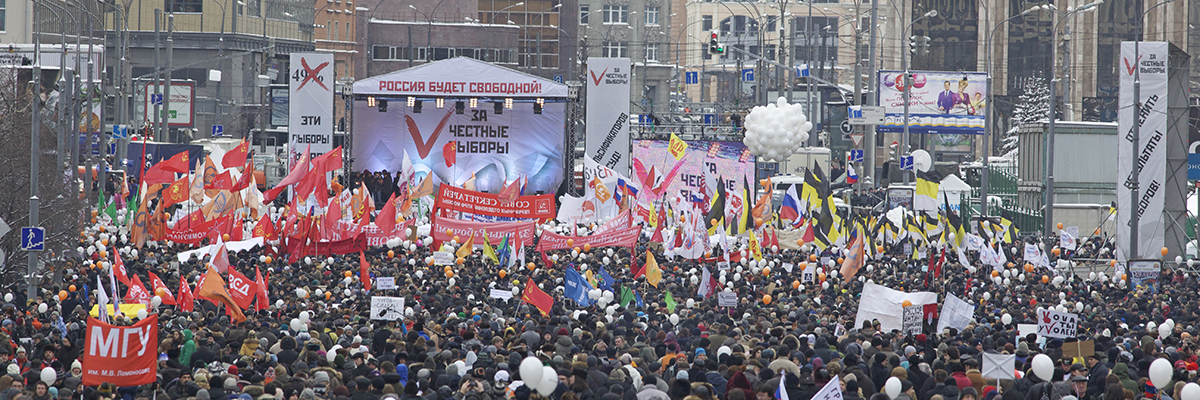
The dissent over the improbability of the results and the observed actual mass falsifications reached such a peak that the citizens of Russia decided they had had enough. The protest erupted into the streets. They were the most powerful and effective since the fall of the Soviet Union. The authorities had to make concessions. Election and party legislation were liberalised. Gubernatorial elections were restored. The level of falsification was reduced to appease the hundreds of thousands of protesters.
 |
||
| MOSCOW - 24 DECEMBER: 100 thousand in Moscow protest Putin and election results on Sakharov Avenue. The biggest protest in Russia for the last 20 years, 24 December, 2011 in Moscow, Russia, Shutterstock |
Yet, Churov survived this wave of indignation and stayed in office till the end of his tenure in 2016. He has learned, indeed. The falsifications stayed a bit below previous extremes until the end of his term, but they had been ingrained into the system and had become an inseparable part of it.
It is telling that the death of a functionary 7 years out of office drew attention from all Russian media outlets, as well as faraway Newsweek, Mirror and the Sun, and others.
The degradation of the electoral system of Russia, common mistrust in the results, and general conviction of legal political work's futility is a much worse heritage left by the infamous Wizard than any meme on 146%.
In this piece, written for Meduza, Andrei Pertsev tells the story of the life and deeds of "Putin's election fixer".
How Vladimir Churov made the Central Election Commission a branch of the Kremlin
Andrei Pertsev for Meduza
The former head of the Russian Central Election Commission, Vladimir Churov, died after a massive heart attack on March 22, 2023. He was 70 years old.
"'How can Putin be wrong?" - wondered Vladimir Churov, then head of the Russian Central Election Commission, in an interview in 2007. It was under his leadership that the CEC finally became a structure wholly subservient to the president and his administration - and the name Churov itself became a byword for electoral fraud.
Vladimir Churov was born in 1953 in St Petersburg, the son of naval officer Evgeny Churov and philologist Irina Brezhneva. He graduated from the two-year journalism course at Leningrad University and its physics department, but he was clearly more interested in the humanities - he often got C's in the exact sciences. Despite this, after university Vladimir got a job in a engineering bureau. And soon he got involved in politics.
All his life - and even in his youth, in Soviet times - Churov held monarchist views. Later, in his own words, he even decided to go into public politics to promote them - having been elected deputy of the Lensoviet in 1990 (i.e. member of the city council of Saints Peterburg, then Leningrad). However, Churov's colleague, Lensoviet deputy Alexei Kovalev, suspected that he had become a deputy for career reasons - in the hope of getting some kind of official position afterward. Some MPs were even convinced that Churov had collaborated with the KGB (there is no conclusive evidence of this).
Nevertheless, already in 1991, the relatively young deputy (Churov was 38) was spotted by the city administration - and invited to work on the External Relations Committee, despite the fact that he had no suitable experience. A former KGB officer and future Russian President Vladimir Putin headed the committee.
In the administration, Churov dealt, among other things, with "economic issues": so-called barter agreements with firms from other countries (metals, timber, and oil products in exchange for food), for example. There were significant criticisms about the way these contracts were concluded and implemented - a working group of MPs headed by Marina Salieh even demanded Putin's resignation over suspicions of corruption.
Nevertheless, Putin went on with his work. However, in 1996, Putin's boss, the mayor of St Petersburg, Anatoly Sobchak, lost the election - and his team, including the future president of the Russian Federation, left the city administration. Churov remained on the Foreign Economic Relations Committee - while maintaining a good relationship with Putin. He later explained that he had done so with the approval of the friend (i.e. Putin). "I was told: 'Volodya, you have become a professional in your field, you should stay. And I stayed," Churov used to say. Moreover, while working for the new city government, Churov did not remove Putin's portrait from his office.
And in 2003, Putin, already in the status of head of state, decided to move his associate closer to himself, to Moscow. The Kremlin envisioned Vladimir Churov as a senator from the Leningrad region, but the "vertical of power" had not yet been formed, and the deputies of the regional legislature (they were supposed to vote for a new member of the Federation Council, i.e. senatorial candidacy) did not support Putin's candidate.
Yet Churov became a parliamentarian in the same year. He was elected to the State Duma on the lists of the LDPR - though he was not a member and did not join the party even after the election. In the State Duma, Churov was given a fairly high-profile post as deputy chairman of the committee on the CIS, but was not particularly memorable - and four years later, Putin found him a new occupation.
On the eve of the 2007 State Duma elections and the 2008 presidential campaign, the presidential administration needed a loyalist who could ensure high results for the current government. The then-head of the Central Election Commission (CEC), Aleksandr Veshnyakov, despite his general allegiance to the Kremlin, allowed himself to criticise its initiatives - in particular, by opposing amendments suggesting that a person without a lawyer's degree could become a member of the CEC.
As a result, in March 2007, Vladimir Churov (the same man without a law degree) replaced Veshnyakov (401 out of 450 Duma deputies voted for the new chairman). The new CEC head immediately stated: "My main difference from Alexander Veshnyakov's position is that I am less inclined to comment on electoral legislation and more inclined to enforce it on all participants in the electoral process" (already after his resignation, Churov hinted that it was Putin who offered him the job at the Central Electoral Commission).
According to Andrei Buzin (former co-chairman of the Golos movement, which monitors Russian elections), Churov was appointed on "a very simple principle - he was known to Putin". "The Kremlin understood that he was completely under their control. And Churov, in his interview where he said Putin was always right, completely disowned the very mission of the CEC chairman," Buzin told Meduza.
The expert noted that at first Churov tried to establish contact with "those who deal with elections - lawyers, academics and observers" - or "pretended to seek it": "He understood nothing about elections when he was appointed, but quickly began to learn".
Churov was indeed a quick learner - and he did not let Putin down in the first election. In 2007, the Russian president topped the United Russia list for the first time, and in its slogans, the party began to claim that it was going into the elections with "The Putin Plan" (which no one had ever seen since then). Russian law requires that candidates who occupy public office must take a leave of absence during the campaign period - but Putin has not even thought of doing so. He continued to promote himself not only through campaign events but also by means of his actual job duties. Churov found no wrongdoing in this.
Nevertheless, the outcome of the 2007 State Duma elections did not cause many protests. Putin's rating was stable at the time and the "ruling party" result of 64.3% did not look too far-fetched.
In the next presidential campaign, in which Dmitry Medvedev took part on behalf of the Kremlin, the situation turned out to be more precarious: Churov was widely accused of large-scale falsification. In response, the CEC head pledged to guarantee the integrity of the election with his beard. "Do I have to swear with my beard that I will do everything I can to make sure the elections are fair? I swear!" - he heatedly said on the air of REN-TV. And later said: "Only 1% of citizens call for shaving off my beard, while 99% call for keeping it. I submit to the majority opinion. Where he got this data is unknown.
The complaints from the opposition - even the establishment opposition - continued to multiply. In 2009, members of the Communist Party demanded Churov's resignation. He advised his critics to "go to Chechnya" - and to protest there: "I will order a memorial wreath in advance for those who dare to do so there.
By then, Churov was already clearly perceived by people observing Russian politics as a protector of Kremlin interests. A Meduza source in the United Russia party noted that Churov was also present at the 2010 meeting of the party's executive committee, where United Russia defended its election campaign strategy to the leadership. According to the source, he even allegedly gave advice on how to "properly" and "neatly" rig the vote, such as ballot box stuffing (Meduza has no other confirmation of this). According to a United Russia member who spoke to Meduza, it was already clear at the time: "Churov is just working for Putin. He Doesn't even pretend to be some kind of external authority."
A Meduza source close to the Russian presidential administration agreed with this assessment. He added that the Kremlin had assigned Churov a "consigliere" to help the CEC head understand the "regional and party patterns" in the elections and literally "looked after" him. Meduza's interlocutor stressed that the official had "direct contact" with Putin during his tenure: "Churov was in "charge of the pitch1" to the president".(footnote: be responsible for a sphere or area of interest (criminal cant))
The major test of his career awaited Churov the following year, 2011. "United Russia was facing a tense election to the State Duma. Even the establishment opposition campaigned under the slogan proposed by the opposition leader Alexei Navalny, "Vote against the crooks and thieves", while observers and journalists reported numerous irregularities and ballot box stuffing. The final result for United Russia (49%) was lower than many of the preliminary estimates, but still looked significantly overestimated.
Protests have begun in Russia - the most massive and spectacular in Russia's modern history. Hundreds of thousands of people took part in the December actions, which have been dubbed the "snow revolution". One of the protesters' main demands was the dismissal of Churov - as the man personally responsible for the falsifications. In the posters of the protesters, the head of the CEC was depicted as a wizard who changes the real results of the vote (Churov was called "wizard" by then-President Dmitry Medvedev after the election).
Churov's dismissal was demanded not only by opposition politicians but also by the Presidential Human Rights Council, which expressed "no confidence" in the CEC head.
A Meduza source in United Russia confirmed that the results of that election were indeed "corrected" directly at the Central Electoral Commission: "Even after correction in the regions, the results did not please [the Kremlin and the 'party of power']".
Churov himself called the elections "fair" and denied evidence of fraud: "There is a lot of gibberish on the internet about irregularities nowadays. Even before polling day, I was aware of several fake 'electoral offices' in flats where the 'movies' were filmed."
But amid protests, Churov was not dismissed. Moreover, in May 2012 - almost immediately after the presidential election in which Putin became president of Russia for the third time in defiance of the constitution - the head of the CEC secretly received the Order of Alexander Nevsky from Dmitry Medvedev.
Churov's resignation remained a common regular slogan of the opposition even after that. Still, Putin's long-time pal completed his term and left the chairmanship of the CEC only in March 2016. The new head of the Central Election Commission was appointed Ella Pamfilova, previously the Commissioner for Human Rights. An expert who has studied the work of the CEC for many years, in a conversation with Meduza, suggested that the Kremlin had intended this appointment to please the opposition: "Like a filter - [Churov] got clogged up, became toxic, he was replaced with a new one. Pamfilova had a liberal image, there were hopes for her".
At first, Pamfilova even set up an expert group under the Central Election Commission with the participation of independent observers, but in December 2016 she called the evidence of election fraud in Mytishchi, Moscow Region, evidence of an "information war" against Russia. The CEC barred Alexei Navalny from the 2018 presidential election; in 2020, the expert council was dissolved, and Pamfilova herself eagerly promoted the vote on constitutional amendments (and "nullification" of Putin's presidential term), which took place over several days and went down in history as "stump voting".
After the 2021 Duma elections, Pamfilova openly criticised the media for reporting falsifications: "Every day you turn on some TVRain channel and hear: there are endless violations everywhere. Where? We do not see a single complaint that reaches the point of requiring consideration by the CEC.
After leaving the Central Electoral Commission, Churov was made ambassador extraordinary and plenipotentiary to the Foreign Ministry, advising the agency on election campaigns in other countries and providing commentary to pro-government media. "What matters most is the uniform. You see, my father, grandfather, great-grandfather, and great-great-grandfather, as far as I know, all wore uniforms for 500 years. When I was promoted to the rank of ambassador by presidential decree, I was happy. The first thing I did was have my uniform made," Churov described the merits of his new position in an interview with Komsomolskaya Pravda, which was published five days before his death.
According to Andrei Buzin, former co-chairman of Golos, during his time at the Central Election Commission, Churov "was hated by absolutely everyone - he was an absolutely unloved character. At the same time, the expert is sure that Churov did not make the decision on falsifications himself - but defended them: "He and Pamfilova are toys in the hands of the Presidential Administration political bloc, puppets who do not consider themselves puppets.
A United Russia politician, who back in 2010 allegedly listened to advice from Vladimir Churov on how to "correctly" stuff votes for United Russia, spoke to Meduza about his aims: "He made no secret of being a monarchist - and he served [as one]. But he did not serve democracy, or even the state. He served Putin."