Russian presidential elections 2024: Is resistance at polls possible?
30.11.2023





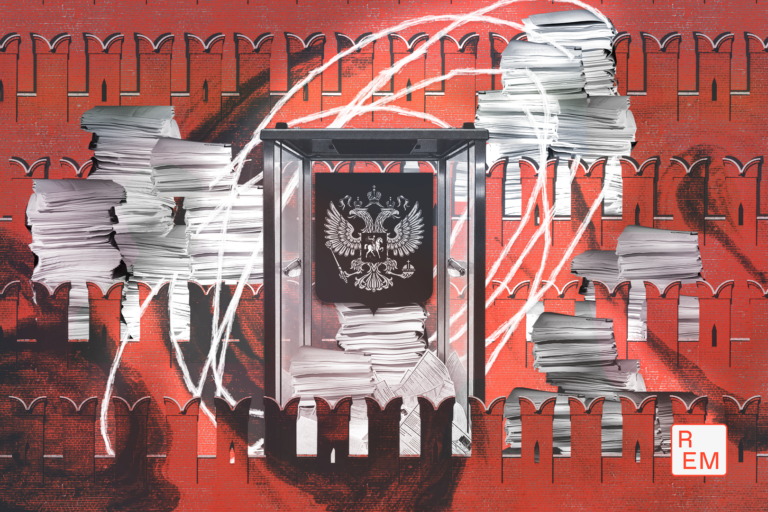
The election on 17 March 2024 will be the first presidential election during the war in recent Russian history. Further, it will be the first presidential election after the constitutional amendments 2020 that nullified the count of consecutive presidential terms and allowed Vladimir Putin to stay in power until 2036.
In this article, REM asked Senior Research FellowFinnish Institute of International Affairs Margarita Zavadskaya if there is any room for maneuver for opposition voters, given the unprecedented level of political constraints.
No Place for Experimentation and Surprises
Presidential elections in closed authoritarian regimes usually make a boring show in the sense that no surprises are likely to occur. Going back to analogous episodes, post-election protests normally happen only if an opposition candidate runs in the electoral bid. For example, it was in the case of Belarusian presidential elections 2020 when Aliaksandr Lukashenka made a strategic mistake and permitted Sviatlana Tsikhanouskaya to compete, thereby severely underestimating the coordination capacity of the Belarusian opposition. Even Putin, known for never taking any unjustified risks at polls, found himself on a slippery slope with a strawberry tycoon Pavel Grudinin representing the Communist Party (CPRF) in 2018, who turned out to be more popular than expected and the Kremlin had to engage in a full-fledged black PR campaign against Grudinin.
Approaching his next election in March 2024, Putin does not look as impressive as he used to, so the Kremlin sticks to a low-risk low-profile campaign with remarkably faceless alternative candidates - a new leader of the Liberal Democratic party (LDPR) Leonid Slutskiy, a mastodont Gennady Zyuganov from communists (CPRF) and Alexey Nechaev from a pocket political party New People. There are rumors that Putin sought to position himself as the “younger” electoral candidate against the alternative candidates.
None of the three candidates from systemic opposition resembles a person around whom the opposition voters would be able to unite. In order to rally in the electoral aftermath, there must be a candidate or a party that lost due to electoral fraud. In cases when such candidates or parties are not even on the ballot, there is nothing to protest against. The odds of protest drop down dramatically in both cases of boycott by the opposition and its deliberate self-exclusion from the legitimate arena of contestation as it is in the case of Russia. In order to coordinate successful protests, opposition voters need at least basic organization and a reliable system of information exchange. After the state’s crackdown on Navalny's regional branches in 2020, such infrastructure was emasculated. Coupled with bone-crushing repression, wartime censorship and large numbers of riot police in big cities, post-election protests are unlikely to emerge.
Could the Kremlin make a mistake that would open a window of opportunity for the opposition? The forthcoming elections will not become a platform for experimentation. In fact, presidential elections in Russia never serve as a test field for electoral innovations. All electoral novelties such as electronic voting (or distance electronic voting, DEG) have been tested and approved in the State Duma poll back in 2021. The September 2023 elections served as a rehearsal for the presidential election in March 2024 and, as such, tested logistical capacities (e.g., online voting) rather than loyalty. Electronic voting proved both efficient in delivering votes and satisfactorily untransparent for the Kremlin. It is likely that it will be expanded further across Russian regions (we wrote about how DEG could be used in the 2024 election here - Ed.)
Recently Ramzan Kadyrov, leader of the Chechen Republic, expressed the idea that presidential elections should accommodate just one candidate due to ‘the ongoing special military operation’, as Russian authorities refer to the war in Ukraine, and that Vladimir Putin is the only candidate who can defend the country. Despite the seemingly absurd idea of having only one candidate on the ballot, such kind of election would still serve its purpose. Because the main task of the March 2024 election is to demonstrate the regime’s capacity to deliver the expected number of votes. Putting one single candidate on the ballot would give a signal to Russian opposition that any resistance is futile, creating the illusion of pro-Putin majority. Further, the March 2024 election serves Putin to prove to the elites the regime’s ability to organize people and bring them to polling stations. The Prigozhin mutiny rendered the regime and Putin personally vulnerable (or at least made him look vulnerable), so Putin’s personal mission is to show himself in proper political shape rather than as a lame duck.
From this perspective, upholding an image of free and fair elections plays less of a role. The opposition has no illusions regarding the quality of elections, while Putin's close circles care mostly about the image of invincibility and overall political predictability rather than electoral integrity. Nevertheless, the Kremlin has taken certain measures to eliminate independent observers and other professional witnesses. Key independent elections watchdog Golos faced challenges, including the arrest of its chair Grigory Melkonyants right before the regional elections in September 2023. Certain legislative changes were adopted to further restrict opportunities for observation. From now on, journalists who are not officially employed at the media they represent are not allowed to the polling stations, i.e. no freelance journalists. Possibilities to shoot videos at polling stations were also seriously restricted. Thus, barring independent observers from electoral precincts aims at leaving undocumented evidence of falsifications.
While the regime expects to obtain at least 80% votes for Putin with a turnout of 70%, it would like to avoid overly active support. The ideal scenario from the Kremlin’s perspective would be a supportive, but not overly active population. It therefore has to strike a balance between mobilizing the population and preventing uncontrolled competition. For example, yet uniting citizens around the idea that Russia needs to be defended from enemies, the regime is careful to control any war-related figures in political contexts. The imprisonment of Igor Girkin known under his nom de guerre Strelkov on the grounds of extremism vividly demonstrates that any overzealous patriotic initiatives are unwelcome.
The 2024 election will have a personalistic focus on Putin, who has long since detached himself from issues on the ground, as has ‘the party of power’ United Russia. This creates a convenient and effective mechanism for blame attribution, whereby Putin individually is credited with good things happening in Russia, whereas the negatives are blamed on the party.
What the Opposition Can and Can’t Do?
What are the possibilities for the opposition in these circumstances and what does the Russian opposition suggest? Not all elections under authoritarian conditions are completely immune to the opposition’s effort to inflict damage on the incumbent. Before the full-scale invasion of Ukraine, ‘to be the most tangible way to increase the costs of falsifying elections and decrease vote tallies. Voting for the second strongest candidate or ‘least bad option’ in a single-member district lies at the core of this strategy. According to existing research, the smart vote improved the results of opposition candidates by 5.6. percent on average in the Moscow Duma elections in 2019. Similar estimates were found for the local elections in 2020.
The bad news is that the smart vote strategy is useless when it comes to two-round elections, let alone a nationwide presidential election, where there is no candidate who might be viewed even as semi-loyal opposition. Perhaps, it is still technically possible to cause harm to the official outcomes and complicate the work of those who commit fraud. But what we need to always remember is that presidential elections with no choice on the ballot are unlikely to give away a chance for the opposition to strike back. Legislative elections, regional or local elections are usually less controlled, and there is more leeway for the opposition to penetrate existing political institutions.
Russian opposition is currently split between three resistance strategies. The first strategy is to boycott the elections as the very participation in the campaign legitimizes Putin’s dictatorship and serves the purpose of cooptation at best. Some representatives of Russian opposition in exile such as Garry Kasparov are known to be the adherents of this option. There is always a possibility to spoil the ballot, but it does not differ from the boycott, they claim. The second proposition is to participate in any political event that resembles elections. This option is being promoted by Maxim Katz, a former ally of Aleksey Navalny. And, finally, the original smart vote approach, which is currently tailored in such a manner that it supports all candidates with anti-war stance and selects the districts where competition is not a total sham.
Supporters of Maxim Katz advocate for voting for literally anyone, for instance, Leonid Slutsky (accused of sexual harassment by four journalists) from LDPR to keep the opposition engaged and continue the resistance. A similar approach was attempted at the presidential elections in 2012 right after the large-scale rallies in Moscow and St. Petersburg. However, Leonid Volkov from the Navalny’s Anti-Corruption Foundation made clear it is not their stance this time. At the moment, being the strongest non-systemic opposition, the Anti-Corruption Foundation has yet not announced their recommendation: “We believe that we should participate only in those elections where we can fight Putin's regime and do damage to it. And when elections are about to put on a show, we should not participate. A separate decision is made for each campaign. Accordingly, our position on the 2024 presidential election is that a decision should be made when the whole picture is clear: candidates, campaigning, observers”.
What is the range of possibilities given the political constraints? First, it is vital to gather evidence of electoral crimes and violations so that it can be investigated or at least documented. Second, preserving networks of the opposition, channels of communication between the opposition of any stripe and anti-war-minded Russians, exchanging information and sharing ideas and plans for action in case any exogenous shocks emerge, remains of utmost importance even under extremely repressive conditions. Third, there is no reason to believe that approaching the March 2024 election would serve as a focal point for large-scale rallies. However, any other event may overlap and even trigger sudden changes.
By Margarita Zavadskaya, Senior Research FellowFinnish Institute of International Affairs