Supreme Court Bars Yabloko: Inside the Lawsuit and the Regime’s Fear of Losing Control
20.08.2026





On August 10, the most pivotal event of the current Russian electoral cycle unfolded: Russia’s Supreme Court annulled the registration of the Yabloko party’s candidate list following a lawsuit filed by the Rodina party. While framed as a routine legal dispute, the verdict points to a broader systemic shift—the authorities’ growing fear of losing control over the trajectory of the campaign.
Russian Election Monitor breaks down the legal arguments behind the lawsuit and examines the political motives that drove the Kremlin to purge Yabloko from the ballot.
What are Rodina’s claims?
Rodina had only 10 days to prepare the lawsuit, yet it contains 40 pages of arguments on four grounds. Part of it is written in language familiar to anyone who has dealt with documents from the Russian Ministry of Justice or the FSB, while another part stylistically resembles traditional lawsuits drafted by Russian electoral lawyers. This suggests that the lawsuit, or parts of it, were prepared in advance as a fallback option in case it became necessary to remove Yabloko quickly from the elections.
The lawsuit itself consists of four parts.
The first concerns “copyright infringement” in Yabloko’s campaign materials. This is one of the few grounds that, under Russian law, can directly lead to a candidate or party being removed from the ballot. This long sparked debate among lawyers, as it represents a disproportionately strong intrusion of civil-law into the sphere of public-law ones. Moreover, filing such a lawsuit does not even require complaints from the rightsholders.
The plaintiff objects not to the campaign materials themselves, which are registered with Russia’s Central Election Commission, but to the party’s website, which contains articles and materials spanning many years. Some of the claims concern publications made, for example, in 2012—14 years before the start of the current elections.
Moreover, the arguments themselves look rather weak. As the well-known electoral lawyer Andrei Buzin noted, the plaintiff “does not cite a single example of the defendant’s use of a work in its entirety, and all of the plaintiff’s examples concern either a) short excerpts of a work (for example, the words ‘may there always be sunshine, may there always be mommy’ from the poem by L. I. Oshanin); b) small fragments of a work (for example, data from the Levada Center); or c) images similar to images that constitute works. The examples the plaintiff gives are borrowed from the internet and are not corroborated by notarized scans.” For example, the plaintiff claims that the Yabloko party logo constitutes a copyright-infringing borrowing from a work by the famous Russian avant-garde artist El Lissitzky (see screenshot from the lawsuit).
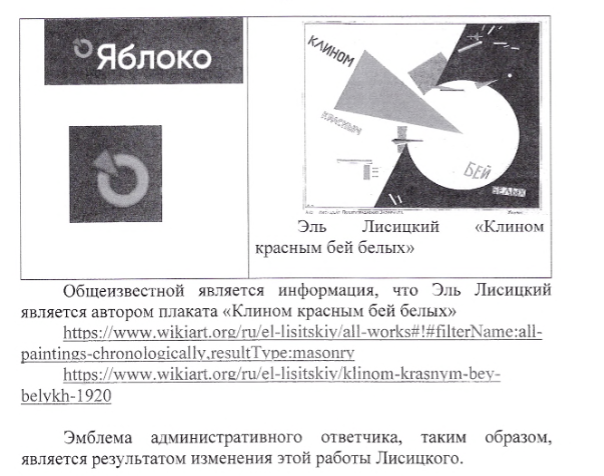
Screenshot from the Rodina party’s lawsuit
The problem is that the legal provisions allowing parties and candidates to be removed from elections for copyright violations are drafted extremely poorly in Russian law. Lawyers and politicians have been trying for years to achieve greater clarity and legal certainty, but without success. For several years now, the Russian Constitutional Court has quite openly avoided providing clarifications. This entire block of claims therefore lies in the realm of judicial arbitrariness—consciously constructed by lawmakers and enforcers. Essentially, if such claims form the basis of a Supreme Court decision to remove Yabloko from the elections, any party could be removed at any time.
The second block of claims also appears very weak. The plaintiffs write that they found a large number of social media posts in which users expressed support for Yabloko. Competitors from Rodina consider this Yabloko’s campaigning not paid for from the election fund. However, back in 2005 the Russian Constitutional Court stated that citizens’ right to actively advocate their position during elections is an integral part of their electoral rights.
The third block, potentially creating the greatest problems for Yabloko, concerns accusing the party of signs of extremism in its campaigning. This is another area of law that is deliberately designed to allow arbitrary enforcement. And most importantly, these allegations could potentially lead not only to removing the party from the elections, but to its complete ban as an extremist organization and criminal prosecution of its members and candidates at all levels.
The plaintiffs accuse the party of supporting the LGBT movement, which is banned in Russia; of calling for the destruction of Russia’s territorial integrity (because Yabloko calls for ending the war with Ukraine); and of inciting enmity toward the authorities and other political parties (which is taken to include phrases such as: “If you vote for Yabloko, it means you are for change, for peace, for freedom, for a different life,” “the authorities keep adopting new repressive laws,” etc.).
The fourth block of claims is the weakest; it doesn’t even cite the legal norms provisions on which the plaintiffs rely. Instead, they simply question whether some candidates’ documents were filed within the required timeframes.
The authorities’ initial plan
From the very start of the campaign, many experts doubted that Yabloko would appear on the ballot in September. These doubts were reinforced by a wave of cases against the party’s most prominent figures. Since autumn 2025, at least eight potential Yabloko candidates have been pre-emptively deprived of the right to run for the State Duma over accusations that they distributed “extremist materials.” For example, party leader Nikolai Rybakov was fined 1,500 rubles (less than $20) for expressing condolences over Alexei Navalny’s death and posting his photo on social media. The Russian authorities consider Navalny an extremist and have long been fining citizens for posting his photos.
Nevertheless, the party list was ultimately registered, which was consistent with the logic followed by Russia’s election administrators in previous years: they sought to maintain a sense of stability in the political system—a certain status quo. None of the parties entitled to participate in federal elections without collecting voters’ signatures in support of their nomination were removed from the elections in either 2016 or 2021. In 2011, when there were only seven parties and all were eligible to participate, there was no such precedent either. Nor were candidates representing such parties removed from presidential elections. In other words, allowing Yabloko onto the ballot was the baseline, standard option intended to demonstrate the stability of the system amid mounting socio-political strains. To mitigate the risks of allowing the party to participate and to make the elections as manageable and predictable as possible, a purge of candidates (not only from Yabloko, but also from the CPRF and other political forces) was envisaged. Almost all fundamental decisions about who could and could not participate in the elections were carried out even before the campaigns were announced. An entire array of legal and administrative mechanisms worked toward this—the “foreign agent” designation, administrative fines under “extremism” articles, criminal cases over “fakes/discrediting the army,” and alleged corruption cases. These mechanisms selectively deprive politicians of passive suffrage and strip them of organizational resources.
Why was the lawsuit filed?
However, the registration of Yabloko—even without the party’s more recognizable leaders, without money, and without the organizational capacity to run a federal campaign—triggered a largely spontaneous mobilization of part of the anti-war electorate.
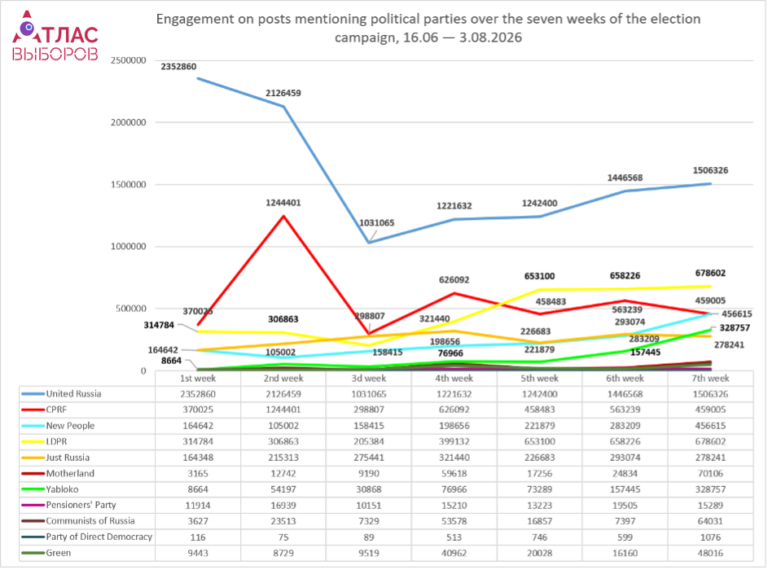
The “Atlas of Elections” project recorded an explosive rise of interest in Yabloko on social media, as well as in the New People party, which part of the opposition views as a more moderate alternative to Yabloko. Over the past two weeks, in terms of engagement (the sum of reactions, comments, and reposts), New People doubled its figures, while Yabloko’s figures increased 4.5-fold. As a result, in absolute terms, New People caught up with the CPRF, while Yabloko overtook A Just Russia.
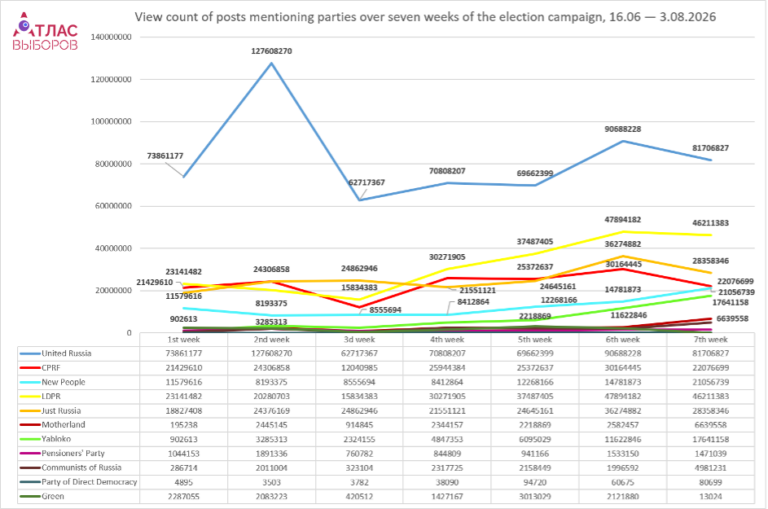
In terms of views, the picture is similar, though somewhat more modest: over two weeks, New People nearly doubled its total, while Yabloko nearly tripled its own. Both parties almost caught up with the CPRF by this metric. Thus, for election organizers who had clearly planned for a quiet campaign, an obvious risk emerged: the situation could begin to slip out of their control.
As Russian electoral statistics expert Boris Ovchinnikov writes, the number of Yandex searches containing both the party’s name and the word “elections” has increased more than fivefold over the past month for Yabloko. If we take as 100% the total number of searches containing the word ‘elections’ together with the names of the “parliamentary five” parties plus Yabloko, then, before its removal from the race Yabloko ranked first with 36% of searches, compared with 4% in 2021. By comparison, United Russia’s share stands at 27%, compared with 37% in 2021, the CPRF’s share has plunged from 42% to 17%, New People accounts for 10% of searches, up from 4% in 2021, while the LDPR and A Just Russia each lost about 1.5 points over five years and now account for 6% and 4% of all searches, respectively.
This growth was spontaneous: it began before statements in support of the party by Yulia Navalnaya and most other opinion leaders. Even coverage of Yabloko in émigré Russian media and major blogs tended to follow the surge in interest rather than cause it.
Of course, there is a gap between becoming interested in a party and taking action (in this case, voting for the party). However, the emergence of interest is the first step, and judging by its emotional intensity, it had every chance of converting it into real electoral support. Looking at these numbers, it is therefore not surprising that the administrators of Russian domestic politics activated their backup plan: removing the party from the elections. The Kremlin (or its security bloc) feared that the situation in the election campaign could spiral out of control.
What does this indicate?
Since 2018, in fact, the Presidential Administration has repeatedly faced unexpected mobilization among its opponents. In the 2018 presidential election, protest sentiment began to coalesce around the CPRF’s approved candidate Pavel Grudinin, forcing an urgent deluge of black PR against him. In 2021, an explosive rise in social media interest was recorded around Alexei Navalny’s “Smart Voting,” resulting in a significant increase in support for the CPRF (the Russian authorities had to urgently block the Smart Voting app in online stores). In 2024, Boris Nadezhdin received completely unexpected and open support. Before the campaign began, almost no one knew him outside the Moscow region. He was, however, easy to keep off the ballot because he was a self-nominated candidate collecting voter signatures.
All this indicates that Russian society contains a substantial group of voters who can easily self-mobilize around virtually any political force that carries even the slightest charge of opposition.
At the same time, the political forces themselves may not want such support. Yabloko itself likely did not expect significant backing at the start of the campaign and simply wanted to participate to preserve its party license for the next five years. Now, however, the party faces the prospect of almost inevitable liquidation — either through designation as an “extremist” organization, or because it is deemed a party that no longer participates in elections.