The armed “Fifth Column”: Why are Russian military personnel protesting the war — and why is it getting them nowhere?
16.09.2026





by Irina Novik
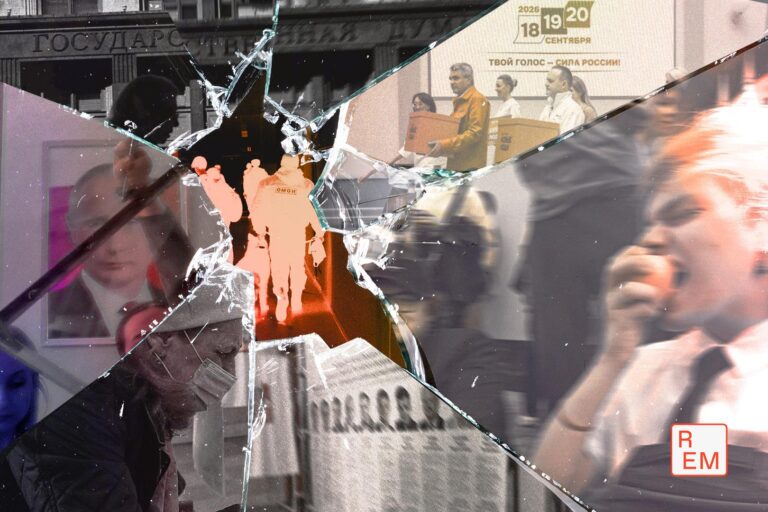
A record number of participants in the “special military operation” — the official Russian term for the full-scale invasion of Ukraine — are running in the upcoming elections on 20 September 2026. More than 1,600 people are reportedly standing for election, including around 200 people seeking seats in the State Duma. Among the candidates fielded by United Russia are military personnel whom Ukraine has accused of war crimes.
But alongside these loyal careerists, the Russian armed forces have also been home to — and continue to produce — nascent opposition figures, even if they do not necessarily see themselves that way. Following the Wagner chief Yevgeny Prigozhin and the wives of mobilized men, whose “uprisings” were suppressed, Russian service members and their relatives have emerged as a new source of dissent, posting daily on social media about grievances with the military. The Kremlin kills or arrests some of them and ignores the rest. What are participants in the “special military operation” actually protesting against? Why have their methods failed to produce results? And what can be expected from the war veterans now running for office?
Irina Novik, a journalist, writer and researcher of the Russian military during the full-scale invasion of Ukraine, who has been designated a “foreign agent” by the Russian authorities, examines these questions exclusively for the Russian Election Monitor.
“The army will turn its weapons on the Kremlin”: Who is Alexander Lunin?
“I am appealing to Vladimir Vladimirovich Putin: if he does not grant me an opportunity to speak live on air, where I can tell the whole truth about what is happening in our country right now, if I do not come to the Kremlin in the near future and speak live alongside you, the army will turn its weapons on the Kremlin”.
Junior Sergeant Alexander Lunin, a former soldier in the war against Ukraine, made these remarks in several videos he posted on social media on 25 June. The 39-year-old complained of the “zeroing” — the practice of killing or otherwise eliminating Russian servicemen as punishment — as well as extortion and abuse by their commanders. Lunin then threatened the president with what amounted to a Prigozhin-style mutiny. Within 24 hours, the Instagram reel had been viewed 12 million times. The video has since been deleted, but copies remain available elsewhere online.
Lunin is, of course, not an opposition figure in the conventional sense. In fact, he is on the other side: he fought against Ukraine. According to Lunin, he was “kicked out” of a volunteer battalion in 2025 for failing to carry out his duties; he insists the real reason was his bluntness (“I say it like it fucking is”, as he puts it). Having served at the front, Lunin says he was simply glad to be home.
Curiously, Lunin claims the idea for the protest video wasn't even his own. He says he was pressured into recording it by officers from the Ministry of Defence and the Interior Ministry, who pulled up in a black SUV outside his home in the village of Lizinovka, in Voronezh region, on 24 June. "Nobody wants bloodshed. Just get it through to the president that things are going to go completely to hell if this keeps up. Because a lot of people are being sent on missions that are simply impossible to complete. And they don't come back. And people don't want to go anymore, and they're punished for it", Lunin quoted the security officials as telling him.
The serviceman had addressed the president before. “Vladimir Vladimirovich, please pay attention to me”, Lunin pleaded in a video he posted on 22 June. And Putin did, in fact, take notice of an ordinary Russian serviceman: on 27 June, Alexander Lunin was arrested and placed in a pretrial detention facility for 11 days. The administrative charge was for promoting banned symbols — though which symbols remains unclear, since the details of the case have never been disclosed.
While Lunin was in detention, some began to count him among the ranks of the “fifth column”. But in one of the new videos he posted after his release, Alexander made his attitude toward the Russian opposition unmistakably clear: “Faggots and queers. There’s only one way to deal with them”.
The blogger Lunin did not stop there. In his subsequent reels, he claims that “they heard him in Moscow”. The Kremlin, meanwhile, said it had not seen the serviceman’s now-viral video appeal to Putin. But judging by Lunin’s latest posts, he appears to have established contact with the authorities — at least with the local administration — and has returned to the combat zone, this time as a volunteer. He is no longer demanding an audience with Putin.
How Yevgeny Prigozhin marched on the Kremlin and died
Voronezh Region, where Alexander Lunin lives, is located 500 kilometres from Moscow. It was also part of the route taken by Yevgeny Prigozhin’s mutiny, which lasted a day, from 23 to 24 June 2023. The head of the Wagner private military company and one of the most prominent figures in Russia’s invasion of Ukraine was the first serviceman to publicly speak out about problems at the front and to launch an armed march on Moscow.
It all began in the second year of the full-scale invasion, in late February 2023. Prigozhin’s press service then published a photograph showing the bodies of dozens of Wagner fighters killed in the Bakhmut area on 21 February alone. The businessman claimed they had died because the PMC was running short of ammunition. He blamed responsible Valery Gerasimov, then head of the General Staff and commander-in-chief of the Russian armed forces, and Sergei Shoigu, the minister of defense at the time.
Four months later, on the evening of 23 June, Prigozhin accused the same two officials of ordering a missile strike on Wagner’s rear camps. According to the businessman, “a huge number of fighters were killed”. Prigozhin vowed to “respond to this atrocity” and announced the start of a “March for Justice” on the Russian capital. That same day, the Federal Security Service (FSB) opened a criminal case against the Wagner PMC leader for inciting armed mutiny.
By the following morning, around 25,000 Wagner fighters — a figure cited by Prigozhin — had entered Rostov-on-Don. They met no resistance, took control of the city, and blockaded the headquarters of the Southern Military District. The rest of the column continued along the federal highway through Voronezh towards Moscow.
Along the way, Prigozhin's men shot down a military aircraft and six helicopters, killing fifteen Russian servicemen. Voronezh region bore the brunt of the mutiny's fallout: an oil depot burned, dozens of rural homes were destroyed, vehicles were blown up, and civilians were wounded.
Late in the evening of 24 June, Putin’s press secretary Dmitry Peskov announced that the criminal case against Prigozhin would be dropped and that the PMC leader and his mercenaries would “leave for Belarus”. Wagner fighters later told me they had genuinely believed Prigozhin capable of changing the course of the war. He didn't get the chance.
Exactly two months after the march began, on 23 August 2023, Prigozhin — along with Wagner co-founder and commander Dmitry Utkin and several other members of the group's leadership — died when a private jet crashed in Tver region. Russian authorities never gave an official cause of the crash and declined to conduct an investigation in accordance with international rules. The war ground on.
Crimes without punishment: What are participants in the war against Ukraine protesting?
While Prigozhin was still alive, on 21 September 2022, Vladimir Putin announced mobilization in Russia. In its immediate aftermath, at least 600,000 people left the country, although some later returned.
There was another reaction as well: a women’s protest movement known as “The Way Home” emerged. Wives, mothers, and other female relatives of those sent to the war — often by force or under threat — demanded that they be brought home. In response, participants were detained at pickets, police showed up at their homes, and officers from Centre “E”, the Interior Ministry’s main directorate for combating extremism, monitored them. Eventually, “The Way Home” was added to the “foreign agent” register. Since February this year, the movement has all but disappeared, halting both its Telegram posts and its offline actions.
The mobilization also gave rise to another category of opponents of the war: deserters. According to data from last summer, more than 20,000 cases involving refusal to serve had been brought before Russian military courts. The actual number of those who fled is much higher.
But even more numerous are those who refuse to follow their commanders’ orders but remain at the front: they are afraid to run, and besides, they have no idea who would want them back. Protest among those taking part in the “special military operation” is born not of pacifism, but of a confrontation with the reality of war. There are almost no patriots at the front. Men sign up for the money: in some cities, the one-time enlistment bonus reaches 4.5 million rubles (more than €46,000), while the monthly salary is around 210,000 rubles (more than €2,100). None of these men could earn that kind of money any other way — and anyone who genuinely could isn't signing a contract in the first place. The authorities have other ways of recruiting people besides offering cash, too: enlisting prison inmates, snatching men off the street, or luring them in through Avito, an online job platform.
Most ordinary Russians only learn the truth about the war when they actually find themselves fighting it. Before that, they rely on television and other readily available media — every outlet that reports honestly on the invasion is blocked in Russia, while YouTube and Telegram are deliberately throttled. And even when accurate information is accessible, many Russians find it easier to dismiss it as fake than to distrust state propagandists like Vladimir Solovyov and Margarita Simonyan — let alone the president himself.
Once they sign a contract, participants in the “special military operation” finally discover what they have really signed up for — as the Russian saying goes, they realize they are not in a fairy tale. Beatings and being sent to punishment pits, “zeroing”, open-ended contracts, no evacuation of the wounded from the battlefield, and corruption — such as paying a commander to avoid being sent on an assault — have all become routine in the Russian army. Following the complete suppression of protests, complaints about these abuses from participants in the “special military operation” and their female relatives appear only on social media. Some Telegram channels publish them literally every day. Having learned the truth — or, more precisely, having come face to face with it and become its victims — Russian contract soldiers are trying to defend their rights. I'd venture that, for many of them, this is the first time they've even considered that they have rights at all: as citizens, and as military personnel.
What opens the eyes of supporters of the invasion more than anything else, of course, is “zeroing”. This is what Russian soldiers call the killing of their own men by commanders in the war against Ukraine. This cannibalistic practice was inherited by the Russian army from Prigozhin’s convict recruits and has taken root like a well-matched organ transplant. Indeed, soldiers fear their own commanders more than they fear Ukrainian drones. Even those who were prepared to die for their country certainly never signed up to be “two-hundred-ed” — killed by their own commander. Why kill your own men? As punishment, or to teach the others a lesson. And sometimes simply because commanders can.
But the main motive for killing them is money. The corrupt scheme is already well established. Before sending men into an assault, commanders forcibly take their soldiers’ bank cards, smartphones with mobile banking apps, and PIN codes. Once the assault troops fail to return from a combat mission — as happens in most cases — their commanders retain access to their money. Given a serviceman’s salary and the fact that dozens of men may be killed at once, this provides not just an additional and steady source of income; it's enough to fund a genuinely lavish lifestyle — an expensive car, a large apartment, regular family holidays by the seaside.
The lion’s share of complaints concerns the lack of rotation and the inability to terminate contracts with the Defense Ministry. Even men with severe wounds aren't discharged. It makes no difference how useful a Russian soldier may actually be on the battlefield; what matters is that the command can report to its superiors that the unit is fully staffed. And the fact that the "great Russian army" consists of drug users, homeless men, and people with disabilities or mental illness is, as a certain children's character would say, "a trifling matter".
The state promises its “defenders” money, benefits, and the status of a “new elite”. Once they find themselves in the combat zone, however, they realize that the only guarantee the Defense Ministry has given them is that they will die. Their protests can therefore be understood as a response to the breach of that bargain.
Putin, of course, never acknowledges that the commanders of his army treat human lives as expendable. But for soldiers, the protest is no longer political — it is personal: why is my life worth nothing? Those taking part in the “special military operation” are not against the war itself; they're against what's being done to them in it. This is what separates soldiers like Lunin or Prigozhin from the genuine anti-war movement. While remaining committed to the ideas and aims of the “special military operation”, they cease to be loyal to those directly involved in carrying it out — their superiors. Instead, they try to fight back, openly speaking out about their commanders’ crimes and, like grieving mothers before them, even threatening civil war.
I've spent more than three years studying and analyzing complaints from servicemen and their families. “Dear Vladimir Vladimirovich, please take my case under your personal control” and “Putin, help us”, they say publicly. But in conversations with me, whether on the record or off, soldiers and relatives will admit in a near-whisper that they don't actually believe Putin. Yet, paradoxically, they still hope he will help them, without realizing that the fish has long since rotted from the head down.
I have followed the Kremlin’s response to such appeals just as closely. And never once have I seen the president do anything about them — or even respond. For example, in 2023, not a single call or message from the wives and mothers of mobilized men made it onto Putin's live call-in show. At most, those seeking help can expect a formal written response from the Presidential Administration saying that “your appeal has been registered”. Publicly, the president speaks only of the army's successes — which is to say, he lies.
Goodwin, Ernest and “Puzikovshchina”: Why telling the truth can get you killed
After Prigozhin’s mutiny, Alexander Lunin is the most striking example of a serviceman who dared to protest — but he is far from the only one. The call signs Ernest, Goodwin, and Puzik became known even to Russians who pay no attention to military affairs at all.
On 13 September 2024, Dmitry Lysakovsky — call sign “Goodwin,” a 45-year-old junior sergeant who commanded a UAV (unmanned aerial vehicle) reconnaissance unit — posted a prerecorded video in his Telegram channel, “Severny Veter” (“Northern Wind”). Standing beside him was his fellow soldier, Lieutenant Colonel Sergei “Ernest” Gritsai of the missile forces. In the video, the two men accused their commander, Igor Puzik — call sign “Zloy” — of drug trafficking and corruption. They said they had tried to resist him, and that in retaliation, Puzik reassigned them from reconnaissance to assault duty and sent them on an impossible mission in the village of Lisivka, Donetsk Region.
The men knew they might not return. They recorded the video before setting out on the assault and asked that it be published if they were killed. The videos spread rapidly across pro-war "Z" channels on Telegram, drawing more than half a million views and thousands of comments.
The truth came out almost immediately. On Wednesday, 11 September, Zloy ordered the two soldiers he had punished to assault Lisivka, whose outskirts Russian troops had already reached by that point. At the time, it was one of the most dangerous stretches of the front line in eastern Ukraine. Reaching the village, Goodwin, Ernest, and four other soldiers took up position in a private house. That same evening, Ukrainian forces struck it with a shell. Three survived; three were killed.
"There was nothing left of Mitka by that point. He burned along with his teeth. He'd fit in a shopping bag. They didn't even notice him at first", Lysakovsky’s girlfriend and fellow soldier, Yevgenia Yarenkevich, told me.
On 14 September, the day after the story became public, Defense Minister Andrei Belousov ordered officials to “look into the situation.” Two years later, those responsible have still not been punished, and Igor Puzik remains in service. The protest by soldiers respected in the pro-war community ended with their “zeroing”. Its only lasting legacy was a new term in the Russian army's vocabulary: “Puzikovshchina”. It came to describe a situation in which a commander deliberately sends an unwanted subordinate to certain death.
Russia’s full-scale invasion of Ukraine has given rise to a unique form of protest in which people do not regard the war itself as a crime and do not demand that it be stopped. They simply want the state to honor its obligations to those who shed blood in the war. These soldiers-turned-dissidents see their enemies not as the Kremlin, but as their commanders — not over the war itself, but over the way the war is being waged at the expense of their own troops. Often, they are even willing to transfer to another unit under a different officer, hoping to escape the corruption and “zeroing” there. (Spoiler: they won’t).
The careers promised by the Kremlin to participants in the “special military operation” often turn out to be yet another myth of Putin’s propaganda, along with promises of advanced medical care and the right to terminate their contracts after a fixed term. In practice, those who have fought and made it to the Duma or the Presidential Administration tend to be steered into positions that give them visibility but little real political influence or access to actual decision-making. Most likely, the 1,668 candidates standing in the current elections will likewise end up not as a “new political elite”, but as a decorative — and, of course, loyal — pool of personnel.
Whether any of them will emerge as a new Prigozhin or Lunin, and where the line lies between personal gain and political protest, are questions that may only be answered after the war is over.