The opposition’s anti-corruption efforts: Where do we go from here?
25.01.2026





by Dr. Ilya Matveev, Public Sociology Laboratory
The organization that used to be preeminent in Russian opposition politics is called the Anti-Corruption Foundation (ACF). Investigations into the shadow dealings and obscene lifestyles of the Kremlin elite provoked street protests and strategic voting at a time when protests were still possible and elections had a shred of competitiveness.
The ACF’s and its leader Alexei Navalny’s masterstroke came with the release of a video detailing Vladimir Putin’s personal involvement in corruption, namely the financing and building of his ridiculous palace in southern Russia. Navalny returned to Russia on 18 January 2021 and was immediately arrested. The next day, his team published the video. These events sparked a wave of demonstrations across the country, revealing the power of anti-corruption campaigning.
However, the ACF’s most successful feat of investigative activism also proved to be its swan song. The protests that followed the release of the video were violently suppressed. Navalny’s organization was systematically dismantled, his supporters were persecuted and other independent media outlets and political groups were shut down. Then came the full-scale invasion of Ukraine, accompanied by a raft of new repressive laws. Any space for legal dissent disappeared completely. On 16 February 2024, Alexei Navalny was killed in prison.
In January 2026, the Anti-Corruption Foundation still exists, albeit entirely outside of Russia and without its popular and charismatic leader. Navalny’s YouTube channel, which boasts over 6 million subscribers, releases new investigations. Among its recent targets are cultural icon-turned-propaganda-talking-head Nikita Mikhalkov; first deputy minister of the interior Andrei Kikot; and prosecutor general Igor Krasnov. The videos attract a respectable audience of 0.5-1 million views on average. However, this is a far cry from the incredible 135 million views gathered by the “Putin’s Palace” video.
There are no protests or political campaigns associated with recent investigations. In a sense, the ACF’s videos are released into a void with no discernible effect on Russian politics or society. Moreover, the war itself poses new and difficult questions for anti-corruption campaigning.
When investigations target the military-industrial complex, do they not help the authorities root out corruption within the war machine and thus increase its effectiveness? Is corruption perhaps not so bad when compared with the smooth and effective operation of Russian violent imperialism?
In this article, I address these questions by focusing on the past, present and future of anti-corruption campaigning in Russia.
Why the Investigations Worked Before...
For several reasons, anti-corruption investigations and campaigning came to occupy a central place in opposition politics. Their evidence-based, factual nature had the effect of direct immediacy, helping to politicize a population that was disillusioned with ideologies. A document or a video – in short, proof – spoke louder than a hundred slogans. Furthermore, the anti-corruption narrative appealed to both centrist-liberal and social-populist sensibilities. For liberals, it represented the value of the rule of law and its protection. For the more radical, it highlighted the inequalities and social injustices inherent in the Russian political and economic order. Anti-corruption thus became a natural unifying platform for various social and ideological groups.
Moreover, anti-corruption was not just a narrative. It was embedded in various political practices, especially by Navalny and the ACF. The latter became skilled in choreographing the release of investigations to inflict maximum damage on the Kremlin. For instance, in 2019, the ACF released scores on investigations into Moscow city officials and municipal deputies, culminating in the election of several candidates endorsed by the Navalny organization to the Moscow city parliament. In those elections, the ruling party, United Russia, lost 13 seats, while the Communist Party and the liberal Yabloko party (both supported by the ACF) gained eight and four seats respectively. Similar tactics were used to mobilize protesters in January 2021.
... and Why They Don't Now
Anti-corruption campaigning was flexible enough to accommodate a variety of tactics and social coalitions. It could work passively, gradually undermining the legitimacy the regime, or actively, provoking demonstrations and strategic voting. Its focus could be narrow, targeting public officials, or broader, targeting Russian elites, including big business. The ACF successfully experimented with these options, gradually broadening its influence and appeal.
Nevertheless, the Kremlin found a way to stop this rise in organized discontent. It was, quite simply, repression.
Previously, the anti-corruption investigations were part of a positive feedback loop. People watched them, then took to the streets or voted strategically in the Kremlin’s sham elections. Demonstrations and declining support for the United Russia proved that anti-corruption campaigning was indeed a viable tactic, reigniting interest in new investigations, which, in turn, produced more protests and voting, and so on.
Now, in contrast, anti-corruption efforts are stuck in a negative feedback loop. They do not provoke any visible signs of discontent in Russian society, as any protest, no matter how small, is heavily repressed. The public does not see the political results of the investigations and thus concludes that such efforts are fruitless and that “everybody knows about corruption in Russia anyway”. This, in turn, discourages people from watching or reading about new investigations. The audience for anti-corruption videos and articles shrinks, which reduces their impact further, and so on.
This negative feedback loop is supported by government censorship: YouTube is slowed down artificially by the Russian authorities; reposting ACF content is dangerous, and even sending a link to an acquaintance privately can result in the sender being reported to the police. Consequently, the audience for ACF videos has dwindled to a small group of dedicated supporters.
Is there a way out of this conundrum? Before presenting my conclusions, I will share the results of a survey of a politicized and opposition-minded audience regarding anti-corruption investigations.
What Does the Audience Think?
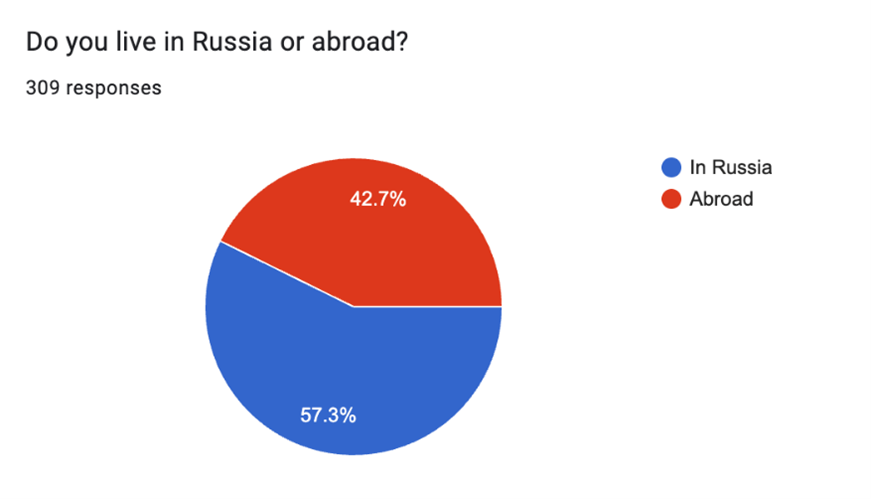
To understand current attitudes towards anti-corruption investigations, I conducted an online survey. The link was shared on my own Telegram channel, the channel of the Public Sociology Laboratory (a research group I belong to) and the channel of Oleg Kashin, a popular journalist. While the sample is in no way representative of the general population, it does provide insight into the views of a politically engaged, opposition-leaning audience. Overall, I received 309 responses. 57% of respondents lived in Russia, while 43% lived outside of Russia.
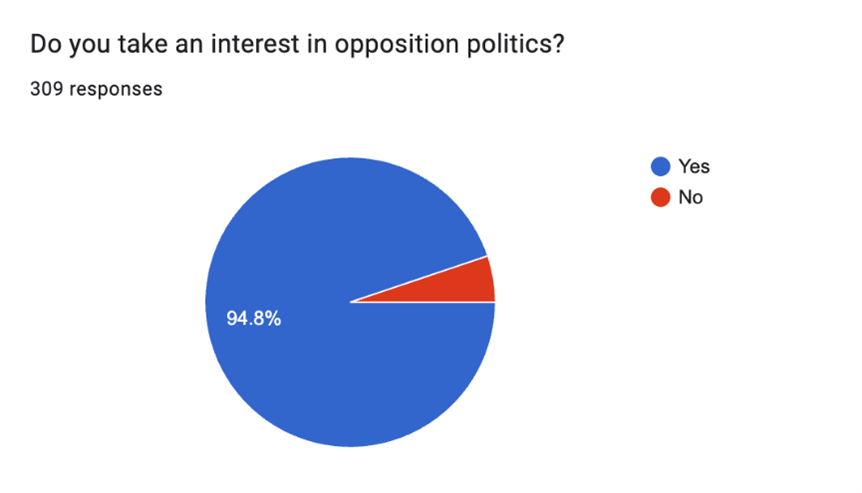
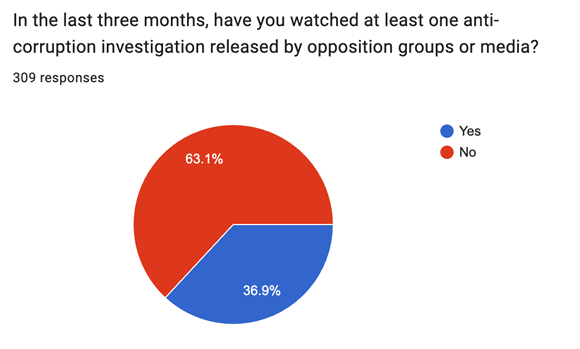
95% of respondents were indeed interested in opposition politics. However, characteristically, only 37% watched at least one anti-corruption investigation in the last three months.
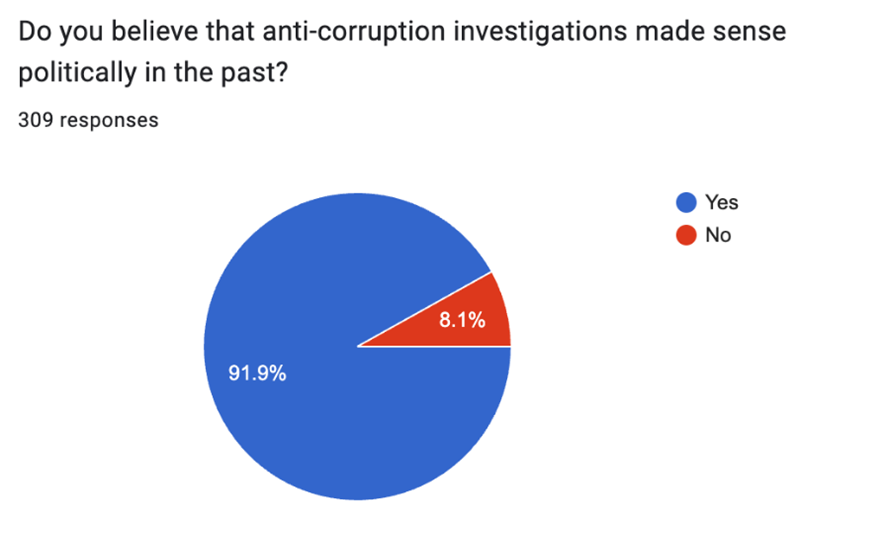
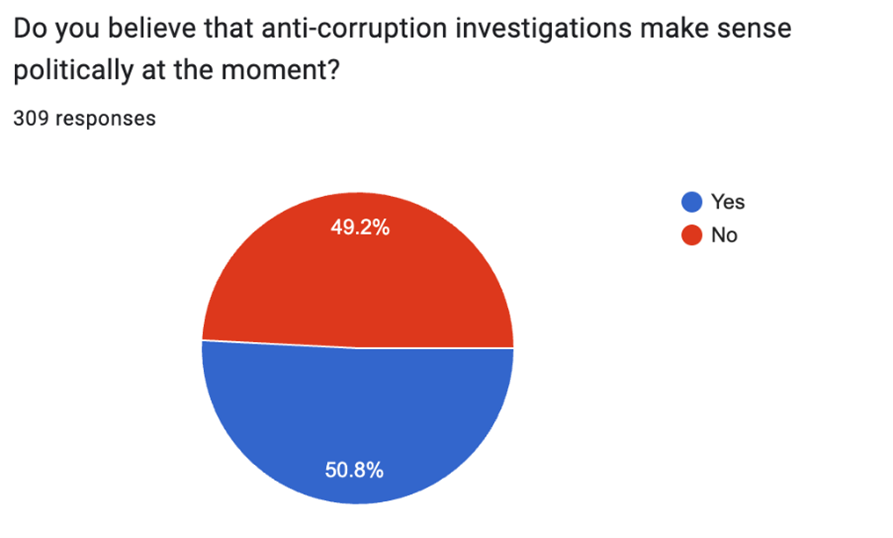
Although an overwhelming majority of respondents (92%) agreed that anti-corruption investigations had political value in the past, only 51% believed that they still do.
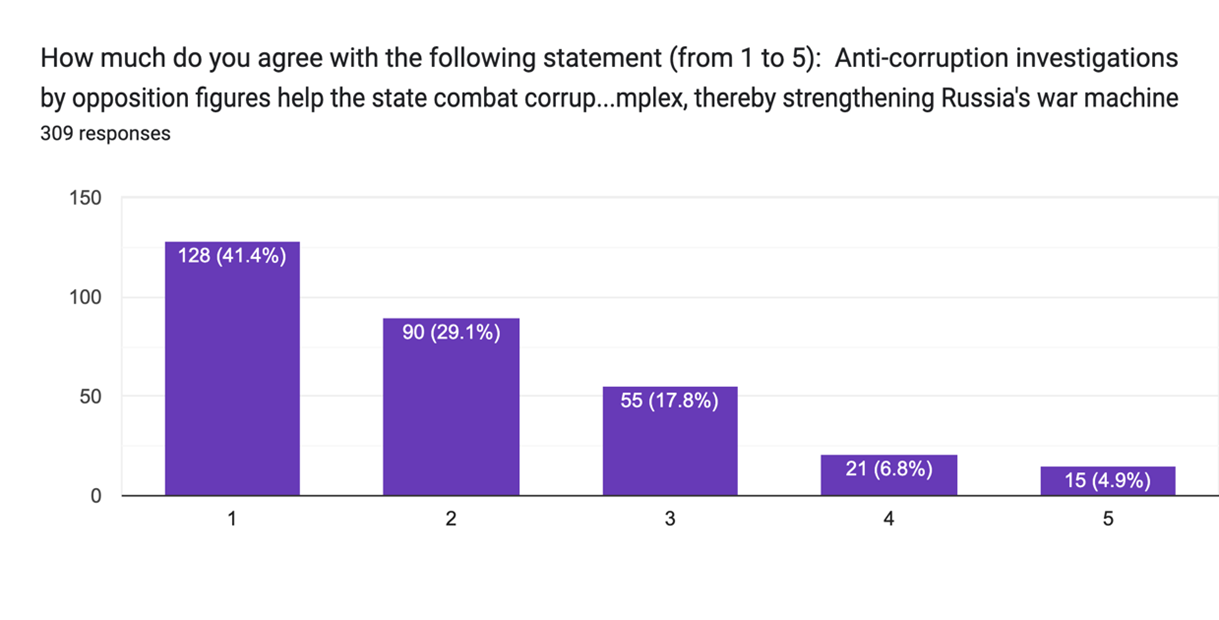
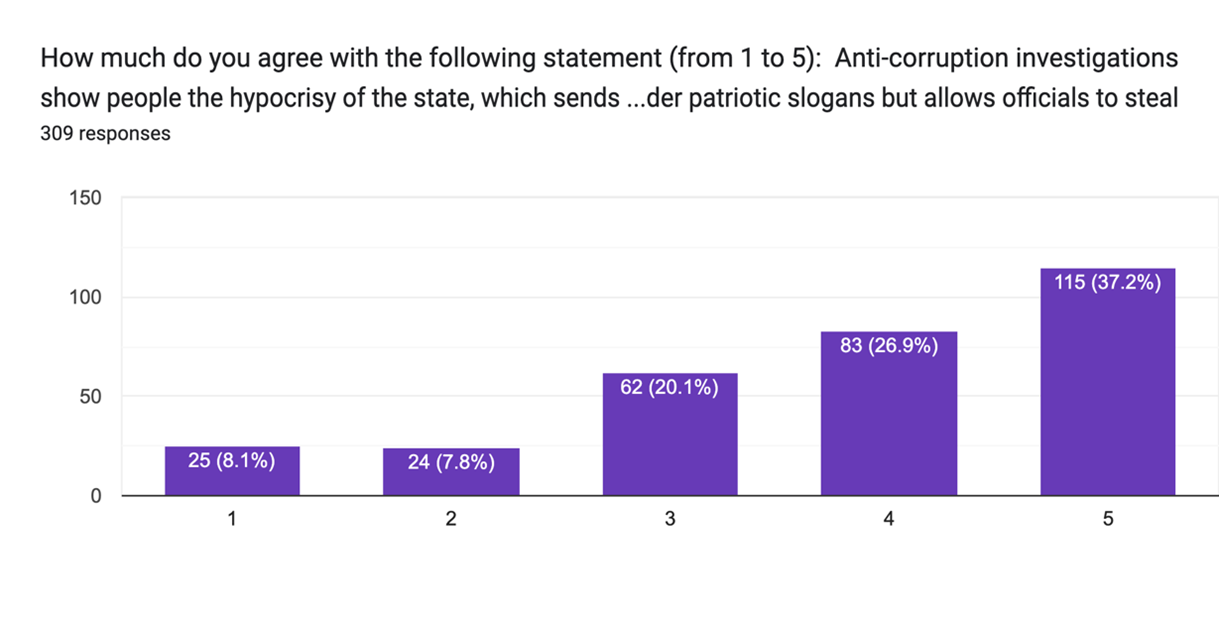
While most respondents disagreed that investigations into the military-industrial complex help to prop up the war machine, most agreed that they expose the state’s hypocrisy in sending soldiers to the front line under patriotic slogans while allowing bureaucrats to steal.
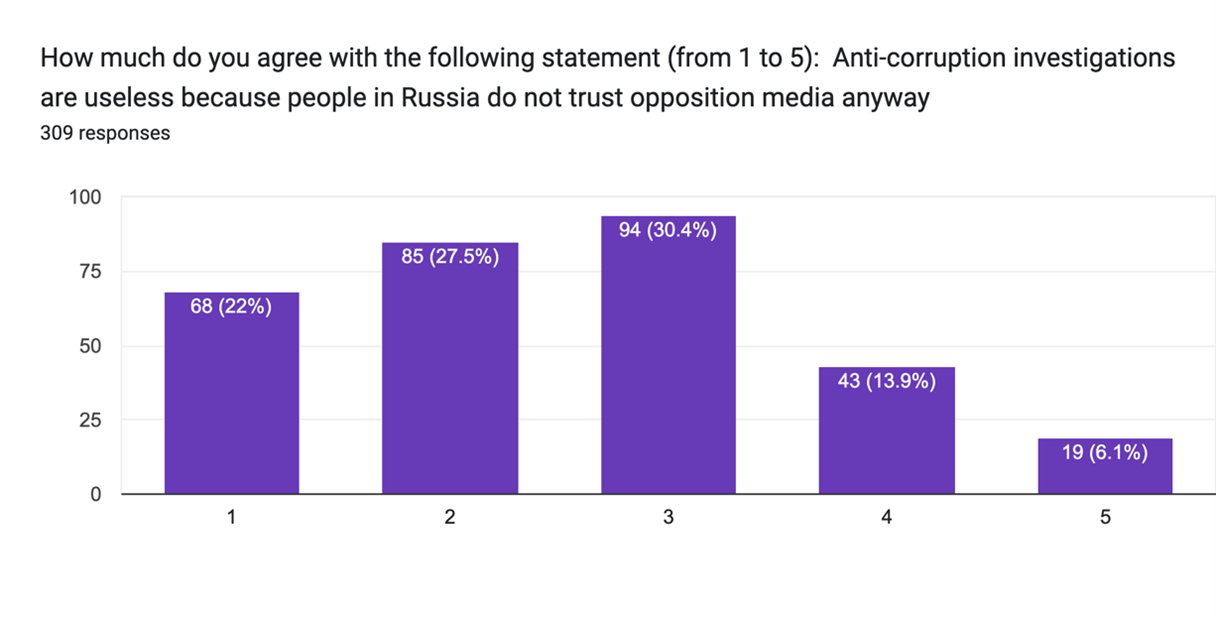
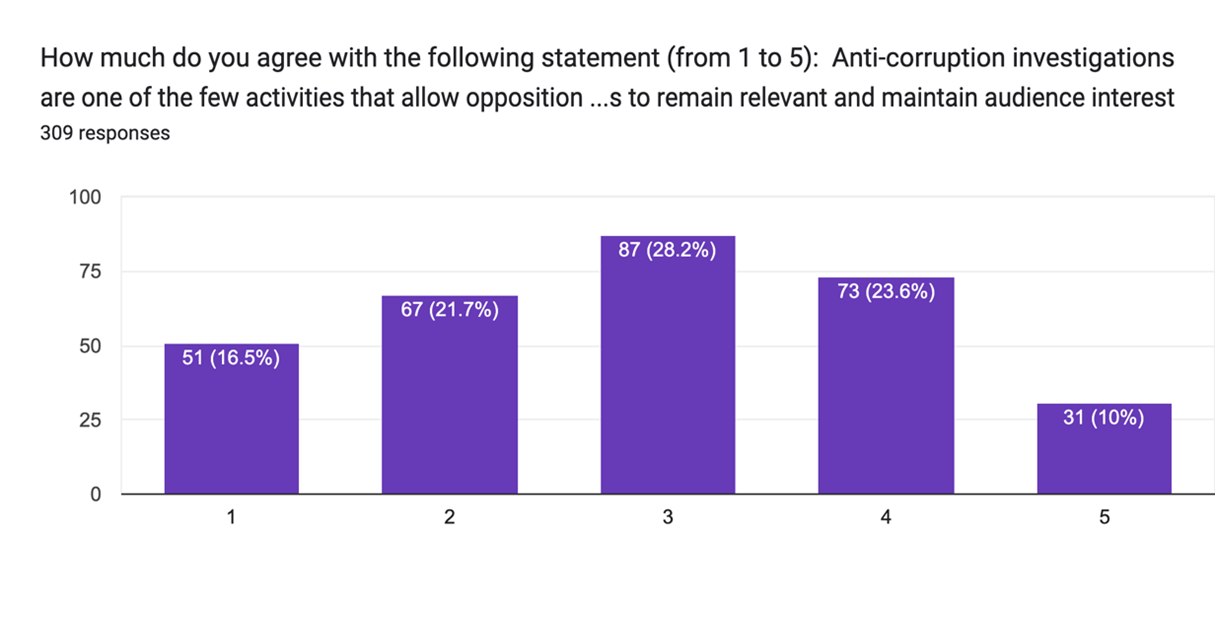
Views were mixed on two other issues: whether anti-corruption investigations are ineffective because Russians do not trust the opposition media, and whether anti-corruption investigations are one of the few ways for opposition media to remain relevant (see the full results below).
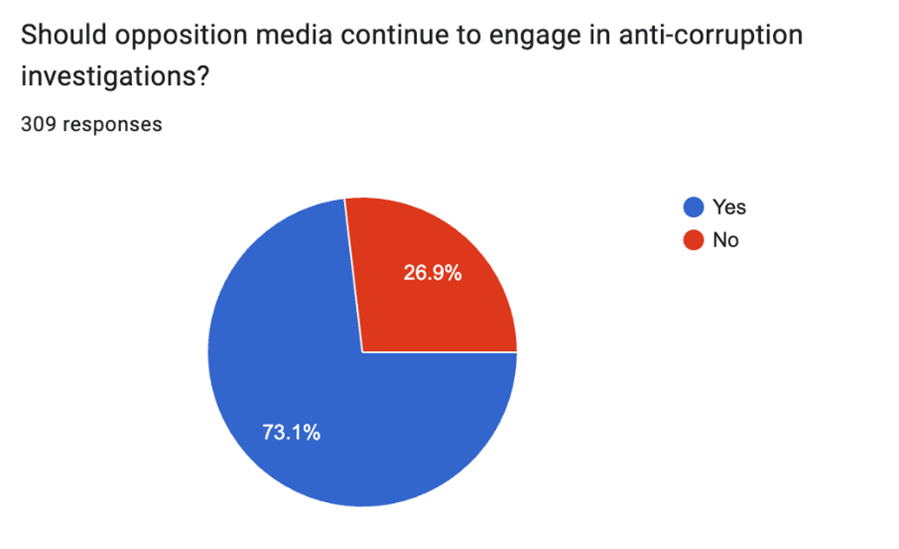
Still, 73% of respondents believed that the opposition media should continue to release anti-corruption investigations.
The survey also included an optional open-ended question: “Please share any additional thoughts or arguments on the anti-corruption investigations today”. There were 125 responses in total.
Several major recurring themes emerged in the responses:
- Anti-corruption investigations might not be relevant today, but they will serve a purpose in the future, e.g. documenting crimes that will be prosecuted by future democratic authorities
- Lack of opportunities to express dissent – right now, it is unclear what to do with the information from the investigations
- Russia has other problems, especially the war itself. These completely overshadow the issue of corruption, which now seems trivial
- Russians are accustomed to corruption, so the investigations do not have any “shock value”
Less prominent but still frequently mentioned themes include the following:
- Anti-corruption narrative alone no longer cuts it. It should form part of a broader, more fully fleshed-out political/ideological platform
- Regional/local level is important and provokes more interest than national-level investigations
- The investigations should somehow reach the loyalist audience and be tailored for it
- The anti-corruption efforts are undermined by the controversies and negative publicity attached to their authors.
Discussion and Conclusions
Currently, anti-corruption investigations by Russian opposition media and political groups are being relegated to the “expert” domain. They document corruption in the hope that a future Russian government will prosecute it; they assist Western authorities in expanding personal sanctions; and they provide insight into the workings of the Russian regime and its war machine. The audience acknowledges this trajectory and the adverse conditions that created it.
Historically, the “expert” function of anti-corruption investigations was secondary to the “populist” function of mobilizing broad sections of Russian society against the political regime. This was the essence of Alexei Navalny’s strategy and politics. However, this latter role has almost disappeared at the moment. The question is: can it be revived?
The survey responses hint at this possibility. In order to reassume a populist function, anti-corruption efforts must truly become populist in both form and substance. They should focus on local and regional corruption to provoke localized discontent. They should also target the loyalist audience, adjusting the style and rhetoric accordingly (and probably doing away with the branding of the ACF and other opposition groups). Finally, they should unapologetically adopt the populist language of inequality and social injustice, addressing the genuine grievances and frustrations of the Russian public.
In other words, they should reclaim the fighting spirit and ambition to directly challenge the Kremlin that Alexei Navalny carried in his work. Glimpses of this approach can be seen in the ACF's “Traitors” series about the 1990s. However, what seemed like an ideological and political rethinking of the anti-corruption genre eventually went nowhere. It is still possible to resume this work. Success is by no means certain, given the conditions that have led to the current crisis of investigative activism. Nevertheless, there will at least be a chance to weaken the regime and break through its defenses.
Appendix: Full Survey Results