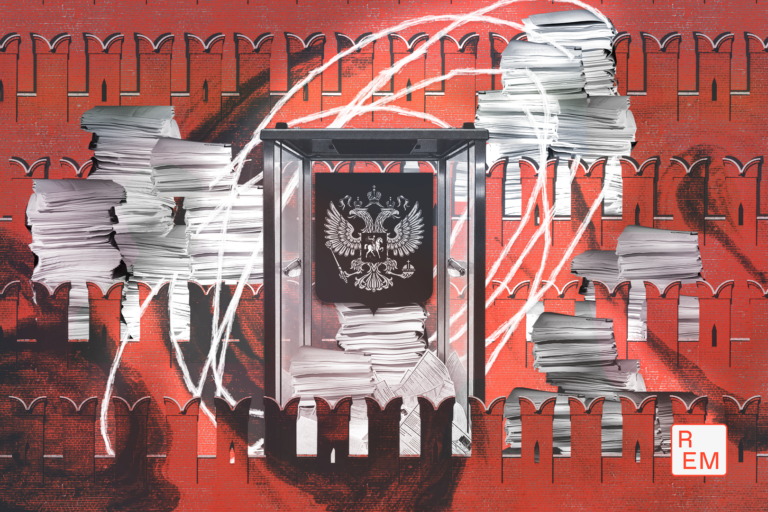
"We don't need a woman, she won't be able to manage our district". How Russian women are running for office
04.09.2024





On 6-8 September 2024, almost all regions of Russia will hold elections for governors, deputies to regional and city legislatures, and by-elections to the State Duma. 83 men and only 12 women are running for governor in 21 regions. Women in Russian politics face numerous challenges, including not being taken seriously, with voter trust often hinging on their appearance and promotion of family values in their campaign.
In its recent article, Russian independent media 7x7 recounted stories of women who stand for election in 2024, the agenda they promote and the obstacles they face. REM presents an abridged translation of the original text.
OVERCOMING INDIFFERENCE: LAUNCHING A CAMPAIGN
Maria Chikulaeva, a 20-year-old law student, wanted to become a deputy of the Chelyabinsk City Duma. While still at school, together with her classmates she came up with a project to improve her neighborhood. After becoming a student, the young woman wrote petitions to authorities about the condition of roads and playgrounds, and sued the city administration to widen a sidewalk on one of the streets.
Maria joined the Yabloko party, protested against restrictions on abortion, and gave lectures on the basics of feminism. Advocating for the return of direct elections for mayors and municipal deputies, she made a documentary about the local government reform in Chelyabinsk. As an activist, Chikulaeva often encountered indifference and even resistance: she was nearly barred from attending public hearings on the abolition of district councils, and her permit for collecting signatures for direct mayoral elections was first approved and then canceled. As she became an election observer, she was prohibited from photographing violations.
In the summer of 2024, Maria Chikulaeva ran as a candidate for the city council and began posting videos of her walks around the city, discussing local problems. By July 4, she had collected 190 signatures from people supporting her candidacy. However, some signatures were invalidated, and the remaining ones were insufficient for her registration.
Chikulaeva urged her supporters not to give up, saying that these were "far from the last elections". Yet the authorities’ tactics remain unchanged over the years. Out of 20 independent candidates running for the Chelyabinsk city council in 2024, only one was registered.
According to Golos movement experts, the authorities tend to artificially restrict competition at the slightest threat to the desired outcomes. They believe that the signature collection process as a filter for candidates does not fulfill its function – it is easily overcome by little-known candidates from minor parties who are pre-approved by the authorities but unknown to voters. At the same time, it becomes an impassable barrier for strong politicians from well-known and active parties.
SQUEEZED OUT OF RACE: FOREIGN AGENTS, MEDIA AND POLICE
One of the ways to prevent independent or opposition candidates from participating in elections is by labeling them "foreign agents".
Anna Karulicheva, 38-year-old lawyer from St. Petersburg’s Yabloko branch, promoted waste segregation in her district and, like her party members, went on pickets supporting Navalny and opposing the war in Ukraine.
Karulicheva ran for the municipal council of the Narvsky district. Until November 2020, she was a member of the council, but later she was deprived of her mandate allegedly due to errors in her financial declarations.
In late June 2024, Anna collected signatures and submitted documents to run for the municipal council. However, on 12 July, three hours before the election commission meeting, the Ministry of Justice listed her as a "foreign agent", making her ineligible to participate in the elections.
However, even a pro-government stance does not guarantee registration as a candidate. Elena Kutergina, 38-year-old journalist and human rights activist from Bratsk, collected humanitarian aid for Russian soldiers and ran for mayor of the city from the Communist Party (СPRF). The election commission denied her registration due to the allegedly incorrectly filled-out documentation on the absence of foreign property. A media campaign was launched against Kutergina: Captain 1st Rank Vladimir Naumenko appeared on Bratsk TV accusing her of being a traitor who "supported the Ukrainian armed forces and President Zelensky's policies". Kutergina herself was not let to speak on television. The advertising agencies she had arrangements with refused to cooperate with her and place her campaign banners.
 Picture: Nastia Pokotinska for 7x7
GENDER AS A POLITICAL CRITERION: WOMEN NEED TO OVERCOME VOTER DISTRUST
In various regions and cities across Russia, many women have run as independent candidates in elections. Anna Dello became one of the few independent candidates in Russia to secure her candidacy in the city council of the provincial town of Teykovo in the Ivanovo region. "They gave me my candidate ID, that's it, ¡No pasarán!" she commented as she began her campaign.
Over the past two years, Dello, a 26-year-old activist and documentary filmmaker, has received several fines and 180 hours of community service for "discrediting the army" due to her solo protests against the war in Ukraine. On social media, Dello criticizes the poor performance of the sewage treatment facilities near the Vyazma River, the lack of roads and traffic lights, and the shortage of doctors in the local hospital. These are the problems she intends to solve as a city council member.
During her signature collection process, Dello noticed that voters have little trust even in independent candidates, and sometimes simply asking for a signature was met with hostility.
"People frown at the words 'candidate for deputy' automatically place you under 'jerk' in their minds", wrote Dello on her Telegram channel. She believes this is due to the lack of dialogue between the authorities and the people.
According to Yulia, an independent candidate for the city council and an activist of the women's socio-political movement Soft Power (she asked not to reveal her last name or city for safety reasons, as the movement was listed as a "foreign agent" in May 2023), Russian voters do not trust politicians in general, but they also do not trust women in particular.
Yulia’s campaign focuses on improving the district, retaining tram routes, ensuring transparency in major renovation procedures, returning public hearings, and preserving green areas.
Yulia recalls a voter telling her at one of the meetings, "We do not need a woman, she will not be able to manage our district".
She notes that women politicians are not taken seriously, especially by the pro-Putin electorate. "It is disappointing, and we are working to change it. Women know people's problems", she says.
Victoria, a political consultant and activist from the Soft Power movement (who also asked not to reveal her last name or city), believes that women have an advantage in municipal elections. Municipal deputies address everyday issues: building playgrounds, installing benches, and fixing potholes. Candidates are often activists who have been doing this work already, so voters can trust that they will continue to work "on the ground" even in their official positions.
As in many professional fields, the distribution of men and women in elections is disproportionate, notes Victoria. However, she also observes that over the past ten years, women's interest in politics has grown.
"I am a supporter of the small deeds theory and believe that any woman who tries to influence the world around her — whether we are talking about organizing a neighborhood cleanup or participating in small group discussions — is participating in politics", Victoria asserts.
Krasnoyarsk human rights activist and Soft Power member Olga Suvorova shares the same perspective. In 2023, she was detained after a meeting of an initiative group supporting independent presidential candidate Ekaterina Duntsova, and later a criminal case was opened against her for making a false report. Despite the pressure, Suvorova continues to believe that female politicians can gain voters' trust through concrete proposals and especially by addressing social issues.
"Women are extremely specific in their electoral promises", notes Suvorova in her interview with 7x7. "They are not as grandiose and pompous as men but they speak about what many people are thinking: 'Let our husbands return home [from the war],' 'We are for peace'. The authorities may consider these slogans simplistic, but voters support them".
WHAT HELPS FEMALE CANDIDATES GET REGISTERED
When interacting with voters, including those with openly sexist attitudes, city council deputy Yulia prefers to focus on the success stories, when she managed to actually solve local problems. According to her, systemic candidates (from parties represented in the State Duma such as the Communist Party of the Russian Federation, the Liberal Democratic Party of Russia, or Just Russia) often use a different strategy, highlighting their families and their party's work in maintaining "traditional values".
This trend is particularly noticeable among female gubernatorial candidates – of the 12 women running for governor only four refrained from sharing family photos and promoting the protection of children and family values.
Golos experts note the lack of detailed platforms among the candidates as one of the election trends. "Election programs in Russia have long fallen out of favor. There is no point in them, nobody reads them. And even if they did, it would not make much difference. The main resource in Russian elections is administrative – signatures are collected by local administrations within the first one or two days, and local deputies are subjected to pressure, intimidation, or simply deceived", concluded the experts who analyzed the nomination and registration results.
Maria Chikulaeva and other female candidates from the Yabloko party based their campaigns on promoting a peaceful agenda. However, this stance predictably hindered their ability to get registered.
When it comes to pro-government female candidates, they often extensively post about the war on social media, participate in pro-war "Z" communities and send humanitarian aid to the front, which helps them get registration for elections at all levels — from local to regional and federal.
Thus, the majority of candidates who passed the registration for gubernatorial elections and by-elections to the State Duma were from systemic parties. "At the slightest threat to desired outcomes, the authorities artificially limit competition", believe Golos experts. They note that because of the state's repressive measures there are almost no independent activists left in the regions who could run for office.
Golos experts emphasize that the pressure from federal and regional authorities on the local self-government system is increasing. "For people, the government is becoming ever more distant", they conclude.