"We’ll have no time to celebrate the victory before the great lent"
20.11.2023





This publication is a translation of an article by "Verstka" on how the authorities are preparing for Vladimir Putin's presidential election campaign. The original text in Russian is available here.
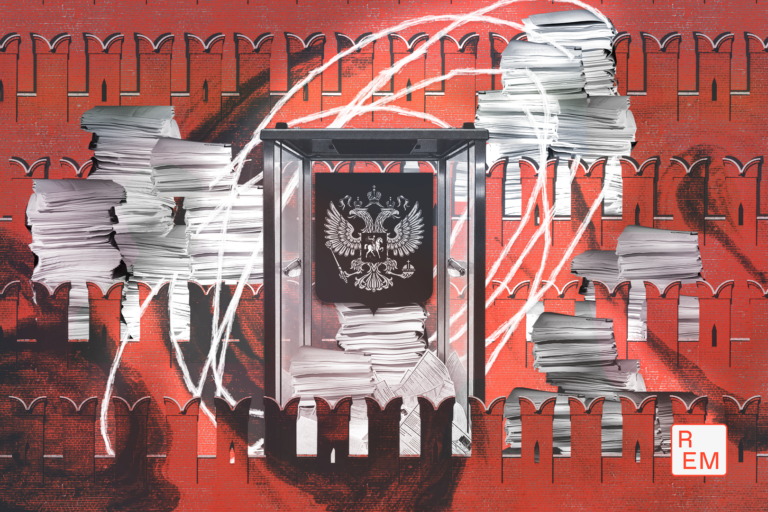
In March 2024 elections, Vladimir Putin should receive at least 80% of the votes with a turnout of 80%. According to “Verstka”, these are the benchmarks that the Kremlin's domestic policy bloc is setting for the Russian authorities. The slogan chosen consists of three words: “Pride. Hope. Confidence”. The heroes of the so-called “special military operation” (SMO) will also be invited to become Putin's confidants; however, the main focus won’t be set on them or on the war itself.
“What can one have time for in this situation except for the last shot of vodka?”
In early October, an employee of a Regional Management Center (RMC) in the Urals tried to book a two-week vacation. The RMCs are regional structures of the Kremlin's Autonomous Non-profit Organization “Dialogue Regions”, and their task is to monitor the local authorities' social networks, collect residents' complaints, and anticipate possible outrages. “We have internal software for time tracking, vacations management etc. I tried to book the vacation dates, but the system just wouldn't let me do it. Out of curiosity I tried to book some other dates – with the same result for all dates previous to the day of voting,” she told “Verstka”.
According to her, “the managers gave a quick explanation” that no one was allowed to go on leave until March 17. This ban could only be “unblocked through Moscow by way of an exception”. Another “Dialog” employee confirmed to “Verstka” that it was impossible to get an approval for vacation leave before the elections.
At the same time, no tasks have been yet assigned to the RMCs which would relate to the presidential campaign. “The only thing we’ve done by now was looking for opinion leaders as candidates for Putin's proxies. First they promised to give us specifics about the campaign in October, but now they're talking about November. However, everyone has already to be at his/her post,” explained a RMC employee to “Verstka”.
Other structures close to the Kremlin do not approve vacation leaves either. “They won't let us go anywhere before the elections. But they haven’t told us what exactly we have to do yet,” explained a staff member of the “People's Front” to “Verstka”. Another regional official complained that the elections in 2024 had a very unlucky overlapping with the Orthodox calendar. ”Maximum concentration is required until March 17. And already on the 18th, the Great Lent begins. Even considering the ideal scenario, I will have four hours at most to celebrate the victory – from the closing of polling stations until midnight. What can I have time for in this situation except for the last shot of vodka?” – commented a civil servant with sad irony in his voice.
Candidates against the war
United Russia has already launched its primaries in all new territories. For example, 145 people have applied for the preliminary voting aimed at selecting candidates for the legislative assembly of the Kherson Region. Judging by the nominee identities, the ruling party has huge problems with recruiting really high-profile candidates.
Putin will run as a self-nominated candidate, but he will be supported by two parliamentary parties – United Russia and Just Russia. The presidential administration has decided, however, to significantly reduce the role of United Russia in the campaign, according to a source in the ruling party. The Kremlin counts on the grassroots support for the president; the results should not be linked to the United Russia ratings, which haven’t grown significantly in recent years.
The bet will be placed on massive federal propaganda and local administrative resources. A source in the ruling party told “Verstka” that United Russia has decided not to open strategic campaign headquarters in the regions at all. “There will be emissaries from Moscow in the regions recognized as problematic. Apart from that, the entire campaign will be modeled and managed from the center. The numerous campaign strategists should please not worry", he said.
Other parliamentary parties are expected to nominate their candidates. The LDPR chairman Leonid Slutsky is likely to run. Sources in the CPRF claim that the Head of party's Central Committee, 79-year-old Gennady Zyuganov, will be nominated, while the “New People” party plans to nominate its leader, Alexey Nechayev.
Moreover, two candidates who openly oppose the war may take part in the campaign: Yabloko leader Grigory Yavlinsky (the party's head Nikolai Rybakov announced his support to nomination of Yavlinsky on October 16) and former State Duma deputy Boris Nadezhdin who once represented the “Union of Right Forces”.
The political scientist Alexander Kynev predicts several liberal candidates to be nominated, should they run in the campaign at all. If there is only one liberal candidate in the campaign, he might become too successful, according to the expert. At the same time, Kynev considers the candidates close to the liberal bloc to be of crucial importance for the elections – to make them look more intriguing. Without them, the campaign will be too boring, and it will be impossible to ensure the necessary turnout by administrative means only, it will have to be altered. The expert believes the campaign to look blatant and unnatural otherwise. "Elections with Putin, Slutsky and Zyuganov only will be boring, they won’t motivate people".
“They split the image into emotions and matched them with Putin”
Putin himself will participate in the elections under the slogan: “Pride. Hope. Confidence”. According to a source in United Russia, “these words will be actively promoted through the federal media, primarily on television. They will also dominate the outdoor advertising”.
According to the Levada Center, back in May 2022 exactly these three words were considered as the most popular positive emotions Russians associate with their country.
A political strategist who worked with United Russia emphasizes that the Kremlin staff “seems to have borrowed” the method for creating the slogan from their Ukrainian colleagues. His explanations: “Remember Putin's slogan from 2018: 'Strong president – strong Russia'. In 2012 his slogan was 'Together towards Great Russia'. They used a very simple logic. Ukrainian strategists traditionally used the results of opinion polls on the emotions of citizens before the elections. That’s where all the Ukrainian slogans came from: “Think!”, “Let's do it together!” and “Ukraine is you”. Now the Kremlin has also split the image of the country into emotions and matched them with Putin”.
The lack of creative technologies whatsoever at the local level shall be compensated by administrative resources – the regions are expected “to provide for the turnout”. According to “Verstka” source in one of the regional administrations east of the Urals, Moscow “has already given directions to provide for 80% turnout with 80% votes for the main candidate,” and this shall be achieved by “administrative methods”.
“The main thing is that there is nothing irritating”
Public opinion leaders who could become Vladimir Putin's proxies are being chosen in a strictly conservative manner. There are going to be several hundred of them countrywide. Two representatives of a regional administration and the Russian parliament related to a “new quota” for Putin’s support group compared to the last election. In addition to budgetary employees like teachers and doctors, as well as “people of labor” and public loyalists, regional authorities have been advised to find several “SMO heroes” willing to support Putin.
According to the source in the Russian parliament, the topic of war should not be emphasized during the campaign, however it would be weird to ignore it completely and not to invite the military servants. “It is important to exclude any irritating elements from Putin's campaign,” he said.
Political analyst Alexander Kynev drew “Verstka”’s attention to the fact that the topic of “special operation” should be handled with caution in the campaign. “The main problem with the “special operation” is that it is impossible to talk about it without answering the question about its end. Any speaker having addressed any audience in Russia during the last time would tell you that the only thing people ask about when it comes to the SMO is 'When is it going to end?' ", notes Kynev. ”If one raises this topic, he will inevitably have to give an answer to this question; and the answer must be clear-cut and straight, not abstract. If the authorities are unable to answer it, it is better not to raise the topic at all, because it will only cause irritation”.
The expert also recalled that in the 2018 presidential campaign, the main problem the authorities had to deal with was the age of the president, who was then 65 years old. “It was solved in a peculiar way - by saying: 'Our president is old, but he has a new team'. In 2018, there was a mass replacement of governors, and this young political generation symbolized the new team behind the president. But now these people are finishing their terms as governors, some have already extended their terms of office, they are not quite new anymore”.
So now the main problem of Kremlin is to find a way of pointing out the renewal of the candidate. “Leaning on the fact that all the other candidates are even older and worse than the president is a doubtful development; negative comparison is a bad electoral technology. It does not motivate, it does not create enthusiasm. The best way to motivate people is to give them some kind of hope, and what hope can there be if everyone else is even worse?”, concludes the political scientist.