2024: A year of great hopes and crushing disappointments
10.01.2025





In this article, REM provides a political summary of the year 2024 in Russia.
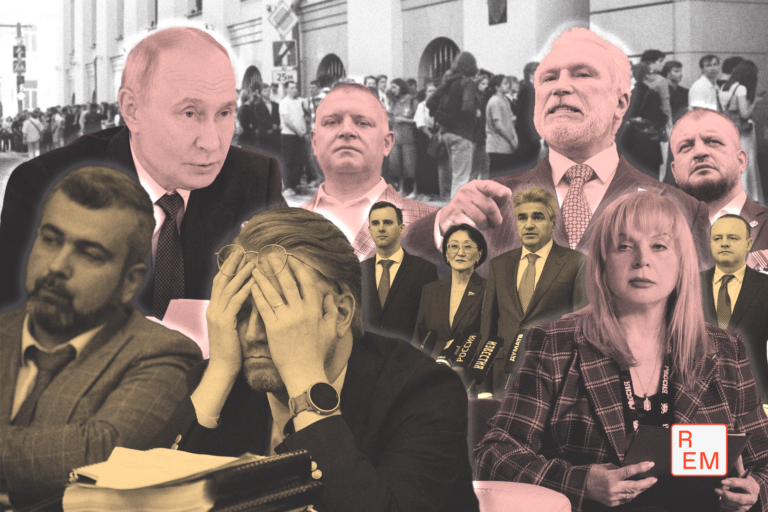
This year saw the most large-scale and theatrically legitimized election fraud in Russia’s history, cementing Vladimir Putin's total consolidation of power. It began with the rise of new opposition politicians, progressed with the murder of the Kremlin's main opponent Alexei Navalny and sweeping political repression, and culminated in a devastating defeat for the opposition in regional elections. Yet, political life in Russia goes on.
Late 2023: Nomination of Duntsova and Nadezhdin, Murder of Navalny
Late 2023 marked the beginning of the election race, with anti-war candidates Ekaterina Duntsova and Boris Nadezhdin launching their presidential campaigns.
Ekaterina Duntsova served as a member of the City Duma in Rzhev, Tver Region, from 2019 to 2022. In late 2023, after submitting her documents to the Central Election Commission (CEC), Duntsova had to collect signatures in the regions to support her nomination. By the end of December 2023, the CEC denied her registration, citing nearly 100 alleged errors in her documents.
At the same time, Boris Nadezhdin, a democratic politician and former State Duma deputy, also announced his intention to run for president. His program emphasized shifting from competition with the West to cooperation with it. In January 2024, Nadezhdin’s campaign volunteers and staff began collecting signatures across Russia, gathering 100,000 signatures in just over three weeks. However, the CEC invalidated 9,000 of the signatures, which exceeded the permissible limit of invalid signatures and led to Nadezhdin's withdrawal from the election race. His attempt to challenge the CEC’s decision in the Supreme Court was unsuccessful.
In January, Ekaterina Duntsova announced the founding of her democratic party Rassvet - which means “Dawn” in Russian - and expressed her support for Nadezhdin. This caused a split within the opposition over the presidential elections: some advocated spoiling ballots to ensure no votes went to any candidate, while others suggested a consolidated vote for Vladislav Davankov as the "lesser evil". Davankov, a candidate from the New People party, had never openly opposed the Russian invasion of Ukraine.
A few days after the CEC denied Nadezhdin's registration, Alexei Navalny mysteriously died in prison. Nadezhdin wrote about the tragedy: “Right now, people across Russia and the world are paralyzed with grief over his loss, and it feels as if the dream of a free Russia has faded”.
Nobel laureate and journalist Dmitry Muratov suggested that Navalny’s death was connected to his repeated placements in solitary confinement (SHIZO in Russian): “This is terrible news. I am sure that the blood clot (if it was a blood clot) is a direct consequence of his 27th term in solitary confinement. What a SHIZO is - immobility, low-calorie food, lack of air, constant cold. Alexei Navalny has been tortured for three years”.
The Anti-Corruption Foundation (FBK) argued that Alexei Navalny was supposed to be exchanged in the summer for Russian intelligence agent Vadim Krasikov, who was serving a life sentence in Germany for the murder of a former Chechen commander Zelimkhan Khangoshvili. Navalny’s supporters believe he was killed to disrupt the exchange for Krasikov.
On the day of Navalny’s death, 16 February 2024, spontaneous memorials appeared across Russian cities, with people placing flowers. According to the human rights project OVD-Info, 110 individuals were detained in 13 cities over the course of two days.
Following this devastating event, the opposition initiated a worldwide ‘Noon Against Putin’ campaign, calling on Russians to gather at their polling stations at 12:00 noon on the Unified Election Day on 17 March. The campaign aimed to unite and express solidarity with those dissatisfied with the brutal policies of the Russian regime.
Spring: Presidential elections and the Rassvet party
On the main voting day, 17 March, long queues of Russians were orserved at polling stations at 12:00 p.m. Meanwhile, Maria Zakharova, the official representative of the Ministry of Foreign Affairs, Maria Zakharova, claimed that the queues outside Russian embassies abroad were unrelated to the "Noon Against Putin" campaign.
It is not possible to determine the exact number of campaign participants, but tens of thousands took part worldwide. OVD-Info reported that 96 voters were detained across Russia on 17 March. In Kazan alone, about 20 people were detained during the "Noon Against Putin" campaign and released later without formal charges.
The list of registered candidates for the 2024 Russian presidential elections was as follows: Vladislav Davankov, 40, (New People), Leonid Slutsky, 56, (LDPR), Nikolai Kharitonov, 75, (CPRF), and Vladimir Putin, 71.
The opposition-supported candidate Vladislav Davankov received 3.85% of the vote. After the elections, he called Putin's victory "undeniable" and appeared with him and other candidates on 18 March at a concert titled “10 Years in Our Native Harbor” on Red Square, which celebrated the annexation of Crimea.
According to the official results, Putin received 87% of the votes with a voter turnout of 77% — both record figures. Voting lasted three days, and in several regions, voters had the option of electronic voting. A major issue with e-voting is that independent observers are unable to verify whether votes have been manipulated. Several regions reported incidents of ballot stuffing, although the actual scale remains unknown, as in 2024, the possibilities for election oversight were more limited than ever.
“There has never been a presidential campaign that so blatantly disregarded constitutional standards”, stated the Movement in Defense of Voters' Rights Golos. Electoral experts estimated that at least 22 million votes (one-third of all cast votes) were stolen from voters and added to Putin’s tally. Thus, these elections cannot be considered legitimate, nor can their winner, Vladimir Putin, be recognized as a legitimate president of the country.
In May 2024, Ekaterina Duntsova, who had been barred from the presidential elections, held the founding congress of her liberal-democratic party Rassvet. Although the Ministry of Justice refused to register the party, the activists opened branches in 50 regions across the country. Members of Rassvet stated on social media that they were already preparing to reapply for registration.
Summer: Prisoner swap and attack on Kursk
One of the most striking political events of the summer 2024 was the exchange of prisoners in August. Activists, politicians and citizens of other countries held in Russian prisons were exchanged for spies and agents of Russian intelligence. Those released from Russian prisons were American journalist Evan Gershkovich, former U.S. Marine Paul Whelan, German citizen Patrick Schäbel, dual German-Russian citizen Kevin Lick, political prisoners Demuri Voronin, Alsu Kurmasheva, German Moyzhes, Vladimir Kara-Murza, Andrey Pivovarov, Sasha Skochilenko, Oleg Orlov, Vadim Ostanin, Lilia Chanysheva, and Ksenia Fadeyeva.
Co-chair of the Golos movement, Grigory Melkonyants, accused in Russia of "organizing the activities of an undesirable organization", has been in pre-trial detention since August 2023. His trial began in 2024 and will continue into 2025. Melkonyants and his lawyers deny all charges, and many experts have called the criminal case against Melkonyants absurd. The International Memorial recognized him as a political prisoner.
Shortly after the prisoner exchange, fighting erupted in the Kursk region. The area experienced five times more shelling than before. Subsequently, the Ukrainian Armed Forces took control of parts of the Kursk region, including the town of Sudzha, with a population of 5,000. A total of 133,000 residents were evacuated from the region.
During the conflict, the acting governor Alexei Smirnov retained his position as head of the region despite the scheduled municipal and regional elections. He was, however, replaced 80 days later by Alexander Khinshtein, chairman of the State Duma Committee on Information Policy.
Fall: Regional elections 2024
In 2024, regional and municipal elections were held across Russia. In Moscow, deputies of the City Duma were elected, while in St. Petersburg, municipal deputies and the governor were elected.
One notable feature of the campaign was the near-complete absence of competition for pro-government candidates and the widespread use of remote electronic voting. On top of that, the law on foreign agents was amended ahead of the elections. The law allowed to bar from elections the Russian citizens declared foreign agents and obliged those already holding elected positions to forfeit their mandates. As a result, deputies Daria Besedina, Yevgeny Stupin and Mikhail Timonov lost their seats in the Moscow City Duma. In Saint Petersburg, Boris Vishnevsky from the Yabloko party was stripped of his mandate in the legislative assembly.
In Moscow, voting was conducted entirely electronically in 2024. To vote with a physical ballot, citizens had to submit a special application in advance.
According to Golos, the number of gubernatorial candidates in 2024 decreased by almost 150% compared to 2019. On average, 6.3 party lists were registered in regional parliamentary elections, the lowest level since 2012. In single-mandate districts, parties without privileges nominated only 73 candidates — four times fewer than the total number of available mandates. Independent candidates submitted 155 applications, which is also below typical figures.
In 2024, the competition in local elections hit record lows in a number of Russian regions. For example, in Salekhard, there were only two candidates per seat, in Anadyr — 2.5 candidates, and in Bratsk’s district №3, only one candidate was registered. In the Republic of Altai gubernatorial race, three candidates competed. As a result of the elections, all governors nominated by the Kremlin had retained their positions.
Winter: The Rise of Rassvet
Despite multiple rejections from the Ministry of Justice, Ekaterina Duntsova and her team are not giving up: they have resubmitted documents to re-register the party, and have also announced the opening of multiple Rassvet centers across the country. The first of them opened in Tula in December 2024.
The Rassvet party continues its work in the regions, regularly reporting on their activities via social media. For instance, in Moscow, activists and Ekaterina Duntsova visited the Jewish Museum and Tolerance Center. In Lipetsk, they launched a debate club, and in Blagoveshchensk, Perm, Yaroslavl, and Chelyabinsk, they organized events to support political prisoners and wrote letters to them. It appears that Rassvet is becoming a new element of Russia’s political system, representing a non-systemic opposition party.
Looking ahead
In 2025–2026, gubernatorial and parliamentary elections are scheduled to take place in many regions of Russia. On the Unified Election Day in 2026, elections to the State Duma are supposed to take place. The past year, along with the preparations already underway by the Presidential Administration for the upcoming regional and federal elections, indicates that elections remain important for the Kremlin. Thus, the upcoming election cycles are significant for the system and deserve close attention.