A slow death of municipal autonomy in Russia
08.09.2023





The war in Ukraine unavoidably shifted the media attention away from the local level of Russian domestic politics. The regional level pops up mostly in the context of border regions with Ukraine, drone attacks, or diversion operations by Russian regiments fighting on the Ukrainian side. The pre-war political developments earmarked the elimination of municipal autonomy not only de facto, but also de jure through the introduction of Constitutional amendments in summer 2020 during the pandemic. The Constitutional vote is primarily known for the nullification of Putin’s presidential terms and omnipresent fraud and voters’ mobilization amid COVID-19.
As the full-scale invasion began, any hopes that there are still islands of political competition on the ground were lost. Municipal MPs with oppositional background, current and former, were forced to flee the country, to apply for humanitarian visas in Europe, to seek political asylum or move to other visa-free (112 destinations as of now). For instance, one of the initiators of the anti-war petition Vitalii Bovar.
Despite the miserable state of the municipalities, on 24 February 2022, 276 municipal MPs signed a petition demanding peace and immediate cessation of the war. After 5 March, when the war censorship legislation came into legal force, some withdrew their signatures. On the anniversary of the invasion of Ukraine, 23 February 2023, more than 60 municipal deputies from nine Russian regions signed a petition, reiterating the demand to resolve the war peacefully. By the time of publication, the letter had 61 signatories – some of them were still in Russia.
Municipalities of the large cities, despite the lack of financial autonomy and limited discretion, became a hotbed for the moderate oppositionists of the late 2010s. The idea behind was undermining and reforming Russian autocracy from within through peaceful and legitimate means. One of the proponents of this approach was Ilia Yashin, a former municipal deputy and one of the leaders of the Russian opposition, who is currently in jail on accusation of extremism.
The Rise and Fall of Strong Mayors
Unfortunately, opposition forces resorted to the municipal level as a potentially promising channel of regime change too late.
The process of centralization and emasculation of municipalities started in the 2010s. Since the beginning of the 2000s, federal legislation has allowed local councils to autonomously determine whether the head of local administration (colloquially, mayor) would be elected or appointed. The basic law regulating local government was adopted in 2003 but came into full legal force only on 1 January 2009.
Initially, the law distinguished between two models of organizing local administration. In the first model, the head of the municipality (mayor) is elected in direct elections and heads the administration. In the second model, the head of the municipality is elected either in direct elections or by deputies from the local legislature. In the latter case, the head of the municipality heads the assembly, while the head of the administration (the so-called ‘city-manager’) is appointed by a special commission, a third of which consists of the nominees from the regional administration. Both elected and appointed heads had lead the local administration but, unlike elected mayors, city-managers were not considered senior officials and reported to the legislature.
Notwithstanding the formal independence of the local legislatures in the decision-making on the models of government, an increasing number of cities began to replace their directly elected executives with appointed city managers because of the governors’ pressure. Thus, in 2004, the model of a directly elected mayor existed in 90% of regional capitals, while city managers were appointed in only 7% of regional capitals. By 2006 this ratio had changed: direct elections of mayors remained in 74% of cities against 26% of cities with city-managers.
Preserving elections allowed mayors to build their own political machines, autonomous from regional administrations that were even capable of competing with governors. In the territories ruled by powerful independent mayors, governors were forced to informally co-opt such elites and did not seek to undermine local leaders. In this sense, elections operated as a tool of co-opting the electoral machines that belonged to local ’big men’, who were expected to prove their effectiveness by delivering votes for United Russia. However, in all other cases, the regional authorities sought to prevent an increase in the influence of local elites and pushed for a city-manager model, relying on United Russia.
Municipal Reform 2014
From December 2014 to January 2015, the Russian local government underwent another round of reform. Similarly, to the dismantling of gubernatorial elections in 2004. The proponents of the new reform of local government referred to the idea that changes would help get rid of “populists” and “ineffective managers”, replacing them with highly qualified personnel to improve economic performance. The amendments included a new model of government, namely the ‘appointed mayor’ or ‘selection commission’ model. Unlike the city manager, the appointed mayor operated as the head of the municipality, not just the local executive, and was appointed by a selection commission (konkursnaya komissiya in Russian) that consisted of 50% appointees by the local council and 50% appointees by the regional executive. The latter made the appointed mayor a weak figure.
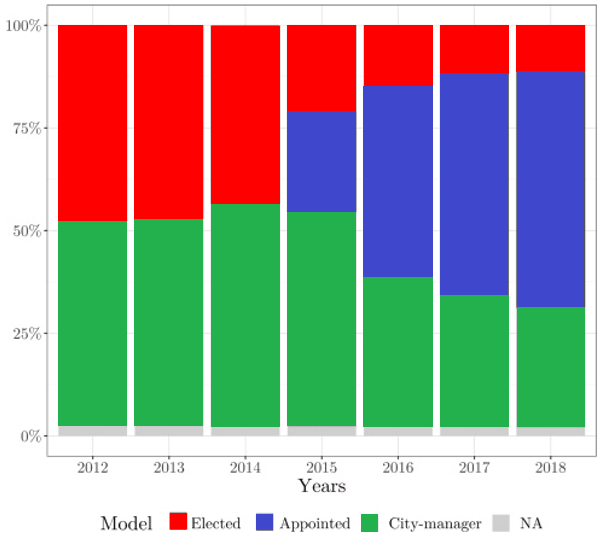
Resistance to and criticism of innovations arose both from regional and local politicians and experts, according to whom the appointed heads began to play the role of genuine deputy governors. However, appealing to the idea of increasing efficiency and legitimacy, most of the regional centers changed their legislation in accordance with the new regulations, thereby making appointments the only option for recruiting municipal heads. The new selection model has crowded out elected mayors and city managers in less than two years after its introduction.
Between 2012 and 2014, slightly less than half of the municipalities elected mayors. After the introduction of the ’selection commission’ model in 2014, the share of elected mayors shrank from 43% to 21% in the following year. By 2018, the share of commission appointees was 57%, while the share of directly elected mayors and city managers was 12% and 29%, respectively. Thus, the new model was already in place before the federal election cycle of 2016–2018 and since then the municipal institutional set-up has remained unchanged.
The transition from direct elections to the appointment model reveals a positive effect on the mayors’ delivering capacity. For example, the new appointment model unequivocally brought about increased voting rates – by almost 4% on average and almost 8% in monotowns at the last presidential elections in 2018. In the latter case, pressurizing the core constituencies that also constitute more pliable populations. At the same time, an electoral boost does not seem to result from the increased turnout. Russian political leadership does not seek to mobilize electoral support and engage more voters in politics but rather keep the voters at bay while upholding a high level of electoral support through the instruments that do not require higher turnout.
Conclusion
The municipal reforms are to be seen as a final step in eradicating the municipal level into ’the power vertical’ by viewing municipal heads as brokers in delivering votes in a less costly manner, compared to the higher costs of tolerating and co-opting elected mayors and their machines. These results provide evidence that the introduction of the new model of selecting mayors aims at decreasing ’the maintenance costs’ of upholding elections, while the co-optation of local machines is no longer a priority for the federal elites.
However, centralization as optimization of delivering capacity on the local level comes at its political costs. First, it does not meet the demand for accountable and efficient local politicians. Second, the lack of elected leaders weakens the co-optation and recruitment of cadres into ‘the power vertical’ that is essential for maintaining the minimal efficiency of an authoritarian polity.
The inclusion of a former Yakutsk mayor Sardana Avksentieva in the brand-new pro-Kremlin New People party makes an illustrative case of how local elections boost co-optation. However, there are only seven cities with directly elected mayors that survived the reform. This may close down such mechanisms of bottom-up recruitment and promotion. At the same time, upward mobility from the local level has never been strong in Russia, and potential adverse effects on political stability are, perhaps, overrated.
Last, but not least: does a more centralized and ‘cheaper’ model of local governance undermine accountability through a further decrease in public goods provision in the medium term? So far, empirical evidence is scarce and inconsistent.
From a broader perspective, the latter has been an integral part of the consolidation of personalist dictatorship with a systematic curtailing of feedback mechanisms, namely, checks and balances. A gradual transition from weak, but somewhat independent local governance toward loyal local appointees contributes to our understanding of how political decision-making works in high-capacity authoritarian states such as Russia. Ultimately, the lack of institutional constraints and access to reliable information makes such pernicious decisions as the invasion of Ukraine possible.
By Margarita Zavadskaya, Aleksandra Rumyantseva and Eleonora Minaeva