"Admitting helplessness is much scarier than the situation in Russia"
24.07.2024





In September 2024, Moscow will hold elections for deputies to the Moscow City Duma. Among the potential candidates is Vladimir Zhilkin - a sociologist, human rights activist, and politician from Tambov, a provincial city 500 km from Moscow. In his hometown, he pursued scientific work, defended the rights of cottagers, ran the local branch of the "Golos" movement, tried to become a State Duma deputy, received the status of a foreign agent, and was detained by the police several times.
In 2024, Zhilkin is running for election again — this time to the Moscow City Duma. He has declared himself an anti-war candidate who is also ready to stand up for the rights of the LGBT community. Additionally, Zhilkin is a supporter of Ekaterina Duntsova and an active participant in the creation of the "Rassvet" party.
In the interview with 7x7, Vladimir Zhilkin talked about how his campaign is going, what Moscow voters think about the war, and why it is important to run for election even when there are no free elections. REM publishes an abridged translation of the interview.
***
UPD: on 7 July, Zhilkin announced that his team was not able to collect 6000 perfect signatures to submit to the Moscow Election Commission and heavily criticized the institution of collecting signatures. He thus deprived himself of the opportunity to be registered as a candidate, although in all likelihood, even with impeccably collected signatures, the Election Commission would still not have allowed him to run, as it happened with Gleb Babich, Ekaterina Duntsova, Boris Nadezhdin and many other opposition candidates.
***
"JOKES ABOUT MOSCOW NOT BEING RUSSIA ARE GREATLY EXAGGERATED"
— Don’t you feel that politics remained in Moscow only?
— I am one of the active members of the forming "Rassvet" party [a political movement created by former Russian presidential candidate Ekaterina Duntsova, who was prevented from running in the March 2024 elections], and issues of federalization and regionalization is one of the important topics for us. We understand that regions need more powers, that budgets need to be revised in favor of the regions. The regions don’t raise this question, and the authorities do everything they can to make "regionalization" and "federalization" be perceived as swear words.
Nevertheless, regions have quite serious political demands, even though this has been driven underground. But this does not mean that people who are more disadvantaged than Muscovites don’t need information, alliance, quality of life and freedoms. At times, I see outbursts of despair and a greater willingness to act in the regions than in the capital. Because it is easier to live in Moscow, which is not the case with orphans or single mothers in Tambov.
— Why are you participating in the Moscow City Duma elections at all? Do you want to become a deputy, organize election monitoring, or just act as an opposition candidate?
— I pursue all these goals. It is difficult to predict to what extent people would engage in any opposition movements. There are certain prerequisites for the passage of independent candidates to the Moscow City Duma, despite all the seeming improbability. We are in a situation where society is oppressed and intimidated, but any election is an opportunity to do something in a legal and peaceful way.
Of course, there are always ambitions for victory. If you don't believe in it, then it is psychologically impossible to run [a campaign] under today's circumstances. But that doesn't rule out pragmatic reasons. I understand the difficulty [of running a campaign] given the system that opposes you. But all these hurdles show that the authorities also see great risks and opportunities to lose.
If we would not speak to people from different social strata and political views, we would live in anticipation of a beautiful Russia of the future, but we would not bring it any closer. Every day, I go to meetings and collect signatures, and people are really surprised to see an independent candidate who talks, who is not afraid to answer difficult questions. That's missionary work, and it’s extremely important. Using elections to make people see that they are not abandoned is a legal field of activity.
There are many people among Muscovites who stand on positions that are common in the regions, particularly regarding attitudes towards the SMO [the war against Ukraine - REM]. For me, these are also sociological observations which are very important to me as a candidate and researcher. Opposition media and human rights activists often hold on to a comfortable worldview delusion that all of Russia is oppositional, tired of Putin, and does not want military action. But unfortunately, I see that society enjoys immersing itself in military rhetoric, which brings a sense of satisfaction. Among those I talk to, every day I meet people who support the SMO [the war against Ukraine - REM] and Putin's policies.
Well, regarding the monitoring. For 10 years, I have been enjoying monitoring elections, and now I am gaining tremendous experience in how the authorities win under today's conditions. On the one hand, there is nothing new, but perhaps there is more optimism and confidence [in the victory of system candidates].
— There are currently many movements supporting independent candidates in elections. Do any of them support you?
— In the initial negotiations with some of those organizations, a certain picture emerged. I was in Tambov, I saw calls to self-nominate, promises of fundraising, legal assistance, and organizing volunteer work. But under today's conditions, these organizations clearly cannot cope - there is no funding, no motivated lawyers. I can't say that I really received media support or help with people. Therefore, my campaign relies exclusively on my own resources.
— Suppose you collect signatures and get registered as a candidate. How will you attract voters?
— In the weeks that I have been meeting people, I realized that it is important for them to be heard, to use the budget in a more socially-oriented way. To me, as a Tambov resident, it is surprising that people recognize the need for independent media that would provide information about their district without any political background or bias. And yet one important point — for Muscovites, control over the authorities and the police is very important. It is important to review the powers of a deputy in this part.
— If you get into the Moscow City Duma, what will you do there under the current conditions, when its deputies are supporters of Putin and the war?
— I don't like this learned helplessness, modeling a situation where I am one against all. Of course, if I am one against all, then at the very least, I should not let things that violate the interests of Muscovites and even more so of my district be silenced.
In my opinion, a mass passage of independent candidates [to the Moscow City Duma] is possible due to the socio-political situation in September, in which it will be impossible to falsify elections and not support the opposition. We remember the queues in support of [presidential candidate Boris] Nadezhdin. A wave arises, and people stop being as afraid as before, they are ready to take action, to come to the elections, and not be "apolitical".
If one or two independent candidates get into the Duma, not on the wave of popular support, but due to the financial and organizational success of the campaign, it is clear that the role of these candidates will be reduced to selective protection of citizens on permitted and possible issues. If a deputy does not feel mass support behind him, he will have to navigate the daily risk of being accused of something. The fate of such a deputy is reduced to survival and informing.
Therefore, today's work of self-nominees and their headquarters in communicating with society is an opportunity to maintain not even a protest mood, but a healthy state of society. Perhaps the result of my campaign and the campaigns of other self-nominees will be that people realize they can be involved in politics, be its actors. For peaceful changes in the country, it is necessary for millions to stand behind the leaders.
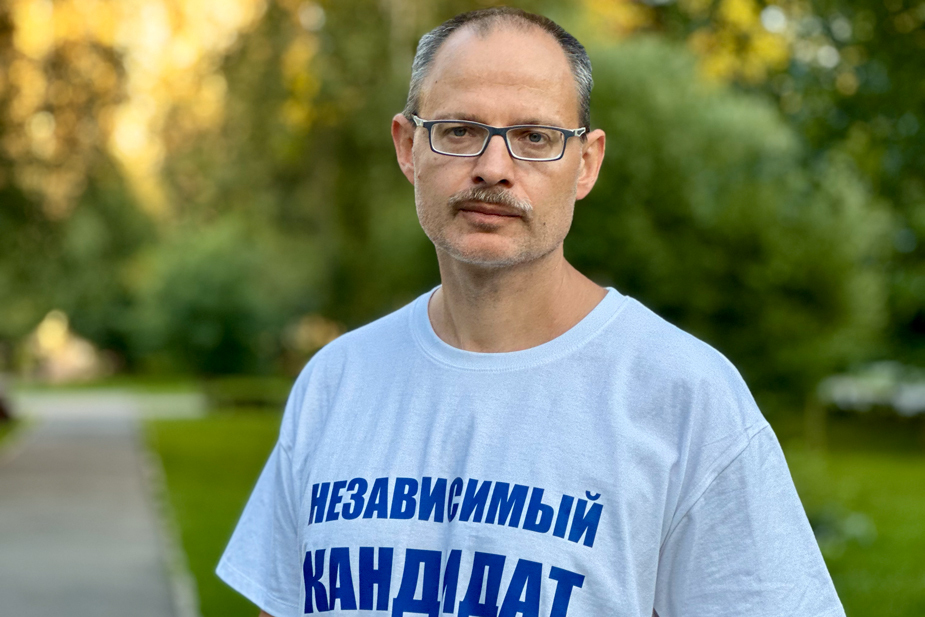
Vladimir Zhilkin. Photo from personal archive provided to 7x7.
— What are the real successes of your campaign? How many signatures have been collected, what are the sentiments of the voters?
— Regarding the number of signatures, I will refrain from answering for now, because some of them are with me and some are in the headquarters. I am not ready to provide specifics at this moment. I hope that we’ll be able to collect the necessary number or at least get close to it. If we fail to collect the required number, then my task will be not to provide the authorities with the names and personal data of the people who supported me.
Regarding sentiments. It strikes me that there is a lot of fear in society. Even when talking to [Putin's] supporters, you realize how carefully they choose words. An exception is the use of the budget.
The second thing that strikes me is that there are significantly more supporters of the SMO [war against Ukraine - REM] than I and my other supporters thought. In those who support the SMO [war against Ukraine - REM], I am surprised by a certain narrow-mindedness. Such people easily leave a signature, and then suddenly ask about my attitude to the "special operation".
So, people in Moscow are not very different from people in the regions in terms of being oppressed and frightened. One of the reasons why I decided to run for office in Moscow was that I thought Muscovites were more open-minded and independent. It turns out that jokes about Moscow not being Russia are greatly exaggerated. Unfortunately, Moscow is just as intimidated and stifled as the regions. The fact that there are fewer cars with the letter Z does not make Moscow more thinking and self-confident.
FAMILY VALUES WITHOUT PUTIN
— Your campaign has a slogan: "Family values without Putin". What does that mean?
— Politicization and ideologization are intruding heavily into the family. Whatever jokes have been made about the cell of society earlier, in my opinion, the family is the foundation of the state and society — and it may have any configuration a person desires. Some people live with their parents until old age, some want to have 20 children in their family—this should be the unconditional right of people, their desire. There is no place for the government or Putin here: families should be left alone. Not to ban abortion, but to create conditions for an informed and civilized family. We are not rabbits or broiler chickens to be bred.
— Because of this thesis of yours, people have started referring to you as an LGBTQ+ candidate. How close to the truth is this?
— It's hard for me to comment on that, because I'm a pro-people candidate. I don't mind any groups referring to me as a candidate for deputy. Let me be a "pro-many-other-things candidate." I am pro-people, no more and no less. I have no priority, no division of voters into "mine" and "not mine". If this group sees me that way, thank you for your trust.
There is definitely a problem for LGBT people in Russia. I am not going to stop helping people just in favor of the trends. To me, as a sociologist, it is obvious that as long as there is a social group, its culture, one can’t deny either the phenomenon itself, the group, or the problems. It is dangerous for society and the state when a social group is ignored by the authorities. If a representative of the authorities, a deputy, turns away from the group, who will address their issues?
ON RISKS AND OPPORTUNITIES
— Do you see any risks for yourself or your campaign due to your participation in Ekaterina Duntsova's "Rassvet" party?
— No. The fact that there is some kind of association of people who want positive legal changes is normal. If the authorities find it necessary to resort to pressure and lawlessness, then weighing risks becomes pointless — we either accept them or not.
And again: what risks are there? The foreign agent status attributed to Duntsova is about her as an individual, not about “Rassvet”. I have been designated a foreign agent before — and even in that position, it's possible to continue to fight and advocate for the interests of citizens.
— Before the war, you were detained several times, faced pressure and were designated a foreign agent. How will you act now, as the risk of being sanctioned by the state has multiplied?
— I do not engage in illegal activities. I am not an extremist in any sense of the word. I am not a foreign agent. I am in the legal field and I emphasize this every time. Perhaps it's due to this position of mine that the state eventually removed my foreign agent status [Zhilkin was removed from the foreign agent list in 2022 - REM]. And if someone decides to go completely rogue, along with all the disadvantages for me, it would be more destructive for the system itself.
— Does your background in human rights advocacy help your campaign?
— It divides the Muscovites I interact with into two groups. It turns out that assumed political opponents, upon hearing the word "human rights activist," begin to demonstrate their susceptibility to propaganda and to name some organizations, primarily “Memorial.” They begin to tell tales about who human rights activists are and who they work for - that is, all this propaganda nonsense.
The second group of people, you may call them allies, on the contrary react positively to this status. For them, freedom of assembly, freedom of speech, and other rights are as important and worth defending as they are for me. However, this part of my allies often say that defending rights is currently impossible in Russia. They talk about what might happen to me or to other people.
I believe the goal of my campaign is to convey that what is considered impossible is indeed possible. That one should not raise one's hands in surrender, but rather act and therefore succeed. Admitting helplessness is much scarier than the situation in Russia right now.
— Several years ago in various interviews, you said that the regime was on the verge of collapse, that the people were tired of Putin and his policies. How relevant do you think this opinion is today?
— I don't like it when someone simplifies their opponent, ridicules, for example, Putin, portraying him as caricatured, pathetic, vulgar. It's an illusion of power, it's sublimation, a game of "we are in power here". Putin and his team are adapting to the realities of the Russian political field, cleaning it regularly, transforming realities to suit their needs. They are not waiting for a miracle.
Therefore, today and tomorrow, non-systemic opposition politicians should strive to be one step ahead, to use any potential opportunities for change, for managing reality. Not to rest on oars, not to wait for miracles, moments, or voices from the sky. Despite pressure and all obstacles, they should try to find windows of opportunity, keep in touch with the public, with voters, convey the truth to people, to know their woes and aspirations, to be there for them. My electoral campaign has proved to me and my allies that not only oppositionists but also the so-called supporters of the government, have a hard time, and are uncomfortable, ashamed and hurt by what is happening now. Today, Russian society is silent, scared, but especially at such times we need politicians who are ready to be there for us, not to abandon us.
— Suppose that in September Putin ceases to be president, and you are elected to the Moscow City Duma. What will you do then?
— In that case, there will come a time when larger-scale projects for the benefit of all Russia residents, not just of Moscow, would be more relevant than a healthy legislation for Muscovites and the budget issues of the capital. In the new conditions, it will be crucial not to miss the historic opportunity for the country's renewal, its return to the global space by resetting values with a focus on the priority of an individual over the system.
The task is to prevent the revenge of regressive forces, which will undoubtedly fight for their ill-gotten capital. Opposition politicians grounded in Russian reality will have to manage the transit of power. If the transit and its management fall into the hands of law enforcers, people with dubious wealth and biographies, involved in corruption, the cost of this error will be fatal for Russians.