An undesirable cudgel
15.04.2024





In the first three months of 2024, Russian authorities recognized more organizations as their enemies than in the full year of 2022.
Novaya Gazeta Europe shows how punitive measures against media and NGOs have been stepped up. This is a translation of the article by Novaya Gazeta Europe published on April 9, 2024.
***
Russian authorities have been declaring organizations they don't like “undesirable” for almost 10 years now. And if initially the list was expanding at a slow pace, now it is growing exponentially. For any action that might be considered as cooperation or organization of work of such undesirable structure, one can be imprisoned for six years.
More than two-thirds of organizations were added to the list after the start of Russia's full-scale invasion of Ukraine. The calculations of Novaya Gazeta Europe show that more organizations were recognized as “undesirable” in the first three months of 2024 than in the full year of 2022. For the Kremlin, this is not only a weapon to persecute independent NGOs and media, but also the embodiment of its policy of isolation from the rest of the world.
Let’s have a look at how the law on “undesirable” organizations has become a successful repressive tool.
They promised to fight “international terrorism”, but in the end they put pressure on public activists and environmentalists
The bill on so-called “undesirable” organizations was introduced in the State Duma on November 27, 2014. Its promoters – deputies Alexander Tarnavsky (Just Russia) and Anton Ishchenko (LDPR) – explained the necessity for a new law by the emergence of “extremist organizations” acting in Russia and financed from abroad, as well as by sanctions introduced by the United States and other countries against Russian companies.
In May 2015, the bill was signed by Vladimir Putin. The document came into force on June 3, which immediately changed the Criminal Code, the Code of Criminal Procedure, the Code of Administrative Offenses, and some federal laws of the Russian Federation.
The bill was designed to eliminate “a possible threat from outside”, as Ishchenko said. “It is unacceptable that any foreign organization is in a position of handing out weapons to people, as was the case in Ukraine”, he told Vedomosti at the time.
Another author of the initiative, Tarnavsky, defined the amendments as “counter-sanctions measures” in his interview with Meduza and expressed hope that “no one at all” would get on the list. At the same time, he said that NGOs are not considered as “subject of interaction or confrontation”, so, in his words, “large transnational companies” would rather be subjects to this law.
According to the lawyer Yuri Ershov, the adoption of this law as it was submitted to the State Duma “should have been impossible without a serious revision”. In particular, it didn’t provide for a mechanism of exclusion from the list, the criteria for recognition as an undesirable organization were vague, and the draft didn’t contain even the basic elements of the right of defense. In addition, the expert noted that violation of the law was not a necessary condition for granting the status of an undesirable organization: “We are talking about unjust repression of those who have not violated the law, based on the subjective and unverifiable criterion of 'threat'", the lawyer pointed out.
“There is a chance for any foreign organization, including commercial ones, to be added to the register, and the vague wording of the law is its main defect”, stated the lawyer Elena Lukyanova. “The law is legally indeterminate, and therefore its enforcement will be absolutely arbitrary. For example, the law contains the wording “threatens the morals”. What should that mean? How should the morals be defined? There is no legal definition for the term of 'morals' “, she noted.
The first organizations were recognized as “undesirable” in Russia in 2015. This status refers to a foreign or international NGO, whose activities may “pose a threat to the foundations of the constitutional order of the Russian Federation, defense, or security of the state”.
In 2021, the legislation was expanded, and since then, a legal entity that does not threaten the constitutional order itself, but acts as an intermediary in financial transactions with another “undesirable organization” can be also recognized as “undesirable”. At the same time, the liability for participation in the events of such organizations abroad was added to the wording of the law, and criminal prosecution became stricter.
The Russian authorities claimed that the document was needed to fight international terrorism, among other things. However, it became clear that this was not the case almost immediately. The decision to recognize an organization as “undesirable” is made by the Prosecutor General's Office in coordination with the Ministry of Foreign Affairs. After that, the Ministry of Justice updates the register within 10 working days. No court decision is required for this, and there are no clear criteria for recognizing an organization as “undesirable” in the law either.
Being asked why the court was excluded from the decision-making chain, Tarnavsky answered that this was done exactly in the same way “as in Europe and America”. ”The decision is made by state bodies, and to challenge the decision one should go to the court”. However, the lawyer Anastasia Burakova said in a conversation with Novaya Gazeta Europe that this law was without peer in the world: “This is an absolutely elastic and unconstitutional law, directed against the right to freedom of association and not complying with the basic principles of legal certainty. It is a repressive cudgel that can be used in any thinkable way, at any time and against anyone needed”.
In July 2022, a few months after the outbreak of a full-scale war in Ukraine and a new wave of emigration, amendments came into force imposing a prison sentence for participation in the activities of an “undesirable” organization even outside the Russian Federation.
The “undesirable” organizations are banned from opening structural units and establishing legal entities, disseminating information materials and implementing programs in the Russian Federation. Financial organizations are prohibited from financing “undesirable” organizations, and citizens are prohibited from participating in their activities.
Employees face both administrative and criminal liability for violating the law. Ordinary citizens are first fined up to 15 thousand rubles (officials – up to 50 thousand, organizations – up to 100 thousand). After two such fines within one year, a criminal case may be initiated. The relevant article provides for a fine of up to 500 thousand rubles, forced labor for up to five years, as well as imprisonment for two to six years. Management of an “undesirable” organization face immediate criminal liability
In early April, the State Duma introduced amendments to the Code of Administrative Offenses and the Criminal Code on sanctions for participation in the activities of any “undesirable” organization. Now only organizers and participants of non-governmental organizations face administrative and criminal penalties. A group of Duma deputies proposed to introduce an opportunity of recognizing governmental foreign organizations as “undesirable”, and to prescribe administrative and criminal liability for participation in their activities.
“Most likely, this will be used as a propaganda tool, because we have not seen a barrage of cases built up on “undesirability” recently, although many organizations have been recognized as such. But a headline stating that Russia has recognized the International Criminal Court, which put Vladimir Putin on the wanted list, as an “undesirable” organization might sound beautiful for propaganda. This law is very elastic and can be used for political repression to its full extent. There are no rational arguments or criteria here”, Burakova said.
According to the lawyer Alexei Pryanishnikov, the number of legal precedents of applying the law on “undesirable organizations” has significantly increased lately: the organizations are recognized as “undesirable” almost as often as organizations are included in the register of foreign agents. In a conversation with Novaya Gazeta Europe he said that there currently were 155 “undesirable” organizations in the register; while 49 organizations were included into the register from 2015 to the end of 2021, 106 more were added from 2022 to February 2024.
The General Prosecutor's Office is targeting various NGOs and foundations that were involved in educational projects in Russia, providing support to political and environmental activists and public activists.
“I didn’t use the wording “were involved” by accident: understanding the level of pressure on civil society, many organizations have folded any official operations in Russia by 2022, and those who had offices in Russia – closed them”, Pryanishnikov added.
The lawyer noted that with the beginning of the full-scale war in Ukraine, the process of recognizing various NGOs as undesirable intensified, and in order to increase the military censorship, many mass media were included in the list.
Data-analysis: how the speed of recognition as “undesirable organization” has changed
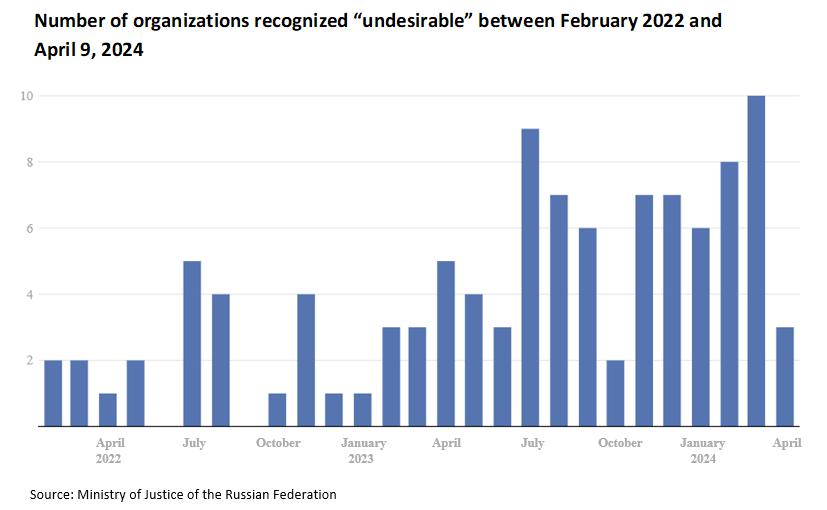
There are currently 155 organizations on the list of “undesirable” organizations. According to the calculations of Novaya Gazeta Europe, only 3-4 organizations per year were added to the list from 2015 to 2019; however, starting from 2020, the number of undesirable organizations is growing at a completely different rate. The dynamics have reached the peak in 2023 (as 56 organizations were added to the list), but 2024 has every chance to score even “better” - in the first three months, more organizations were declared “undesirable” than in the full year of 2022.
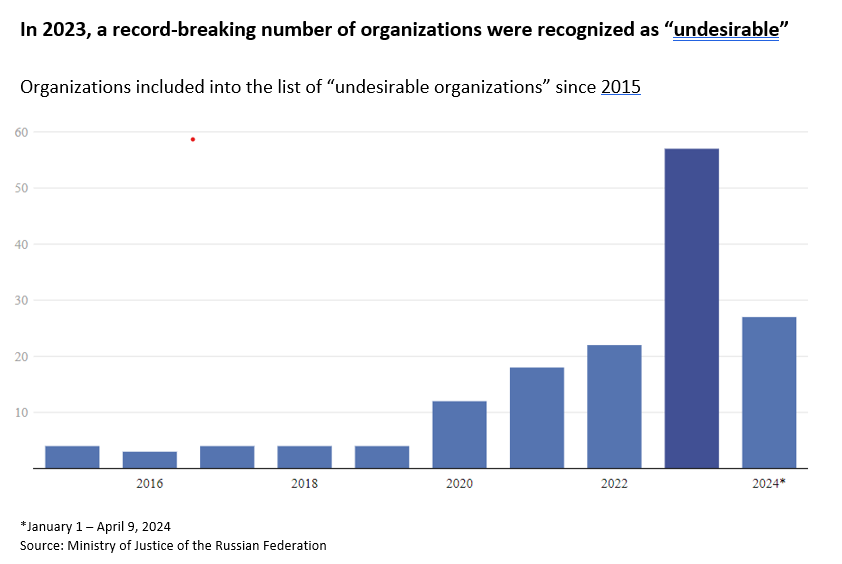
Since the beginning of 2023, not a single month has passed without some organizations being declared undesirable. As noted by lawyer Maxim Olenichev in a conversation with Novaya Gazeta Europe, more than ⅔ of organizations were added to the list of “undesirable” organizations after Russia's full-scale invasion of Ukraine. This is a reflection of the Russian authorities' public rhetoric aimed at restricting Russia from its ties with the Western world.
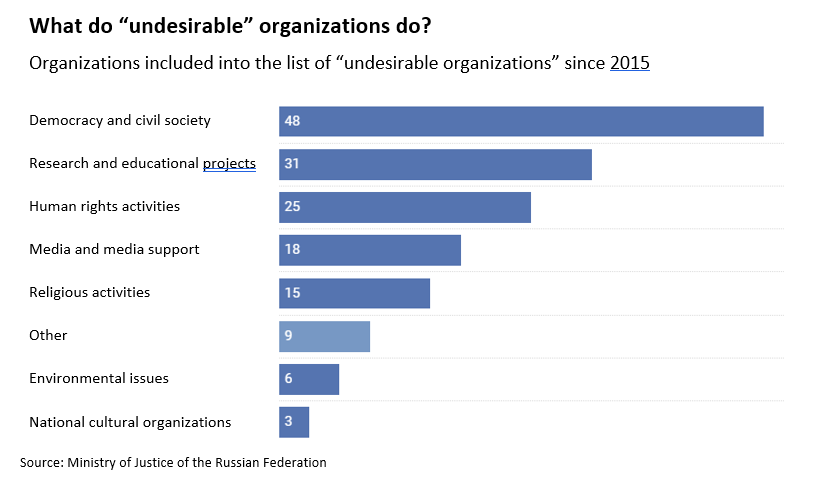
Analyzing the types of organizations on the list, we can conclude that the most “undesirable” phenomena are democracy, civil society, education, and human rights. Notably, the list also includes media, religious and even environmental organizations. Among the latter are the World Wildlife Fund (WWF) and Greenpeace International.
“Greenpeace was an independent environmental organization, and the main and only focus of the Russian branch was environmental protection in Russia. The organization brought together some of the best experts in the country on a wide range of environmental issues, and all of them were focused on making life in Russia safer and environment-friendlier”, a former Greenpeace member said in a conversation with Novaya Gazeta Europe.
“We worked to make people living in a country with such amazing and (in)valuable nature recognize and cherish its value. When I learned that the Prosecutor General's Office had declared Greenpeace International's head office undesirable, I already knew that Greenpeace Russia would be forced to close down. It was kind of an “expected surprise”. You realize that it could happen, but it doesn't make you feel better in the moment.
My work has been a huge support for me in difficult times - while there was so much insane cruelty and unjustifiable destruction around, we have worked on preserving something valuable, creating something good or at least helping not to make things worse.
It kept me going when it seemed like the world was just going crazy. But by declaring Greenpeace an “undesirable organization”, the Prosecutor General's Office just knocked the ground out from under my feet, deprived me of this important meaning.
The designation of Greenpeace International as “undesirable organization” was a big mistake that caused irreparable damage to the independent environmental movement in Russia”, says a former member of the organization.
Another ex-employee of the Russian branch of Greenpeace, Daria Gorchakova, who worked as a volunteer coordinator in the Zero Waste project, told Novaya Gazeta Europe that after Greenpeace International was declared “undesirable”, they had to remove absolutely all references of Greenpeace in all social networks, delete groups, rename or delete chats, while in parallel responding to a ton of messages from volunteers.
“The next step was to wind-up the organization. In fact, Greenpeace International was recognized as undesirable, not its Russian branch, but being a subsidiary of Greenpeace International we were obliged to close down too”, Gorchakova added.
In 2021, the first place among those persecuted under this law was taken by religious movements – altogether six organizations from Ukraine, Latvia and the United States. In 2022, the most persecuted type of organizations were mass media (also six organizations; in 2023, eight organizations from this category were recognized as undesirable, but by that time they landed only on the fourth place).
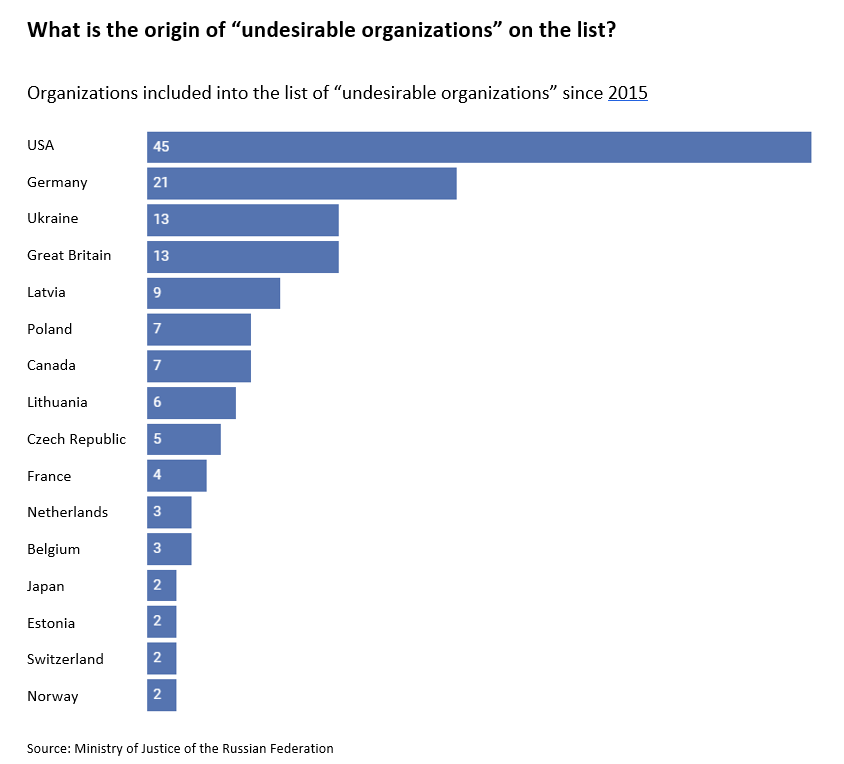
Most of organizations recognized as “undesirable” are from the USA and Germany, followed by Ukraine. The chart below shows only countries that appear on the list two or more times.
The first ones who fell under the law
The first organizations were added to the list in 2015. They were the National Endowment for Democracy, the Open Society Foundation, the Open Society Institute Assistance Foundation, and the U.S.-Russian Foundation for Economic and Legal Development.
“The law on undesirable organizations was initially directed against various foundations that funded civil society structures. It is a kind of iron curtain that puts all civil society structures and NGOs under control.
For a long time, the register of undesirable organizations included large foundations and donors, but in 2017 they started using the law against Russian political structures.
Subsequently, they started to apply the law to prosecute political activity”, Anastasia Burakova, a lawyer and founder of the Ark project, said in a conversation with Novaya Gazeta Europe.
“The organizations were added to the list both on a systematic basis and in waves”, said the lawyer Maxim Olenichev in a conversation with Novaya Gazeta Europe.
“The list of “undesirable organizations” is a political tool to respond to the way the policy of the Russian authorities has changed. Initially, the authorities decided to get rid of the Soros Foundation's philanthropic activities. By 2015, the Foundation had helped publish hundreds of books on humanities knowledge, which enriched the stocks of Russian libraries, introduced Internet to the university environment and provided students with Internet access, as well as promoted scientific and educational development. The Russian authorities saw this as a threat. The foundation stopped any collaboration with Russia”, he said.
In 2017, the British structures Open Russia Civic Movement (which never existed in British registers) and Otkrytaya Rossia (Open Russia) joined the group of those considered “undesirable” by the Russian authorities. The latter has no connections with the Russian movement, which was established in Russia. Nevertheless, Open Russia activists were among the first ones to be prosecuted under the law on “undesirable organizations”. The Center for Media Rights Protection estimates that almost 45% of administrative cases are initiated for cooperation with this organization.
“Open Russia was the first large political project in Russia to be recognized as an undesirable organization”, said a former member of the movement, who himself has been subjected to administrative prosecution several times (he preferred to remain anonymous for security reasons – ed. note). At the same time, the organization's activities were not illegal as such: Open Russia was engaged in human rights work, awareness-raising and educational projects, as well as preparing people to participate in elections.
”Open Russia is a champion in terms of persecution”, lawyer Alexei Pryanishnikov agreed in a conversation with Novaya Gazeta Europe.
“There are more than 350 administrative violation cases under Article 20.33 of the Code of Administrative Offenses and 8 out of 9 known criminal cases under Article 284.1 of the Criminal Code opened against members of this organization. This statistics is record-breaking not only considering the number of cases, but also considering the level of their absurdity”, he added.
According to the interlocutor of Novaya Gazeta Europe, the participants of the movement faced only administrative prosecution at first, mostly in the regions; no reports were drawn up on activists in Moscow and St. Petersburg.
“The law implies that only a foreign organization may be recognized as undesirable, but Open Russia has never been one. And the movement that was deemed “undesirable” was later dissolved. A few days after that, a legally new organization was created. According to the law, all persecutions had to stop, because there were no legal grounds for them. And, strangely enough, it worked for a few years”, said a former member of Open Russia.
In 2020, the BBC Russian Service reported that in the three years since Mikhail Khodorkovsky's British structures were put on the register, investigative authorities have opened about 300 cases against Russians who supported Open Russia in one way or another. Nearly all of them are based on reposts in social networks.
“Initiating such cases under Article 20.33 of the Code of Administrative Offenses is a vicious practice that allows investigators and prosecutors to “achieve” the necessary statistical results without any effort or investigation”, said the lawyer Yulia Fedotova, who has been subjected to administrative prosecution according to the law on “undesirable organizations” too. “They basically need to sit in front of the screen for a while, take some screenshots – and that’s it”, she added.
Soon they started to apply this repressive mechanism to other civil society structures, and the next big wave began in 2021: human rights defenders, European election monitoring structures and independent media were recognized as “undesirable organizations” next.
In 2021, the first organization directly linked to Russian media, Project Media, Inc. (linked to the publication “Project”), was added to the register. In February 2022, it was followed by a Latvian company IStories fonds (“Vazhnye istorii”), in July 2022 by “The Insider”, and in January 2023 by “Meduza”.
According to a former member of Open Russia, the pressure on political organizations in the Russian Federation and a new wave of repressions against “undesirable organizations” began in 2021 – just before the elections to the State Duma.
“That’s when a huge pressure on all the big parties, movements, and organizations has started. In particular, the Anti-Corruption Foundation was recognized as “extremist”. All politicians were actively preparing for the State Duma elections. And at the same time, the first restrictive amendments to the law on “undesirable organizations” were adopted. In order to protect activists so that no one would go to jail, Open Russia was liquidated in all its forms, and it ceased to exist, because according to the law, if a person left the organization, he or she could not be prosecuted. But nobody cared about the law”, said a former member of Open Russia.
After the start of Russia's full-scale invasion of Ukraine, the number of “undesirable” organizations in the registry multiplied, and many independent media were included in it. In particular, the Dozhd TV channel and Novaya Gazeta Europe. This means that any reposting of their materials or a link to their source can be considered as a reason for imposition of administrative sanctions (at first).
For example, a court in St. Petersburg fined the journalist Maria Zholobova five thousand rubles in May 2023 for sending a request for information to one of the defense contractors, introducing herself as a correspondent of “Vazhnye istorii”. We also know about at least one court case for participation in the activities of “Meduza”, which was instituted against Russian journalist Valery Nechay because of reposting an interview with Oleg Kuvaev, creator of the cartoon “Masyanya”.
A report on participation in the work of an “undesirable organization” was also drawn up on journalist and writer Dmitry Bykov because of his conversation with Boris Grebenshchikov, published on the YouTube channel of Novaya Gazeta Europe.
In addition, in January 2024, a court in Buryatia imposed a fine of 5,000 rubles on Buryat activist Nadezhda Nizovkina, finding her guilty under the article on participation in the activities of an ”undesirable organization” because of her comment to the Dozhd TV channel.
Criminal prosecution of the opposition
The first person in Russia to be confronted with a criminal case according to the law on “undesirable organization” was former Open Russia activist Anastasia Shevchenko. She was taken into custody in January 2019 and placed under house arrest for two years.
“This was a very difficult moment for me, for Open Russia. After the detention, within a week, Nastya's daughter Alina died (the mother was allowed to visit her daughter in the hospital only after much persuasion and after Alina's heart stopped, when she was already unconscious – ed. note). All of this was absolutely wild”, the former Open Russia activist said in a conversation with Novaya Gazeta Europe.
“Nobody wanted this to happen – my daughter to die like that. But all these delays, approvals, distrust led to the tragedy. I think that if I had been released in time, and I had been near Alina, this would not have happened. But in the given circumstances my child has died in one day time”, said Shevchenko herself.
In 2021, the activist was sentenced to four years of suspended imprisonment, after an appeal the term was reduced to three years. In August 2022, Shevchenko claimed to have left Russia with her children for Vilnius. Later, the court changed her sentence from suspended to a real one, Shevchenko was put on the wanted list.
In May 2022 in Nizhny Novgorod, businessman Mikhail Iosilevich, the creator of the “Church of the Flying Spaghetti Monster”, was sentenced to one year and eight months in a penal colony. The court found him guilty of cooperating with Open Russia because of the training of election monitors conducted by another organization in the run-up to the 2020 city council elections. This was the first sentence with a real term due to collaboration with an “undesirable organization”. The defense tried to prove in court that the training was organized by the Golos movement and Yabloko party, but the court considered it to be participation in Open Russia's activities. Iosilevich spent eight months in the pre-trial detention facility. After the judicial pleadings, he tried to leave Russia despite having travel restrictions imposed on himself: on May 10, he boarded a plane to Israel, but was taken off the plane.
Another headline-making case involving an “undesirable organization” was brought against the former director of Open Russia, Andrei Pivovarov. On May 31, 2021, he was taken off a flight to Warsaw right at the Pulkovo airport – and detained.
“We were going to fly together on a short vacation to prepare for the upcoming election marathon. He passed all the customs control, and as I already was on the plane, he called me and said that he saw a FSB car arriving and that a delay of departure was announced”, said Pivovarov's wife Tatiana Usmanova in a conversation with Novaya Gazeta Europe.
Just a few days before that, Open Russia has announced that it was forced to completely stop its activities and close its regional branch offices due to the plans of the Russian authorities to introduce restrictive amendments to the law on “undesirable organizations”.
“My life changed almost three years ago, as if I were in a movie. Frankly speaking, it was a huge shock for me. I couldn’t imagine in my wildest dreams that something like that could happen. Especially after Open Russia was closed down. At the end, he was sent to Krasnodar to be as isolated, as far away from his family and from media exposure as possible”, Usmanova said.
Pivovarov linked this case to his plans to run for the State Duma, and human rights activists noted that the case against him was a purely political one.
In 2022, a court in Krasnodar sentenced Pivovarov to four years in prison under Article 284.1 of the Criminal Code. The court found that the politician was running an undesirable organization, conducting, for example, marketing and fundraising campaigns, as well as distributing online materials about the activities of the organization and its projects.
“Since then, my whole life has been dedicated only to Andrei, to his criminal case, to make his life at least a little better under these circumstances”, Usmanova added.
Another big trial was in the case of politician and publicist Vladimir Kara-Murza: in May 2023, he was sentenced to 25 years in a strict regime prison colony, having been found guilty of cooperating with Open Russia, as well as of state treason and spreading “fake-news” about the Russian army. The politician was detained in April 2022 in Moscow for the fact that “he changed the trajectory of his movement at the sight of police officers”, after that he was sent to a special detention center for 15 days, where he became a defendant in the criminal case.
“Legal enforcement of the law on “undesirable organizations” is characterized by a high level of arbitrary behavior and extremely low standards of proof”, said lawyer Alexei Pryanishnikov in a conversation with Novaya Gazeta Europe.
“There is a total lawlessness at all levels in these cases: the operatives of the Department for Countering Extremism and the FSB are monitoring social networks and fantasizing in full swing, using photos in social networks with representatives of an “undesirable organization” as evidence of participation in its activities [lt]...[gt] For example, in my personal case under Article 20.33 of the Code of Administrative Offenses they used a photo lineup, on which I was next to Mikhail Khodorkovsky, as evidence of my participation in Open Russia”, he said.
“Spreading fear”
The lawyer Anastasia Burakova defined such law enforcement as an example of an “absolutely elastic norm”.
“People who did not participate in the activities of an organization from the register were persecuted.
This is a repressive mechanism that is used against civil society structures, against undesirable people who engage in activities that irritate the Kremlin”.
As an example Burakova cited Grigory Melkonyants, co-chairman of the Movement in defense of Voter’s Rights “Golos”, who is being prosecuted under Article 284.1 of the Russian Criminal Code. He was accused of collaborating with the “undesirable” organization “European Network of Election Monitoring Organizations”, although Golos itself was not recognized as such.
However, as the lawyer notes, prosecution under this article is now relatively rare – less common than, for example, for spreading “fake-news” about the Russian army.
“Supposedly, they have adopted too many other repressive tools they like to use more. They seldom refer to the tool of “undesirable organizations”, although everything has been set to use it anytime. And a huge number of people can get under the roller of repressions. Millions, I would say, because an ordinary repost made even before a mass media was recognized as “undesirable” might be considered as collaboration”, Burakova said.
As lawyer Maxim Olenichev noted in a conversation with Novaya Gazeta Europe, before Russia's full-scale invasion of Ukraine, the authorities mostly prosecuted activists and nonprofit organizations for information posted online or for continuing the activities of an “undesirable” organization in Russia (e.g., Open Russia).
However, after February 2022, the situation changed dramatically: according to the lawyer, charges for administrative offense had been brought more and more often against people who had never been public.
Olenichev added that the authorities use this law to prosecute not the “undesirable” organizations themselves (they have all ceased public work in Russia), but rather Russian citizens and organizations staying in Russia who were incautious enough in the past to publish materials of an organization later recognized as “undesirable” online.
“In this context, the Russian authorities have organized the repressions so that they spread fear in Russian society for any cooperation or participation in the activities of an “undesirable” organization”, the lawyer said.