Republic of Karelia
11.04.2026
The Republic of Karelia stands out among Russian regions as one of the most politically protest-oriented and competitive, characterized by a fragmentation of regional elites. This is due to several factors: the region’s political culture, shaped by its proximity to Europe and lingering memories of Stalinist repression; the absence of a single dominant economic group; and the significant role of small and medium-sized businesses. The White Sea–Baltic Canal runs through the region, and there are sites of mass graves of victims of political repression, further grounding this culture in historical memory.
This unique identity was reinforced by long-standing (dating back to the Soviet period) and close (up until the full-scale war in Ukraine) cooperation with Finland and the European Union across multiple sectors. The breakdown of relations with Europe has triggered a severe economic crisis, exacerbated by Finland fully closing all border crossing points in autumn 2023.
Even amid the overall decline of political competition in Russia, Karelia continues to demonstrate a higher-than-average level, although it is lower than in the 1990s and early 2000s. A key pillar of this competition has been the regional branch of the Yabloko party, which has remained active and relatively popular throughout the region’s modern history. Its current leader, Emilia Slabunova, served as chair of the federal Yabloko party from 2015 to 2019. Historically, Yabloko—long led by Vasily Popov—controlled significant business and media resources. However, in 2015, Popov was forced to emigrate to Finland to seek political asylum, and his associate Galina Shirshina was removed from her post as mayor of Petrozavodsk. Subsequently, the party was barred from City Council elections, and its business and media resources were effectively dismantled.
As of mid-2026, the political landscape remains fragmented but strained. The regional parliament is composed of seven factions: the five parliamentary parties plus Yabloko and the Party of Pensioners. However, Karelia has become a leading region in political pressure, with seven individuals designated as “foreign agents” by early 2026—one of the highest rates per capita in Russia.
1. Basic characteristics
The Republic of Karelia has an extensive state border with Finland (a NATO member since 2023) and has access to the Baltic Sea as well as the Arctic Ocean.
The capital is Petrozavodsk has approximately 230,000 residents that constitutes 45% of the region’s population. The remaining 12 towns are small and experiencing depopulation, as is the region overall.
Total population of the Republic is ~515,000 (share of Russia’s population: 35%).
Ethnic composition:
-
- Russians ~82%
- Karelians ~7.4% (titular ethnic group)
- Belarusians ~3.8%
- Ukrainians ~2.0%
- Finns ~1.4%
- Vepsians ~0.5% (indigenous minority)
According to the official data, the Republic of Karelia has approximately 494,500 voters, which is 0.44% of the Russia’s electorate.
2. Political representation
2024 Presidential Election
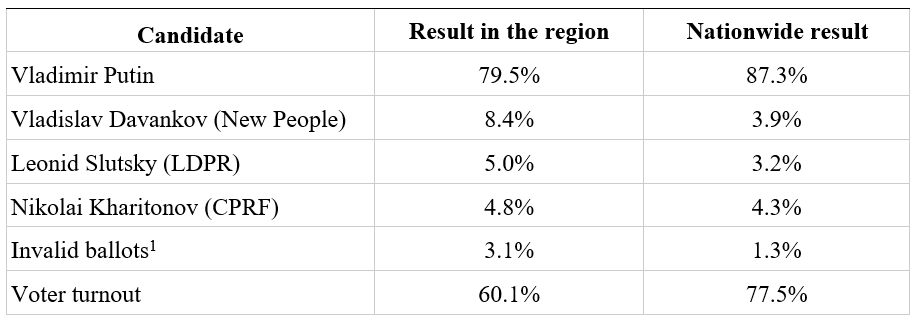
The 2024 presidential election in the Republic of Karelia confirmed the region’s status as a territory with historically lower turnout and a distinctive distribution of protest votes compared to national averages: Vladimir Putin received 8% fewer votes than the countrywide average, while all opposition candidates performed better than their nationwide results. The share of invalid ballots was also among the highest in the country.
Gubernatorial elections
In 2022 gubernatorial election, Artur Parfenchikov (United Russia) was re-elected with 69.2% of the vote on a new record-low turnout of 27.9%; his competitors included Andrey Rogalevich (Just Russia) with 13.4%, Evgeny Ulianov (CPRF) with 12.6%, Anatoly Dudarin (Democratic Party of Russia) with 1,7%, and Ivan Kadayas (Rodina) with 0.6%.
Regional parliament
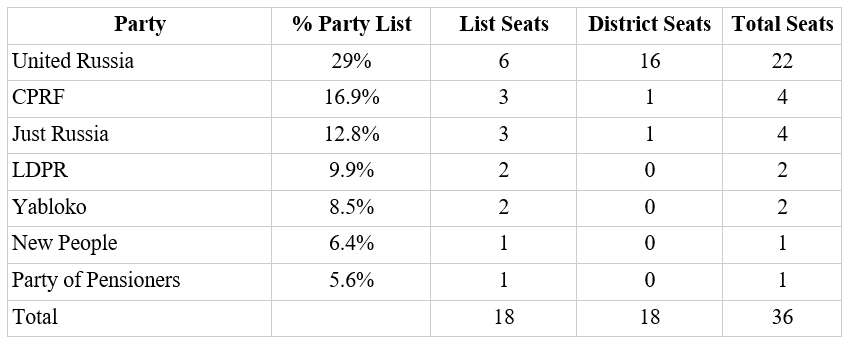
The 2021 elections were held under a mixed system (a total of 36 seats: 18 allocated via party lists and 18 via single-member constituencies). As of 2026, Karelia remains one of only two regions in Russia with seven factions represented in its regional parliament (the other being Amur Oblast).
Petrozavodsk City Council
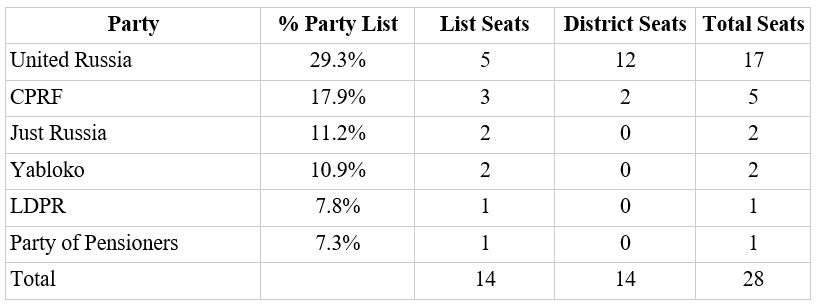
The 2021 elections were held under a mixed system. 14 deputies were elected via party lists and 14 in single-member districts.
3. Local self-government and municipal reform
The history of local self-government in Petrozavodsk is closely tied to the struggle for influence between the republican authorities and city elites. The mayor of the Karelian capital has traditionally been regarded as the “second most powerful figure” in the region, while the interests of major construction and retail businesses have always intersected around the administration. A key figure shaping the opposition agenda for many years was businessman and leader of Karelian Yabloko, Vasily Popov, who acted as the main opponent to regional governors and an architect of numerous electoral campaigns.
A turning point came with the 2013 mayoral election, when the incumbent mayor from United Russia, Nikolai Levin, unexpectedly lost to independent candidate Galina Shirshina. Backed by Yabloko and Popov’s team, Shirshina became a symbol of regional opposition: she reduced public transport fares, abolished golden parachutes for officials, and introduced a system of video reporting. However, a sharp conflict with Governor Alexander Khudilainen led to her early dismissal by the city council in 2015, after which direct mayoral elections in the city were permanently abolished.
The system of popular elections was replaced by appointments through a selection committee. The first such “hired” city manager was Irina Miroshnik (2016–2021), whose tenure was marked by stability and loyalty to the regional authorities. In 2021, the city administration was headed by Vladimir Lyubarsky, a former deputy governor for domestic policy. His career ended unexpectedly: in 2023, he voluntarily stepped down to go to the war zone in Ukraine but soon became a defendant in a criminal case involving large-scale bribery.
Since late 2023, the administration of Petrozavodsk has been headed by Inna Kolykhmatova. The current stage of the city’s development is characterized by the full integration of municipal authorities into the regional “team.”
The municipal reform launched in Russia in spring 2025 was designed to replace the two-tier system of local governance with unified municipal districts. By 2026, the reform in Karelia had entered its final stage. Its key outcomes include:
- 107 urban and rural settlement administrations ceased to exist as independent authorities; 16 municipal districts were created instead.
- The number of local-level deputies (from settlement councils) was reduced from more than 1,100 to around 300 deputies in district and city councils.
- Instead of 109 separate local budgets (107 local administrations and 2 urban districts—Petrozavodsk and Kostomuksha), 18 consolidated budgets are now formed (16 district-level and 2 city-level).
- Former village administration buildings now house territorial offices of district administrations. These offices are staffed (typically by administrative managers), but they do not have the status of separate legal entities or independent budgets—all financial decisions are made at the district center.
4. History of regional governance
Karelia was the second autonomous republic in Russia to adopt a declaration of sovereignty on 9 August 1990. Following the first competitive elections in 1990, the region developed a strong democratic movement, and even local party and Soviet officials appeared relatively pragmatic and reform-oriented by the standards of the time. Over the years, the republic has been led by the following people:
Viktor Stepanov (1990–1998)
A representative of the moderate wing of the CPRF, Stepanov led the republic during a period of systemic transformation. Under his leadership, Karelia adopted its declaration of sovereignty and held a referendum on introducing the post of elected head of the region. He balanced between the federal center and local councils, managing to avoid major civil conflicts during the 1993 constitutional crisis.
In 1994, he became the republic’s first sole executive leader, winning a non-competitive election. His term ended in 1998, when he lost in the second round of a competitive election to the mayor of the regional capital, receiving 43% of the vote. Since then, Stepanov has served as a deputy of the Legislative Assembly of Karelia and is a member of the Just Russia faction.
Sergey Katanandov (1998–2010)
A former mayor of Petrozavodsk and a construction engineer by training, Katanandov’s 12-year tenure was marked by the consolidation of a vertical power structure and integration into the federal elite. He initiated a referendum to change the structure of government, transforming the position of prime minister into the post of Head of the Republic and making the parliament unicameral.
The latter part of his tenure was overshadowed by social protests against the monetization of social benefits, an interethnic conflict in Kondopoga (2006), and a prolonged information conflict with the opposition led by Vasily Popov. Katanandov resigned early in 2010 amid declining support for United Russia and conflicts with municipal elites. After stepping down, he served as a senator representing Karelia from 2010 to 2017. His son, Denis Katanandov, is the chair of the Petrozavodsk City Court.
Andrey Nelidov (2010–2012)
Nelidov came to power as an “outsider,” with prior experience in the Leningrad region and a business background. His short tenure was marked by negative attitudes from local elites and extremely low approval ratings (around 11%). In the 2011 elections to the Legislative Assembly, the United Russia list under his leadership delivered one of the weakest results in the country (30%).
Nelidov was dismissed in 2012 due to his inability to manage intra-elite political conflicts. He later headed the Kizhi Museum-Reserve, which sparked public protests, and in 2015 he was arrested and subsequently sentenced to eight years in prison for bribery.
Alexander Khudilainen (2012–2017)
Nelidov was succeeded by Alexander Khudilainen, a political figure from the Leningrad region who had served as chairman of the regional legislative assembly in 2011–2012 and previously headed the Gatchinsky District. Ethnically an Ingrian Finn, he speaks Finnish. Being tough and a bit rude, Khudilainen was appointed to carry out a political “clean-up” of the region’s opposition. He succeeded in this task (see above regarding the dismantling of Yabloko), but accumulated such a high disapproval rating that the Kremlin ultimately chose not to back him for another term. In February 2016, Vladimir Putin formally reprimanded him for failing to meet housing resettlement targets. A year later, in February 2017, Khudilainen resigned early.
Artur Parfenchikov (2017–present)
A native of Petrozavodsk, Parfenchikov previously headed the Federal Bailiff Service of Russia. His appointment was seen as the return of a “local,” which helped temporarily ease tensions with regional elites.
On 10 September 2017, he won the election for Head of Karelia with 61.34% of the vote on a turnout of 29.3%. He was nominated by United Russia but was not a party member at the time. On 11 September 2022, he was re-elected for a second term with 69.15%. In June 2024, he formally joined United Russia and became head of its regional branch.
In 2024–2026, his administration has focused on developing tourism (which has grown significantly in Russia following the annexation of Crimea and restrictions on foreign travel) and addressing infrastructure challenges. He maintains a distinctly technocratic style of governance and actively uses social media to communicate directly with residents.