Election update XIII
03.09.2025





On 12-14 September, Russia will hold its 2025 regional elections. While these events can hardly be described as genuine elections, they are still among the few indicators of internal dynamics in a country that has been waging war against Ukraine for the past three and a half years.
Observers who closely follow Russia’s electoral processes know that the Kremlin continues to take elections seriously. The myth of President Putin’s unconditional popular support, the unshakable ‘power vertical’ and United Russia’s absolute dominance begins to unravel under scrutiny. The Kremlin deploys every possible tactic to avoid genuine competition — even at the local level — because it knows it can lose. Every possible method is being used to cleanse the political field and eliminate even the slightest opposition.
In this August 2025 election update, REM focuses on two key topics — recent changes to electoral legislation introduced by the Russian government ahead of the elections and the results of candidates' registration.
1. Changes to electoral legislation
The report Legal Specifics of Russia’s 2025 Elections outlines recent legal amendments designed to further weaken electoral integrity and reduce citizens’ political representation.
The report is based on an analysis of Federal Law No. 115, adopted by Russia on 23 May 2025, which amended existing electoral legislation. The law introduces three main changes.
1.1. Nationwide rollout of the “Moscow model” of electronic voting
In the September 2025 elections, the Russian government plans to expand Moscow’s practice of using electronic voting terminals (EVTs) — instead of voting on paper ballots — to the entire country.
The electronic voting terminals allow violations of ballot secrecy, prevent voters from verifying how their vote was counted, and eliminate the possibility of conducting a recount based on voter-controlled paper records. Moreover, the law permits merging data from electronic and paper ballot voting, making it impossible to independently analyze the results of electronic voting.
Federal Law No. 115 rebrands EVTs as Electronic Voting Complexes (EVCs), but this name change does not alter their core design. Like Moscow’s EVTs, the EVCs go beyond simple ballot scanning or tabulation tools and raise serious transparency concerns.
Structural features of EVTs/EVCs:
- Allow scanning of voter passports and video recording at the moment of voting — threatening ballot secrecy;
- Prevent voters from verifying how their vote was registered;
- Make manual recounts on voter-controlled paper records impossible;
- Remain directly connected to the Internet during voting.
Another provision further undermining transparency allows merging the results of EVC-based voting with the results of remote electronic voting (REV). Since REV results cannot be independently verified, this merger renders the entire electronic vote count effectively beyond public oversight, enabling even broader potential for manipulation.
1.2. Redistricting in favor of United Russia
The validity of single-mandate district maps has been reduced from ten to five years, allowing the parliamentary majority to redraw district boundaries ahead of each election cycle. Therefore, the 2026 State Duma elections are expected to result in an even smaller number of opposition deputies winning single-mandate districts.
The 2025 redistricting has already shifted representation toward regions that consistently deliver pro-government results, while eliminating districts in areas where opposition candidates have previously won. This follows the same logic as the 2015 redistricting, which employed the so-called “petal slicing” manipulation method — dividing large urban centers and attaching them to vast rural areas to dilute the urban protest vote. [For a detailed analysis, see REM’s report: Why the Russian Government Is Still Afraid of Elections].
Since 2015, constitutional amendments have incorporated four new regions into Russia — occupied territories of Ukraine — granting them a total of seven single-mandate districts. Meanwhile, population growth in Moscow, Moscow Oblast, and Krasnodar Krai has resulted in each gaining an additional district. All of these territories are known for consistently producing pro-government electoral outcomes. In contrast, regions that had previously elected non–United Russia candidates have lost districts, further skewing the electoral map in favor of the ruling party.
1.3. New law temporarily deprives millions of Russians of parliamentary representation
One of the new provisions bans by-elections in the year preceding federal parliamentary elections. By-elections are held when a single-mandate deputy vacates their seat — due to death, resignation, or loss of mandate. Under this rule, no by-elections will be held in 2025, leaving over 3 million voters without representation in the State Duma for more than a year.
In some cases, the gap is even longer. For example, voters in Altai Krai will go without a representative for 26 months. Overall, seven districts lack representation at the moment: one due to an MP’s death, and six because deputies resigned to take higher posts (as regional governors, deputy ministers, or vice-governors).
In this context, the cancellation of by-elections undermines citizens’ constitutional rights to representation and participation in governance.
2. Results of (non-)registration of candidates. Governors, regional parliaments, city councils of regional capitals
2.1. Gubernatorial elections
The 2025 gubernatorial elections will be held in 20 regions, including the occupied city of Sevastopol. Of the 23 registered political parties, 15 have announced plans to nominate candidates. In addition, several dozen self-nominated candidates have entered the race. Among them is Oleg Nikolaev — the incumbent governor of Chuvashia and a member of the central council of the Just Russia party — who is formally running as a self-nominee.
At the registration stage, candidates from 14 parties made it to the final phase, but only 10 party-nominated candidates and one self-nominee (Nikolaev) were officially registered — a total of 95 people out of 135 nominated (Figure 1).
As a result, only 10 parties will be represented in the gubernatorial races: five are parliamentary parties, while the other five are considered “minor” or spoiler parties.
Figure 1.
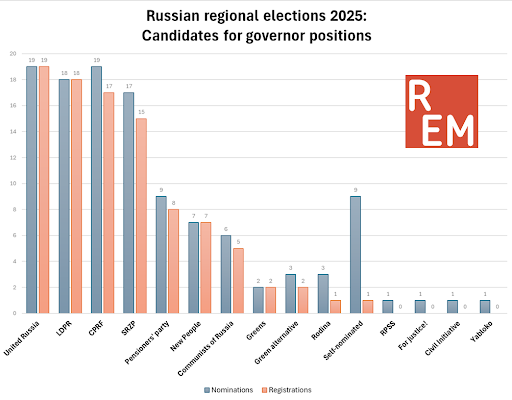
Among the parliamentary parties, United Russia traditionally leads in the number of gubernatorial candidates. In 2025, it is fielding 19 candidates, all of whom are incumbent regional heads — eight holding the status of acting governors. The only region where the ruling party did not nominate a candidate is Chuvashia.
The Liberal Democratic Party of Russia (LDPR) ranks second, with 18 candidates. The party did not nominate contenders in the Bryansk and Orenburg regions.
The Communist Party of the Russian Federation (CPRF) is fielding 17 candidates. In Chuvashia, the party chose to support Oleg Nikolaev, while its candidates in the Komi Republic and Leningrad Region failed to pass the municipal filter and were therefore not registered. Notably, Oleg Mikhailov, the CPRF’s candidate in Komi, was regarded by some experts as one of the few opposition figures capable of mounting real competition against an acting governor.
Just Russia – For Truth put forward 15 candidates. The party nominated its representatives in all regions except Tatarstan and Kamchatka Krai. In Chuvashia, it supported Nikolaev, while in two other regions (Perm Krai and the Jewish Autonomous Region), its candidates failed to pass the municipal filter.
New People nominated seven candidates. Party leader Alexey Nechaev explained the limited participation by saying the party does not wish to run "just for the sake of participation".
Among the “minor” parties, two spoilers of the CPRF — Communists of Russia and the Pensioners’ Party — managed to register a combined 13 candidates (five and eight, respectively).
The Greens and Green Alternative each registered two candidates, and Rodina registered one.
After the end of registration, the only strong opposition candidate remaining was the former governor of Irkutsk region, communist Sergey Levchenko. As a result, Irkutsk remains the only region with a gubernatorial race that can be considered relatively competitive by today’s standards.
2.2. Elections to regional parliaments
The elections to regional parliaments will take place in 11 regions. Only 12 parties (out of 23) will participate: five parliamentary and seven “minor” (Figure 2).
Four parliamentary parties — United Russia, CPRF, LDPR and Just Russia – For Truth — will be represented in all 11 regions where elections to regional legislatures will be held. The fifth Duma party, New People, registered its lists in nine regions — except for Belgorod Oblast and the Yamalo-Nenets Autonomous Okrug.
Figure 2.
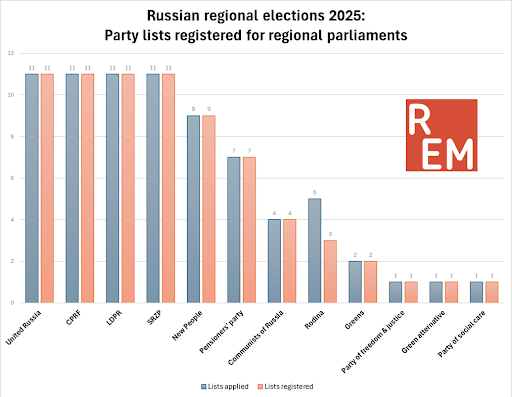
As in the gubernatorial elections, the most active among the non-parliamentary parties were the CPRF spoiler parties — the Pensioners’ Party (in seven regions) and Communists of Russia (in four regions). Notably, neither party faced a single registration refusal, underscoring the Kremlin’s interest in their participation.
The party Rodina suffered the most losses, managing to collect signatures and register lists in three out of five regions. In two regions, the Greens secured a place on the ballot.
Additionally, one list each was registered by the Russian Party of Freedom and Justice and Green Alternative, with the Party of Social Protection (PSZ) potentially joining them.
Compared to the 2020 elections, party activity has declined: in those same 11 regions, 125 lists were nominated for regional legislatures in 2020, compared to just 74 in 2025. Similarly, 93 lists were registered in 2020, versus 71 in 2025.
2.3. Elections to the city parliaments of regional capitals
Elections to the city parliaments of regional capitals will be held in 25 regions. Fourteen of the 23 currently registered parties will participate in these city campaigns.
As with the regional legislature elections, parliamentary parties faced no obstacles — all their candidate lists were successfully registered. Non-parliamentary parties, however, experienced some setbacks.
Figure 3.
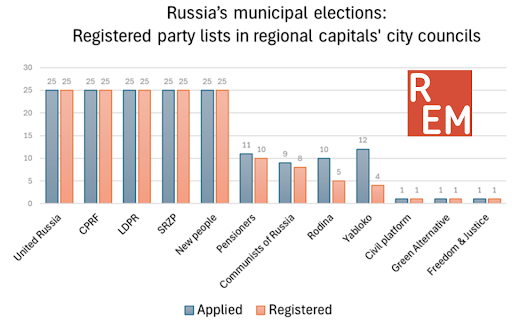
Similar to gubernatorial and regional parliamentary elections, the most effective non-parliamentary parties were the CPRF spoiler parties. The Pensioners’ Party will appear on ballots in 10 of the 11 capitals where it nominated candidates, while Communists of Russia will be represented in 8 cities, having nominated 9 lists. The party Rodina will participate in five elections, despite submitting 10 lists.
Civic Platform, the Russian Party of Freedom and Justice (RPSS), and Green Alternative each nominated one list, all of which were registered.
The main loser at the nomination stage was Yabloko, which attempted to nominate candidates in 12 administrative centers but was rejected by local election commissions in 8 cases.