Elections 2023 appear even less free and fair than before
12.09.2023





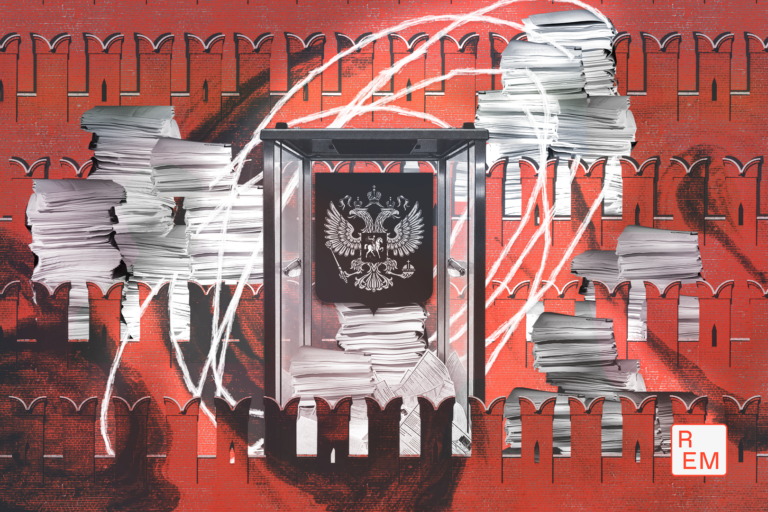
8, 9 and 10 September in Russia were days of elections of State Duma deputies in four districts, heads of 21 regions, deputies of 16 regional parliaments, 12 city councils of regional capitals, as well as elections in the occupied territories and numerous local elections.
REM summarizes the main conclusions from the observation, based on the Golos report. The full version of the report is available here: in Russian and in English.
Assessing the elections, experts observe a serious deterioration in the realization of voting rights by citizens. The drop is striking even compared to the previous elections which were not particularly free and fair either.
This year's campaign is characterized by centralized propaganda, censorship, forceful suppression of any dissent, demonstrative use of administrative resources for the benefit of the United Russia party and its candidates, coercion of administratively dependent (state-employed) categories of voters to participate in elections and vote for specific candidates. All this comes with a widespread unpunished violation of electoral legislation, the principles of equal and free elections, and the voting rights of citizens. A significant loss of independence by election commissions is recorded.
1. Main Irregularities
1.1. Manipulation of Legislation on the Eve of Elections
The consistency of electoral legislation is one of the most important conditions for holding free and democratic elections. Frequent amendments to electoral legislation indicate the authorities’ wish to manipulate the elections. In 2023, serious changes to the electoral legislation were recorded in those regions where in previous years the authorities faced significant problems in domestic politics. The main change is that the share of majoritarian mandates has been increased and the share of mandates distributed between party lists has been reduced. This allowed United Russia to retain the majority of parliamentary seats even in those regions where the party showed weak results in voting on party lists.
Read this article to learn more about changes to the legislation in the run-up to the elections.
1.2. Attempts to Complicate Election Observation
Parties and candidates were prohibited from nominating their representatives (the type of representative who has the right of advisory vote) to election commissions. In the last few years, this has been the most popular among the opposition and independent observers way of organizing public control at the polling stations. In addition, candidates’ proxies can no longer be present at polling stations on voting days, neither can freelance journalists.
For many years the authorities have been trying to replace the institute of independent monitoring with government-controlled observers from public chambers and even fake foreign observers. In 2023, state-enforced pressure on observers reached new levels. A criminal case was opened against the Co-Chair of the Golos movement Grigory Melkonyants for “organizing the work of an undesirable organization on the territory of Russia”. Melkonyants was arrested and spent the voting days in the pre-trial detention center.
The Chairman of the State Duma Commission on the Investigation of Interference of Foreign States in the Internal Affairs of Russia, Vasily Piskarev, stated that the reason for the persecution was the reports and expertise produced by Golos.
1.3. Lack of Conditions for Free Public Debates
Severe restrictions on freedom of assembly, freedom of expression and freedom of association, compatible to those imposed under martial law, continue to be applied. Most means of free communication between candidates and voters have been destroyed. The media are under severe censorship: the number of blockings and criminal cases against journalists is increasing, many media were forced to stop their work, leave the country and shut down their regional correspondent networks.
Social networks, which could partially fill the lack of space for open public discussion, are also under pressure: some of them are blocked on Russian territory, while the most popular social network VKontakte is controlled by the son of the Deputy Head of the Russian Presidential Administration.
Campaigning was also challenging. Circulation of campaign materials was impeded, volunteers involved in campaigning were subjected to pressure from law enforcement agencies, printing firms unexpectedly canceled already paid contracts for advertising campaigns.
1.4. Increased Pressure on Candidates, Observers and Voters
One of the main trends of the 2023 campaign was the increased pressure on all parties involved in elections: political parties, candidates, observers and voters. In almost every opposition party there were candidates against whom a criminal or administrative case (e.g., for extremism) was fabricated, or they were subjected to searches and interrogations during the election campaign. As a result, this led to a drastic decline in electoral competition: many politicians refused to nominate their candidacies in the current elections.
1.5. Merging of the State and the Ruling Party
During the election campaign, websites and social media of state, municipal, and budgetary institutions actively participated in campaigning for candidates from United Russia. Management of state institutions had no fear to explicitly agitate for the acting governors and deputies, who are United Russia party members. Even election commissions, which should inherently be “above the fray”, were involved in campaigning activities.
1.6. Election Commissions are Even Less Independent
In the 2023 elections, the Central Election Commission (CEC) independently made decisions on the (non)registration of candidates and party lists for regional elections and threatened members of the regional election commission who objected in such cases. The reason for such interventions from CEC was the desire to register ‘spoiler' candidates to pull away votes from the opposition and distort competition.
In addition, the REV system – Remote Electronic Voting – which was widely used this time, is not controlled by either the territorial commissions or the higher Moscow City Election Commission or the Central Election Commission. REV in Moscow is controlled by the mayor's office, and by the state corporation Rostelecom in the rest of Russia.
1.7. Special Election Zone
The organization of elections in the occupied territories of Ukraine was of an unprecedented nature: even the approximate number of voters had not been known in advance. The actual boundaries of the territory in which the elections would be held had not been known; extraterritorial election commissions (polling stations in different regions of Russia where immigrants from the occupied territories could vote) were formed without the participation of representatives of political parties and without the possibility of sending observers there; ballots were handed out using identity documents that are not provided for by election legislation (driving licenses, Ukrainian passports).
2. Preliminary Results of Observation During Voting Days
The main problems of the 2023 vote were significantly increased pressure on voters, the use of violence and pressure on public observers on voting days, large-scale failures in the operation of REV systems, signs of mass fraud and demonstrative disregard for the rights of candidates, observers and voters.
2.1. Forced Voting
Pressure on citizens to vote has been increasing over recent years, and the recent elections are no exception. What helped increase the pressure was the combining of multi-day voting and online voting, which reached an unprecedented scale this year.
Remote Electronic Voting is not subject to public oversight, while those who coerced voters into voting (in most cases, state employer) can gain access to the information on their vote. Spreading voting time over a workday, Friday, provided additional opportunities for coercion. An abnormally high turnout rate for REV was recorded precisely in the first half of the day on Friday. This is when multiple reports about forced voting at the workplace were registered nationwide.
2.2 Violation of the Rights of Commission Members, Observers, Candidates and the Media
Multiple attempts to limit observers’ movement at polling stations, photography, video recording and observers’ familiarization with documents were recorded, as well as removal from polling stations without a court order and exerting psychological and force pressure. There was a significant increase in the number of reports of illegal and unjustified use of force, including law enforcement officers acting on the instructions of the commission chairperson. Many members of election commissions were emboldened by their power.
2.3 Non-Compliance with Procedures on Voting and Vote Counting, Signs of Fraud
Assessing the extent of the electoral fraud in the September 2023 elections will take some time. During voting days, reports on alleged falsifications, violations of the rules regulating the storage of ballots at night time, and other violations of procedures were reported from many regions. Irregularities were reported from at least 13 (out of 21) regions.
Should you be willing to access more detailed information on the monitoring process during each of the three days, we recommend reading these reviews in English: 8 September, 9 September, 10 September.