Electoral anomaly in Cyprus. How Foreign Ministry and CEC fabricated 40,000 votes for Putin
29.03.2024





According to official data from the Russian Central Election Commission, more than 53,000 voters cast their ballots in the March 2024 presidential election in Cyprus. Nearly 37,000 of them voted early. Observers believe that these votes may have been rigged in Putin's favor. However, they may not have been "rigged" but simply "made up" since no independent observation makes rigging superfluous.
REM has collected evidence demonstrating why the presidential vote 2024 in Cyprus can be considered the largest overseas electoral fraud in Russia's modern history.
How many Russians live in Cyprus?
The Central Election Commission reported that 295 polling stations in 144 countries were set up for Russian citizens residing or temporarily staying abroad. According to the CEC, as of 1 January 2024, 2,002,787 Russian voters reside outside the Russian Federation.
According to The Guardian, about 50,000 Russians lived in Cyprus before the full-scale invasion, and another 30,000 Russians moved there in 2022–2023. In addition, according to unofficial calculations (official data is simply unavailable), about 50,000 Russians live in Nothern Cyprus (so-called TRNC). Thus, the total Russian population is at least 120,000 –130,000 people.
How the voting was organized in 2024
As specified by the Russian Foreign Ministry, this year, Cyprus hosted two polling stations in Nicosia and four more mobile polling stations in Limassol, Paphos, Larnaca, and Ayia Napa. All polling stations held early voting from 1 to 4 March and the main voting from 15 to 17 March.
In addition, there was a voting center in the occupied part of Nicosia in a hastily set up consulate of the Russian Federation. Apparently, it was "tied" to one of the two official polling stations in Nicosia, because there is no information about it on the website of the Russian CEC. "For the first time ever, Russians living in Northern Cyprus will be able to realize their voting rights", said Murat Zyazikov, Russian ambassador to Cyprus, in January 2024.
One of the Northern Cyprus media published a photo of the "consulate", where, according to local bloggers, "elections" were held on 6-8 March. Since there is no additional information (except for the official data of the Russian CEC) on this polling station, we can neither assess the possible electoral activity of the Russian-speaking community of the occupied part of Cyprus nor confirm whether the voting actually took place.
Why is the 2024 vote in Cyprus an anomaly?
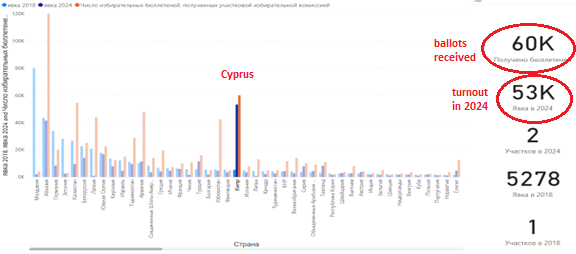
Anomaly 1: 60,000 ballots
As reported by the CEC, as many as 60,000 ballots were sent to Cyprus in 2024. This is the second-highest number of ballots ever shipped abroad, following Abkhazia, an unrecognized Russian-controlled territory (120,000 ballots were sent there). This number is also surprising because in the 2018 presidential election, 5,276 Russians voted in Cyprus, i.e. barely 10% of its Russian population.
Anomaly 2: Total turnout of 53,000 voters
It seems that the "Russian Cypriots" repaid the state for its trust: based on the official data, 53,216 people went to the polls, that is, 10 times more than in 2018. This is almost 14% of all Russians who voted abroad.
Anomaly 3: 37,000 early voters
Out of an unprecedented 53,000 voters in Cyprus, almost 70%, or about 37,000 people, supposedly voted early. There was almost no information about early voting, either. The Russian consulate in Cyprus posted an announcement about early voting on its website only on 1 March, when, according to the official version, it was already in full swing.
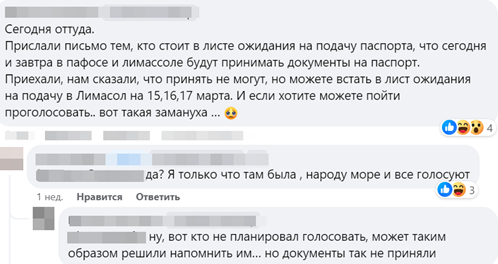
Early voting in Cyprus was held at the beginning of March. This is what Cypriot residents wrote about on Facebook. Consular officials also sent out an invitation to people on the waiting list for passport renewal to come to the consulate and submit their documents. Those who showed up did not receive consular services but were offered to vote, and many accepted.
It is almost impossible to believe that nearly 37,000 people voted at 4 polling stations in 4 days. Simple arithmetic shows that more than 4,500 people should have voted at each of them on the day. This is 1,200 fewer people than were able to vote in Berlin, Germany on 17 March (according to official figures, 3,288 voters cast their ballots in Berlin). In Berlin, however, the line of those wishing to vote stretched for 1.5 kilometers, with аbout 60 embassy staff working at the election. Nothing like this could have been organized at any polling station in Cyprus. The available photo and video materials show that voting on one of the main days (when the Russian ambassador himself voted), took place in an empty hall, there were no crowds of people.
Organizers of the "Noon against Putin" campaign in Cyprus calculated that in order to process the declared number of voters, the staff at all polling stations in Cyprus would have had to work morning till evening for 7 consecutive days (from 1 to 7 March), spending no more than 38 seconds on each voter.
Anomaly 4: Putin wins and Davankov loses
According to the CEC's calculations, candidate Putin won 81.7% of the votes in Cyprus.
Vladislav Davankov from the New People party got 2.5%, losing to candidates from the CPRF (4.6%) and LDPR (5.6%).
81.7% is even more than Putin got in Cyprus in 2018. Then the final protocol recorded 76.8% for Putin, 8.3% for Grudinin (CPRF), 7% for Sobchak (a supposedly liberal candidate from the Civil Initiative party), 2.2% for Yavlinsky (Yabloko), 1.8% for Boris Titov (another pseudo-liberal in the 2018 elections), and Vladimir Zhirinovsky obtained only 1.7%. Thus, 11% of the electorate voted for supposedly liberal candidates (Sobchak, Yavlinsky, Titov) in Cyprus in 2018. In 2024, voters abandoned both their liberal views (the only so-called liberal candidate received only 2.5% of the vote, and 3.2% of spoiled ballots can be added to this) and abstained from protest voting (which in 2018 can include voting for the CPRF candidate, 8.3%). Conversely, this time 5.6% of voters opted for a completely non-charismatic Slutsky (whose LDPR predecessor Vladimir Zhirinovsky got only 1.7% in 2018).
This drop in the protest vote came at a time when the island received at least 30,000 "relocated" Russians who left the country because of the war in 2022-2023, most of them are opposed to the regime.
Vote abroad initiative collected exit poll data showing that 23% of respondents voted for Putin, while 46% voted for Davankov, and 13% spoiled their ballots. 15% of respondents refused to answer. When comparing the exit pоll results with official results in other countries, one can conclude that the majority of those who refused to participate in the exit poll could have been Putin voters. By adding this 15% to Putin's exit poll result, it can be assumed that the real number of Putin's supporters is closer to, but not higher than, 40%. Davankov should have secured a solid victory in Cyprus.
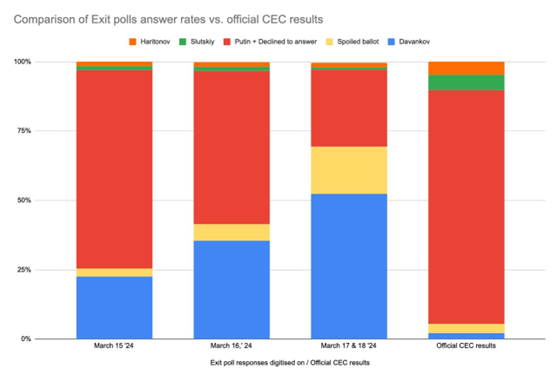
In sum, judging by the CEC data, Russian Cypriots turned out to have more support for the Russian government than their compatriots in other countries (overall, 72.3% of Russians abroad voted for Putin, while 16.65% voted for Davankov). We can hardly believe it either.
Davankov also performed poorly in Cameroon, Palestine, Belarus, Turkmenistan, Syria, some polling stations in South Ossetia and Abkhazia, Tajikistan, Kyrgyzstan and DPRK. In Gabon, Equatorial Guinea, Chad and Eritrea no votes were cast for Davankov. This list of authoritarian countries shows what the Russian CEC thinks about Russian Cypriots.
Conclusion
Adding up all the anomalies of the Cypriot vote of 2024, it is safe to say that the Russian CEC's official data does not reflect the real number of people who voted in Cyprus, nor the voting result. And while we can asses the actual outcome using the exit poll data and compare it with the official CEC data, the number of rigged or simply fictitious votes for Putin is incalculable.
Based on the exit polls and the results of previous elections, we can only roughly assume that about 10% of Russians could have voted in Cyprus, i.e. 8 to 10 thousand people. A few thousand more could have voted in Nothern Cyprus.
We estimate that about 13,000 people took part in the elections in Cyprus, as opposed to 53,000, according to CEC. It seems that the remaining 40,000 ballots were simply made up by the authorities and cast for Putin. This significantly distorted not only the result of the vote in Cyprus but also the result of overseas voting in general. Worldwide, according to the CEC, 275,000 voters cast their ballots in Putin's favor, including voting in the Russian-controlled and unrecognized territories of Abkhazia, South Ossetia, and Transnistria, as well as in Russian military units abroad.
Only one question remains unresolved: why did the Russian authorities decide to falsify the voting results in Cyprus so brazenly and not in Abkhazia, where the Russian authorities sent twice as many ballots as to Cyprus (120,000 ballots)?