Experts: High results in 2025 governor elections attributed to vote rigging
19.09.2025





Electoral analyst Ivan Shukshin has examined the results from several Russian regions where gubernatorial ‘elections’ took place in September 2025. His unambiguous conclusion: the results were falsified.
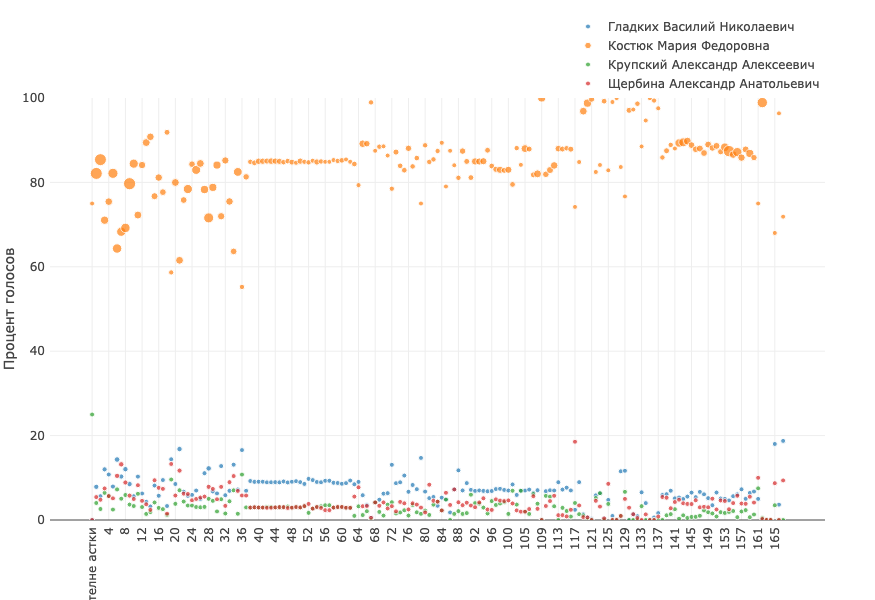
The data Shukshin used for analysis comes from Russia’s official Central Election Commission (CEC) database. His findings are based on applying the simplest statistical method for detecting electoral fraud. This method involves plotting the percentage of votes received by each candidate at every polling station as points on a chart. If votes are counted honestly, the points scatter randomly, since voters at different polling stations tend to make different choices. However, if election commissions simply copy the numbers handed down from above into the final protocols, the chart will show straight lines.
It should be noted that statistical analysis does not account for other structural distortions of Russia’s electoral process: lack of genuine competition, disqualification of strong candidates, state censorship, ban of independent media and rallies, resource inequality among candidates, coercion to vote, and so on.
But even within this already distorted environment, authorities still cannot afford to count votes accurately.
Below, we present Shukshin’s conclusions across several regions.
1. Jewish Autonomous Region: The final protocols were blatantly fabricated
The results for the Kremlin candidate Maria Kostyuk at many polling stations have nothing to do with the number of votes cast for her. The graph below shows that the target figure handed down to the commissions was 85%. “Smarter” falsifiers occasionally varied it with 83%, but in many districts, commissions simply reported a flat 85% (Fig. 1).
Fig. 1. Candidates’ results by polling stations in the Jewish Autonomous Region.
Yellow dots: Maria Kostyuk.
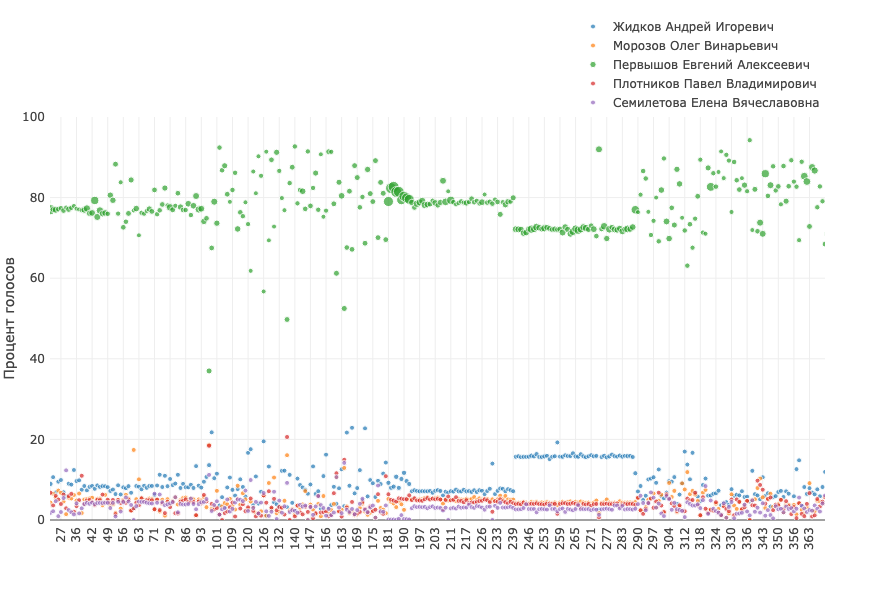
2. Tambov Region – Yevgeny Pervyshov Did Not Win Honestly
Pervyshov’s victory was not the result of ballots cast in his favor, but of manipulated spreadsheets. According to Shukshin, without fraud, Pervyshov’s actual support would have been closer to 50% (Fig. 2). At several polling stations where the reported results fall below that threshold, the data likely reflect genuine vote counts.
“The fear of a runoff created a powerful incentive to pick up the phone and mobilize the criminal network responsible for electoral fraud”, Shukshin notes.
Fig. 2. Candidates’ results by polling stations in Tambov Region.
Green dots: Yevgeny Pervyshov.
3. Leningrad Region – Alexander Drozdenko is Another “Fabricated” Governor
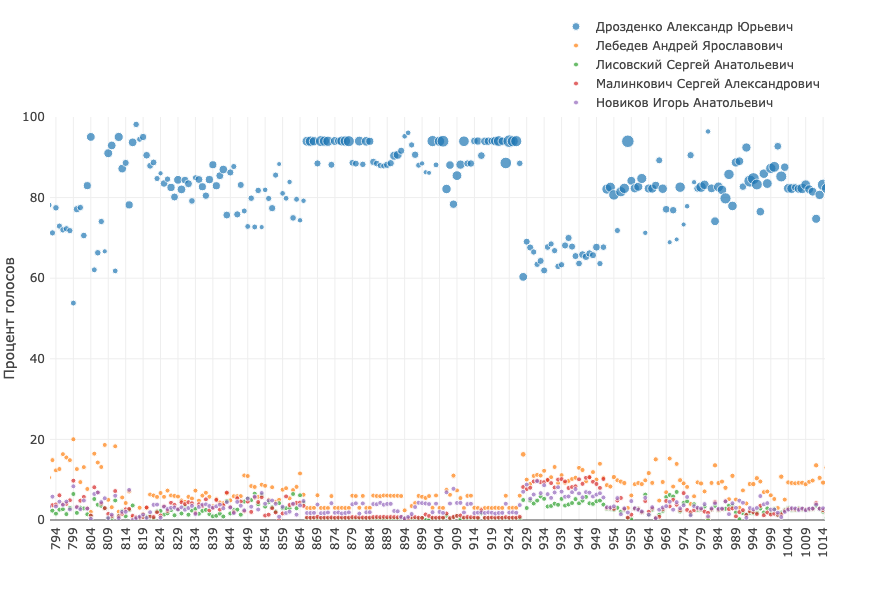
Analysis of the first day’s voter turnout indicated a widespread fabrication of electoral figures, which persisted through the “vote counting” phase.
Shukshin notes that different districts in the Leningrad Region falsified results in different ways. In Vsevolozhsky District (Fig. 3), the figure handed down from above to the election commissions was 82%. In Tosnensky District (Fig. 4), the benchmark was set at an astronomical 94%.
Fig. 3. Candidates’ results by polling stations in Vsevolozhsky District, Leningrad Region.
Blue dots: Alexander Drozdenko.
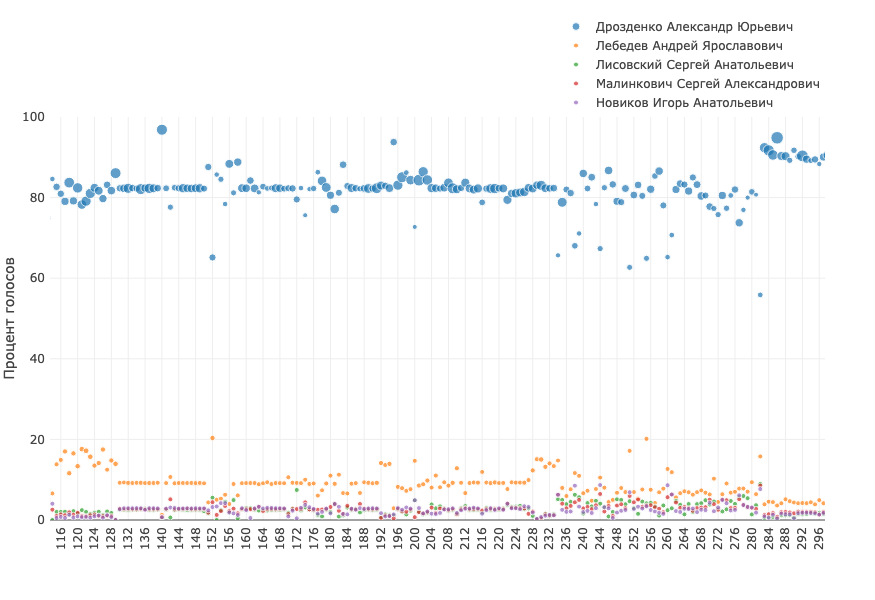
Fig. 4. Candidates’ results by polling stations in Tosnensky District, Leningrad Region.
Blue dots: Alexander Drozdenko.
4. Rostov Region – Creatively Fabricated Results of Yuri Slyusar
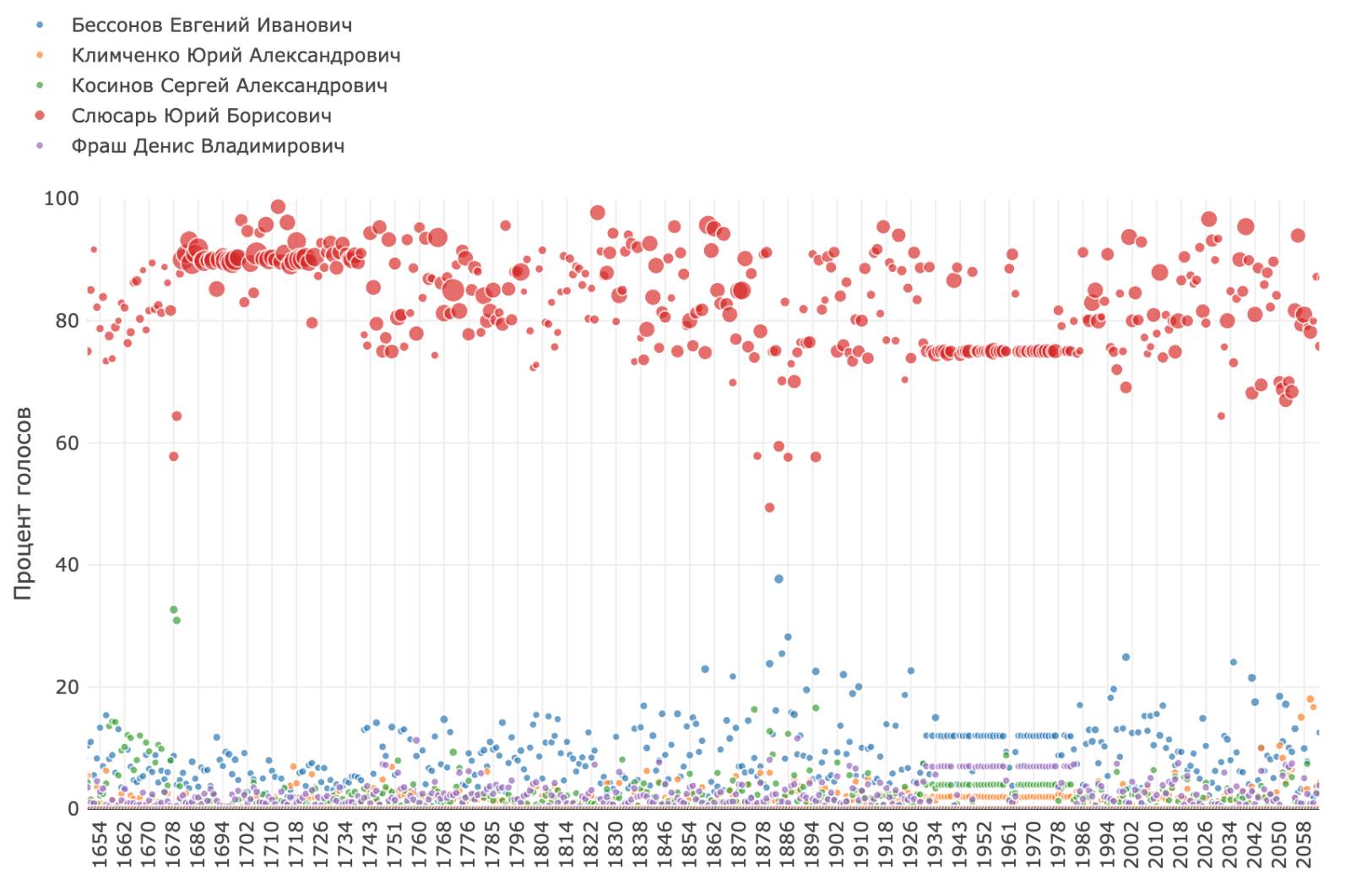
In Rostov, different districts probably received different “target fugires” from above. In some cases, falsifiers were “creative”: Slyusar was given a flat 90% (Fig. 5, upper left corner) while rivals’ numbers varied. In others, like Proletarsky district (Fig. 5, upper right corner), all candidates’ figures were drawn in neat straight lines — Slyusar with 75%, others with proportional but perfectly lined up shares: below 10% each to Denis Frash (LDPR), Sergei Kosinov (Just Russia), and Yury Klimchenko (Pensioners’ Party).
Fig. 5. Candidates’ results by polling stations in Rostov Region.
Red dots: Yury Slyusar.
5. Krasnodar Krai – Veniamin Kondratyev and the most rigged elections
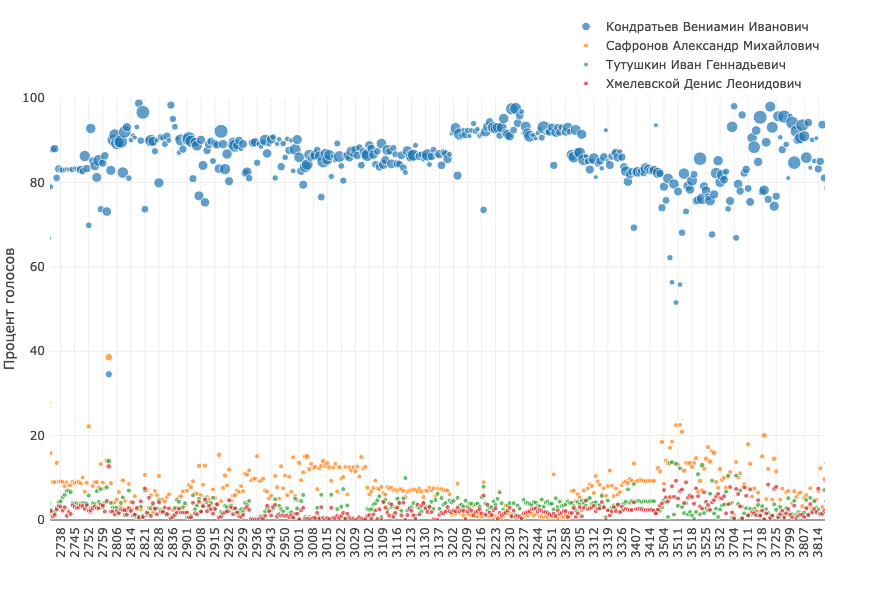
According to Shukshin, Krasnodar deserves the title of “the most rigged elections.” The region saw the largest number of reported procedural violations during voting. But commissions also falsified the actual tallies, drawing entire “lines” of results across cities such as Kushchyovskaya, Leningradskaya, Labinsk, and Novokubansk (Fig. 6).
“[Based on the distribution of dots - REM] Each city picked whichever figure it wanted to fabricate”, concludes Shukshin.
Fig. 6. Candidates’ results by polling stations in Krasnodar Krai.
Blue dots: Veniamin Kondratyev.
Notably, on 15 September 2025, the Krasnodar regional branch of the Communist Party (CPRF) refused to recognize the election results.
6. Other Regions: Likely the Same Falsifications Everywhere
The visualized graphs are available on the website of Vyboroteka — a database for electoral data. The data from the 2025 gubernatorial elections has already been added to the project website.
Even a brief look at the official election results across regions suggests that the fraud was systematic.
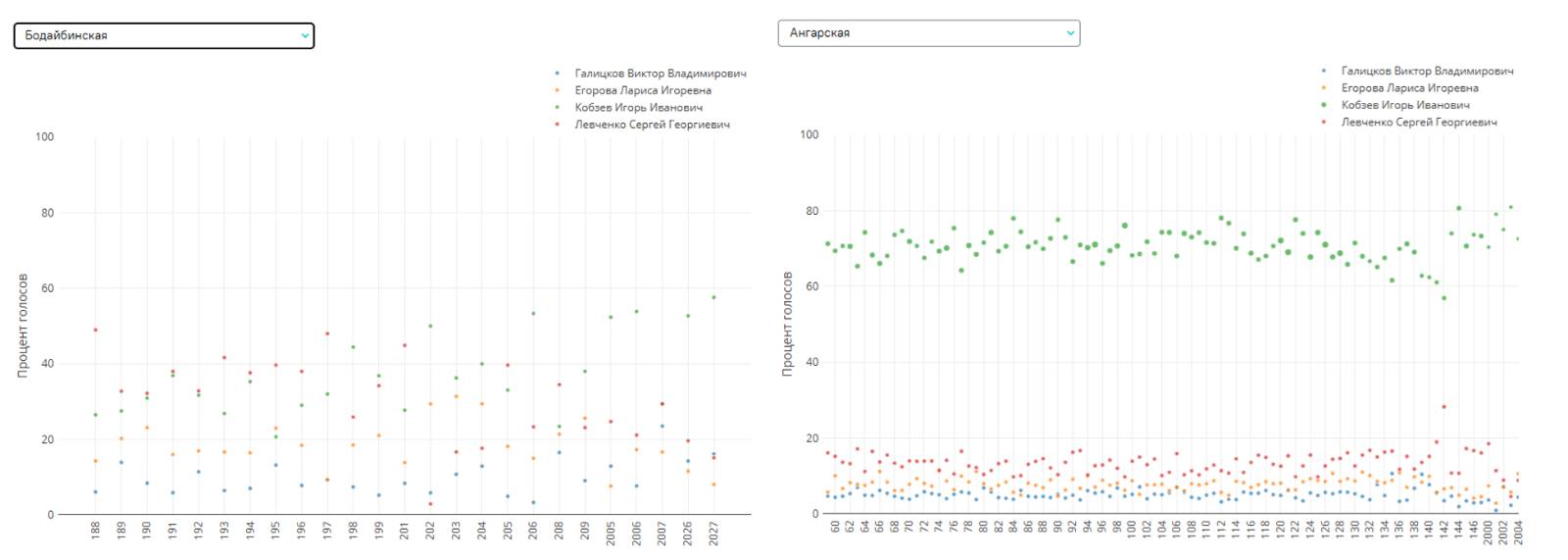
For example, Figure 7 contrasts two graphs — official results from the Irkutsk Region. On the left, there are results from Bodaiybo city (likely reflecting actual voter distribution); on the right, results from Angarsk (clearly manipulated). Such examples can be found in every region where gubernatorial elections were held on 12-14 September 2025.
Fig. 7. Actual vs. fabricated results for Irkutsk Region governor.
Green dots: Igor Kobzev (United Russia), red: main competitor Sergey Levchenko (CPRF).
7. Conclusions
The main takeaway from Shukshin’s statistical analysis is that Russian elections reflect not the will of the voters, but the will of the authorities.
Even if a particular region was not flagged for fraud by the simple detection method described above, this does not imply that the voting there was fair. Other forms of manipulation — such as ballot stuffing — may have been employed, which are detectable only through more advanced techniques like Shpilkin’s analysis.
According to Shukshin, the primary driver behind this widespread falsification is the authorities’ desire to avoid second-round runoffs — races that Kremlin-backed candidates could easily lose if votes were counted correctly. This is what leads to the consistent manipulation toward victories in excess of 60%.
“People often ask me how much candidates would have received without falsifications. When election commissions across the country are fabricating results, we can only guess. But there are additional analytical methods that can bring us closer to the truth. I’ll present them in the second part of my report”, Shukshin concludes.