Express review of the second voting day on 7 September
08.09.2024





Based on the Golos report, REM summarized the key trends observed during the second voting day.
During the second day of voting, the Golos Movement received 101 reports to the Map of Violations and through other channels. The top five regions by the number of reported possible violations on 7 September are:
1. Moscow - 31
2. St. Petersburg - 16
3. Moscow Region - 12
4. Krasnodar Region - 11
5. Leningrad Region - 8
Main trends of the second voting day
The second day of voting continued the same trends seen on the first day. Namely, mass coercion of voters, including with the use of digital tools (REV, QR codes), scandals at Moscow polling stations because the election commissions refused to issue paper ballots to voters, and obstruction of observation. In addition, Golos received reports containing signs of systemic falsifications or preparations for them, as well as bribery and ‘carousels’ (i.e. multiple voting of the same people at different polling stations).
Signs of coercion to vote
There have been reports from several regions that managers are forcing their employees to report turnout using geolocation, which confirms voting at a particular polling station. This is done using ‘Geo-SMS’, a mobile application that tracks the phone’s geolocation.
Such reports were received from Tatarstan, Krasnodar Krai, Penza and Ryazan oblasts, and St. Petersburg.
Members of election commissions were involved in the coercion of voters, as at some polling stations QR codes for reporting were located right in the voting premises or near them.
Reports of voter coercion (without the use of technical tools) were received from Vladimir region, Tatarstan, Samara region, and Altai Republic.
At the polling station in the Vsevolozhskiy district of the Leningrad region, voters came to the polling station with printed notes that said who to vote for. One of the voters said that he was given that note. Observers at the polling station reported that there were many voters with printed notes.
Signs of possible falsifications
Multi-day voting provides ample opportunity for vote-rigging, and its signs became evident on the morning of the second day of voting. After the first voting day was over, and when casted ballots were left in the voting premises overnight, doubts about their safety began to emerge. Observers reported violations of procedures for packing and overnight storage of ballots in the Moscow Region, St. Petersburg, Khabarovsk, and Bashkortostan.
Throughout Saturday, there were reports from at least two regions - St Petersburg and the Chelyabinsk region - of ‘carouselers’, i.e. people who vote illegally at multiple polling stations.
Voting at home also provides opportunities for rigging, as it is difficult to control. Multiple reports of possible violations in the organization and conduct of home voting came from many regions, in particular from St. Petersburg and Leningrad Region.
Turnout fraud
Initial analysis of statistical data showed anomalies in voting behavior that cannot be explained by anything else than falsification. For example, in Bashkortostan, the identical turnout data for Friday morning and Friday evening for many polling stations within one territorial commission can be seen. This is visible on the diagram in the form of ‘even parallel bars’ (each bar consists of points, each point - one PEC, the lower bar - morning turnout, the upper bar - evening turnout). Normally, the points should be scattered, as no one ever comes in formation at many polling stations in parallel, but in Bashkortostan such miracles happen regularly. The graphs show how anomalous such identical results are.
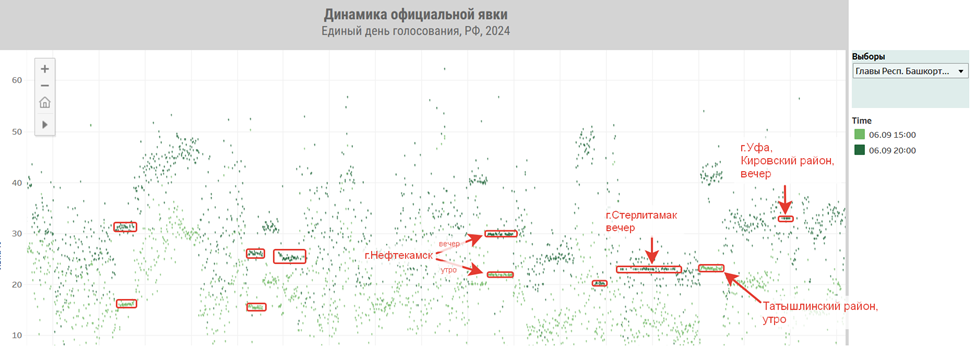
Source: Golos report
Unsurprisingly, the official turnout in Bashkortostan has already reached 52 percent in two days.
E-voting
The electronic voting system in Moscow is generating conflicts at PECs over refusals to issue paper ballots to voters. The full picture is yet to be clarified, but first voter complaints indicate that commissions have hardened their stance and started to refuse almost all voters requesting paper ballots. On Saturday, 7 September, only three (!) cases were recorded in the whole of Moscow, when commissions issued paper ballots to the voters who did not ‘order’ paper ballot in advance.
In Moscow PECs, the same type of notices signed by PEC chairpersons appeared and were handed out to independent commission members and observers. The notices stated that ‘attempts to induce’ voters to choose one or another form of voting (e.g., using a paper ballot) would be interpreted as violations of citizens' constitutional rights and could result in administrative and criminal liability.
Obstruction of election observation
Observation on election days 6-7 September was as difficult as it gets; observers were prevented from entering polling stations, and some were even subjected to reprisals. Reports of violations of the right to observe elections were received from Krasnodar Krai, Moscow, St. Petersburg, Rostov Oblast, Lipetsk Oblast and other regions.
There are cases of interfering with video surveillance, which has already become quite limited compared to its initial purpose, according to which ‘any person, without leaving home, could make sure that the elections are fair’ (proposed by Vladimir Putin in 2012). Now, to get access to camera records, it is necessary to apply to the regional public chamber. However, this does not necessarily guarantee the access to video from polling stations. For example, in St. Petersburg, it is impossible to get into the so-called ‘observation center’, because it allegedly does not have enough capacity.