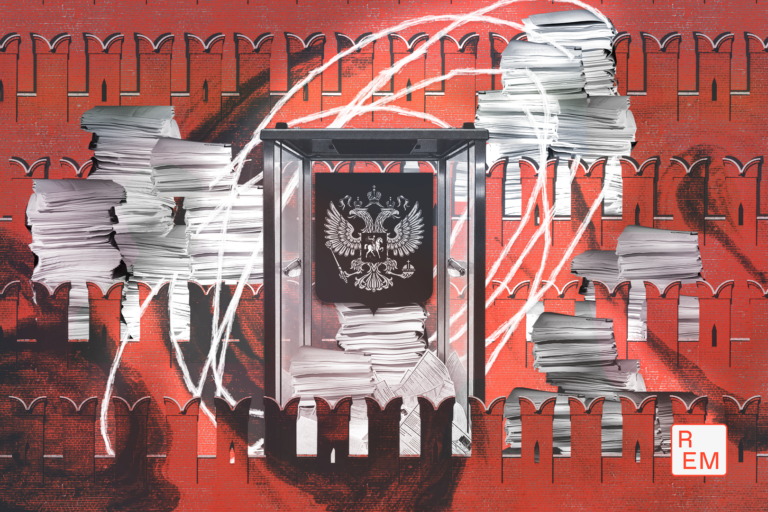
How the authorities allure Russians to the election to increase the turnout
13.03.2024





The Russian presidential election will be held from 15 to 17 March 2024. In the run-up to it, Russian cities have been flooded with election advertisements.
For years, the authorities have been inventing various ways of alluring Russians to take part in the elections. On the one hand, they come up with entertainment programs, festivities, drawings of lottery and sales organized right at the polling stations. On the other hand, administrative pressure is used to force voters to participate in the elections.
The 2024 campaign is no exception. In this article, we review the instruments used to allure Russian citizens to the polls and analyze why it is necessary at all.
Carrots
On 14 March 2004, an 11-year-old girl named Alina [name changed] was playing piano in the hallway of her school in a small town in central Russia. On that day, the country was holding presidential elections, and Alina’s school became a polling station. On this occasion, a concert was organized in the hallway.
“I remember very well that it was a holiday of some kind. I just wanted to bring people joy with my music, and that was it. Of course, I had no interest in politics whatsoever at that time. But now I realize that it was not an ordinary event. It was probably the only time I participated in a concert from the school”, Alina recalls 20 years after that concert.
No one explained to Alina at that time what the occasion actually was. She was playing “Barcarolle” by Ukrainian composer Yuri Shchurovsky. Vladimir Putin won that election with 71 percent of the vote and became president for the second time.
It's hard to say when was the first time that the elections in Russia were accompanied by concerts, fairs, gift-giving and other elements of the show, but in recent years it has become a habit. Alina was in Moscow during the 2018 presidential elections. There was a polling station in one of the student dormitories, and a field kitchen offering the so-called “soldier’s porridge” – buckwheat with stew meat – was set up in front of it.
“There was a line of approximately 30 people [to the field kitchen]. The emphasis was placed on the fact that it was “soldier’s porridge”, and I was confused, because it might be appropriate for the Victory Day, but not for the presidential elections”, the woman said.
By using such soft “carrot instruments”, the authorities are trying to increase the voter turnout at important federal elections. For example, in 2018, the Presidential Administration wanted to get 70 percent of the votes for Vladimir Putin with a turnout of 70 percent. According to electoral experts, the authorities are trying to increase the turnout to underline the legitimacy of the campaign and show that the candidate did not just win the elections, but was supported by the majority of Russians.
Kremlin tried to achieve this in various ways during previous presidential elections. For example, in Moscow the authorities ordered to give out free concert tickets to those who voted for the first time, and in Yaroslavl - sell cheap pastries near polling stations.
In 2018, the authorities paid special attention to voting among young people and entire families. The “Big Family Games” and “Election Photo” campaigns were launched specifically for this purpose before the elections in order to “create a positive background at polling stations” and hold the elections in a festive atmosphere. Concerts organized by the “Russian Youth Union” were also supposed to help increase the turnout of young people. The director of the organization, Pavel Krasnorutsky, spoke plainly at that time (quoted in an article by RBK):
“Many universities and colleges will house polling stations, and we hope that young people will come to see their colleagues and, among other things, vote and fulfill their civic duty”.
As a result, in the 2018 elections, Vladimir Putin won 76 percent of the vote with a turnout of 67 percent. After that, the practice of organizing concerts, flash mobs and shopping outlets during the elections spread also to other levels.
Such attempts by the authorities to increase the turnout even became subject of folk art. In Yaroslavl, after the 2018 regional elections, Elkhan Mardaliyev, a member of the regional Duma of the communist party, came up with a joke: “The female citizen Ivanova came to the polling station and: bought buckwheat, took a picture, ate pastries, measured her blood pressure, chose urban improvement projects – and forgot to vote”.
But apart from concerts and cheap food, the authorities use other tools for the turnout increase – administrative pressure on state employees and various ways of forcing people to vote.
Sticks
Russian regions can be roughly divided into three groups in terms of which administrative technologies are used there. The first group is commonly referred to in the expert community as “electoral sultanates”. These include, first of all, the regions of the North Caucasus, national republics and, for example, the Kemerovo Region. In these regions the voting results do not depend on the will of citizens – the results are simply being falsified. Therefore, regional election commissions often report extremely high turnout of around 90 percent in these regions.
The second group consists of regions of mixed type. Electoral fraud mostly doesn’t happen in the regional centers there, they have a well-developed civil society and independent media. However, in rural areas voting results are still being forged. Krasnodar Krai belongs to this group, for example.
The third group includes regions (and the list is long) where it is not customary to falsify elections, and the only thing the authorities can do is to “herd together” voters using administrative pressure.
News about “herding voters together” to polling stations regularly appear in the Russian media short before the elections at various levels. One of the most typical falsification methods is the so-called “carousel voting”, a way of bribing voters. Basically, it means that a voter comes to the polling station with an already filled-in voting form, drops it into the ballot box, and then takes a blank one to exchange it for money with the organizer of the “carousel voting”.
Such a situation occurred in Moscow in 2012 during the presidential elections, but not a single incident of “carousel voting” at polling stations was confirmed at that time. Since 2017, organizing and participating in “carousel voting” has become a criminal offense.
While the “carousel voting” is used largely to influence the voting results directly, administrative pressure is used in a different way to increase the turnout. First of all, it is used to force public sector employees to vote.
This works as follows: top managers order ordinary employees to go to the elections and present a report on it. Sometimes it’s obligatory to bring family members to the polling station. And sometimes even to get struck off the Register of Electors at their polling station and vote, for example, at their job address, so that the managers could easier check up on the execution of their order. Should an employee refuse to act as ordered, he gets threatened with “sticks” - i.e., with reprimands, withholding of bonuses, and employment termination.
Digital enforcement
In 2019, the authorities have come up with a new format for conducting elections – remote e-voting, which was tested at the municipal elections in Moscow for the first time. Some public activists and ordinary Russian citizens were outraged that this tool was non-transparent and could be used for election fraud. By that time, the remote e-voting system showed a turnout of 92 percent, while the total turnout reached a total of 27 percent.
Despite the discontent of experts and observers, the remote e-voting is still used in elections. The authorities started to force the public sector employees to vote using the remote e-voting system.
“The remote e-voting is impossible to control, it is a black box. We assume that the results of [electronic] voting are generated by system administrators and their actions, not by counting actual votes. Forcing the employees to e-vote should only create the appearance that at least some people are using the remote e-voting system, but in reality we cannot know how these votes are or are not counted”, says an expert on the remote e-voting system.
In the presidential election in 2024, the remote e-voting system will also be applied. Moreover, according to the expert, the e-voting was this time introduced in the opposition-minded regions of the North-West, the Urals and Siberia in addition to the border regions. As of 6 March 2024, around 3.7 million people were registered in the remote e-voting system.
At the same time, the other tools described above for increasing the turnout are going to be used in the 2024 elections as well.
Which of these tools are used in the lead-up to the current election?
The election in March 2024 will be the fifth one for Vladimir Putin, and if he wins, he could remain in power until 2030. Back in October 2023, two months before Putin's campaign was officially announced, Verstka reported that the president in office should receive 80 percent of the vote in this election – with a turnout of 80 percent. According to the newspaper's sources, this shall be achieved by “administrative methods”.
In January 2024, Verstka wrote that the main task for Vladimir Putin's political technologists is to ensure the turnout, because “everything is clear with the winner”. The authorities at various levels began to prepare for “ensuring the turnout” well in advance, but so far mostly by using harmless ‘carrots’.
It all started with flash mobs in Kamchatka: there, in February 2024, people lined up in a “tick” - the symbol of elections. Then another action was launched in the region with the self-explanatory name “I am going to the elections of the President of the Russian Federation”. Its goals were announced as follows: “to increase the cognitive activity of students and young people in the field of electoral law”.
In Kaliningrad food fairs will be held during the elections, so that voters could buy cheap products and enjoy performances of various artists. “It’s going to be entertaining not only for adults, but also for children. Therefore, the whole family should come to the fair”, the city hall urges.
In Karelia, they have come up with a different way to invite voters to the polling stations: they will hold a vote for the best “people's teacher” in parallel with the presidential election. The calls to participate in the ‘referendum’ sound like this: “Come to school, choose your favorite teacher”.
One can see that in the current elections the authorities are again trying to encourage whole families to vote – and to actively educate teenagers and even kindergarteners “in the field of electoral law”. In kindergartens in Tomsk, the propaganda was addressed to children – they held a game “To the polls I’d like to go, so just let them teach me”, where the children were offered to vote for “the main characters of the fairy-tale kingdoms”.
But the most popular way of advertising elections is still spreading the outdoor campaigning materials: they can be seen in the entrance halls, on the doors of various shops and administrative buildings. In Chelyabinsk region, door hangers with election advertising were attached to every apartment’s door in one of the buildings. One of the building residents decided to cover the advertisement with anti-war statements – and put it up near the polling station.
Material incentives are also used as advertisement of presidential elections. For example, in Omsk, local residents were promised free bus tickets if they came to the polling stations. The authorities promised to pay for 6 to 8 trips. One bus trip in Omsk costs 30 rubles.
The “sticks”-method, however, is also actively applied in the lead-up to the elections of 2024.
In Krasnodar Krai, the administration of a technical school requires students to go to the polling stations to “ensure the turnout”. The attendance will be taken by SMS. In Voronezh, students of a local state university were forced to fill in a questionnaire on how and for whom they will vote. The university administration also requires students not to leave the city for other regions and to vote in Voronezh.
In Khanty-Mansiysk Autonomous Region, teachers are forced to participate in the elections, while the management of the Rosseti company agitates its employees to register in the remote e-voting system and vote remotely.
In early March, the Golos movement reported that a digital service to control the turnout of public sector employees had been developed on behalf of the United Russia party. A database called Mobilization with voters' phone numbers was created in advance. Each of those listed in the database has received instructions to download a special application required to confirm the act of voting. Moreover, one can check in in the app only at the polling station where he or she is registered as elector, the app is using geolocation tools for that. “This directly violates the secrecy of voting and the freedom of expression, and is prosecuted by law”, summarizes an expert of Golos.
The electoral expert emphasizes: the authorities have a task of achieving higher voting results than in 2018. This needs to be done in order to point out that even under conditions of war and confrontation with the West the society is consolidated around the president and “provides him with a mandate to do whatever he wants”.
“[The authorities] need to make it clear that the society is not tired of its national leader even after 24 years of him being in power. So our elections are a ritual event of some kind. While in well functioning democratic systems the elections are held out for people to choose the government, in authoritarian systems like ours the elections are held out for the government to check whether the bureaucratic administrative mechanisms still work and show obedience – and for the society to swear allegiance to the leader”, summarizes the expert.