How the Russian opposition is preparing for 2024 presidential elections
11.12.2023





The Russian presidential election will be held on March 17, 2024. The incumbent president of the Russian Federation, Vladimir Putin, is to stand for a fifth term. Putin, who is 71, has already been in power in Russia longer than any ruler since Stalin. A new term, if he was successful, would see him remain as president until at least 2030.
There is little doubt that the Kremlin will make every effort to keep Putin in power. By and large, the vast majority of opposition figures have been forced to leave Russia and are currently in exile. Many of Putin's opponents are in prison. Some of them have been killed.
However, even under these circumstances, there are political figures who are willing to challenge Putin. Dissenting oppositionists and movements are discussing possible scenarios, arguing with each other and uniting efforts to use the upcoming elections as a window of opportunity for regime change.
We have gathered different perspectives in this review to discuss what to expect from the elections, how the opposition intends to act and what it recommends to the voters.
Why going to the polls in 2024?
The Russian opposition of today consists of politicians and public figures who emigrated long before the war in Ukraine has started (for example, Garry Kasparov and Mikhail Khodorkovsky), of those who left because of the war (including Maxim Katz), as well as of those who stayed in Russia by personal choice (Yulia Galyamina, Boris Nadezhdin, and others) or were imprisoned (Alexei Navalny, Ilya Yashin, and others).
Those who have managed to speak out about the upcoming presidential election agree on one thing: the 2024 election will determine the future of the country. And although many regime opponents are convinced that the election results will be rigged and Putin will most likely win, they still encourage Russians to go to the polls.
For example, Yulia Galyamina, an opposition politician and co-founder of the women's political movement “Soft Power”, believes that the authorities would rather benefit if the voters refused to participate in the elections. In reality, voting, even under the conditions that prevail in modern Russia, can develop political intrigue and show the elites the percentage of those who disagree with the regime. Participating in elections during the ongoing war in Ukraine, in her opinion, is a way to express the anti-war stance.
“Elections are thin ice for the power vertical representatives. And a chance for all the dissenters. It's a chance that can be created, or it can be disgustedly disregarded. In some situations, disgust is just not an option. In 2020, the Belarusians did not win. But they have created a chance for victory”, - commented Galyamina.
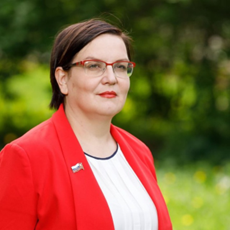 Yulia Galyamina. Source: https://t.me/galyamina
Maxim Katz, a former municipal deputy and video blogger with millions of followers, is convinced that the 2024 elections will become a place for the society to decide “whether Russia needs Putin's system at all”. "If anyone asks us whether we are against United Russia and Putin or not, we shall always go and say we are against – especially since this effort costs nothing”, - said Katz.
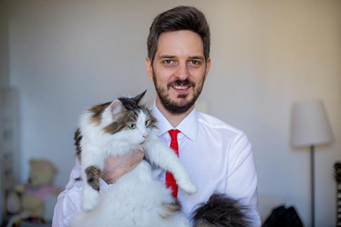 Maxim Katz. Source: https://t.me/maximkatz
Katz relies on the official opinion polls showing that at least 20% of Russians are not satisfied with the current state of affairs. These people will no longer vote for Vladimir Putin, and they are exactly the ones who should be convinced to go to the polls according to Maxim Katz.
In the fall of 2023, Mikhail Khodorkovsky, the founder of the Open Russia movement, which is banned in Russia, called on the opposition to agree on a common line of conduct during the 2024 presidential campaign. In October, the Coalition of Anti-War Forces, an alliance of democratic forces organized with Khodorkovsky’s help after a conference in Berlin, launched a PR campaign with the slogan "No to Putin!". Its goal is to use social networks, outdoor advertising and door-to-door campaigning to urge Russians not to vote for Vladimir Putin. Apart from Khodorkovsky, the chess player Garry Kasparov, the economist Sergei Guriev, the economist Sergei Aleksashenko, and other political exiles are members of the Coalition.
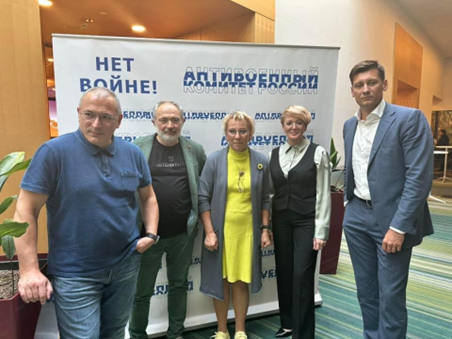 Source: https://t.me/mozhemobyasnit
One of the Coalition members, former Duma deputy Dmitry Gudkov, mentioned different approaches existing among the association members on how to act during the elections: “Some members think that the elections should be boycotted, while others want to encourage people to vote for one of the registered candidates. However, almost everyone supported the idea of coming to the polls at the same time”.
After the regional elections in the fall of 2023, the opposition began to develop possible strategies for the presidential elections in the spring of 2024. Their positions in this respect diverge.
How to vote?
Maxim Katz has started the discussion on how to vote in the presidential election. His main point is that it’s necessary to choose any candidate whatsoever from the ballot except Putin, and collectively vote for him in order to lower the rating of the president in office. It even doesn't matter who exactly it’s going to be, because the Central Election Commission won't register really strong competitors of Putin anyway. Katz has also proposed an election slogan: “Let's just bring everything back to normal, let's just cancel all this [Putin and the war]”. Whereas Alexei Navalny and the Anti-Corruption Foundation he founded opposed Katz's position. From their point of view, it could have worked in the 2010s, but it isn’t realistic anymore.
Navalny wrote: “You should vote not with your hands and feet by going to the polls and throwing [the ballot] in, but with your head. Forget the approach that you can just show up and vote for a party representative. Or for whoever has the least obnoxious face on the poster. You shall think and calculate the candidates' chances. It's a complicated job, and we came up with Smart Voting [a system of campaigning for one alternative candidate] in order to do it for you”.
Navalny also accepts the scenario of boycotting the elections – if there are no alternative candidates on the ballot to be found. “We can't rule out some bottom shelf thrash. For example, only two names on the ballot – Putin and Kadyrov. Go, feel free to choose! I personally can't consider that an election at all. And in this case I will call for a boycott”, writes Navalny from prison. He plans to agitate for a boycott or participation in the voting when the names of registered candidates are known and their election campaigns begin.
Navalny has published a 10-points questionnaire. According to his idea, these questions should help politicians to formulate their strategy for participation in the elections, and voters to understand their intentions. On November 21, Navalny has published the interim results of the survey. Over 54,000 people have filled out the questionnaire, and 2/3 of the respondents have admitted not yet to have a strategy for the presidential election. More than 50% are theoretically ready to boycott the election, and the vast majority agree to vote for “any candidate but against Putin”.
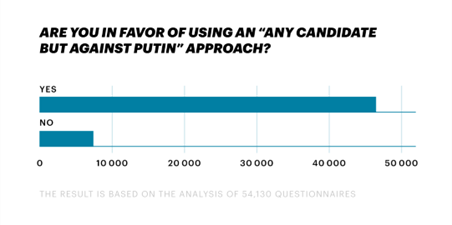 Source: https://navalny.com
Alexei Navalny promised to announce his election strategy no later than January 15, 2024.
Who to vote for?
Among the potential “united candidates” from the opposition proposed by Navalny, the former Yekaterinburg mayor Yevgeny Roizman is in the lead, followed by Dmitry Muratov, editor-in-chief and co-founder of “Novaya Gazeta” and Nobel Peace Prize laureate, and – far behind – Grigory Yavlinsky, leader of the “Yabloko” party. Muratov, however, refused to be a “united candidate” from the opposition, calling Navalny's idea an odd one. Roizman has not publicly commented on Navalny's questionnaire, probably due to the court's ban on the use of communication and Internet facilities as part of the investigation into the case of discrediting the armed forces. Alexei Venediktov, Number 4 in the rating, declared that nobody offered him to run in the elections, and he will not nominate himself on his own.
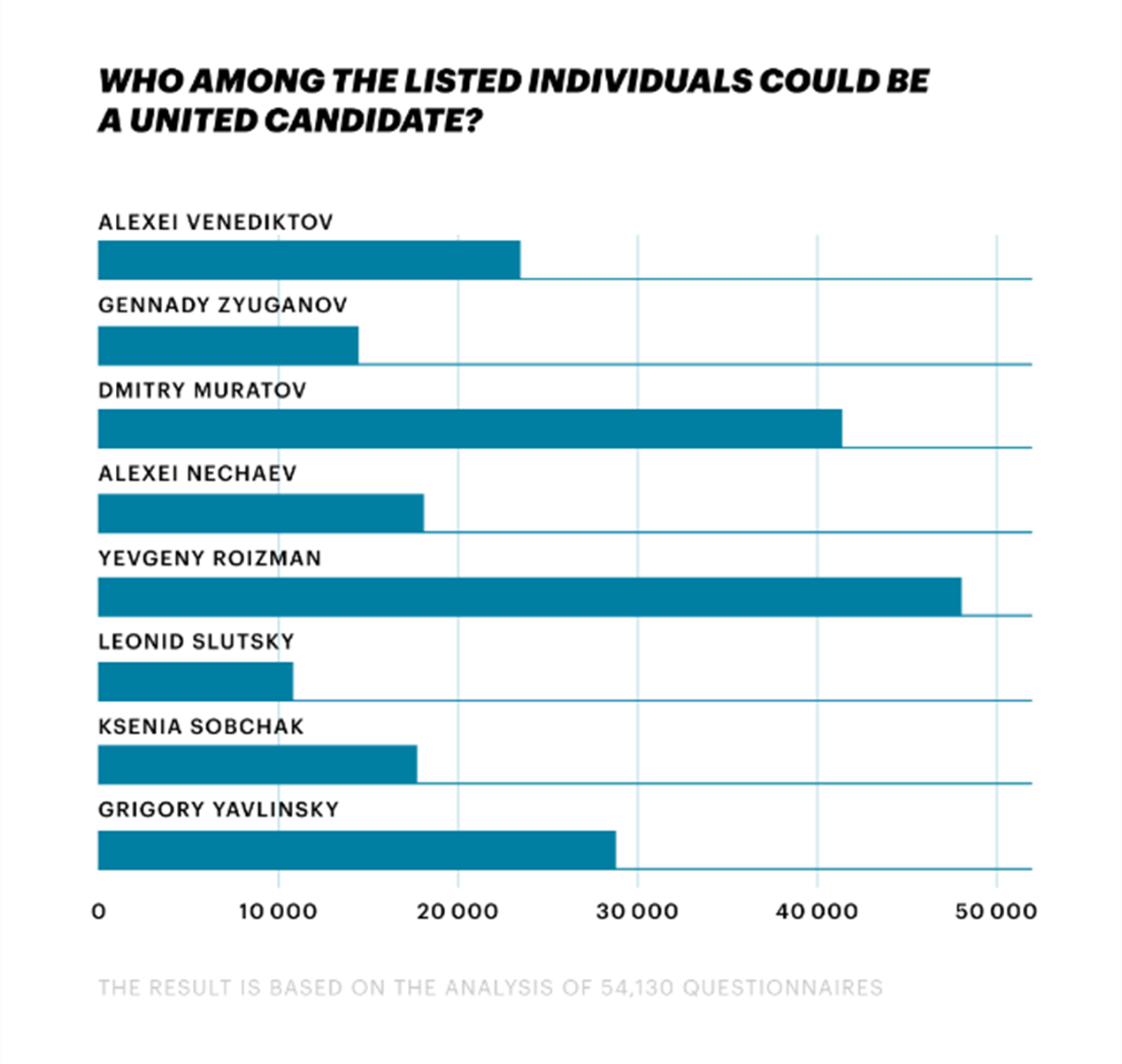 Source: https://navalny.com
At the moment, Grigory Yavlinsky remains the only potential “united candidate” from Navalny's list, and his “Yabloko” party has already begun collecting signatures to nominate Yavlinsky as a presidential candidate.
However, in addition to the politicians and public figures from Navalny's questionnaire, other potential candidates have announced their desire to run for president.
Thus, Boris Nadezhdin became the first candidate to declare his readiness to challenge Vladimir Putin. Nadezhdin claims to be a “professional politician”. He is a deputy of the Dolgoprudny district council in the Moscow region representing the “Just Russia” party and a former State Duma deputy. The politician offered the voters two slogans: “Russia shall become the main country of Europe, not a vassal of China” and “Putin has completely destroyed the institutions of a modern state in Russia – the parliament and independent court”.
Nadezhdin explained his participation in the 2024 presidential election with the words “a duty to my country, my ancestors and my descendants”. He has indirectly criticized the war in Ukraine calling it a “fatal mistake” and a blow to Russia's economy and demography. Soon after these statements, the politician began explaining in interviews that participating in elections (or handing over power to a successor) is the only correct way to change the regime. Nadezhdin was supported by the “Civic Initiative” party, founded by a member of the Boris Yeltsin government and former economy minister Andrei Nechaev (his name can be found in Navalny's questionnaire on the 5th place). In 2018, the journalist Ksenia Sobchak has represented this very party when participating in the presidential election, gaining 1.6% of the vote. She has recently announced that she has no intentions to run in 2024.
Ekaterina Duntsova, a journalist, activist and ex-member of the Tver region Municipal Council, has announced her candidacy on November 18. Her slogan for the elections is “Let's give Russia its future back”. She has been fighting for several years for the return of direct mayoral elections in her hometown of Rzhev (Tver region). Duntsova explained her desire to participate in the presidential campaign by the fact that “for the last decade the country has been moving in the wrong direction: the course taken does not lead to development, but to self-destruction; every day the life of ordinary Russians is becoming more and more difficult”.
Democratic reforms are in the center of Ekaterina Duntsova's election program. She promises to end the war in Ukraine, release political prisoners, reverse repressive laws and restore Russia's relations with the outside world. She also plans to spend money on improving the lives of citizens instead of buying new tanks. After the statement, Duntsova and her headquarters started the process of launching an initiative group to nominate her a candidate and collect signatures, since self-nominated candidates have to submit at least 300,000 signatures of voters in their support to the Central Election Commission in order to be registered.
Following the democratic candidates Boris Nadezhdin and Ekaterina Duntsova, the former “defence minister” of the “Donetsk People's Republic” (Donetsk Region of Ukraine, annexed by Russia and formerly a self-proclaimed separatist entity) and former FSB officer Igor Strelkov (Girkin) announced his desire to run in the elections. The statement was written in the pre-trial detention centre, where he is being held because of charges in an extremism case. Sergei Udaltsov, coordinator of Russia's socialist movement “Left Front”, announced that Igor Strelkov would take part in primaries to nominate a “united candidate” for the presidential election “from leftist and patriotic forces”.
In 2022, the court in The Hague found Igor Strelkov guilty in the MH17 criminal case over the crash of the shot-down Malaysian Boeing and the killing of 298 passengers. Alexei Navalny called Igor Strelkov a political prisoner, linking the criminal case against him to Strelkov's criticism of the Russian authorities. Mikhail Khodorkovsky also reacted in the same way.
Strategies for the opposition
The representatives of the Coalition of Anti-War Forces have agreed not to recognize the results of the voting should Vladimir Putin win. Coalition activists called for dialog with the Anti-Corruption Foundation and even formed a group of mediators to coordinate with Navalny's team. Navalny himself said he was not going to cooperate with the Coalition.
Navalny wrote: “We are not going to participate in this bike-shedding. We neither have time nor desire for this. We understand our plan for the presidential elections: polls, focus groups, research, analysis of data provided by the campaigning machine that [Navalny's associate Leonid] Volkov is working on”.
As a result, the Russian opposition remains divided, still trying to find answers to the main questions of the presidential campaign: Whether to participate in the election or boycott it? How to vote? And who should become the “united candidate”?
Old conflicts at the personal and institutional levels, as well as attitudinal differences prevent politicians from making certain decisions. On the other hand, the Russian government adds to the uncertainty: Vladimir Putin remains silent, although he was expected to announce his participation in the elections in early November. The main achievement of the opposition in this situation could be to understand the logic of the current political machine and, by joining the efforts, to at least inflict a noticeable reputational damage to the system, if not to beat the opponent on his field.