How voter signatures collection turned into an impassable barrier for the opposition
08.02.2024





Boris Nadezhdin, an anti-war candidate for the Russian presidency, was not registered as such by the Russian Central Election Commission. Being nominee of a non-parliamentary party, he needed to submit 105,000 signatures of Russian citizens in support of his candidacy. He did so, but the working group of the Election Commission invalidated 9,209 of the signatures submitted for verification. The number of rejected signatures exceeded the 5% legal limit for errors.
In this review REM explains how Russian election commissions use the signatures as a tool to eliminate undesirable candidates, and who is to blame for Boris Nadezhdin's rejected documents.
Artificial barrier for oppositionists
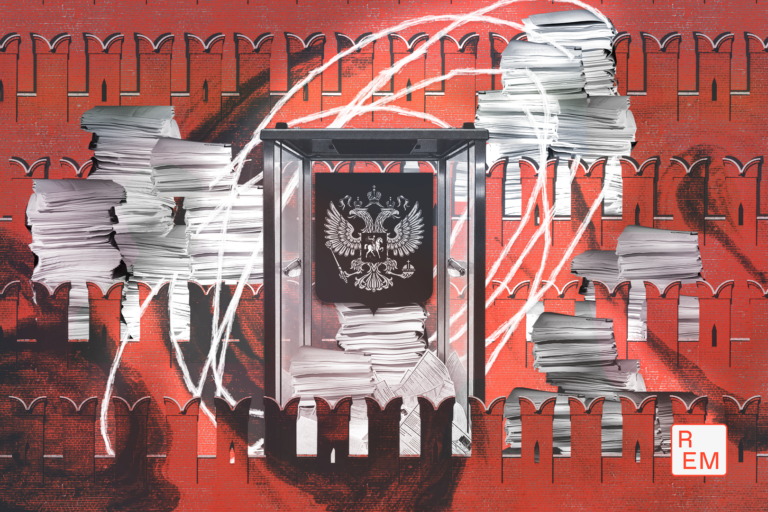
The practice of collecting voter signatures to register a candidate for elections exists in various countries. But in Russia, this tool has been perverted by the notorious mechanisms of administrative intervention: officials support the pro-government candidates in collecting signatures (that’s how the signatures in support of Vladimir Putin were collected during the current campaign), while the signatures in support of opposition candidates get “rejected” by election commissions thus leading to denial of registration. Technically, it looks as if an opposition candidate failed to fulfill the requirements of law. But in fact this becomes an artificial barrier, which is almost impossible to clear.
In the last decade, the practice of registration denial for this reason has been widely used both at the federal and regional levels. In 2015-2016, election commissions did not allow candidates from the “Party of People's Freedom” (Parnas), co-chaired by Boris Nemtsov and former Russian Prime Minister Mikhail Kasyanov, to participate in the elections. In 2016, election commissions removed all “Parnas” candidates running for the St. Petersburg Legislative Assembly from the elections.
In 2019, Alexei Navalny's associates Lyubov Sobol and Ivan Zhdanov, as well as opposition politician Dmitry Gudkov, were not allowed to participate in the Moscow City Duma elections. Members of the election commission have decided that some signatures in support of the candidates belonged to deceased persons. The politicians failed to prove the contrary.
Alexei Navalny's supporters witnessed the signatures of people they personally knew being declared invalid. In 2020, four employees of Navalny's local campaign offices failed to qualify for the Tambov City Duma elections. Candidate Diana Rudakova said that the signatures of her husband, relatives, and neighbors were invalidated. Another candidate, Leonid Yarygin, claimed the signatures of his mother and a friend being declared invalid.
In 2021, Anton Furgal, son of the arrested and convicted governor of Khabarovsk Krai Sergei Furgal (his arrest in 2020 spurred a wave of protests by his supporters that still lasts), tried to get elected to the State Duma. He collected the required amount of signatures, but almost half of them were declared unreliable and invalid by the election commission.
According to Russian election observers, on the single voting day in 2023 not a single candidate from non-parliamentary parties in four regions – Zabaykalsky Krai, Arkhangelsk, Irkutsk, and Kemerovo Regions – was able to get registered based on voters' signatures.
Candidates supported by the authorities, as well as “spoilers” – parties and candidates who are supposed to pull votes away from the official opposition – rarely face problems with registration. For example, nominees from the party “Communists of Russia” get successfully registered most of the time: usually fewer than 5% of their signatures are declared invalid, which is within the acceptable limit for errors. This time, however, the Central Election Commission found a large number of defective signatures in support of the presidential candidate from the party “Communists of Russia” Sergei Malinkovich. Some experts believe that this was done, first, to show that not only signatures in support of Boris Nadezhdin got “rejected”, and second, to slow down the procedure of rechecking objections from Nadezhdin's team: something like “it took a lot of time to work with Malinkovich's signatures”. Malinkovich himself gave up the claims to the Central Election Commission for not being registered.
Who drains Nadezhdin away?
There are at least two versions explaining why some of Boris Nadezhdin's signatures were declared invalid by the Central Election Commission. It might be a long-established custom of sorting out oppositionists, and/or “sabotage” from within the candidate's team.
The “Novaya Gazeta Europe” newspaper published an article exploring the version of a “frame-up” by the candidate's own supporters. The article citing several volunteers claims that part of Nadezhdin's team, working on behalf of the “Civil Initiative” party, could have deliberately prepared unverified or even forged signatures for submission to the Central Election Commission. Andrei Nechayev, chairman of the “Civil Initiative” party, referred to this version as to a “lie”.
Political observer Andrei Pertsev rather does not trust the information from this article in “Novaya Gazeta Europe”: “I don't really get the point of this version. The text does not clearly state why it [forgery of signatures] was done. Either to prevent him from being registered, or simply to [increase] the number [of collected signatures]. The first version being just ridiculous; there was no need to throw anything in to get a denial of registration”.
Boris Nadezhdin's team members published photos of some of the signatures after the Central Election Commission's verification. Apparently, the signature scanner and/or the staff of the working group made mistakes when transferring the data for verification. The politician's supporters found misspelled city names (for instance, “Rostov-on-Dom” instead of “Rostov-on-Don”) and street names, as well as misspelled names and dates of birth. The “system” has automatically declared such signatures invalid.
According to Roman Udot, former co-chairman of “Golos”, these mistakes could have been made during the digitization process.
“During the verification of signatures in support of Putin, they sampled the same number of 60,000 signatures but found only 90 problematic signatures. Apparently, this “eye” (signature scanner – REM) favors Vladimir Vladimirovich. One wonders why it finds 9,000 errors when verifying signatures in support of Nadezhdin and only 90 when verifying signatures for Putin. There is a screw loose somewhere. This is the so-called 'hallucination' of the scanner”, the expert said on the air of the “Breakfast Show” on February 7.
The Russian Central Election Commission admitted some typos and errors (858 cases) to be its own fault. However, other claims remained in force. Thus, the CEC considers more than 2,500 signatures invalid, because the dates of their entry were allegedly written not by the voters themselves. And 4,400 signatures were rejected by handwriting experts.
“This is the worst cause, because it is [almost] impossible to challenge”, a Russian lawyer explained to REM. Roman Udot also agrees with this statement: “The CEC always believes its handwriting experts. You can fight it off in court if you bring your own handwriting expert, but the courts usually don't go for that”, he summarized.
Boris Nadezhdin himself declared that he would challenge in Russian courts “not only the denial of registration, but also the very procedure of signature verification and the federal law”. However, there was not a single case in the Russian judicial practice when a candidate managed to successfully validate in court the signatures rejected by the CEC, as well as to reverse the Central Election Commission's decision not to register him. It seems that Russia is heading towards another “boring” election.