Media monitoring: After the elections
17.09.2024





On 6-8 September, various elections took place across Russia, including by-elections for the State Duma, gubernatorial elections, and municipal elections. The Movement in Defense of Voters' Rights Golos recorded nearly 400 reports of violations and highlighted five key trends of the September 2024 elections: record-low competition among candidates, deliberate downplaying of the importance of voting in the media, voter coercion to turnout, obstruction of observation, and a low level of security for voting results.
A team of independent researchers, commissioned by REM to monitor the most popular Russian social media, VKontakte and Telegram, during the Unified Election Day from 6 to 8 September, discovered that people working in the educational system (school and kindergarten teachers), primarily women, were the main campaigners for pro-Kremlin candidates on social media. These are allegedly the same persons involved in election manipulations at the polling stations. Despite state-dependent institutions' strong efforts to promote war veterans on social media, these candidates were only able to secure positions at the municipal level.
“Transparent elections without incidents”
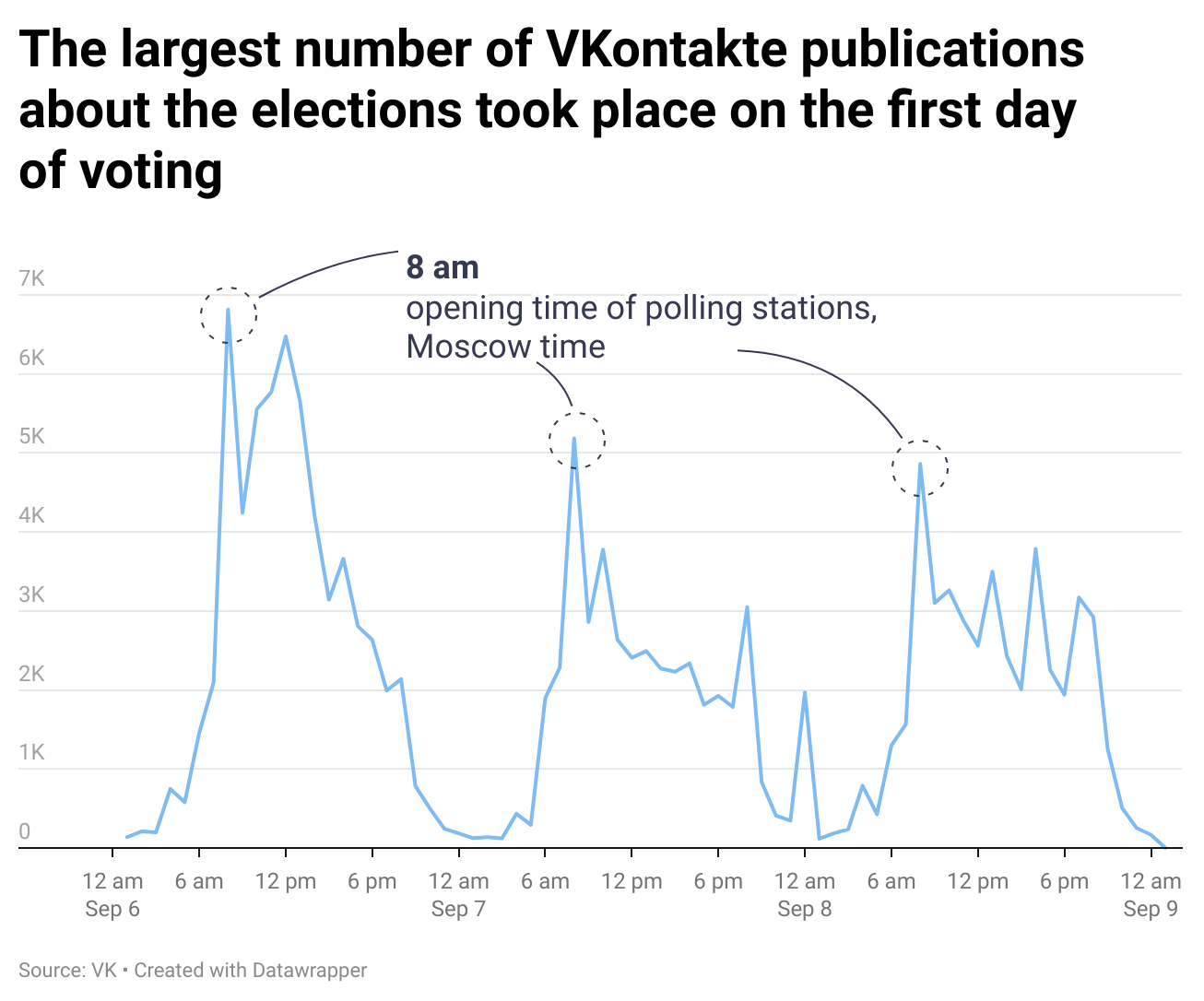
During the three days of the elections, 151.3 thousand posts were published in VKontakte, covering the voting process in 83 regions of Russia. The majority of publications (62.1 thousand) fell on the first day - Friday. On the weekend, including the main day of voting on 8 September, there were 1.4 times fewer posts. Most of the posts were made during the opening hour of polling stations (8 a.m. Moscow time).
More than half of the posts (77.3 thousand) were not unique texts, on average, they were published 12 times and were written according to a template (or standardized guidelines). This suggests that the activity on social media related to the elections was likely artificial and primarily generated by public sector employees.
A particular focus in VKontakte posts was placed on the "legitimacy and transparency" of the voting process. The platform also frequently featured posts about voter turnout and calls to come to the polls, and to participate in prize drawings in particular.
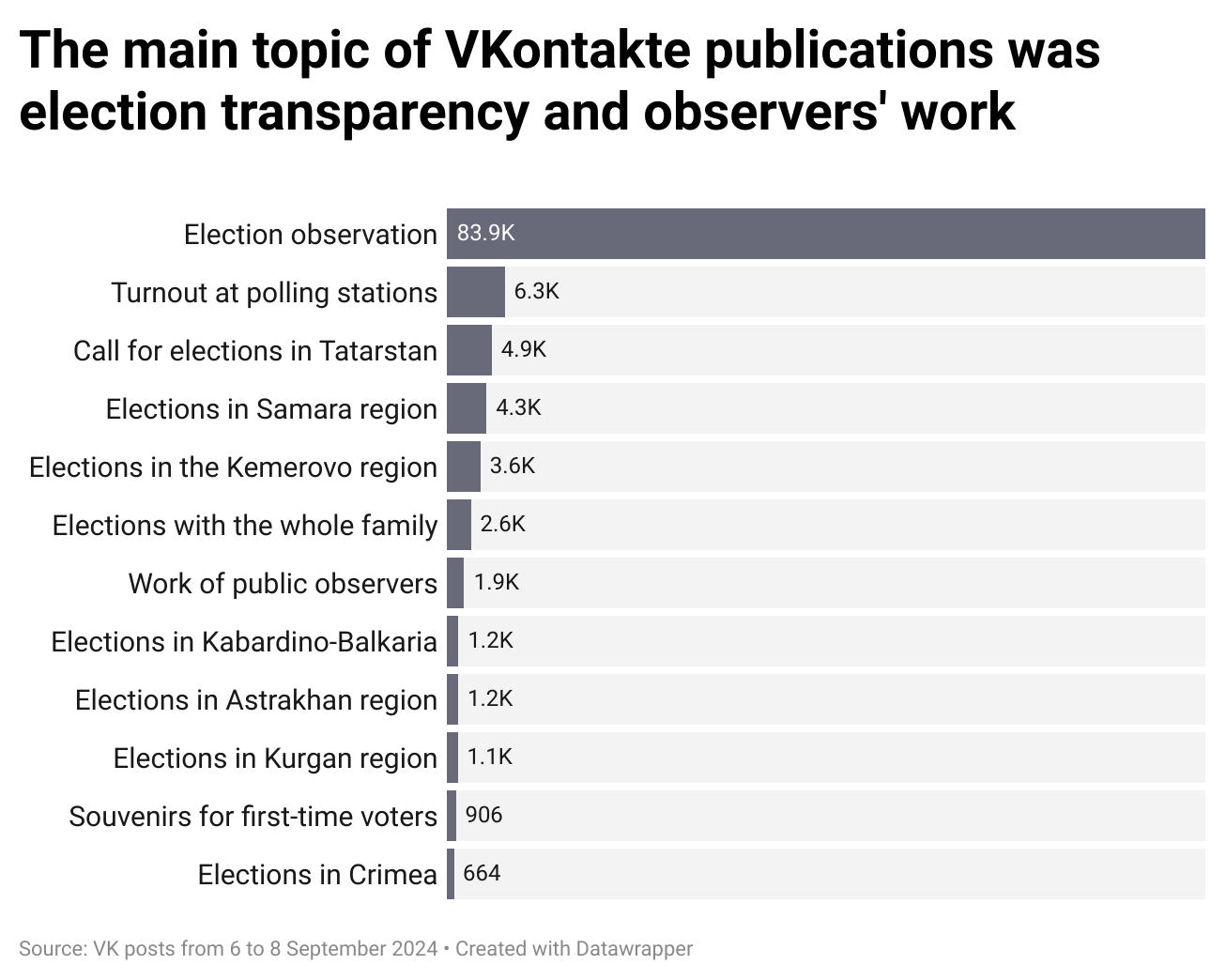
A significant share of VKontakte publications was focused on observation of the voting process. Around 20 thousand posts were made with the hashtag #наблюдаюзавыборами (#observingtheelection). These are publications on personal pages of users, telling about the work of the polling station and election commissions. “The day passed calmly, without any provocations or conflict situations. I was very happy to be an observer in such a friendly team!!!” - wrote an observer at the end of the last day of voting.
Almost all the authors of these posts are women. Only a few of them listed their profession in their VKontakte profiles, mostly as teachers or educators. Although there were not many exact duplicates among the posts, they often contained certain phrases such as: “transparent voting” (649 times), “strict control” (437), “peaceful environment” (151), “friendly atmosphere” (116), “positive start” (113), “festive mood” (96), “friendly team” (25), and so on.
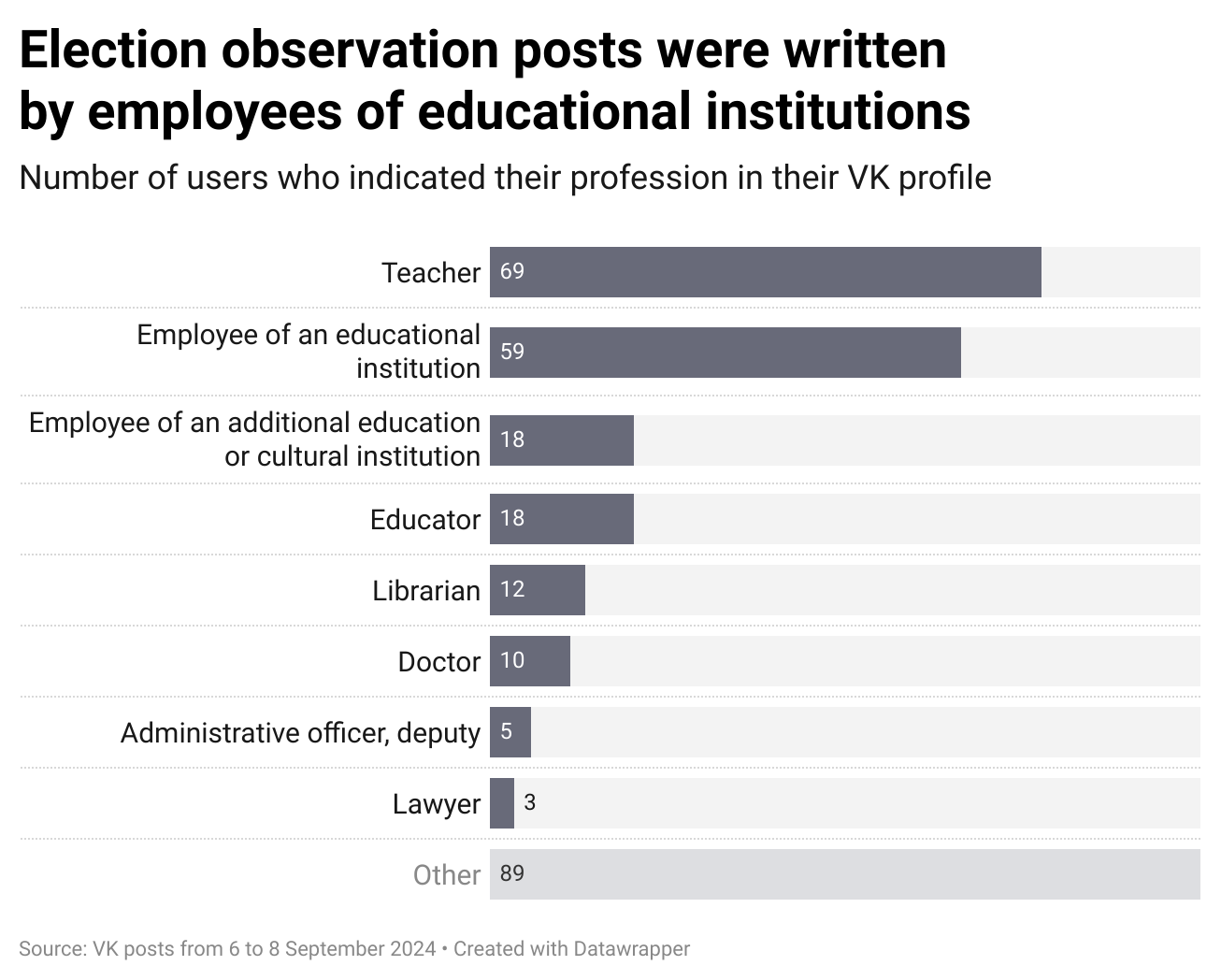
The "calmness and predictability" of the voting process also became a central theme in publications by regional and federal media outlets. "Respect for political opponents and the absence of political scandals – is a feature of many governors running for a second or subsequent term," was a typical message promoted by propaganda media (in this case, an article from ASTV.RU about the campaign in the Sakhalin region).
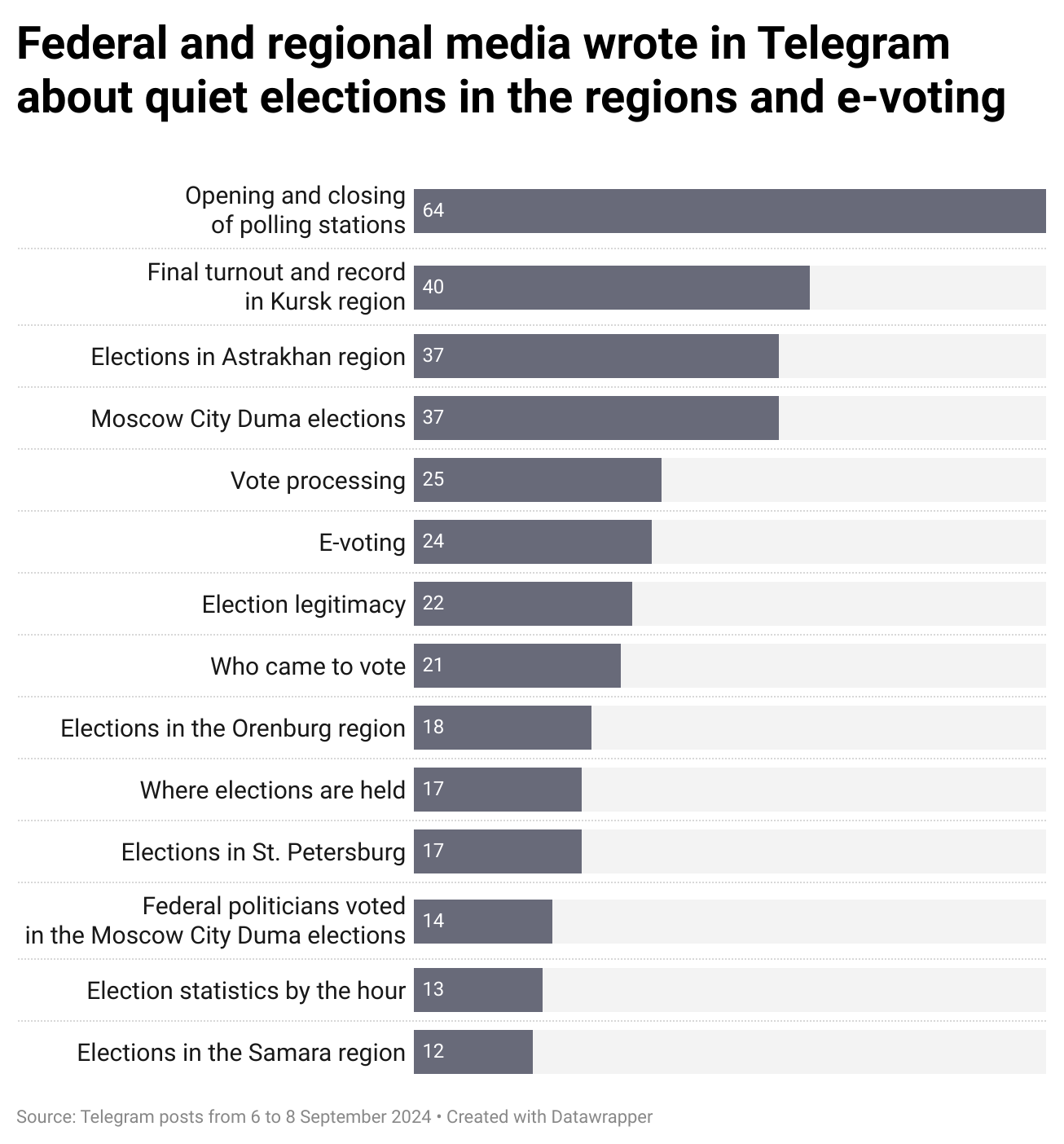
Over the course of the three-day voting period, regional and federal media outlets published several hundred posts on Telegram, with the majority being posted on the last day of voting, 8 September. The media closely monitored the voting process and turnout in various regions, with a special focus on the electronic voting procedure.
Who came to vote
One of the widely discussed news during the elections was the record turnout in the governor's election in the Kursk region, where a state of emergency was in effect due to the invasion of the AFU (Armed Forces of Ukraine). Voter turnout in the region reached 57.24%, compared to 41.56% in the 2019 governor's election. "It's always like this for us: in times of trouble and danger, people unite. In this case, the people showed that they cannot be intimidated by any blackmail, psychological attacks, or shelling", explained the head of the Central Election Commission Ella Pamfilova during a briefing on 7 September.
Social media users actively reported that they participated in the elections. Thousands of posts were dedicated to "family" voting and the fact that different generations of voters come to the polling stations. "Long-livers", "youth" and "veterans of the special military operation (SMO)" were often mentioned in the context of the elections. The latter were referenced in at least 600 posts on VKontakte across different regions of Russia. A separate topic on Telegram was Vladimir Putin voting electronically in the Moscow City Duma elections.
The race of the winners: who was followed in social networks
The most mentioned figures on VKontakte during the recent elections were incumbent governors and acting officials who secured victories. Throughout the three-day voting period, the share of mentions of such candidates compared to their competitors remained generally stable.
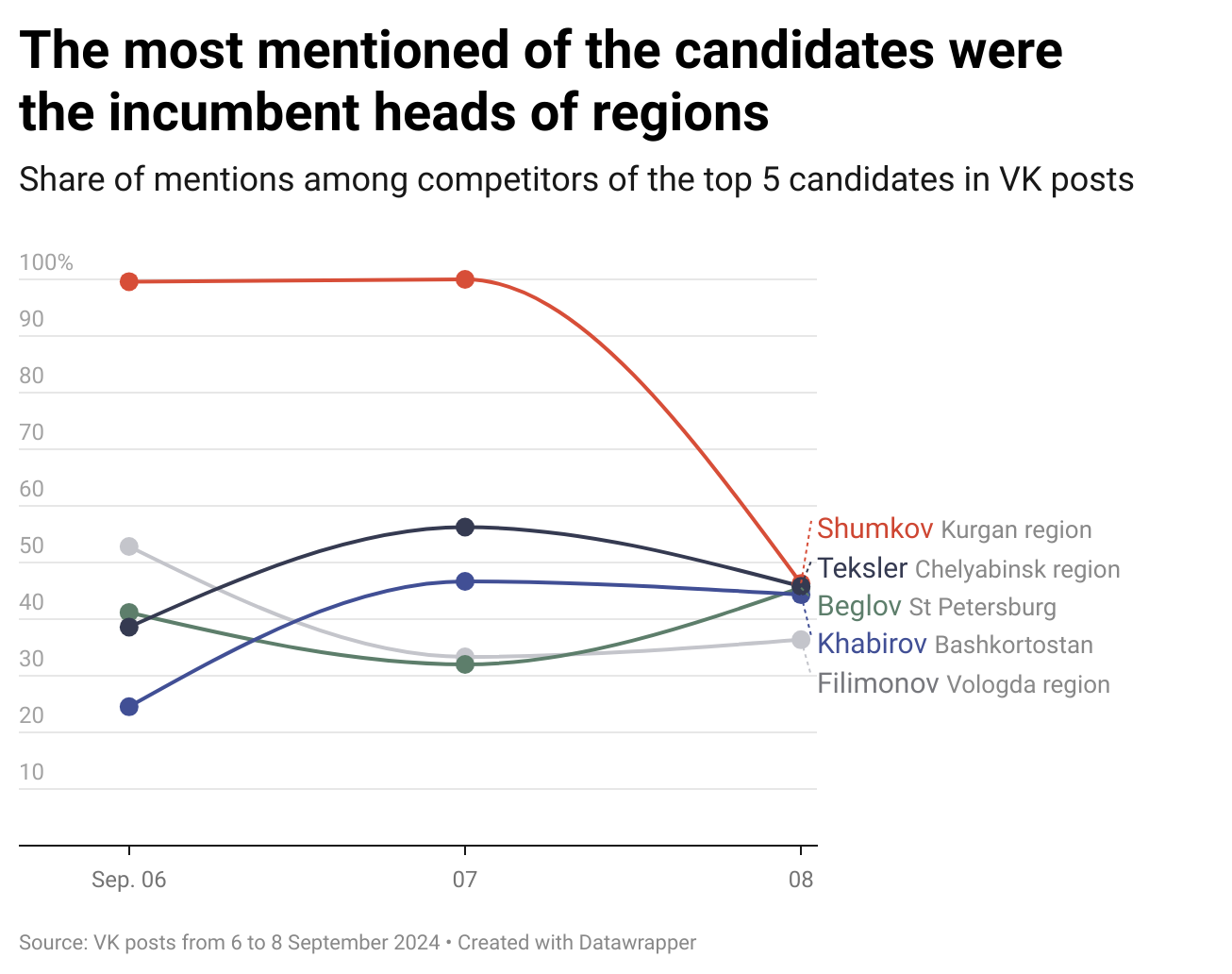
Vadim Shumkov, Governor of the Kurgan Region, was an exception. In addition to the gubernatorial elections in the region, voting for the city council took place and on the first day more than 1,000 posts were published featuring Shumkov’s address to “dear countrymen” urging them to “make a conscious, balanced choice that you believe is right for yourself and for our Kurgan region”. This set a record for the number of posts mentioning any candidate. In the end, Shumkov garnered over 85% of the vote, surpassing even Putin’s regional result in the 2024 presidential election.
Electronic voting
Over the three days of voting, 3.8 million people used the remote electronic voting (REV) system. Almost 3 million of them voted in the Moscow City Duma elections, while the rest voted in 25 other regions across Russia. The Moscow City Duma elections, with 95.5% of votes made electronically there this year, as well as electronic voting in Moscow became one of the main media topics on Telegram.
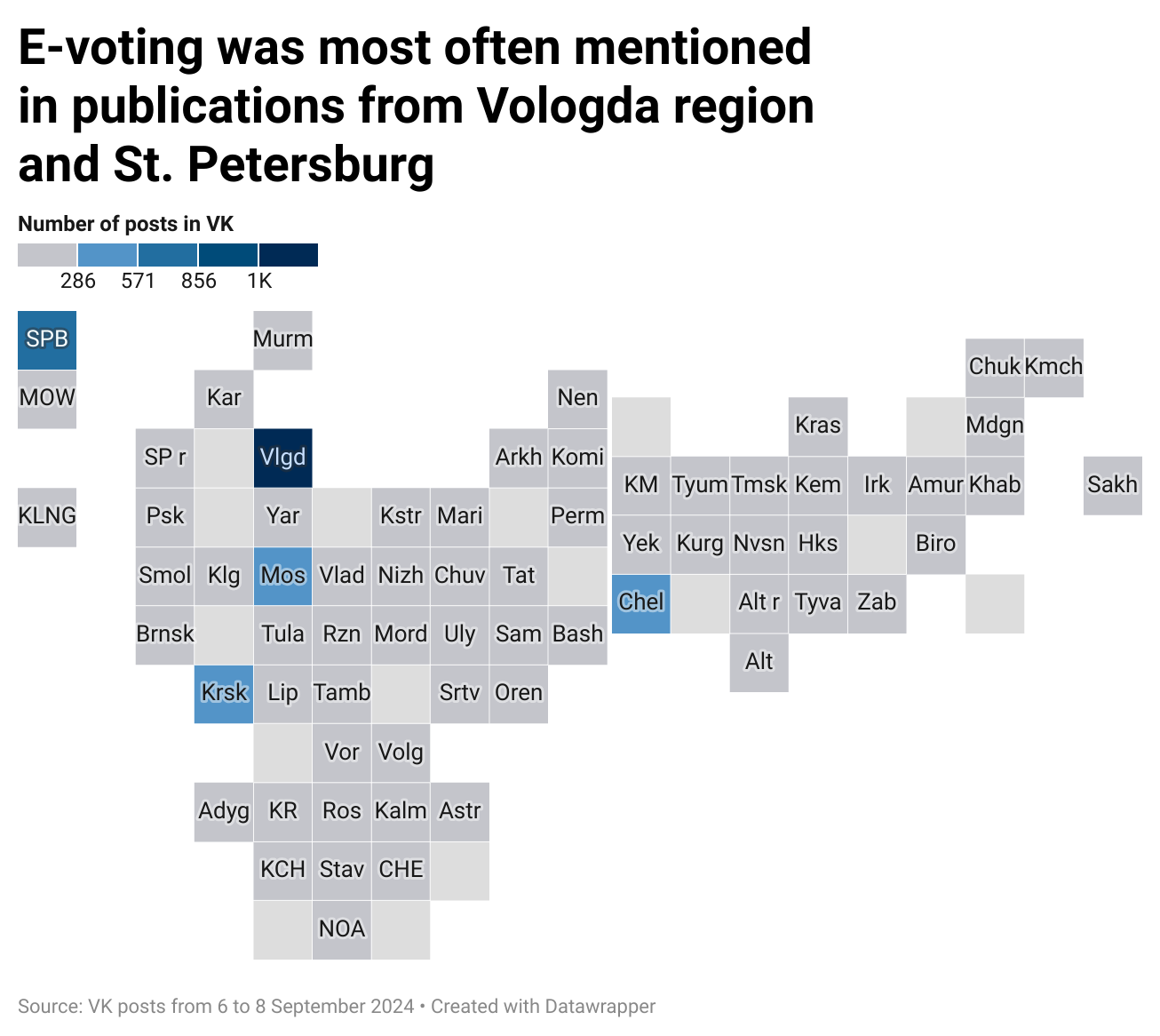
On VKontakte, REV was mentioned in 7 thousand posts, most of them made in the Vologda region (1.4 thousand), St. Petersburg (835) and the Chelyabinsk region (466), where gubernatorial elections were held. E-voting was also frequently mentioned in the Kursk region, where it helped to increase turnout amidst the evacuation of residents from the region.
Counting methodology
- Vkontakte
Using the platform’s API, the research team downloaded all posts from 6-8 September 2024 that contained election-related keywords. After filtering for relevance, the researchers identified 151,311 posts about the elections. Additionally, data about users (region, job title, age, name of a public or a person's name, etc.) was included. Mentions of candidates and e-voting in the posts were counted.
- Telegram
Using the API, the research team downloaded posts from 101 media channels (both regional and federal) during the period of 6-8 September 2024. Using keywords, posts related to the elections were identified, resulting in 480 texts.