Election update V. Putin's presidential campaign has been rigged from the start
17.01.2024





Golos, the Movement in defense of voters' rights, analyzes the way the Russian authorities are preparing for the 2024 presidential election in its Election Bulletin[1], a digest of the main news about the Russian elections.
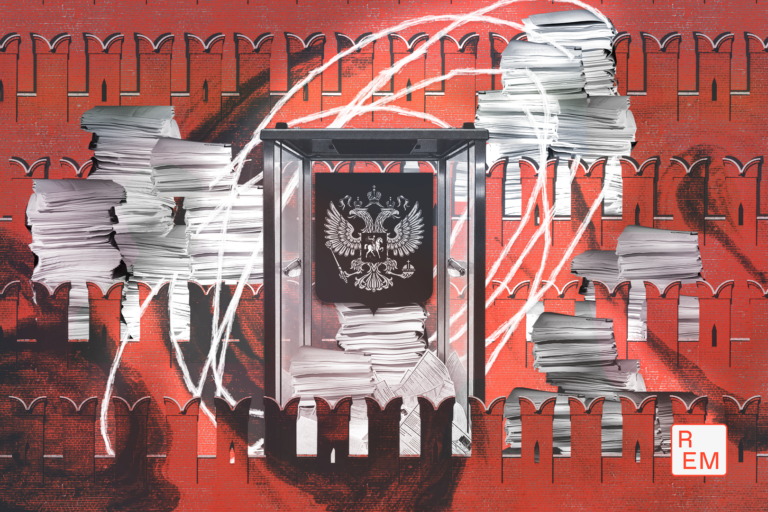
In late 2023-early 2024, the Russian Central Election Commission adopted regulations for candidates to run for the presidency. Predictably, not all applicants were able to pass even the initial technical stage necessary to obtain the status of a registered candidate. Meanwhile, the election campaign of incumbent President Vladimir Putin started with violations of electoral legislation.
In this review, we briefly recap the most significant events of late 2023 and early 2024.
1. Candidates for the Russian presidency have been nominated. There are half as many candidates as there were six years ago.
All candidates for the Russian presidency have been nominated. In total, 15 people have submitted their documents to the Central Election Commission. Nine candidates were nominated by political parties: Sergei Baburin (Russian People's Union), Andrei Bogdanov (RPSS), Vladislav Davankov (New People), Sergei Malinkovich (Communists of Russia), Vladimir Mikhailov (Social Defense Party), Boris Nadezhdin ( Civic Initiative), Irina Sviridova (Democratic Party of Russia), Leonid Slutsky (LDPR), Nikolai Kharitonov (CPRF). Six candidates are running as self-nominees: Anatoly Batashev, Yekaterina Duntsova, Ivan Ostrakovsky, Vladimir Putin, Rada Russkikh, and Alexandra Tishchenko.
Four potential candidates withdrew from the election just as it began. Irregularities, real or fictitious, were found in the documents submitted by Yekaterina Duntsova, Alexandra Tishchenko and Ivan Otrakousky (self-nominees), and Vladimir Mikhailov, the candidate of the Social Defense Party. Thus, 11 candidates are still running. Candidates from New People, LDPR and CPRF have already been registered and can start their campaign. The rest will have to collect voters' signatures for registration: 100 thousand for candidates nominated by non-parliamentary parties and 300 thousand for self-nominated candidates.
For comparison, in the previous presidential election, 36 people submitted documents to the Central Election Commission, with 17 of them successfully passing the nomination stage. In other words, at the initial stage, there were only half as many people willing to participate in the elections this year as there were six years ago. Decreasing political activity was also manifest in the regional elections in September 2023 with significantly fewer people willing to run for office than in previous similar elections. Politicians realize that participation in elections is associated with great risks and brings almost no benefits. Therefore, large groups of voters are left without a candidate on the ballot.
2. Vladimir Putin started collecting signatures in support of his nomination. Severe legal violations are suspected to have taken place.
According to the media, Vladimir Putin has started collecting signatures in support of his nomination for a third consecutive presidential term. Representatives of United Russia, Just Russia, and the Kremlin-controlled All-Russian People's Front rushed to report on their involvement in the signature collection. The law "On Presidential Elections," however, prohibits the free performance of work and services by legal entities directly or indirectly related to elections. That is, parties and public associations can help collect signatures only if the election fund is used to pay for their services. In 2018, the pro-Kremlin civic movement "Victory Volunteers" assisted the incumbent president. However, their services were not paid for through the candidate's election account, violating the law. If the same happens this year, all the signatures collected in this way should be recognized as invalid. However, the CEC is unlikely to notice this violation, leaving other candidates in a disadvantaged position.
In addition, the nomination of the incumbent president was openly supported by various governmental and state-related agencies. Thus, the Russian Federal Service for Supervision of Information Technologies and Communications (Roskomnadzor), which is obliged to monitor compliance with campaign rules, announced on its website its support for Putin's nomination and even promised that its employees would vote for the incumbent president. The Ministry of Natural Resources also posted news of the president's nomination on its website, and the Public Chamber of Russia, which organizes "independent public monitoring," expressed support for Putin's nomination.
This is a direct violation of electoral legislation since state, municipal and law enforcement agencies, as well as officials (many of whom have publicly reported that they signed in favor of Putin's nomination), cannot campaign for any of the candidates or use their official and official positions to create advantages for them.
3. The CEC approved the list of regions for e-voting. It is there that the authorities face the greatest challenges.
The Russian Central Election Commission has published a list of regions whose residents will be able to vote online in March. The list includes 29 territories with more than 47 million voters (almost 43% of Russia’s voters).
Experts have already pointed out that the list includes mainly those regions where the results of pro-government candidates and voter turnout are usually lower than the national average. Indeed, there is no point in introducing online voting in places where the authorities already have the results they need: Chechnya or Kuzbass show good pro-Putin figures even without e-voting.
When it comes to the voting procedure and ballot counting, e-voting remains utterly non-transparent and unaccountable to the public. Its previous use in Russia has repeatedly raised well-founded concerns about the technology's transparency.
[1] All Electoral Bulletin issues are available on the following website (in Russian): https://www.bulleten.org/