Report: Pressure on journalists and media in 2025
16.02.2026





The year 2025 brought new legislative restrictions for Russian media, along with harsher penalties under already existing laws. A sharp increase in criminal cases against journalists was recorded, as well as a significant expansion of the registers of “undesirable organizations” and “foreign agents”. New forms of pressure also emerged.
More details can be found in the recently published annual report (in Russian) by the Mass Media Defence Centre on the state of freedom of speech in Russia. REM publishes an abridged version of the report.
KEY FINDINGS
In 2025, the Mass Media Defence Centre (MMDC) identifies the following key trends.
1. Intensified pressure on "foreign agents" and "undesirable" media
In 2025, pressure on journalists designated as foreign agents intensified sharply. Not only did the number of journalists added to the register grow, but administrative and criminal prosecutions also surged. The MMDC recorded 28 criminal cases for evasion of foreign agent obligations — 75% more than in 2024. Prosecutions for organizing or participating in the activities of “undesirable organizations” were also increasingly used, targeting at least seven journalists in 2025, compared to just one the year before.
At the same time, the foreign agent legislation was further tightened. Criminal cases for evading foreign agent duties can now be initiated after a single administrative fine (previously, a criminal case could be initiated after two fines within a year).
2. Increase in the number of criminal cases
In 2025, the MMDC recorded at least 81 criminal cases against Russian journalists. This is almost twice as many as in 2024, when 45 criminal cases were reported. The number of convictions also increased, reaching 41 in 2025 compared to 27 in 2024.
3. New methods of restricting access to information
In 2025, regulatory authorities relied both on well-established methods — such as website blocking, demands to remove content, and the revocation of media registrations — and on new ones, including the de-delegation of domains in the .ru zone. This is a harsher measure than website blocking, as it causes a site to cease functioning entirely, including for users located outside Russia.
4. New bans on information dissemination and liability for audiences
In 2025, regulation of the internet and media, as well as control over public expression, became stricter. In particular, penalties were introduced for consuming information rather than disseminating it, with legislation prohibiting the search for extremist materials.
5. Pressure on major IT companies
Reports documented multimillion-ruble fines imposed for failure to remove information prohibited from circulation in Russia. Companies penalized under these measures included Telegram, Pinterest, Twitch, Discord, YouTube, TikTok, and others. As a result, efforts to restrict the flow of information increasingly target media intermediaries as well. Pressure on such platforms multiplies the scale of censorship, worsens the information environment, and complicates or entirely deprives audiences of access to socially significant information.
IN DETAIL
1. New repressive legislation
In 2025, the State Duma paid particular attention to issues related to media and the dissemination of information. New restrictions were introduced, and liability for various offenses was tightened. Below is a list of the key laws that entered into force, were adopted, or were considered by lawmakers.
Expansion of the grounds for inclusion in Rosfinmonitoring’s list of terrorists and extremists
On 1 June 2025, a law came into force expanding the grounds for including individuals in the list of organizations and individuals known to be involved in extremist activities or terrorism. In particular, the list may now include citizens suspected or accused of crimes under certain parts of the articles “public dissemination of knowingly false information about the use of the Armed Forces of the Russian Federation” (hereinafter referred to as “army ‘fake news’”) and on the “discrediting of the use of the Armed Forces of the Russian Federation”.
Ban on searching for extremist materials
In July, the State Duma considered a bill prohibiting the “search for knowingly extremist materials and access to them”. Despite extensive public debate surrounding the initiative, the bill was adopted and entered into force on 1 September. Russia has now introduced liability for searching the internet for materials that have been designated as extremist by a court (the register is maintained by the Ministry of Justice and currently contains more than 5,000 entries). Thus, for the first time in Russia, liability has been introduced not only for those who disseminate content, but also for audiences who consume it. In December, the first fine under the new article became known. According to the administrative case file, in September 2025 the accused was traveling on a bus and opened extremist materials on his phone that had been included in the Ministry of Justice’s list. Information indicating that he had accessed the channels of these organizations was transmitted to the FSB by a mobile service provider.
Simplified procedure for designating communities as extremist
In July, a law entered into force allowing communities to be designated as extremist not only through a court ruling, but also automatically — if their members or leadership have been convicted under articles related to the creation of an extremist community or participation in one.
(REM: Many independent media outlets, civil society organizations and movements, and even political parties are now at risk. For example, “extremism” cases have been initiated against several members of the Yabloko party, the Golos movement, the RusNews media outlet, and others — see Section 3 of the report for more details).
Fines for disclosure of state secrets
The State Duma introduced penalties for citizens and officials for disclosing state secrets in the media and internet. Previously, only organizations could be fined for such violations; the new measures extend liability to individuals as well. In addition, these amendments allow for fines against private individuals for disclosing “restricted-access information,” which includes, for example, investigative secrecy, medical confidentiality, attorney–client privilege, and notarial secrecy. Administrative liability applies in cases where there are no elements of a criminal offense.
Fines for VPN advertising
In July, penalties were introduced for advertising VPN services as a means of circumventing internet restrictions. Fines can reach up to 80,000 rubles (about 900 euros) for individuals, and up to 500,000 rubles for legal entities. In addition, fines were introduced for owners of VPN services who refuse to cooperate with Roskomnadzor and continue to provide access to information blocked in Russia.
Tightening of foreign agent legislation
A whole set of legislative initiatives focused on tightening the foreign agent framework.
- On 1 March, a law on special bank accounts for foreign agents entered into force. Under this law, royalties under copyright contracts and other income must be paid into these accounts, and access to the funds is only possible after the foreign agent designation is lifted.
- In April, the State Duma adopted a law banning foreign agents from engaging in educational and outreach activities.
- The grounds for inclusion in the register of foreign agents were expanded. In particular, “foreign agent” activities now include recruiting individuals to disseminate or prepare materials for a broad audience, as well as financing such activities.
- In June, fines for the absence of mandatory labeling on materials created or distributed by foreign agents were increased from 10,000–30,000 rubles to 30,000–50,000 rubles (330-550 euros).
- In September, amendments were adopted to toughen penalties for evading the duties of foreign agents. Criminal liability under this article can now be imposed after a single administrative fine for failing to add the required label or submit reports. Previously, a criminal case could only be initiated after two fines within a year.
2. New criminal cases
In 2024, a law requiring the mandatory registration of social media pages with over 10,000 subscribers came into force. Owners of such platforms must disclose information about themselves and all administrators to authorities. Non-compliance results in advertising bans, restrictions on donation collection, and potential blocking. In addition, users are prohibited from reposting content from non-compliant pages.
In 2025, it became known that criminal prosecutions were initiated against at least 81 Russian journalists. Compared to 2024, this represents a significant increase: that year, 45 new cases against employees of Russian-language media were recorded.
Criminal cases were most often brought under the following articles:
- Evasion of foreign agent obligations — applied to at least 28 journalists and media workers (more than half of the 54 criminal cases initiated under this article in 2025)
- Public dissemination of knowingly false information about the Armed Forces of the Russian Federation — featured in the cases of 12 journalists
- Justification of terrorism — criminal cases were initiated against eight journalists in 2025
- Organization of or participation in the activities of an undesirable organization — seven journalists became defendants under this charge
- Extortion — criminal cases were initiated against six journalists.
Of the 81 recorded cases against Russian journalists, 18 were brought under so-called “extremism” and “terrorism” articles.
In addition, in 2025, Russia opened criminal cases against two journalists from the United Kingdom, and one journalist each from Ukraine, Spain, and Lithuania.
3. Sentences in previous criminal cases
In 2025, Russian courts handed down at least 41 sentences against Russian journalists and media workers. Twelve of those sentenced are currently in detention.
Convictions were most frequently issued under the following articles:
- “Army ‘fake news’” — 14 convictions
- Evasion of foreign agent obligations — 11 convictions
- Justification of terrorism — 7 convictions
- Participation in an extremist community — 5 convictions
- Activities of an undesirable organization — 3 convictions
4. Searches and detentions
In 2025, the MMDC recorded at least 21 searches of editorial offices, homes of journalists, and their relatives. Additionally, the MMDC documented 29 detentions of journalists in 2025, related both to the initiation of criminal cases and to their work as reporters.
5. New foreign agents
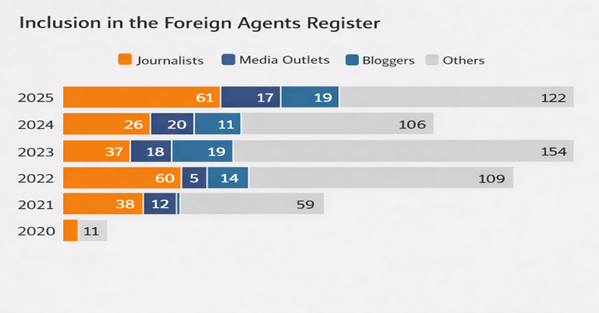
As of the end of 2025, there were 888 active foreign agents in Russia: 691 individuals, 122 organizations, and 75 public associations. Among them were 221 journalists, 62 bloggers, and 78 media outlets. Thus, journalists and bloggers account for more than 40% of all those designated as foreign agents.
In 2025, the register was expanded by 219 new foreign agents (compared to 164 in 2024). Almost half of them are journalists and media outlets. Among the foreign agents designated in 2025:
- 61 journalists
- 17 media outlets
- 19 bloggers
The number of new journalist foreign agents more than doubled compared to 2024, rising from 26 to 61.
In addition, journalists working for such media are recognized as “participants” of foreign agent media. The 17 media added to the foreign agent register in 2025 account for 82 participants.
By including individuals in the register as participants of a foreign agent, the Ministry of Justice effectively imposes on them the obligations under foreign agent legislation. At the same time, the Ministry provides no evidence that the person actually works for the media. There is no way to exit the list of participants of a foreign agent, as the law neither mentions such a possibility nor establishes any procedure.
Furthermore, the number of administrative cases under the article on violations of foreign agent legislation continues to grow. In 2025, the MMDC recorded 942 rulings imposing administrative penalties under various provisions of this article, issued by courts of first instance. The actual number of fines is likely somewhat higher, as not all court decisions are published on court websites. Even so, this figure already significantly exceeds previous years: in 2024, courts fined individuals and organizations under this article at least 719 times, and in 2023, 368 times. Journalists, media outlets, and bloggers account for 37% of all cases under this article. According to the MMDC, in 2025 they were held administratively liable on 354 occasions.
6. New "undesirable" media outlets and journalists
By the end of 2025, the list of foreign and international organizations whose activities are deemed undesirable in the Russian Federation included 296 organizations. Over the course of the year, 101 new entries were added (compared to 65 entries in 2024).
In 2025, the activities of three organizations directly linked to the media were designated as undesirable. In February, The Independent Barents Observer AS, the owner of the online outlet The Barents Observer, was added to the register; in May, Germany-registered Radio Echo GmbH, which operates the online radio station and outlet Echo; and in December, the German media corporation Deutsche Welle. In total, the register now includes 18 media outlets.
In addition, the Prosecutor General’s Office of the Russian Federation designated as undesirable the activities of several human rights organizations that support independent media. These include Journalists in Need Network (Germany), the Justice for Journalists Foundation (United Kingdom), Sdružení investigativních novinářů – Fund 19/29 (Czech Republic), Reporters Without Borders (France), the International Center for Journalists (United States), and the European Fund for Journalism in Exile (Germany).
Administrative and criminal prosecution for participation in the activities of undesirable organizations
In 2025, the MMDC recorded at least 195 first-instance court rulings imposing administrative liability for participation in the activities of an undesirable organization.
- In 25 cases, individuals were fined for sharing links to materials from media outlets designated as undesirable organizations, or for reposting such content.
- In 23 cases, fines were imposed for working as a journalist for a media outlet designated as an undesirable organization.
- In 9 cases, experts were fined for providing comments or interviews to media outlets.
- In 37 cases, administrative penalties were imposed for reposting or distributing materials from undesirable organizations that are not media outlets.
- In 26 cases, individuals were fined for preparing expert materials for various undesirable organizations not classified as media outlets (most often the Carnegie Endowment).
- In one case, a woman was fined for commenting on a post in the channel of an organization designated as undesirable.
7. Further restrictions on access to independent informaiton
Blocked media outlets
In 2025, the MMDC recorded at least 84 website blockings affecting media outlets. Of these, 47 were mirror sites of resources that had been blocked earlier. Of all resources whose access was restricted, 51 were websites of Russian media outlets and 16 belonged to Ukrainian publications. The list also includes resources based in Germany, the United Kingdom, Finland, Poland, Lithuania, Italy, Belarus, and other countries.
Pressure on Telegram channels
Another tool used to restrict the dissemination of information in 2025 was removal demands issued by Roskomnadzor. It is likely that most such cases were not publicly disclosed; however, the instances that became public indicate that demands were made not only to registered media outlets, but also to Telegram channels. For reasons that remain unclear, several Telegram channels were removed in 2025. In April, the Telegram channel VChK-OGPU, a Russian anonymous outlet designated as a foreign agent and known for publishing compromising materials and insider information about Russian officials, disappeared from the platform. In May, Telegram removed the channel of the St. Petersburg outlet MR7, which had previously been stripped of its media registration by a court at Roskomnadzor’s request.
Domain suspension
In 2025, Roskomnadzor began using a new method of restricting access to websites: demands to de-delegate domains in the .ru zone. This is a harsher measure than website blocking, as de-delegation causes a domain to cease functioning entirely, including for users accessing it from foreign IP addresses.
In December, at least six such cases became known. Domains belonging to journalist Dmitry Kolezev, the Bashkir independent media outlet Aspekty, the publication Republic, and writer Alexey Exler (all designated as foreign agents) were de-delegated. In addition, The Moscow Times reported receiving a notification from Reg.ru stating that service for its .ru domain would be terminated.
Media closures
Several outlets decided to shut down or suspend operations due to mounting pressure. In June, the independent Saratov-based outlet Svobodnye Novosti, which had been stripped of its media registration in 2024, announced it was ceasing operations. Novaya Gazeta – Ryazan also announced a suspension of activities after criminal charges of extortion were brought against its editor-in-chief. Closures were also announced by Gorby magazine, which was designated a foreign agent in June, and by the editorial team of the Telegram channel From Karelia with Freedom, whose founder, journalist Valery Potashov, was added to the foreign agents register in July.
8. Other threats
Revocation of citizenship
In December 2025, it became known that Roman Anin, publisher of Important Stories, had been stripped of his Russian citizenship. Earlier, he had been sentenced in absentia to 8.5 years in prison under the article on “army fake news”. As the journalist was born in Moldova and obtained Russian citizenship only in 2006, the conviction served as grounds for revoking his acquired citizenship.
Blocking media outlets and journalists from donation platforms
In 2025, the donation platform Boosty blocked the accounts of journalists and activists listed in the foreign agents register. At least 26 accounts were affected by these restrictions.
Internet shutdowns
Mobile internet shutdowns in Russia began in May 2025, when access in Moscow was restricted during Victory Day celebrations. The practice later spread to the regions.
The restrictions were justified by security considerations and countering drone attacks; however, internet access was also cut in regions far from the combat zone. In July, shutdowns were recorded in 77 regions, including Primorye, Sakhalin, and Kamchatka.
In December, independent experts reported that “whitelists” had been introduced in 64 regions — lists of websites and applications whose operation is not blocked.