Repression in numbers: Three years of Russia's full-scale invasion of Ukraine
29.03.2025





Over the past three years, expressing a critical stance against the war in Ukraine has become increasingly dangerous in Russia, as the government introduced a series of stringent laws to suppress dissent. All independent media were forced to shut down or leave the country as military censorship laws were enacted. The official narrative strictly forbids referring to the war as Russian aggression against Ukraine, instead labeling it a “special military operation” aimed at securing Ukraine's “demilitarization”, “denazification”, and neutrality.
Since the start of the full-scale invasion, the Kremlin has created an atmosphere of fear, where people are afraid to speak freely, and encouraged the practice of denunciation. Speaking out against the war or showing any solidarity with Ukraine has been treated as a crime under the current regime.
In February 2025, human rights organization OVD-Info published a report documenting key trends in political repression against anti-war activism in Russia. The report sheds light on statistics of criminal and administrative cases related to anti-war activities over the last three years. It also includes an analysis of legislative changes and various forms of pressure beyond criminal prosecution, such as extrajudicial persecution, pressure on journalists and independent media, as well as the practice of labeling individuals and organizations “foreign agents” and “undesirable”.
REM publishes an abridged version of the report.
1. INTRODUCTION
The third year of Russia's full-scale war against Ukraine has been marked by continued political repression. Authorities are using a range of repressive measures, from criminal prosecutions for "fake news" and discrediting the Russian army to extrajudicial punishments such as dismissals, pressure on relatives, and denial of documents. New laws have been introduced to expand the powers of the security forces.
The Russian authorities pay special attention to the fight against dissent on the Internet. The majority of criminal cases arise from social media posts, often involving content published years before the prosecution began.
The security services target not only Russian citizens but also Ukrainian prisoners of war and civilians from the occupied territories. Many of these individuals are charged with espionage, terrorism, or treason and are sentenced to long prison terms.
2. DETENTIONS FOR ANTI-WAR VIEWS
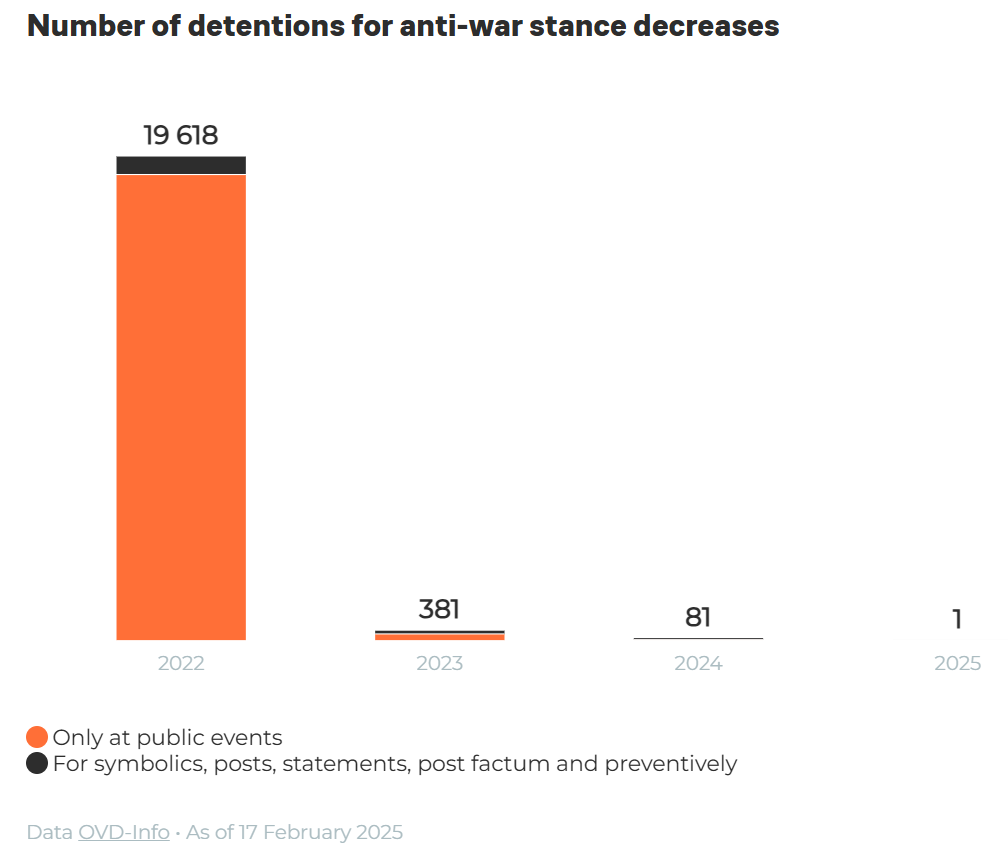
Detentions for expressing anti-war views began from the very first day of the full-scale invasion of Ukraine, when many Russians took to the streets in protest on 24 February 2022. In total, OVD-Info recorded over 18,900 detentions during public anti-war demonstrations throughout 2022.
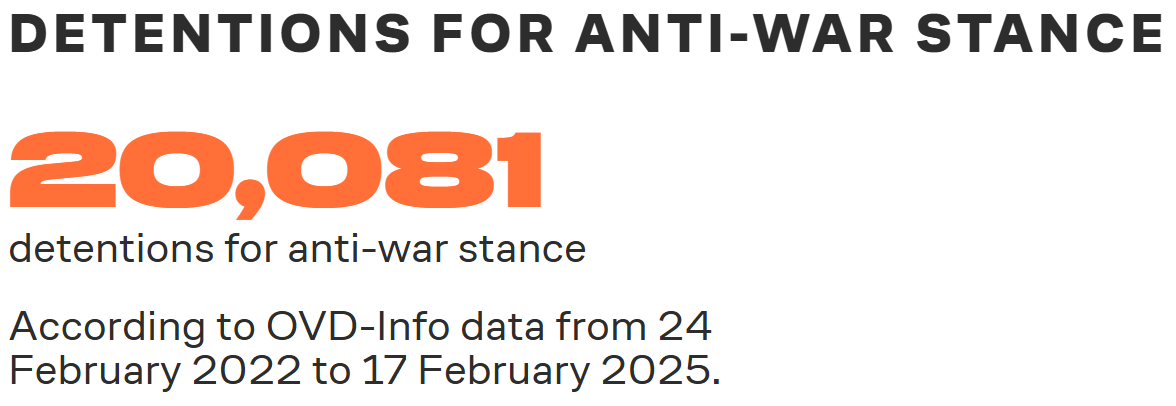
Following the introduction of a series of laws in March 2022 against discrediting the Russian army and the dissemination of "fake news" about the military (in effect, any criticism of the invasion of Ukraine and the very use of the word 'war'), anti-war street protests gradually declined.
As a result, Russians turned to the forms of protest that did not involve street demonstrations, primarily solitary pickets. This led to a decrease in the number of detentions for anti-war views. For example, in 2023, there were 274 arrests for public protests, and in 2024, only 41 arrests.
In addition, over the three years of war, the security forces detained individuals 856 times for anti-war posts, symbols and other reasons that could be directly or indirectly related to the war. By the end of 2024, the majority of detentions unrelated to public protests were for social media posts.
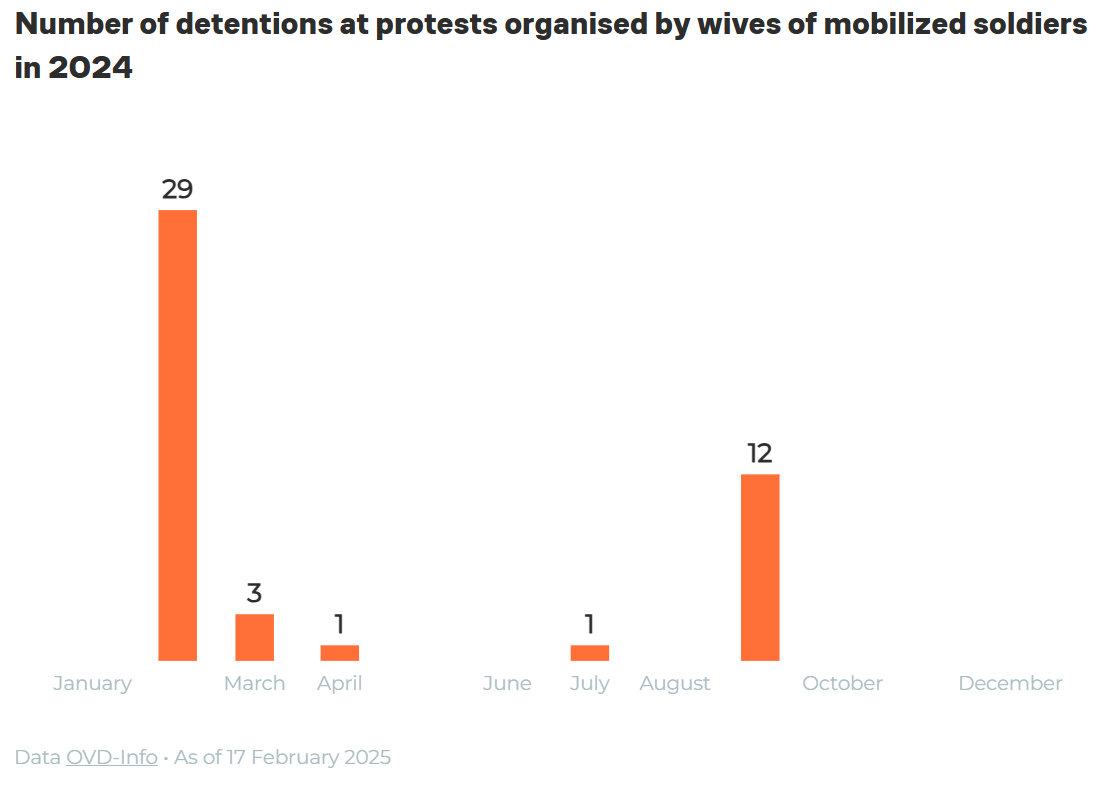
In addition to detaining anti-war protesters, in 2024, security forces also targeted individuals who, while not opposing the invasion of Ukraine itself, criticized specific government decisions related to the war. For instance, reports indicate that 46 individuals were detained at events organized by the wives and mothers of mobilized soldiers who were trying to bring their husbands and sons back from the frontline.
These mobilized individuals, drafted in the autumn of 2022, cannot return home until the mobilization decree is lifted. The detentions occurred in three cities: Moscow (40 cases), Yekaterinburg (5 cases), and Saint Petersburg (1 case), with the majority taking place in February 2024.
3. CRIMINAL CASES
As of mid-February 2025, 1,185 individuals are known to have faced criminal prosecution due to anti-war statements or actions. Currently, 913 people remain under criminal prosecution for anti-war reasons. This number includes those whose cases are under investigation or in court, as well as those still serving their sentences. Among them, 372 individuals are currently in places of detention.
The proportion of individuals targeted under anti-war criminal cases in 2022 and 2023 made up more than half of all politically motivated criminal cases. In 2022, they accounted for 57% of all politically motivated criminal cases, and in 2023, for 53%. However, in 2024, the proportion of criminal cases opened for anti-war statements or actions significantly decreased, dropping to 32% of all politically motivated criminal prosecutions.
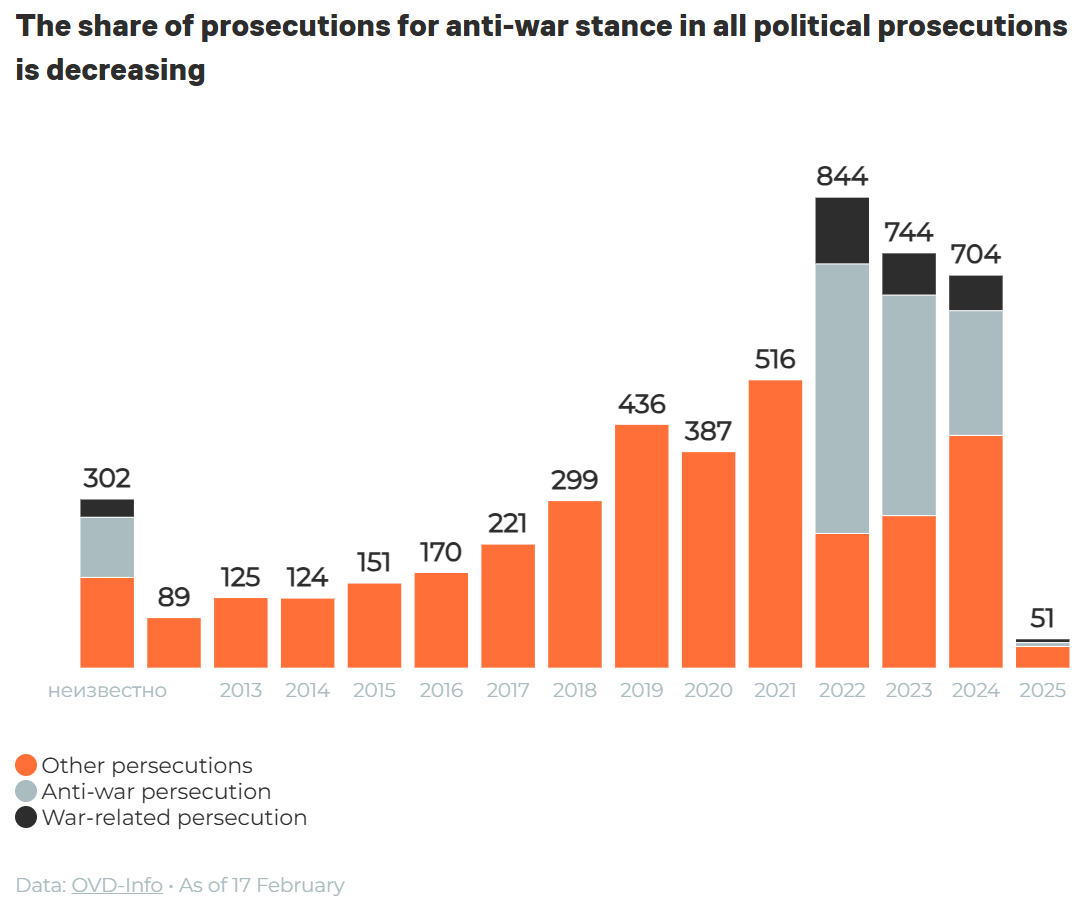
The exact reasons for the decrease in the proportion of anti-war criminal cases are not fully clear, but it is possible to make some informed guesses. First and foremost, this may suggest that anti-war statements and actions have become less frequent. Some individuals may have been deterred by reports of harsh punishments for anti-war statements (such as numerous sentences ranging from five to eight years under the "fake news" law), leading to increased self-censorship within society.
Additionally, authorities have increasingly begun to prosecute individuals based on their status — both inherent (such as sexual orientation or foreign citizenship) and assigned (such as the label of “foreign agent” or ties to “undesirable” or “extremist” organizations). Prosecuting these cases likely requires less effort than pursuing anti-war statements on social media.
In terms of geographical distribution, the highest number of anti-war persecutions (at least 185 individuals) since 2022 has been recorded in Moscow. Saint Petersburg ranks second, with 87 individuals persecuted, followed by Sverdlovsk Region (35), Tatarstan (34), Moscow Region (32), the annexed Crimea (31), and Krasnodar Region (31).
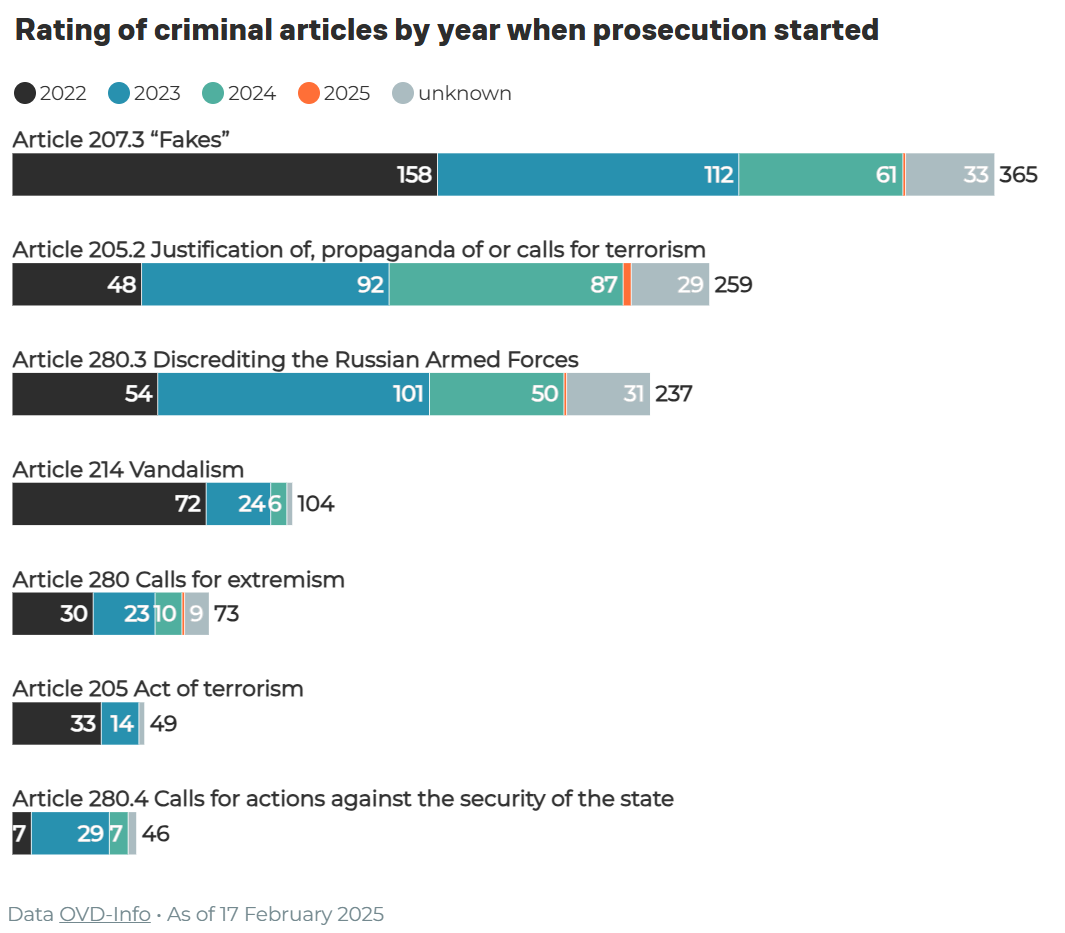
Among the articles of the Criminal Code that have been used to initiate "anti-war" cases, Article 207.3 of the Criminal Code of the Russian Federation stands out. This article was hastily added to the Criminal Code in March 2022, shortly after the start of the full-scale invasion. It deals with the dissemination of deliberately false information and is commonly referred to as the "fake news" article. Individuals charged under Article 207.3 either made statements about the crimes committed by the Russian army in Ukraine or, less frequently, posted messages about losses among Russian soldiers.
In 2022 and 2023, the authorities used the "fake news" article more frequently than others to silence anti-war activists. In 2022, 158 individuals were accused of spreading "fake news". In 2023, criminal cases for "fake news" were initiated against at least 112 individuals. The second most used article of the Criminal Code, deliberately introduced to combat anti-war statements, is Article 280.3, which addresses the discrediting of Russia's Armed Forces. This article criminalises almost any statement that could be interpreted as criticising the war or calling for peace, whether written or oral, as well as solo pickets.
As of 2024, the leading position in the grim ranking of criminal articles is held by Article 205.2 of the Criminal Code, which addresses calls for terrorist activities or their public justification.
What actions lead to prosecution?
For the three-year full-scale war, Russian authorities initiated the most "anti-war" criminal cases due to statements made online. In 2022, 220 people were prosecuted for anti-war posts on social media. Most cases stem from posts on VKontakte, which continues to be the social network most closely aligned with the government. Telegram is in second place, followed by YouTube. In most instances (85% of cases where publication dates could be determined), the authorities initiated the prosecutions in 2024 for posts made in 2022 and 2023.
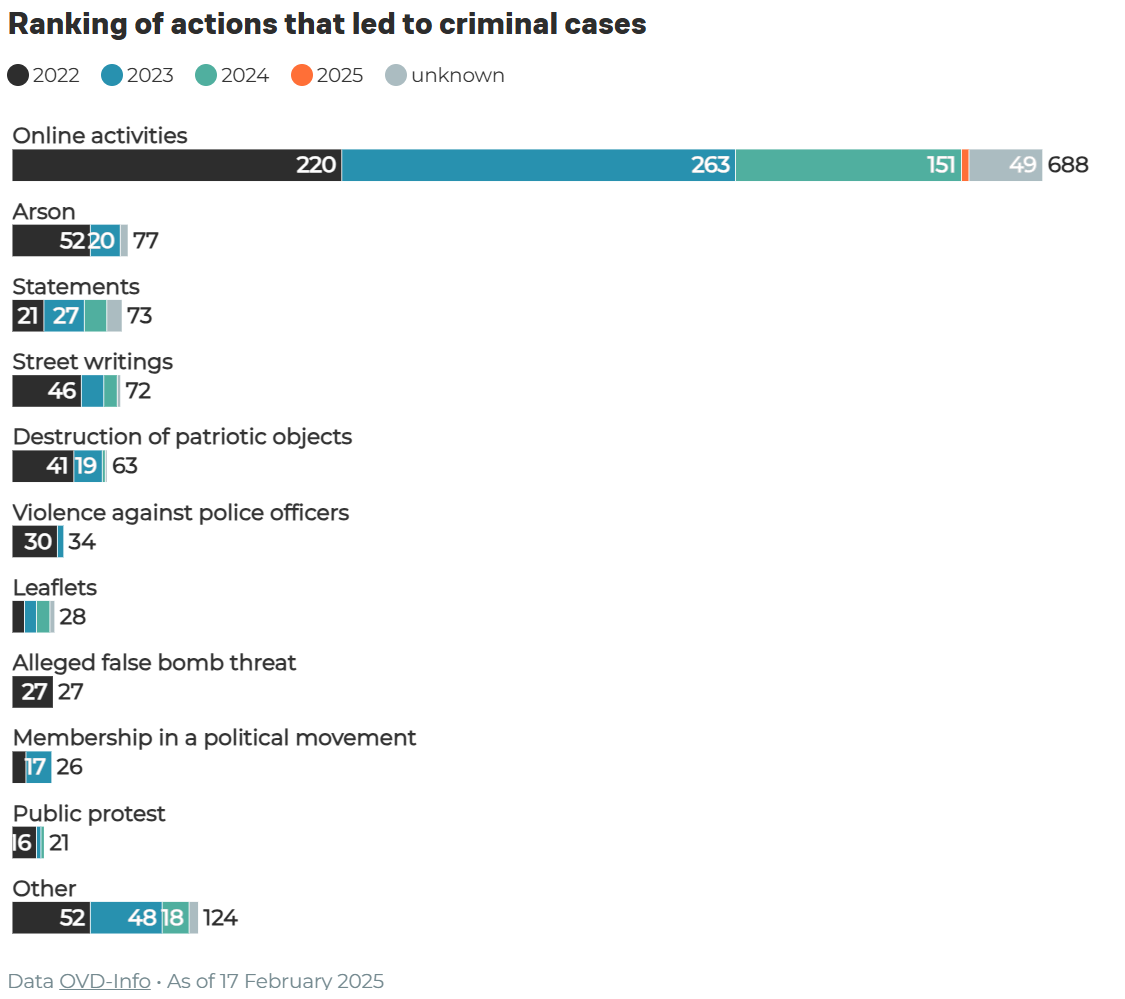
Despite the overall decrease in the number of prosecutions initiated in 2024 compared to 2023, the number of prosecutions concerning online activity is still around ten times higher than the number of prosecutions concerning offline statements.
In addition to those who spoke out in public places, a significant portion of those persecuted, especially in 2022, were people who wrote anti-war slogans on various objects. Their number is not far behind those persecuted for arson (46). Taking this into account, as well as data on those persecuted for distributing leaflets (28), the number of people persecuted for statements overall significantly exceeds the number of those persecuted for other types of activities.
In addition to those who spoke out in public places, a significant proportion of those prosecuted, particularly in 2022, are individuals who wrote anti-war inscriptions on various objects. Their numbers are approximately equal to those prosecuted for arson (46). At least 28 people were prosecuted for distributing leaflets. Overall, the number of individuals prosecuted for speech-related actions exceeds the number prosecuted for other activities.
Sentences
The relatively low number of convictions in so-called “anti-war cases” in 2022 (82 convicted) can be explained by the fact that a significant proportion of the cases initiated that year reached a verdict only in 2023 (209 people convicted).
It is difficult to compare the sentences handed down in these cases, as they involve articles of varying degrees of severity, from vandalism, which carries a sentence of up to three years' imprisonment in the worst case, to treason, which can lead to life imprisonment.
According to OVD-Info, courts most often impose actual prison sentences. This was particularly common in 2023 and 2024 when a large number of “anti-war cases” reached the sentencing stage. Fines were by far the second most common form of punishment, with all other forms of punishment trailing far behind.
Most often, those prosecuted in "anti-war cases" are sentenced to relatively long prison terms, ranging from four to seven years and seven to ten years. The number of such sentences in 2024 increased by more than a third compared to 2023. The third most common sentences are from two to three years.
Fines remain the most prevalent form of punishment in cases of discrediting the Armed Forces throughout 2023 and 2024. However, the number of prison sentences under this article rose in 2024 compared to the previous year.
4. CONCLUSIONS
The year 2024 marked an expansion of repressive practices by the Russian authorities compared to previous years. The authorities have adapted their political pressure tactics to the situation: with mass anti-war demonstrations virtually ceasing by 2023, the focus shifted to prosecuting online speech. Russian law enforcement continues to search for and punish posts and comments from the past, fostering an atmosphere of total fear for anyone who has ever expressed an anti-war stance, and pushing war opponents out of the public sphere.
Repressive legislation continues to expand, with new laws enabling the confiscation of property for anti-war statements, increasing penalties for treason, and broadening criminal liability for failing to report crimes [this data is included in the full report but not in this summary – REM].
The authorities actively use trumped-up criminal cases and often resort to torture, threats and provocation. Repression affects not only activists and journalists, but also ordinary citizens whose kitchen talk could be considered criminal.
The blocking of independent media and bans on circumventing censorship make access to alternative information increasingly difficult. This data is also included in the full report; however, a more detailed analysis of the situation with freedom of expression can be found in the report by the Mass Media Defense Center translated by REM: Critical State of Freedom of Speech.
The persecutions do not only affect Russian citizens. Many cases have been initiated against prisoners of war and civilians from the occupied territories of Ukraine. They are accused of sabotage, espionage and treason and sentenced to long prison terms [this data is included in the full report but not in this summary – REM].
Despite the sharp decline in public anti-war demonstrations in the third year of Russia's full-scale invasion of Ukraine, the authorities continue to view opposition to the war as a threat to their power and are expanding repressive practices to suppress any form of resistance. In this situation, it is important to keep documenting instances of persecution, analyzing legislative changes and raising public awareness.