Russian opposition: A strategic impasse
03.04.2024





In this article, Dr. Ilya Matveev discusses the current state of the Russian opposition politics and outlines three areas for strategic discussion about its future.
NO ROOM FOR ACTION
The current state of opposition politics in Russia is rather paradoxical. On the one hand, the opposition to Putin’s regime represents a significant grassroots movement. Studies of social movements highlight the role of various resources available to them. From this perspective, the opposition movement is far from hopeless. It consists of dozens, if not hundreds, of different organizations (recently, more than 80 groups joined together to create a common platform). Its media resources are particularly well developed, with a total daily audience of millions.
The financial resources available to the opposition are also not insignificant. There are some notable leaders, although still no unifying figure comparable to the late Alexei Navalny (his wife Yulia’s brave attempt to take on this role is yet to succeed). Most importantly, part of the Russian population and perhaps the majority of the new diaspora abroad is willing to participate in opposition activities. This could be gleamed from Ekaterina Duntsova and Boris Nadezhdin’s short but impressive presidential campaigns. Both figures almost immediately attracted hundreds of thousands of Telegram followers as well as thousands of volunteers across the country and abroad. Not just resentment and frustration, but an appetite for action is brewing among sections of the Russian population.
On the other hand, despite commanding considerable resources, the opposition has not had any strategic or even tactical successes for a long time, perhaps since the Duma campaign of 2021. In my assessment, this is largely due to the change in the external environment in which it operates; namely, the dramatic rise in state repression. Since 24 February 2022, Russia has been under de facto martial law. Repression already exceeds late Soviet levels. It is highly systemic, consistent and targets any expression of dissent, be it public or private. In recent years, repression has become the primary tool of regime maintenance. Propaganda has assumed a secondary role – it is unable to persuade or rouse strong feelings. Rather, people choose to believe it for lack of practical alternatives; essentially, indoctrination takes place under the barrel of a gun. Apparent economic stability is important for regime legitimacy, however, surveys show that even those who view the economic situation positively are increasingly frustrated with the war.
Nevertheless, there is simply no space to express this frustration. Legal protest is impossible and peaceful civil disobedience, as well as sporadic violent resistance, is immediately crushed by the repressive apparatus. The regime simply has no tolerance for the anti-war message and is able to silence it effectively, hence the opposition movement’s strategic impasse.
ELECTIONS AS A FORM OF VIOLENCE
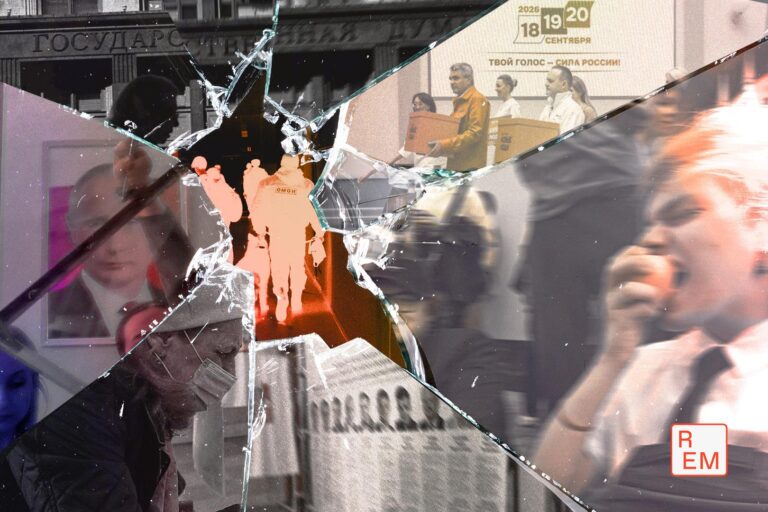
Recent presidential elections in Russia are another indication of this impasse. The opposition movement once again tried to use this opportunity to attack the regime and prevent it from achieving its goals, but largely failed.
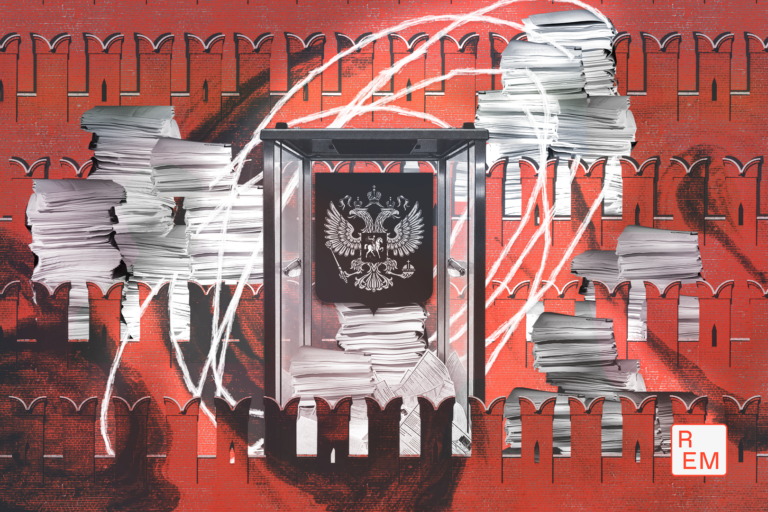
Elections in Putin’s Russia have long represented a site of struggle between the regime and the opposition. It is a kind of political struggle, but one that has almost nothing to do with electoral campaigns in democracies. The opposition basically has two choices – to boycott the vote or to encourage some kind of strategic voting with a recognition that the game is rigged and it is by definition impossible to replace Russia’s current leadership with elections. Neither choice is great. Boycott is essentially a passive process – not doing something – and it is difficult to turn it into a political event that damages the regime in a significant way, especially if the numbers are not there. Strategic voting by the opposition, on the other hand, tends to legitimize the electoral process (despite it being rigged and the opposition fully understanding that it is rigged). Moreover, due to the regime’s control over the elections, both boycott and strategic voting might turn out to be ineffective in changing the official results – the regime could always simply rewrite them to suit its goals.
Nevertheless, elections have historically created a certain opening for the opposition. From the regime’s perspective, it makes sense to introduce a modicum of competitiveness in the electoral process – it makes the results more legitimate and allows to root out unpopular and ineffective politicians at the local level. In essence, rigged, but not fully staged elections are a strategy to ensure the regime’s stability without relying on violence alone. However, this modicum of competitiveness is precisely what the opposition might use to achieve its own goals. From the opposition’s perspective, voting is one of the very few activities that are safe and legal (and therefore could potentially involve a broad spectrum of the population). Moreover, strategic voting could be combined with street protests and a media assault on the regime to produce maximum effect. This is precisely what happened during the local elections in Moscow in 2019 – Navalny’s Anti-Corruption Foundation made dozens of videos exposing the corruption of the city leadership, called for demonstrations to protest the removal of the independent candidates and encouraged strategic voting. This triple assault resulted in a significant tactical victory for the opposition.
The regime’s continuing evolution towards the kind of dictatorship that relies primarily on violence changed the nature of the elections and robbed the opposition of one of its key strategies. The 2020 constitutional amendments allowing Putin to reign until 2030 and the full-scale invasion of Ukraine in 2022 were two key stops along the way. The 2024 presidential elections confirmed and expanded this trend. For the first time, the Kremlin did not allow the participation of a ‘liberal’ candidate, no matter how weak and unpopular. Moreover, at least half of the vote was fabricated to produce a ridiculous result: 87% support for Putin, on par with Central Asian dictatorships and Assad’s Syria.
Russian opposition made a serious attempt to fight this time as well. It managed to overcome internal squabbles and settle on a single strategy: voting for anyone but Putin (although Maxim Katz, unlike the Navalny’s Anti-Corruption Foundation, preferred one particular candidate, Vladislav Davankov). Moreover, the call to come to the voting stations on a specific day at a specific time (the action known as ‘Noon Against Putin’) produced visual proof that the anti-Putin vote was non-negligible. Nevertheless, the results were falsified to such an extent that the opposition’s electoral mobilization had no impact on them. In principle, the discrepancy between the actual anti-regime vote and the official result could have provoked street protests, as it did in 2011. However, under the current level of repression, street protests are simply impossible until a tipping point is reached in terms of numbers - that probably need to be in the millions - and other variables such as elite defection. Since these criteria were not met, the opposition’s campaign essentially went with a whimper and the regime could consider itself to have won a tactical victory. The positive effects of the opposition campaign were internal ones: people both inside and outside of Russia saw each other in long lines at the voting stations, which increased the morale and confidence that the anti-regime and anti-war sentiment is far from marginal.
However, a dictatorship that primarily relies on violence is a formidable enemy. In fact, this time, elections themselves were a form of violence, with extreme pressure applied to state employees to coerce them to vote and at least 119 people arrested across the country on the last day of the elections for ‘offenses’ such as spoiling ballots. The opposition is yet to find ways to break out of the confinement created by the regime’s brutality.
PROSPECTS FOR THE FUTURE
The impasse in which the opposition finds itself is largely explained by external factors. These may change in the future: the worsening economic situation may undermine even today’s passive and unenthusiastic support for the regime, elites may defect because of the war’s uncertain prospects, Putin may slowly become a lame duck and so on. This may very well happen, but it does not mean that the opposition should simply wait for a more opportune moment. Some internal changes are also warranted. In my view, there are three areas for strategic rethinking.
One such area concerns the opposition’s messaging. Since 2017-2018, Alexei Navalny integrated social issues into his platform, criticizing economic inequality and demanding a significant increase in the minimum wage, among other things. He also supported the creation of trade unions, such as the Alliance of Teachers and the Alliance of Doctors. It seems that his innovation is lost on the current opposition media, including even the Anti-Corruption Foundation’s (ACF) own outlets. A cursory look at the major opposition YouTube channels, such as the ACF’s Popular Politics or Maxim Katz’s blog reveals that poverty, inequality and economic hardship are not among the topics they highlight or discuss. Nor are these issues even mentioned in the long manifesto adopted by some members of Platforma, a new joint opposition initiative, although the manifesto addresses environmental, gender and LGBTQ+ demands. This glaring omission of the topic that hits close to home for the majority of the Russian population is a step back for the opposition movement.
Another area for improvement concerns alliances. Despite constant bickering, major opposition forces are capable of joint action, as revealed by the common strategy of the ACF and Maxim Katz regarding the recent presidential elections. Yet they fare much worse when it comes to broadening their coalition. For example, many opposition leaders were highly skeptical of the protests in Bashkortostan provoked by the imprisonment of a local activist Fail Alsynov. Mikhail Khodorkovsky, for example, identified these protests as ‘separatist’ and ‘nationalist’, although Alsynov was famous in Bashkortostan for protecting the Kushtau hill from mining development, and the protests largely reflected this issue, not Bashkir nationalism, let alone separatism. Indigenous peoples’ rights groups noted that the opposition’s reaction to the protests was practically indistinguishable from that of the pro-regime commentators. Local movements in Russia’s ethnic regions could be a powerful force within the broad anti-regime coalition. However, the current members of this coalition are often hostile, sometimes due to outright xenophobia. They should seek new alliances instead, with local movements as well as movements that are not openly anti-regime or anti-war, but touch upon the issues that are highly sensitive to the regime, such as the movement of the wives and mothers of mobilized soldiers.
The final area for improvement concerns tactics, or the opposition movement’s ‘repertoire of action’, as sociologists call it. Currently, the opposition groups seem to be overwhelmingly focused on the media, especially YouTube. Media could generate broad, but shallow engagement from the audience. Discussion groups, education projects and all kinds of solidarity actions produce a deeper, more meaningful form of engagement. Perhaps the opposition should focus more on the activities that are less publicly visible, and yet allow for the real participation of the people. Such an approach would build resilience and strength that are necessary for the environment as brutal as 2024 Russia.
Needless to say, I do not have all the answers, and the suggestions above are advanced as a starting point for the discussion. However, I am firmly convinced that such a strategic discussion is essential for the opposition movement to finally begin breaking out of the impasse it finds itself in.
By Dr. Ilya Matveev, Visiting Scholar at UC Berkeley