Spoilers and doppelgängers in Russian elections
09.09.2023





Three Borises Vishnevskys with a similar appearance, who ran for the Legislative Assembly of St. Petersburg became the main meme of the election campaign in Russia in 2021. While only one out of three Vishnevskys, the Yabloko party candidate, was actually real. The other two changed their names and grew out goatees specifically to mislead potential voters.
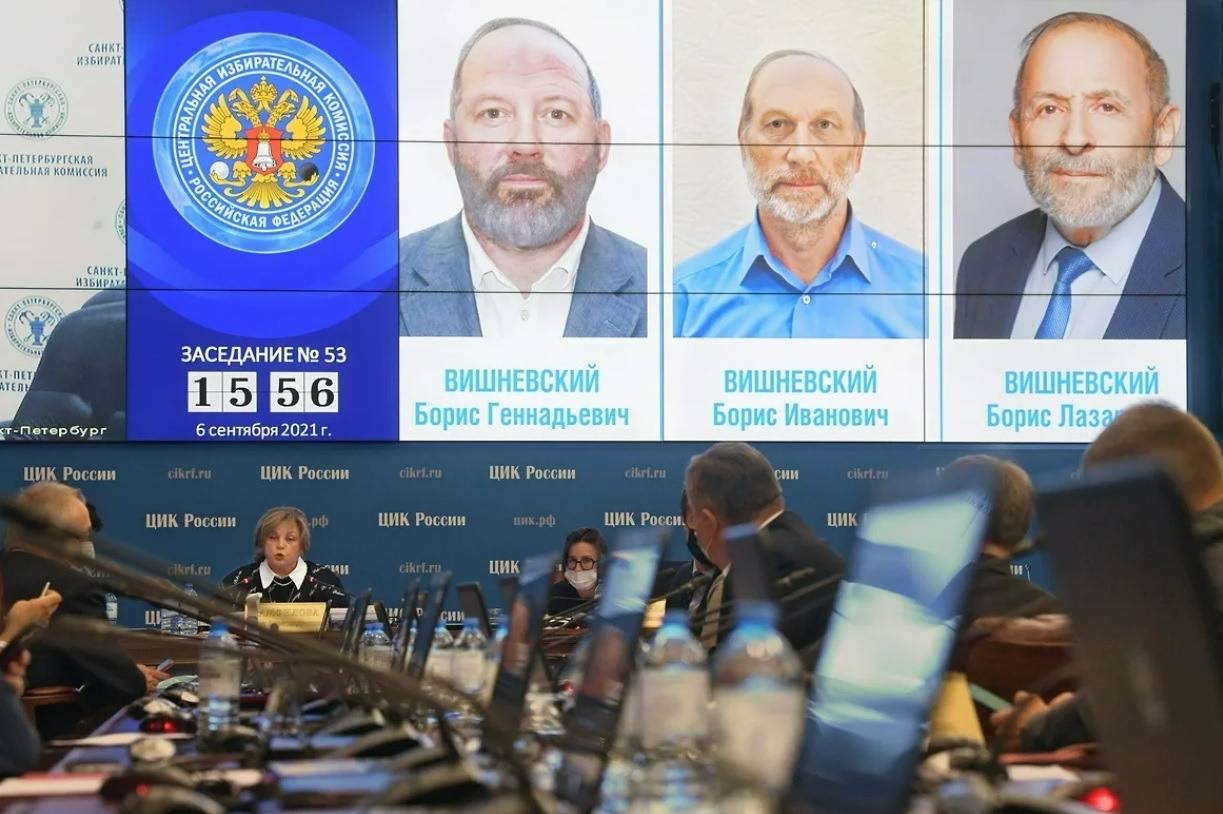 Three Borises Vishnevskys ran for the Legislative Assembly of Saint Petersburg in 2021. Source: Kommersant.ru
Ella Pamfilova, head of the Central Elections Committee of Russia (CEC), called what had happened “political technologists' lowest point of the fall”, but claimed that there were no legal grounds to disqualify the doppelgängers from the elections.
Political technologists regularly use the tactic of ‘double’ candidates. The idea behind this trick is to nominate people with the same surnames, and sometimes names, as those of strong competitors in order to prevent them from winning. The so-called spoiler parties act in a similar way: mimicking well-known political brands, they pull votes away from the latter.
REM figured out where the doppelgänger and spoiler electoral technology came from and how it was used during the 2023 campaign in Russia.
Eight Namesakes in the Ballot Is Not the Limit
Eight candidates with the same surname Vakhtin were nominated for elections in one of the constituencies of the Voronezh region in 2023. One of the namesakes represents the Rodina party. The rest are self-nominated. Someone was clearly trying to prevent the Rodina candidate from getting a mandate. Such a campaign could not be organized by any political force except for the authorities, experts assume.
Stanislav Andreychuk, co-chairman of the Movement in Defence of Voters' Rights Golos, seemed unsurprised by the eight Vakhtins in the district elections. "A few years ago, I saw a ballot in a rural election in the Altai Republic consisting only of candidates with the same surname. Moreover, this applied to both candidates and party lists”, he said.
Khakassia became another prominent example of the use of doubles in 2023, at the election for the head of the republic. Vladimir Grudinin, nominated by the Communists of Russia is the namesake of Pavel Grudinin, a businessman who was a candidate from The Communist Party of the Russian Federation (CPRF) in the presidential election in 2018. Pavel Grudinin was considered the main competitor of Vladimir Putin. As a result of the elections, Pavel Grudinin won 11.77% of the vote.
Quite possibly, by nominating Grudinin the Khakassian pro-Kremlin authorities tried to help United Russia member Sergei Sokol, the main competitor of the incumbent governor, Valentin Konovalov. Konovalov represents the Communist Party of the Russian Federation - a party whose ‘spoiler’ is the Communists of Russia. However, this did not help Sokol as he was forced to withdraw from the elections due to illness. Now communist Konovalov will battle with pseudo-communist Grudinin.
Cases of doubles registration appear in other regions of the Russian Federation, many of those nominated by the Communists of Russia, that is, not only they are doubles but also spoilers for the СPRF party. The leader of the СPRF fraction in the regional council Sergei Tokarev and the former member of the local election committee Oleg Tokarev, coming from the Communists of Russia, will be competing for a deputy seat in the State Duma in the by-elections.
The party Communists of Russia nominated four doubles for the elections to the City Duma of Togliatti against candidates from Just Russia. Simultaneously with the local activist, urbanist Mikhail Shishov, who comes from CPRF, Dmitry Shishov from Just Russia ran for the elections to the Arkhangelsk City Duma.
"The technology of spoilers, in its most radical version of namesakes, is used most commonly at local elections and sometimes at regional ones. This is a very old and stable technology, time has no effect on it. It has remained the same as it was thirty years ago”, says Andreychuk.
Communists and Spoiler-Communists
The Communist Party of the Russian Federation (CPRF) was founded in June 1993 and was the successor to the only party of the USSR. The party Communists of Russia appeared in 2009 first as a social movement, and then became a party opposing itself to CPRF. Communists of Russia included some members of the Politburo of the CPRF who left the party due to contradictions with its leadership.
Communists of Russia constantly emphasize not being adherents of the views of CPRF. Their website has a special article on the differences in the ideologies between these two. Unlike CPRF, Communists of Russia oppose the interference of the Russian Orthodox Church in education and culture. Also, Communists of Russia claim that the principle of collective leadership operates in their party, while the CPRF has a cult of Gennady Zyuganov’s personality, who has been the permanent chairman since 1993.
However, the parties have more similarities than differences. Even the logos of CPRF and the Communists of Russia look identical: a hammer and a sickle connected with a communist slogan on a red background. In 2015, CPRF attempted to legally challenge the right of their rivals to use visually similar symbols, but the court sided with the Communists of Russia.
Stanislav Andreychuk is convinced that Communists of Russia was originally created as a spoiler party. According to the expert, all they are doing is pulling votes from CPRF.
Thus, in 2021 the Communists of Russia were able to get into the regional parliaments in Altai, Amur and Omsk regions. In these regions, according to the results of the draw, they were at the top of the ballot. At the same time, CPRF was at the top of the ballot in the state Duma elections. Therefore, it was very easy for voters in these regions to confuse these parties and accidentally vote for the Communists of Russia instead of the CPRF.
"Any activities of the Communists of Russia in these regions [before the elections] had not been noticed. Therefore, the results obtained by this party, more than 12% in the Altai region, 11% in the Omsk region and more than 8% in the Amur region, should rather be regarded as a mistake and added to the CPRF’s results. If the votes cast for the two communist parties were combined, CPRF in Altai would have received 36% against almost 34% given to United Russia", claims Andreychuk.
Doubles and Spoilers from the 90-s
The tactic of nominating double candidates was first used in Russia in the elections for deputies of the Legislative Assembly of St. Petersburg in December 1998. Three Mironovs, three Sergeevs, two Boldyrevs and two Belyaevs were nominated in one of the districts that time.
In those elections, candidates from the Yabloko party were massively opposed by candidates representing the organization called “Yabloko-St. Petersburg”. Spoiler-Yablokists were represented in 24 of the 30 districts where the original Yabloko nominated its candidates. Yabloko St. Petersburg was registered at a fake address, and the organization was previously unknown to anyone. Participants of the 1998 elections were positive that it was one of the maneuvers of the governor's team.
The technology of using spoilers or doubles at elections was exported from Russia to some neighboring countries, political scientist and postdoctoral student at the University of Bremen Ekaterina Paustyan told REM.
“The technology of doubles has been used in Moldova and Ukraine, especially in Ukraine. My colleague and I are researching this topic on the example of four parliamentary elections to the Rada (2002, 2012, 2014, 2019), but there were doubles in the mayoral elections and in the elections to local councils as well. In Moldova, as far as we know, such cases appeared only at the parliamentary ones. The technology actually came to Ukraine from Russia in the late 1990s and early 2000s. Besides Eastern Europe, this tactic is extensively taken into the local elections in India. There have been sporadic cases in Venezuela, Costa Rica, Pakistan, the Philippines”, noted the expert.
As an example, the political scientist mentioned the last elections to the Verkhovna Rada of Ukraine in 2019. That time in constituency No. 133, which occupies the Kyiv district of Odessa, the candidate list included four people with the surname Baransky, two Dmitrys Tantsuras and two Artems Dmitruks.
How Does the CEC Tackle the Doppelgängers (Spoiler: It Does Not)
Experts from the Russian State Duma analytical department have acknowledged that double candidates can take votes from a competitor or help a certain nominee. Doppelgängers can use agitation to criticize opponents, leak incriminating evidence and file complaints against other candidates.
Political technologists differ in their opinions on how many votes the doubles can take away from a candidate. Some say that doppelgängers take not more than 2-5%, others are sure that the figure can reach up to 20%. Stanislav Andreychuk mentions that the influence of doubles on the election results is noticeable when it comes to spoiler parties, for example, so far the Communists of Russia has been quite successful in pulling CPRF votes away.
In 2022, a year after the scandal with Boris Vishnevsky in St. Petersburg, head of the Central Election Commission Ella Pamfilova announced that the problem of double candidates had been resolved. The CEC introduced a rule to tackle this issue: if a candidate changed his last name, first name or patronymic a year or less before the election, his former full name would be indicated on the ballot.
Commenting on the situation with spoilers in the 2023 campaigns, Pamfilova admitted that the amendments to the law adopted by the CEC do not actually prevent doubles from being nominated. After all, none of the eight Vakhtins in the Voronezh region changed their surname.