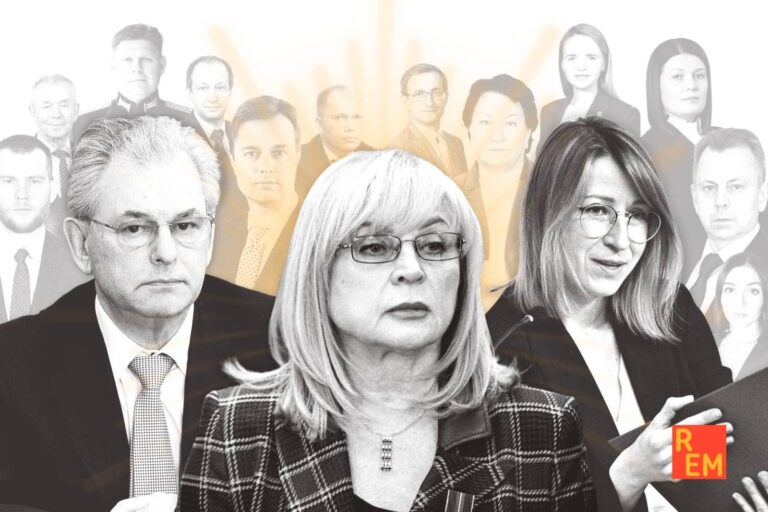
'They decide who lives, who gets imprisoned, and who gets elected'. Russia bans 'foreign agents' from elections
25.06.2024





In early June, Georgia's Speaker of the Parliament signed the divisive "foreign agents" bill, that had sparked weeks of mass street protests in the capital Tbilisi, into law. Under the new legislation, media and non-governmental organizations that receive over 20% of funding from abroad will have to register as “organizations acting in the interest of a foreign power”, submit themselves to stringent audits, or face punitive fines.
In Georgia, the law is commonly referred to as “Russian law” and is strongly associated with the Russian scenario of authocratization. In this article, REM discusses the evolution of the legislation on foreign agents in Russia and the meaning of the recent legislative amendments on the participation of “foreign agents” in elections.
FROM 2012 TO PRESENT: HOW THE LEGISLATION ON FOREIGN AGENTS HAS EVOLVED
The Russian foreign agent law, introduced in 2012, marked a turning point in the Kremlin's control over civil society. Initially targeting non-governmental organizations that received foreign funding and engaged in vaguely defined "political activity", the law required these organizations to register as "foreign agents" - a term fraught with negative connotations suggesting espionage and betrayal. Further, the law imposed stringent reporting requirements and frequent financial audits, creating substantial operational hurdles for NGOs.
On 4 June 2014, an amendment to the "foreign agents law" came into force, authorizing the Ministry of Justice to register independent groups as "foreign agents" without their consent, if the Ministry regards the organizations as engaged in "political activity" and if the organization is receiving foreign funding.
In subsequent years, the law’s scope broadened further. In 2017, amendments extended the "foreign agents law" to media, compelling those receiving foreign funding to register as foreign agents, which gravely affected independent journalism. By 2020, the law extended to individuals, namely civil society activists and journalists, further tightening the noose. The amendments introduced criminal liabilities for non-compliance, raising the stakes with hefty fines and imprisonment. 2021-2022 brought even stricter reporting mandates and an expanded definition of "political activity", enabling a more arbitrary definition of it.
The result of these alarming developments has been a significant suppression of Russian vibrant civil society, a fast-shrinking space for public discussion and criticism of the government, and Russia's overall drift toward authoritarianism. However, till this year the law of foreign agents did not touch the electoral legislation straightly. Since now, it has changed.
However, until recently, the “foreign agents” law did not directly address electoral legislation. In 2024 this has changed.
THE MEANING OF RECENT AMENDMENTS TO ELECTORAL LEGISLATION
On 22 March 2024, a group of municipal deputies declared "foreign agents" announced their intention to stand for election to the Moscow City Duma in September 2024. The reaction of federal authorities to this announcement was lightning fast. In early May, Russian State Duma banned "foreign agents" from participating in elections at any level. Current deputies with a “foreign agent” status – there were 10 such deputies in Russia – were to be stripped of their mandates.
The new ban significantly worsens the situation with citizens' electoral rights, conclude experts of the Golos movement: “This is a continued attack on the ability of Russia's most opposition-minded citizens to participate in elections. Given the fact that it is easy to obtain and practically impossible to challenge the status of a “foreign agent”, [the new amendments] offer a simple and effective way to remove from the elections candidates who are inconvenient to the authorities”.
Alexander Baunov, Senior Fellow at the Carnegie Center for Russian and Eurasian Studies in Berlin, who himself has been declared a “foreign agent”, believes that the amendments to the electoral legislation adopted by the State Duma are undeservedly neglected major news.
Baunov’s comment reads: “As of today, Russian autocracy is no longer an electoral autocracy. Electoral autocracies use elections as the main method of legitimization. In electoral autocracies, elections do not suggest the victory of the opposition, but independent candidates who break through the barrier retain a vestige of equality with official candidates. The mandate of an opposition parliamentarian is equal to that of a pro-government MP but the latter is bigger in number and has more resources. A candidate for the presidential post who has passed the registration quest has a candidate status equal to the candidates supported by the regime but does not have a chance to win. Thus, a game with a deliberately unequal outcome preserves remnants of equality in the process.
The ban on “foreign agents” from being elected to all levels of government destroys the remnants of equality. The inequality of citizens is now extended to the parliament and other power bodies. The inequality of candidates and deputies has been institutionalized. Any candidate, who has been declared “foreign agent” in a non-transparent, extrajudicial and irreversible manner, will be removed from the elections, and any deputy will be deprived of their mandate as a result of the same non-transparent and arbitrary procedure. [lt]…[gt]
In electoral autocracies, the notion of the inviolability of the mandate persists. Without it, it is impossible to draw the opposition into the electoral process, and without opposition’s at least imaginary presence in the electoral process, the elections will not look legitimate. Legitimacy has been sacrificed to security and the desire to please the leadership. [lt]…[gt]
One could say that Russia has become closer to Iran. In Iran, the Expediency Council sifts through candidates to determine whether they are loyal to the Islamic system. But Russia has gone further. In Iran, the candidates who passed the filter, once in parliament, retain the inviolability of the mandate and can oppose the executive branch. In Russia, the mandate is no longer inviolable and integral: at any moment, opposing the government can be declared as a foreign action. The mandate is no longer worth anything.
This system is much closer to the USSR, where the supreme party power did not need legitimization through elections, and used specific authoritarian institutions for this purpose, like party congresses or plenums, while elections produced a corps of assistants and executors whose mandate stemmed not from the citizens but from the executive.
The ban of "foreign agents" from being elected [lt]…[gt] finally transfers the granting of the deputy mandate from the hands of citizens into the hands of the executive branch”.
'THEY DECIDE WHO LIVES, WHO GETS IMPRISONED, AND WHO GETS ELECTED'. THREE STORIES OF 'FOREIGN AGENT' DEPUTIES
At the moment, there are only a dozen of municipal deputies declared “foreign agents” in Russia. It seems like a drop in the ocean, but they are quite active in defending the interests of their constituents.
For instance, Victor Vorobyov is a lawyer and deputy of the regional parliament of the Komi Republic. He became the first municipal deputy in Russia who was in April 2022 labeled a "foreign agent". Vorobyov advocated for the right to speak the Komi language at meetings of the State Council and proposed allocating funds from the budget to a local fund in memory of victims of political repression. After the death of Alexei Navalny in prison, Vorobyov demanded a thorough investigation of the politician's death by the prosecutor's office of the Yamalo-Nenets Autonomous County. After being declared “foreign agent” Vorobyov lost his deputy salary which allowed him to focus on his work in the State Council.
Natalia Gryaznevich, a deputy from St. Petersburg, was added to the list of "foreign agents" in December 2022. In her opinion, the new amendments to the law imply an open acknowledgment by the authorities that they violate citizens' rights. “Russia is their playground, and they decide everything here – who lives, who dies, who gets imprisoned, and who gets elected”, says Gryaznevich. The “foreign agent” status makes the work much harder because even officials do not understand what data they can share with "foreign agents" and refuse to provide even basic information. Gryaznevich is not planning to run for election again.
Municipal deputy Olga Podolskaya from the Tula region had planned to run for the town of Efremov municipal Duma but after being added to the “foreign agents” list her priorities shifted as she needed to challenge the decision in court first. Like other deputies, she has six months to do. However, the chances of the court siding with her are slim to none.
With the new amendments to the electoral legislation, Russian authorities have a legal instrument to cut off inconvenient candidates from the election. Anyone can be declared a "foreign agent" even without receiving funding from abroad - it is enough for the Ministry of Justice to prove "foreign influence" in any form.
This way, Moscow City Duma deputy Darya Besedina was declared a “foreign agent” for giving comments to a “foreign agent” media. Viktor Vorobyov was declared a “foreign agent” for his criticism of the acting Head of the Komi Republic and condemnation of the war in Ukraine. Olga Podolskaya was labeled a “foreign agent” after expressing support to Alexei Moskalev, who was sentenced to two years in a penal colony for an anti-war school drawing of his sixth-grade daughter Masha.
'LET'S POKE THEM WITH A STICK AND SEE HOW THESE SPIDERS REACT'
The announcement by the group of municipal deputies to stand for election to the Moscow City Duma was supposed to be a protest against the regime. As a matter of fact, everyone realized that the opportunities for participating in political life for “foreign agents” are quite limited, especially for those who left the country. Politician Elvira Vikhareva, who inspired the action, wanted to remind Russians that they have "an alternative to the naphthalene in power".
“We did not aim to get elected but to poke them [the authorities] with a stick and see how these spiders react. The reaction from them, as we see now, is the reaction of fear", wrote Yelena Solovyeva, a journalist from Syktyvkar who joined Vihareva's action.
On 8 May 2024, without waiting for the entry into force of amendments to electoral legislation, the United Russia faction in the Moscow City Duma used its vote majority to deprive one of the “foreign agent” deputies, Evgeny Stupin, of his mandate. The official reason was the deputy's failure to attend parliamentary sessions. Stupin opposed the war in Ukraine and fled Russia. Until recently, he continued to participate in sessions remotely.