“Valuable staff”: How Kremlin is turning war participants into school teachers
01.12.2024





More and more participants in the invasion of Ukraine are receiving political positions, mainly in regional governments and parliaments, where they are elected with the support of authorities. Many former officials, members of parliament, and civil servants deliberately use “military tourism” to enhance their social status. It is believed, with good reason, that a voluntary “business trip” to the front contributes to a political career. At the same time, this trend has not yet become widespread, and only a few “veterans ” make it into big politics.
An even more alarming phenomenon, with potentially significant consequences for the post-war structure of the country, is the integration of “front-line veterans” into schools and other educational institutions. Aside from being an educational facility, the school in Russia is a key institution in the electoral process. Most polling stations are located in schools, while school staff make up the bulk of election commission members. Chairpersons, their deputies, and commission secretaries are typically representatives of school administrations, while the remaining commission members are subject teachers.
By providing war veterans with positions in schools, the Kremlin not only ensures the uninterrupted dissemination of its propaganda narrative to the younger generation but also relies on a safe pair of hands among veteran falsifiers who would surely prevent the “enemy” from gaining power.
Following the full-scale invasion of Ukraine, the Kremlin significantly ramped up its efforts to promote ideological principles in schools. Veterans of the war are now entrusted with “patriotic education” of schoolchildren. Former soldiers not only participate in “Lessons of Courage” and “Conversations About Important Things” but also become teachers. For instance, they teach a newly introduced subject called“Fundamentals of Security and Defense of the Motherland.”
In small towns and villages, schools often face a shortage of teachers, as young educators tend to prefer life in larger cities, leaving retired teachers without replacements. In these areas, veterans are given the opportunity to teach other subjects like history or social sciences.
“7x7” explains why the Kremlin is lobbying for the employment of “war heroes” in schools, whether such patriotic propaganda could be successful, and how it might affect the younger generation. REM presents an abridged translation of the article.
Why Kremlin Promotes War Veterans in Schools
In March 2024, the “Vershina” Center for Military-Patriotic Education was established in Moscow. The center offers retraining programs for military personnel returning from the war in Ukraine, helping them transition into teaching professions. The “Vershina” website states that participants of the war in Ukraine can receive education in several areas, including the theory and methodology of teaching the “Fundamentals of Security and Defense of the Motherland” subject, psychology of interpersonal communication and the basics of communication, or be trained as a military-patriotic education club leader in a comprehensive school.
It appears that the “Vershina” retraining center does not thoroughly examine the backgrounds of its students. Among the graduates of the first cohort was 51-year-old Andrey Shinyagin. According to the “Agentstvo” media, prior to the war in Ukraine, Shinyagin and his accomplices, posing as officers of the Foreign Intelligence Service, lured women into an apartment where they beat them, stripped them, handcuffed them, and planted drugs on them. The men filmed everything on video and later blackmailed the women, threatening to show the footage to their relatives unless they paid money. For this, Shinyagin was sentenced to four years in a general-regime penal colony in 2017. Whether Shinyagin is currently teaching in a school is unknown.
Since the start of the full-scale war in Ukraine, the media have reported at least 14 cases of combatants going to work in schools. One of the first such cases occurred in December 2022, when a 21-year-old man took a job as a physical education teacher at school No. 42 in Ulyanovsk after returning from the war. Two years later, in August 2024, it was reported that another man who had returned from the war was appointed as the principal of School No. 87 in Perm. According to publicly available sources, “veterans” mostly work as physical education and “Lessons of Courage” teachers, mentors in “cadet classes”, and teach the subject “Fundamentals of Security and Defense of the Motherland.”
The Kremlin's main goal in integrating veterans of the war in Ukraine into schools is to signal to the military that they are the country's new elite, argues political scientist Abbas Gallyamov. He believes this is a classic propaganda project, primarily aimed not at those who are currently fighting, but at those considering signing a contract with the Russian army.
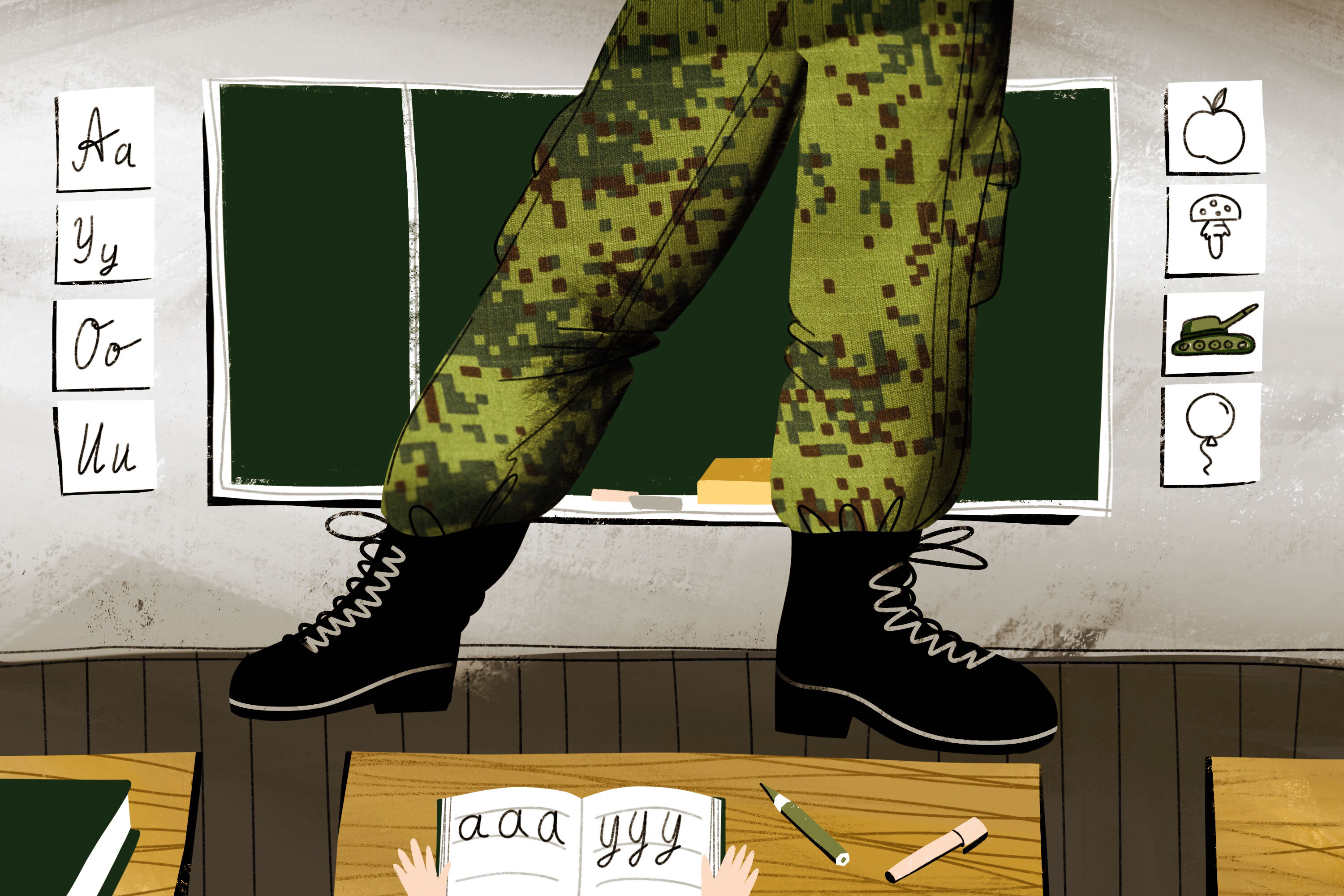 Picture: Anastasia Pokotinska for 7x7
“Of course, the main motivating factor for going to war is money. However, on average, ordinary Russians - even those loyal to the authorities - don't trust the state much, believing it will deceive them. They see news reports about some soldiers struggling to receive their payments and doubt whether signing a contract under such conditions is worth it. Through work in schools, the government sends a message to these people: 'We want to entrust you with educating future generations because you are valuable staff“.
Gallyamov assumes that the Kremlin will not stop at advertising careers in schools and regional parliaments but will be using all available resources. The longer the war drags on and the more evidence there is that it is not going as planned, the fewer people are willing to go to war, while it’s still necessary to lure recruits there somehow.
"War veterans are likely to be integrated into the movie industry soon. It is also highly probable that individuals with medical training who fought in the war will be appointed to roles such as chief physicians", Gallyamov suggests.
How PTSD in Teachers Might Affect Children
In May 2024, the Investigative Committee in the Voronezh region opened a criminal case for a sexual offense against a teacher of history, social studies, and life safety. He allegedly attempted to molest an eighth-grade schoolboy from the school where he taught. The 24-year-old suspect is a veteran of the war in Ukraine.
This is the only known case reported in Russian media where a veteran-turned-teacher attempted to molest a child. However, news about demobilized army men committing crimes is not uncommon. According to the “Verstka” media, 242 people have died, and 227 others have sustained life-threatening injuries as a result of crimes committed by war veterans returning home.
During combat operations, a significant number of servicemen face mental disorders, including post-traumatic stress disorder (PTSD). Child psychologist Anna Tomilina told “7x7” that PTSD affects at least 20%-30% of combatants. Those who were on the front line for more than 35 days develop mental disorders in 98% of cases. Servicemen often refuse to seek psychological help. Tomilina attributes this to the fear that society will perceive them as weak.
People with PTSD may experience sudden outbursts of anger, irritability, and anxiety, which can impair their emotional control. If they end up working in schools without undergoing prior treatment, there is a high likelihood that they could lash out at students and coworkers in stressful situations.
Will the Authorities Succeed?
At least 53 university and school teachers in Russia have faced administrative or criminal prosecution for their anti-war stance since the start of the full-scale war against Ukraine. There are no statistics on how often educators are dismissed for refusing to broadcast state propaganda rhetoric. However, since the war began, changes were made to educational programs. History curricula now include sections such as “The Special Military Operation (SMO),” “Falsification of History,” “The Revival of Nazism,” “Ukrainian Neo-Nazism,” and more. The list of “state standards for education” now includes guidelines focusing on the spiritual, patriotic, and personal development of children.
Educator and psychologist Dima Zitser believes that the success of instilling patriotism through new subjects and standards at school depends on the age of students. If war veterans teach teenagers, the chances of them internalizing the imposed propaganda are lower, as adolescents have already formed their own worldviews. It is easier to involve elementary school children in the ideology, as at this age, they still trust adults and shape their understanding of the world based on the values of those around them.
Notably, patriotism propaganda extends beyond schools. The state employs a comprehensive approach, embedding patriotic education across various children's and youth organizations. For instance, “Conversations About Important Things” are now held in kindergartens, and activists of the pro-government youth movement “The Movement of the First” regularly hold meetings of teenagers and war participants. According to Zitser, if a child is integrated into the system from kindergarten, it is much harder for them to resist propaganda even when they reach adulthood.
These efforts, aimed at promoting the belief in the legitimacy of the political system and the inevitability of election outcomes, while also 'protecting' electoral processes by placing loyal personnel in key positions, help create a strong support system for the Kremlin. Over time, it becomes increasingly difficult to break through this system.