Vote report. How Kremlin uses social media to control and boost turnout
29.03.2024





The presidential election closed on March 17. The official Central Election Commission says that Vladimir Putin won 87.28% of the votes. According to the CEC chairperson Ella Pamfilova, more than 76 million people voted for Putin. Pamfilova called these figures "unprecedented".
According to the independent election watchdog Golos, more than 2,000 alleged violations of electoral law have been documented, including illegal campaigning (Putin portraits at polling stations, quiz games with prizes and tickets to soccer matches for those who voted), voter coercion and carousel voting.
In addition to these already common violations, the authorities decided to make full use of social media during the three voting days. Whereas in the run-up to the election, social media monitoring showed massive illegal use of VKontakte (the Russian alternative to Facebook) and Telegram to create a positive image of Putin, during the election, social media were used to control and boost turnout among voters dependent on the authorities.
Commissioned by the REM, Cedar team conducted a social media monitoring, exploring dynamics in social media during the voting days on March 15-17, 2024.
METHODOLOGY
Using the VK API, Cedar team downloaded all publications from March 15 to 17 with the words "voted", "checked the box," "went to the polls", etc. They got 1014627 posts in total. They kept only posts made on personal pages, excluded public page posts, and cleaned the dataset using regular expressions, reducing the number to 108.5 thousand posts.
Using Bertopic, researchers clustered these posts to understand what content users were writing about. Next, they used keywords to identify posts from public sector employees, as well as posts about e-voting.
To understand what independent and state media wrote about, the research team downloaded their publications from March 15 to 17 using the Telegram API. The resulting 23.5 thousand posts were clustered with Bertopic.
Follow this link for more details on the project methodology.
REPORTS ON VKONTAKTE
Due to pressure on dependent voters, the CEC reported a 50% turnout by the second day of voting. Public sector employees and students were coerced to send photos of their ballots and were given certificates on their way out of the polling stations.
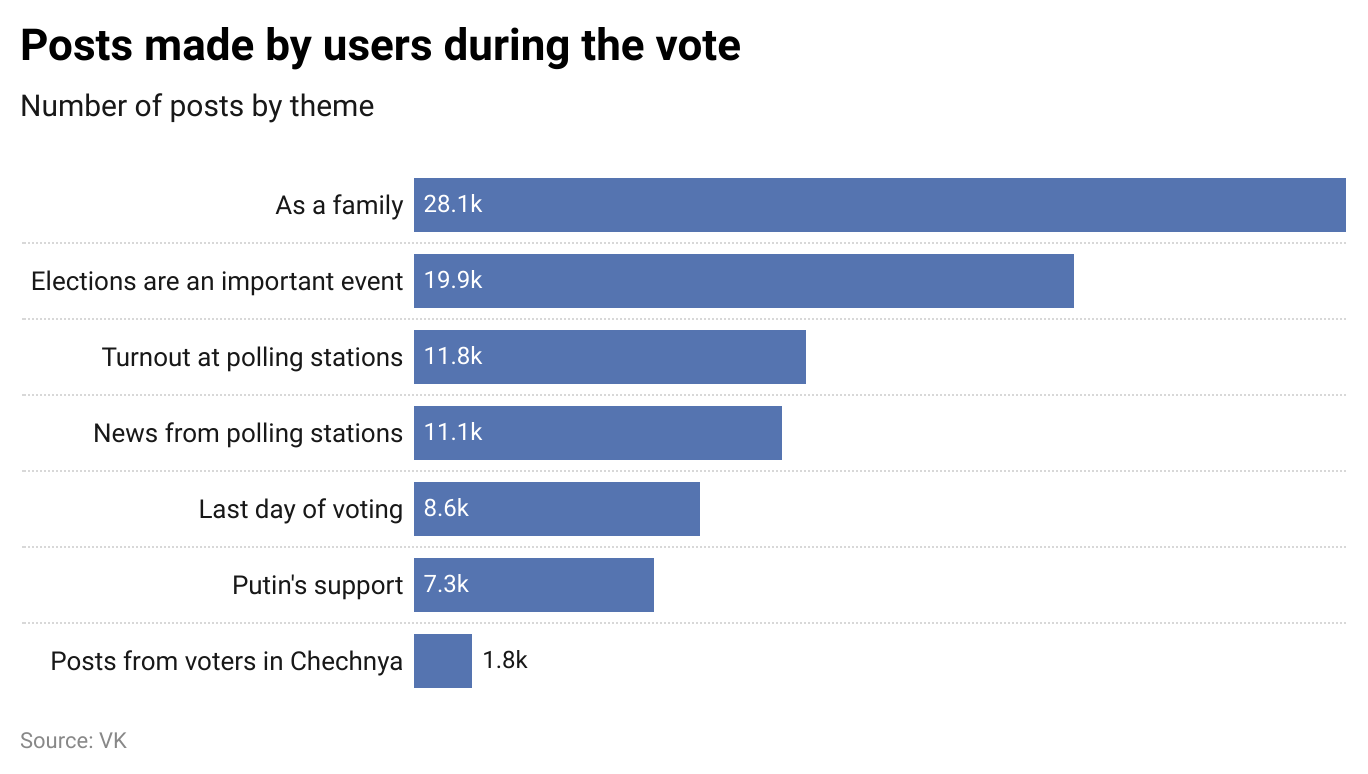
Many people were forced to write reports on social media. The bulk of such reports had the #allfamilytogether hashtag (#всейсемьей in Russian). Nearly 20 thousand posts described how the presidential election was the main event in people’s lives. While another 7.2 thousand posts expressed support for Putin. Other hashtags were also used, for example in Chechnya 1.7 thousand reports had this hashtag — #CHR2024URElectionRF (#ЧР2024ЕРВыборыРФ in Russian).
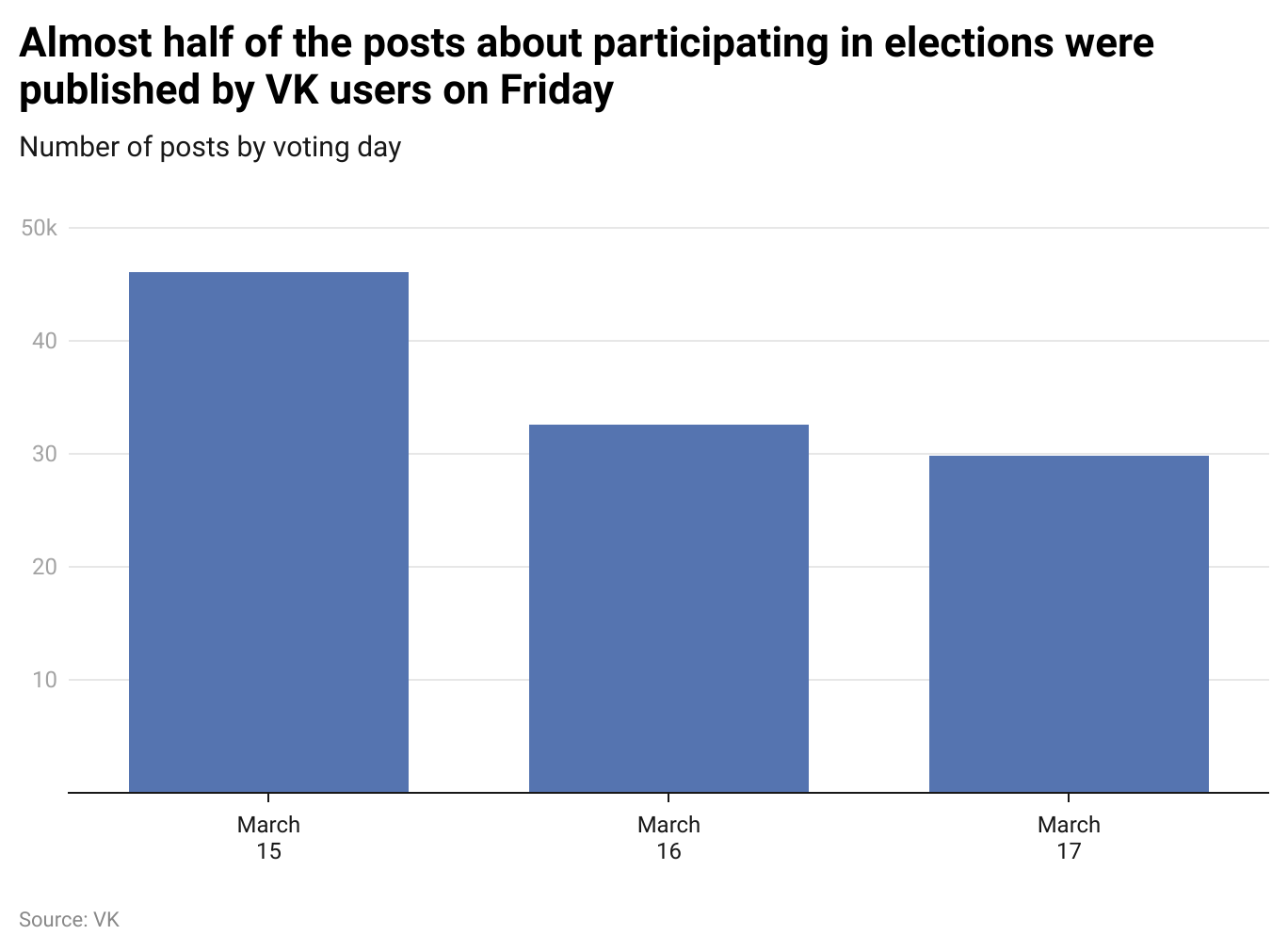
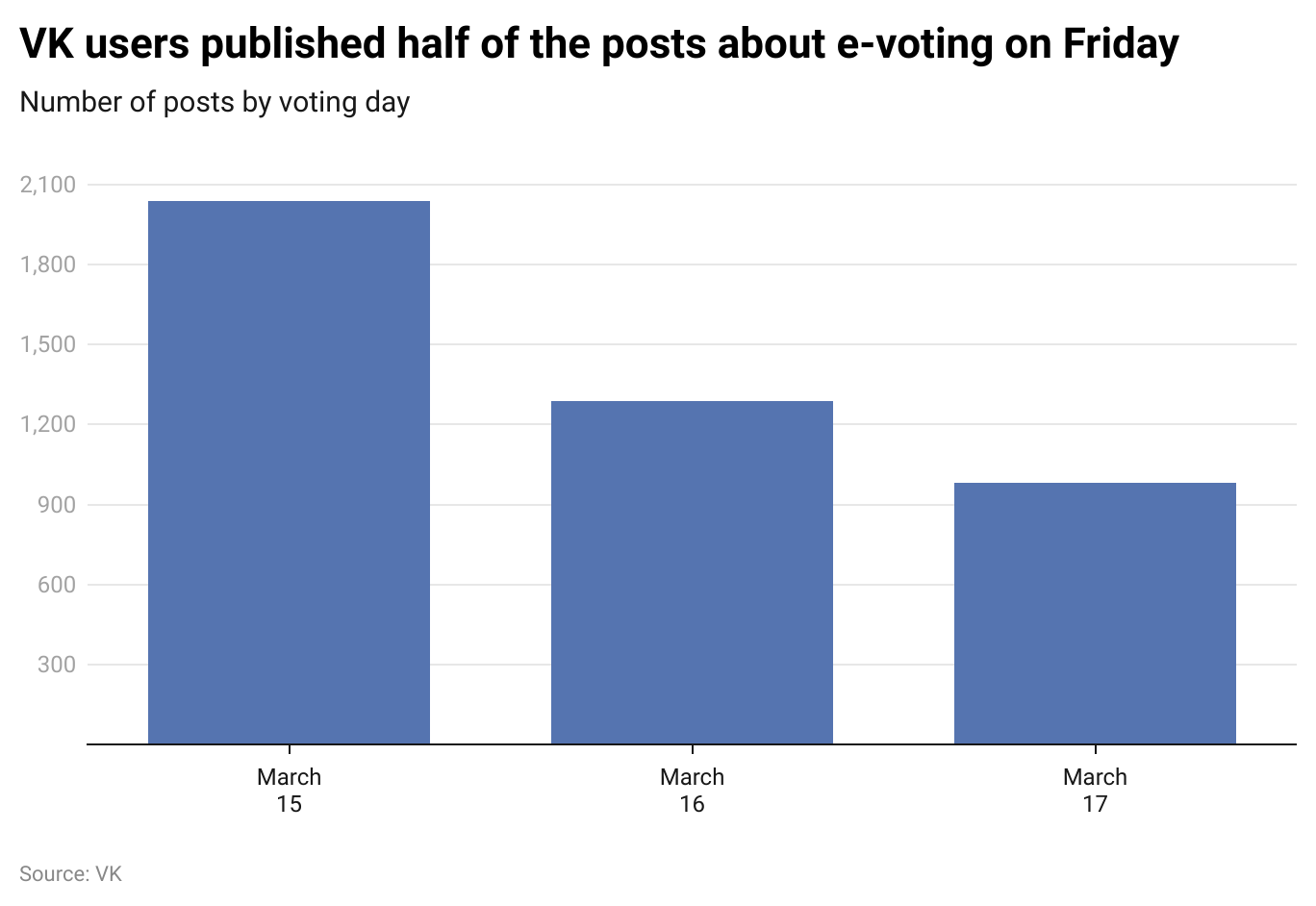
Over three days, VK users published 108.5 thousand posts about participation in the elections. Most of the posts date from March 15, Friday, the only weekday set aside for voting. This could be attributed to the mass compulsion of state employees to go to the polls during working hours.
Golos attributes the record turnout to unprecedented pressure on voters and the widespread use of remote electronic voting. As Novaya Gazeta Europe wrote earlier, 37,000 state organizations and public sector employees advertised e-voting.
Over the three election days, VK users left thousands of posts about their experience of online voting. Half of them were published on March 15.
"My wife and I have already voted online. For Putin, of course! I'm sure that no matter how hard the West tries to disrupt our elections, Russians will vote overwhelmingly 'For!' [Putin]". This is a post by an MGIK journalism professor and leader of the "Party of Russian Ukrainians."
Hundreds of VK users posted about their voting for Putin, including teachers, librarians, academics, university staff and even philosophers. Less than 30 posts were made by Davankov supporters, 15 posts mentioned Kharitonov, and only 10 were related to Slutsky.
MEDIA COVERAGE
In its report, Golos observed an unprecedented upsurge in violence during these elections. Over the three days of voting, 89 people were detained as Russians set fire to polling stations, poured ink into ballot boxes and wrote anti-war slogans on ballots. CEC’s head Ella Pamfilova reported that only 214 ballots were spoiled, calling the offenders "scum".
State media published more than 1.3 thousand news stories about incidents during the election. Next to the Belgorod Region shelling, this issue was the second most popular one in the pro-government media. Another 1.1 thousand news items discussed the high voter turnout.
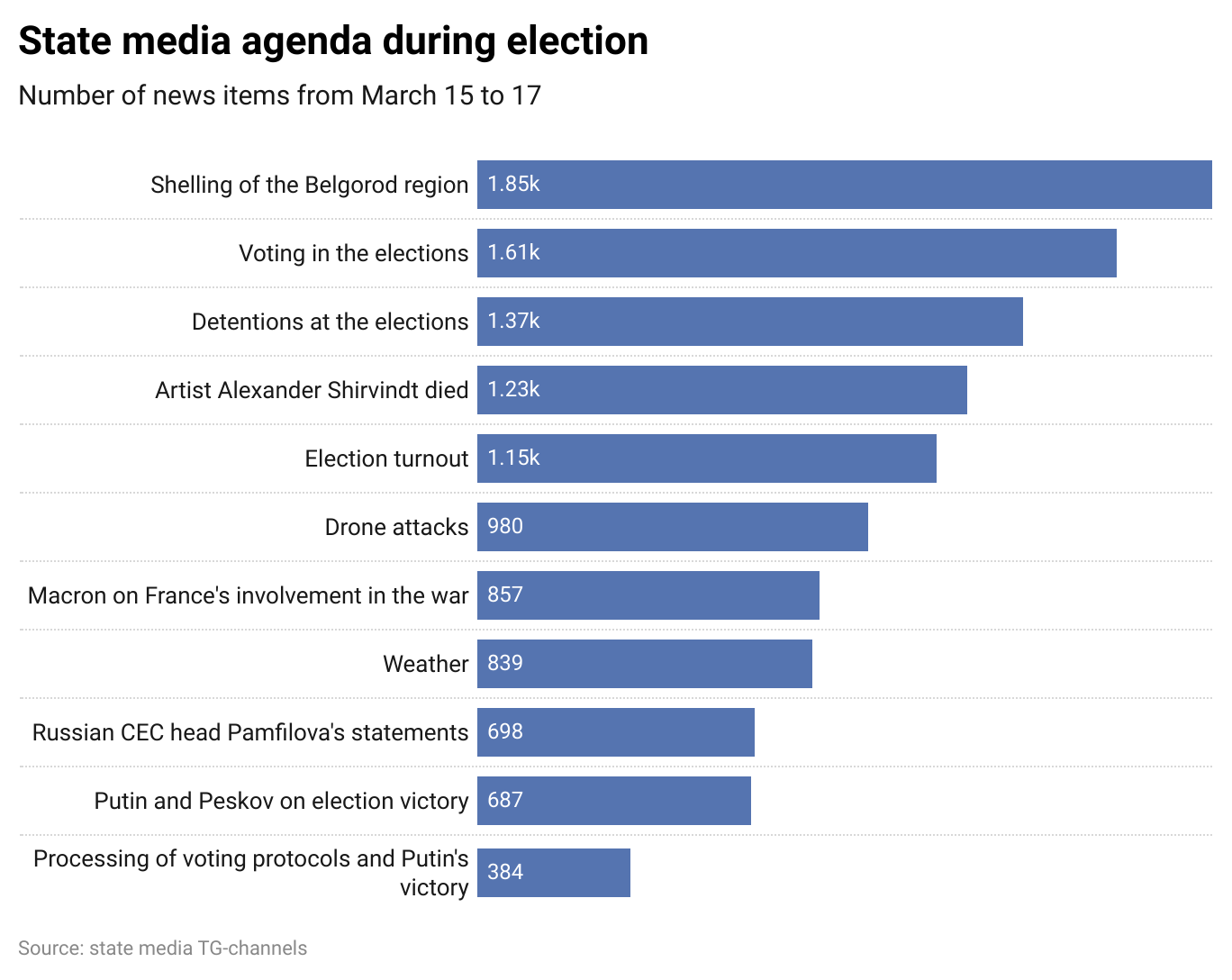
Even before the final vote count, state media started writing about Putin's victory. On the evening of March 17, the president visited his election headquarters. There, he explained the high turnout by referencing the dramatic situation Russia was going through. The election results, according to Putin, demonstrated citizens' trust. The pro-government media published 687 news items with the abstracts of this speech. Another 384 publications were devoted to the results of protocol processing and Putin's preliminary victory.
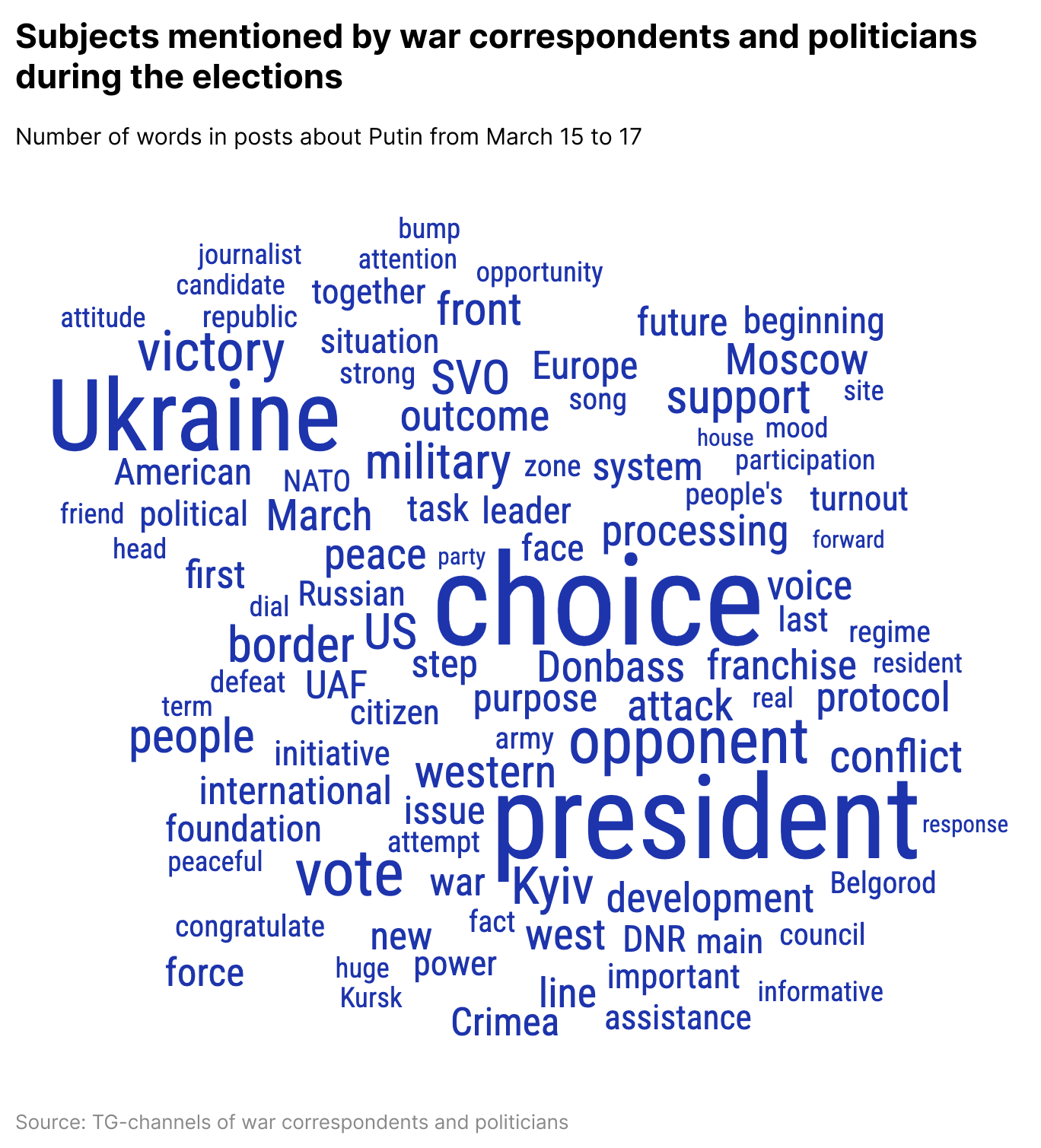
On election days, politicians and military correspondents published a hundred posts about the president: his victory, popular support, confrontation with the West, and the need to bring the “special military operation” to an end.
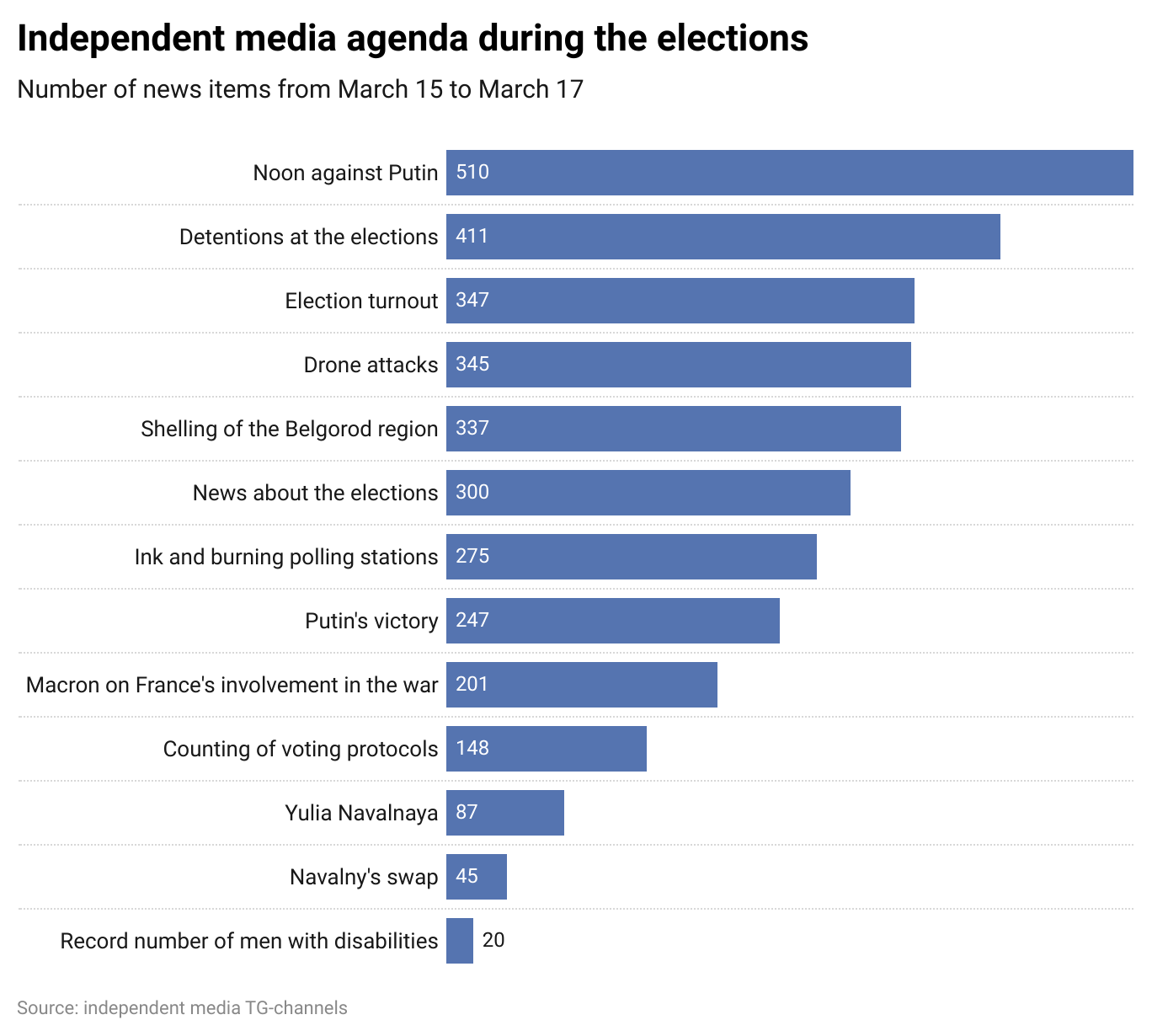
With more than 500 news items, "Noon against Putin" became the main story covered by the independent media over the three election days. Independent media also provided extensive coverage of election violations. Over the three days, they published more than 400 news items on arrests at polling stations, 275 entries on spoiled ballots and arson.