Who is next? Persecution of governors in Russia
24.08.2025





During Putin's 25 years in power, 32 Russian governors have faced prosecution. Most of these governors (21) became defendants in criminal cases while still in office. In the remaining 11 cases, law enforcement bodies initiated proceedings after the governor had retired. Not all of these governors ended up in prison. Nineteen cases went to trial, while the rest were dismissed either because the statute of limitations had expired or because no evidence of the crime was presented.
These statistics include Alexei Smirnov, the former governor of the Kursk region, who held office for several months in the fall of 2024 during the Ukrainian offensive in Kursk. Smirnov abruptly resigned in December 2024, citing "personal reasons", and it emerged in March 2025 that criminal proceedings had been initiated against him for bribery and embezzlement during the construction of defensive structures on the border with Ukraine. Former Russian Transport Minister Roman Starovoit, also a former Kursk governor and Smirnov's predecessor, may also have been involved in the case. Starovoit’s body was found on 7 July 2025. According to investigators, he committed suicide.
7x7 examined how the criminal prosecution of regional elites — both loyal to and critical of the Kremlin — has evolved over time in Putin's Russia. REM is publishing an abridged translation of the original article.
Kremlin against opposition: “Quickly, harshly, and without unnecessary sentiment”
In 2012, Evgeny Urlashov won the mayoral election in Yaroslavl against the United Russia candidate. At the time, the Kremlin was already actively constructing a political hierarchy, promoting individuals loyal to it to mayoral and gubernatorial positions. However, it had not yet fully controlled elections. Urlashov openly criticised United Russia and publicly announced his intention to first run for the regional Duma and then for governor. This frightened the Kremlin.
On 3 July 2013, Urlashov was detained on suspicion of extorting a bribe of 17 million rubles [approximately 400,000 euros at the 2013 exchange rate - REM]. Three years later, the court sentenced him to 12.5 years in a strict regime colony and a fine of 60 million rubles [approximately 840,000 euros at the 2016 exchange rate - REM].
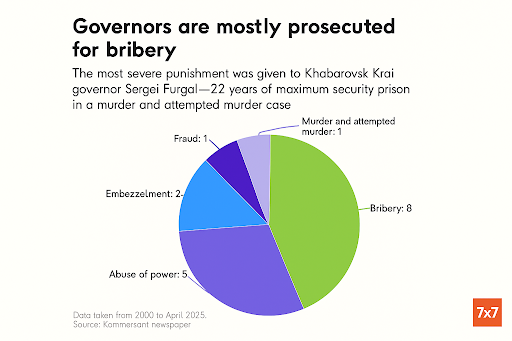
This was one of the most high-profile cases in which the Kremlin dealt with a disloyal mayor. A similar pattern was followed in the case of Sergei Furgal, governor of Khabarovsk Krai, who was detained by security forces after the Investigative Committee opened a criminal case against him in July 2020, accusing him of orchestrating the murders of several businesspeople. In February 2023, the former Khabarovsk governor was sentenced to 22 years in prison.

In a commentary for 7x7, political consultant Alexei Aksyutenko cited Urlashov and Furgal as examples of politicians who provoke irritation among those in power. The Kremlin, he noted, deals with such figures “quickly, harshly, and without unnecessary sentiment”. However, such cases have become increasingly rare. By 2025, only in Khakassia is the current regional head, Valentin Konovalov of the Communist Party, formally in opposition to the Kremlin — and even that opposition appears symbolic. In 2018, Konovalov was permitted to win the election against former governor Viktor Zimin, known as “Putin’s bathhouse attendant”. In the 2023 elections, the Kremlin prematurely removed Konovalov's main rival, Sergei Sokol, an unpopular veteran of the war in Ukraine, from the race.
Kremlin against loyalists: Weaken local elites and strengthen the vertical of power
While the authorities typically deal with disloyal politicians by launching criminal cases, their approach to loyal representatives has varied over the years.
From his first term, Putin sought to limit the influence of mayors and governors — even those who showed full support for the federal government. He understood that these figures were regional political elites, whose influence and power at the local level gave them a certain degree of independence from the Kremlin.
Direct elections for governors were abolished in 2004 for eight years. When they were reinstated, a so-called “municipal filter” was introduced, requiring candidates to collect signatures in order to run. These signatures had to come from heads of municipalities and local deputies — most of whom belong to the ruling United Russia and typically support only their own party. As a result, the nomination of opposition candidates became rare, while governors shifted from being political figures to managers of a federal project. At the same time, the persecution of loyalists began — what political consultant Aksyutenko described as a purge of the regional elite.
In 2015, Komi Governor Vyacheslav Gaizer fell victim to this “purge” — he was sentenced to 11 years in a strict-regime colony for corruption. In 2017, Mari El Governor Leonid Markelov and Udmurtia Governor Alexander Solovyov followed. Both were accused of accepting bribes from regional businesspeople.
“Neither Markelov nor Solovyov had any patrons at the federal level,” anti-corruption expert Ilya Shumanov told 7x7. “You could even say they were part of the real regional elite, with strong local backing from businesses and regional clans”.
Redistribution of regional property is a common reason for the criminal prosecution of governors and administrators, explains political observer Andrei Pertsev:
“Often, financial flows are concentrated among officials who have close ties to friendly businesses. When such officials fall out of favor or lose power, these businesses begin to align themselves with stronger players backed by the Kremlin”.
The Kremlin was able to sever the ties between governors and the local businesses that supported their power by relying on the so-called “Varangians” — officials with no prior connection to the regions where Putin appointed them to govern.
The authorities, Shumanov said, began selecting individuals who were loyal to the Kremlin and connected to federal — rather than regional — financial and industrial groups or clans. The late former governor of the Kursk region, Roman Starovoit, is an example of this type of politician. He was a protégé of the Rotenberg brothers, Russian businesspeople closely associated with Putin.
Over time, securing a position in a governor’s office became a prerequisite for career advancement at the federal level. This shift in status was accompanied by a change in the logic of prosecution. Governors and their deputies began to be punished not only for corruption, but also for failures to implement major federal programs, such as school construction and road repairs. In May 2025, former Vice Governor of Krasnodar Krai Alexander Nesterenko was detained on charges of abuse of office, after the pace of social infrastructure projects slowed under his leadership. As with the prosecution of governors in the regions bordering Ukraine (Kursk, Belgorod and Bryansk), the charges were linked to a perceived failure to safeguard the country’s borders.
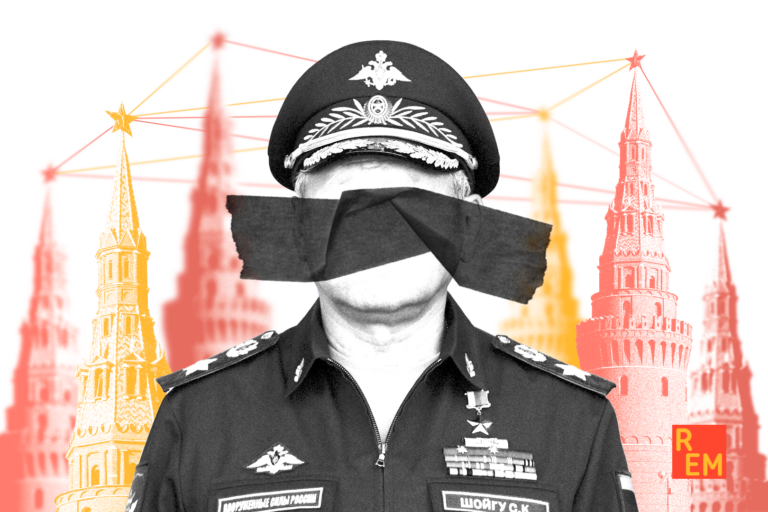
During wartime, the Kremlin makes it clear that there will be no leniency, regardless of who backs a politician or official. In May 2024, Putin dismissed Defense Minister Sergei Shoigu. Immediately afterward, purges began within the ministry: the Investigative Committee launched criminal cases against key figures in the Ministry of Defense. Both the deputy defense minister and the deputy chief of the Russian General Staff received long prison sentences. In total, 13 people were detained in connection with the Defense Ministry case.
“The story of Shoigu and his subordinates is very revealing”, said Alexei Aksyutenko. “Shoigu had some of the strongest protection in the country, but even that couldn’t save him”.
Ilya Shumanov adds, “The new reality is very different. The Kremlin is shifting responsibility for failures onto governors, among others, as they are now the most vulnerable and weakest players in the system. Governors are no longer protected because they no longer guarantee regional stability. That role now belongs to the Kremlin”.
Any regional official can be imprisoned for corruption
Corruption is the most common reason the federal government prosecutes regional officials loyal to it. According to Novaya Gazeta, between 2000 and 2020, governors and mayors were most frequently charged with corruption-related offenses: abuse of power, misuse of budget funds, bribery, forgery and negligence.
It is easy to initiate such a case, as any official who signs documents can, in one way or another, be linked to corruption schemes. Investigators can use this to launch criminal proceedings in various ways — even embezzlement by a contractor can implicate a high-ranking official. This doesn’t necessarily mean the official broke the law, but rather that, for one reason or another, he fell out of favor with his superiors.
Political commentator Andrei Pertsev explained that mayors and governors are most often prosecuted for corruption because law enforcement agencies “need to tick boxes for reporting purposes”, and that corruption cases can be brought against “almost any official”.
In addition, criminal cases against regional officials are not always initiated to strengthen the vertical of power, but also to satisfy public demand. In most cases, according to Ilya Shumanov, anti-corruption rhetoric resonates positively with citizens — they “rejoice when someone is dispossessed”, because they believe regional authorities are stealing.
“Every official in Russia can fall victim to the Kremlin”
Resignations and rotations of governors in Russia, driven by the Kremlin rather than voter choice, became the norm during Putin’s previous term (2018–2024). Every now and then, political analysts speculated about who might be removed from office. As Russia started the full-scale war against Ukraine, the pace of turnover among governors and regional elites slowed. Until 2022, the Kremlin changed an average of 13 governors annually, but between 2022 and 2024, that number dropped to just five. Political observer Alexander Kynev attributed this to the federal government’s focus shifting to “more pressing issues — problems with weapons, staffing, sanctions, and foreign policy”. Additionally, Putin sought to avoid further regional turbulence ahead of the 2024 presidential election.
By 2024, federal authorities had adapted to the new realities and resumed managing regional policy immediately after Putin’s planned victory in March 2024. Between July 2024 and June 2025, 13 governors were replaced across Russia. According to Kynev, this return to the usual pattern of resignations was influenced by the approaching 2026 State Duma elections, which “usually sharply increase the level of turnover among regional officials”. Additionally, Kynev noted that the appointment of governors in some regions appears to be a test of “new and tougher management practices”.
One such example is Georgy Filimonov, head of the Vologda region. He restricted alcohol sales, advocated for a total ban on abortions, and initiated the creation of a youth organization Oprichniki named after the feared enforcers during Ivan the Terrible’s reign. The Presidential Administration is closely monitoring the reactions of the elite and broader society to the actions of governors such as Filimonov, explains Kynev.
The war against Ukraine remains a significant factor in the repression not only of anti-war Russians but also of regional and federal officials. As long as Russia continues the war, criminal prosecutions within the country will remain highly unpredictable and are expected to intensify, since any failure connected to military events will be viewed as a sign of flaws in the country’s governance.
“If there will be more cases like Shoigu or Starovoit, Russia will soon face a shortage not only of small-town administrators but also of law enforcement personnel, as no one will want to risk their own life and their children’s future”, explains Aksyutenko.
Political commentator Andrei Pertsev agrees: “Every official understands that they are a potential victim”. In his view, the number of criminal prosecutions against governors will remain roughly the same, as law enforcement agencies are unlikely to lower their KPIs.