Why the war did not become the main topic of the election campaign
05.09.2023





In a few days, Russia will be holding elections. Russians are set to vote for 21 governors and deputies of 16 regional parliaments, not counting the occupied Donetsk and Luhansk so-called "people's republics", Zaporizhzhia and Kherson regions. For insights on how the Russian authorities are preparing for the elections in these regions, read this recent publication.
In the past, parties and candidates would offer distinct promises to voters, address social concerns, and even position themselves in opposition to the current administration. However, the current campaigns appear lackluster and devoid of a clear message. Surprisingly, even the topic of war is scarcely touched upon by the primary candidates.
This REM review delves into what this lack of ideas signifies and explores why the war in Ukraine hasn't emerged as the predominant topic of the pre-election campaigns.
War and Elections: Why the Topic is Marginal
In the 2022 election campaigns, where 14 governors and 6 parliaments were up for election, the subject of war was barely addressed. Experts at the time suggested that political strategists were uncertain about the Russian public's widespread support for military endeavors. Had there been evident support, candidates would have prominently featured the war in their campaigns.
In the ongoing election cycle, there seems to be a noticeable uptick in the number of billboards with military motifs. Even Moscow's Mayor, Sergey Sobyanin, who previously distanced himself from the war, has now released campaign material endorsing military actions in Ukraine. This shift was highlighted by the independent news outlet SOTA. Reporters observed that a portion of his pamphlet showcases a photograph of him in military attire, standing in a dugout. Accompanying the image of Sobyanin alongside a soldier is the message emphasizing the need to stand by the armed forces who are defending the Motherland with weapons in their hands.
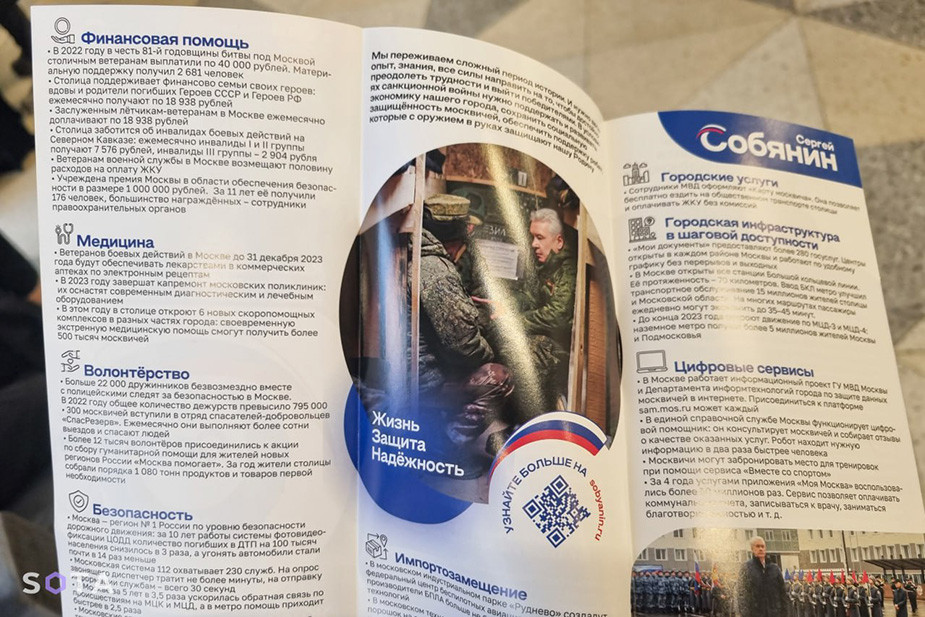 Sergey Sobyanin, Moscow's Mayor, appears in military attire on his election leaflet. Source: https://t.me/sotaproject
In Ulyanovsk (a city in Central Russia with a population of 613,000), the Communist Party of the Russian Federation (CPRF) displayed pre-election banners featuring war participants. Billboards showcasing the faces of military personnel adorned the city streets.
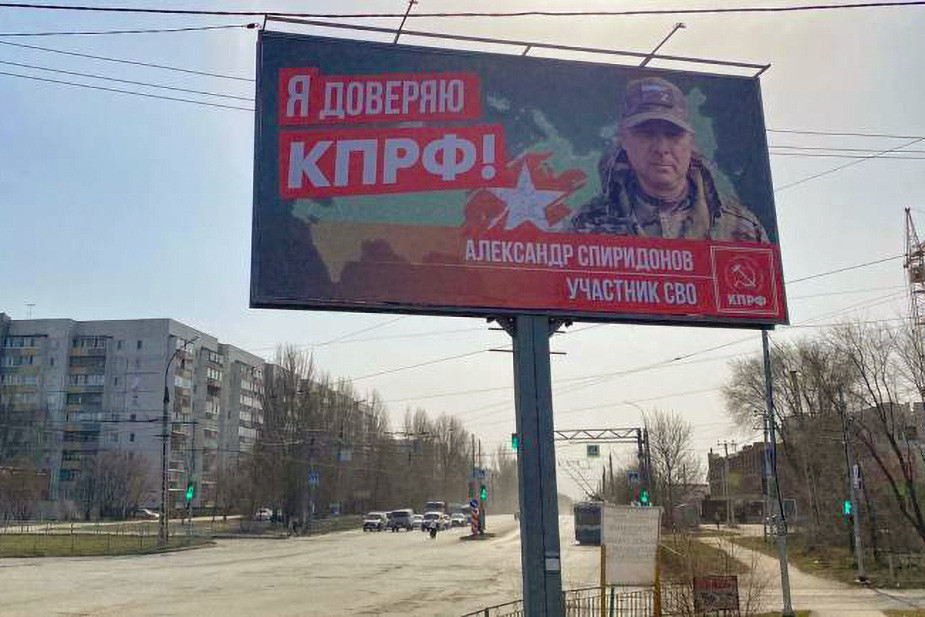 CPRF banner in Ulyanovsk features a war participant: "I trust CPRF! Aleksander Spiridonov, participant of the special military operation". Source: semnasem.org
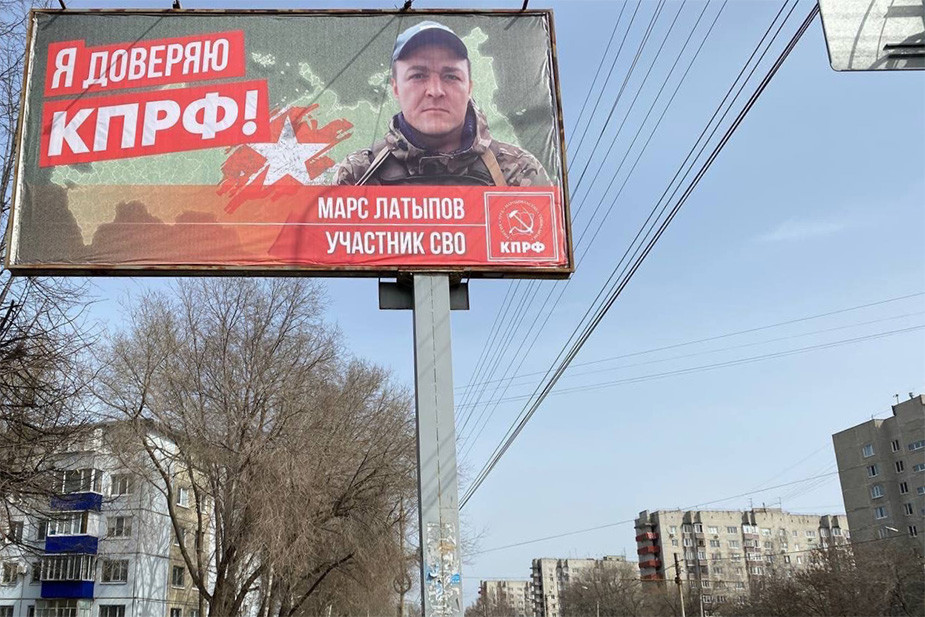 CPRF banner in Ulyanovsk features a war participant: "I trust CPRF! Mars Latypov, participant of the special military operation". Source: semnasem.org
Roman Yakovlev, the Communist Party's gubernatorial candidate for the Novosibirsk region, Siberia (region's population 2.8 million), used a campaign billboard to express his vision of establishing a defense industry hub in the region. In a conversation with local media, Yakovlev emphasized the current need for the army to be equipped with ammunition, weapons, and advanced technology.
Vladimir Kazanin, gubernatorial candidate for the Omsk region from the Communists of Russia party (frequently viewed as a “spoiler” to the CPRF), showcased the most patriotic banner. His campaign material boldly states: "FOR SMO [Special Military Operation] - Vote FOR your governor" («ZA СВО — Голосуй ZA СВОего губернатора»).
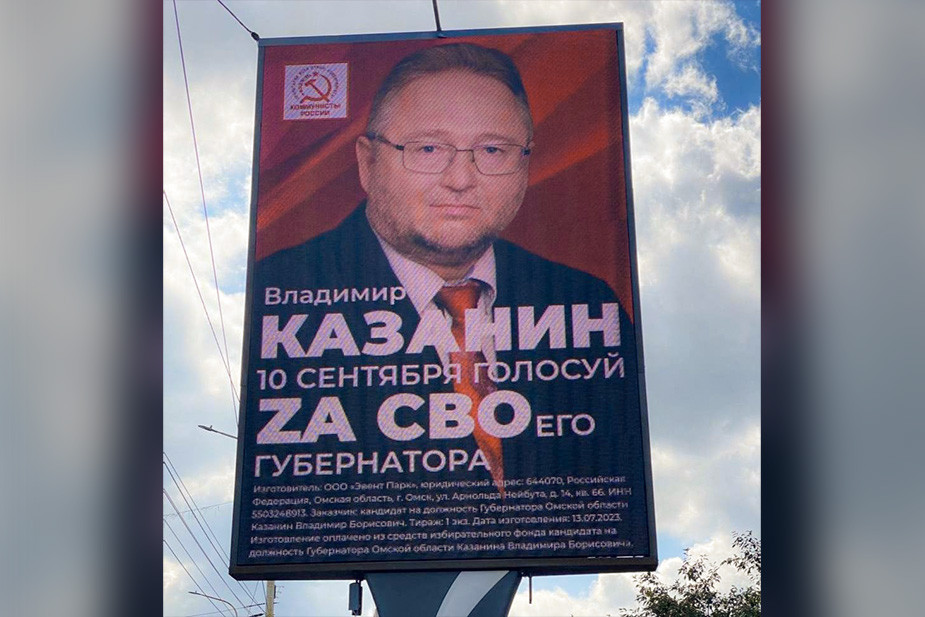 Billboard with Vladimir Kazanin, candidate for governor from CPRF. Source: https://t.me/agituha
However, political scientist Alexander Kynev calls Kazanin an "outsider candidate". According to the expert, it makes more sense to examine the messages and rhetoric of candidates and parties with legitimate prospects for success. Furthermore, Kynev observes that the subject of war isn't a widespread topic in campaign materials. Politicians tend to highlight not so much the significance of the military actions themselves, but rather the imperative of social support for those involved in the war and their families.
To support his view, Kynev references a campaign brochure from Dmitry Nikolaev, an LDPR candidate for the Yekaterinburg City Council (city in the Ural region, population 1.5 million). The brochure details a comprehensive list of efforts by deputies and party members to support the participants of the "special operation". These efforts include procuring military equipment, supplying medicines, dispatching parcels and letters to conflict zones, establishing a workshop for crafting camouflage nets and helmets, as well as offering legal aid to the families of soldiers.
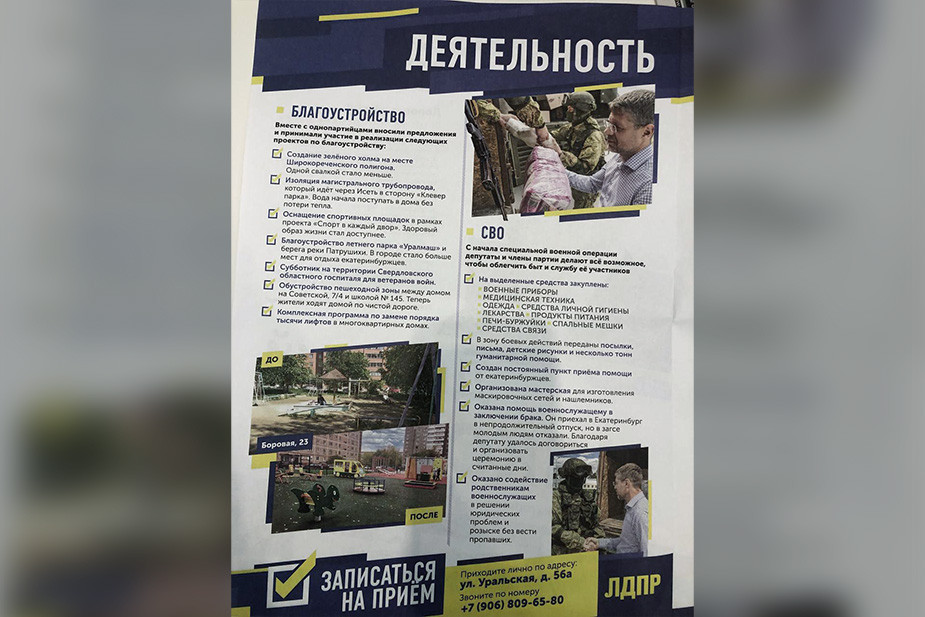 Campaign brochure from Dmitry Nikolaev, an LDPR candidate in Yekaterinburg. The efforts by LDPR deputies to support the participants of the SMO are listed in the column on the right. Source: https://t.me/agituha
In 2023, a significant number of candidates and parties remain focused on regional development, sidestepping discussions related to the war. Consider the Oryol governor and communist, Andrey Klychkov, as an example. Despite refraining from military topics in campaigns, he stands out as one of the most proactive regional heads in supporting the military. He consistently dispatches humanitarian aid and makes visits to military units.
Political scientist Vladimir Slatinov explained in a conversation with journalists of the Abireg news outlet that Klychkov's intention is to present himself as a proficient manager, rather than as a proponent of the war with Ukraine.
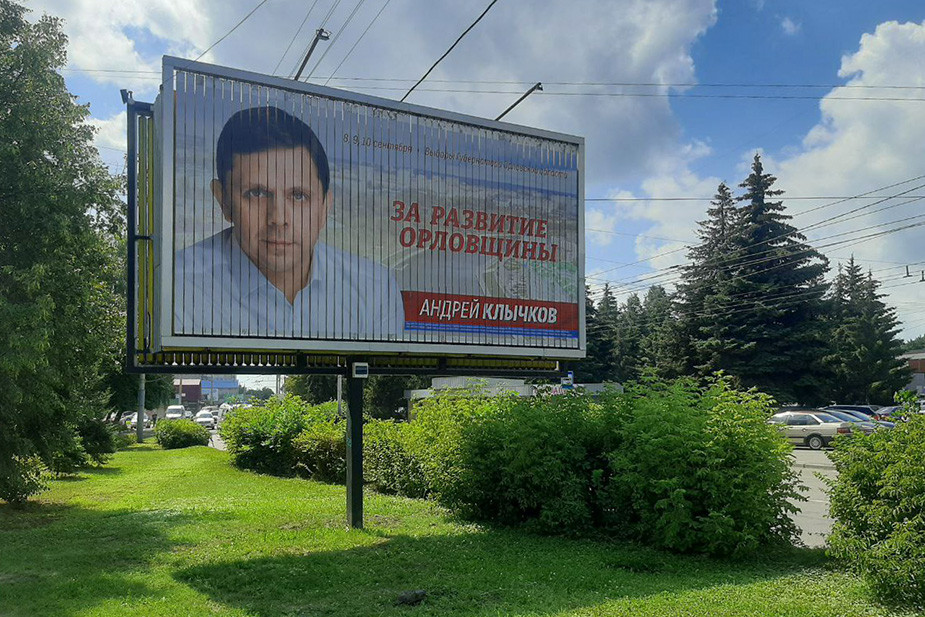 "For the development of the Oryol region. Andrey Klychkov". Source: https://t.me/alexander_kynev
Sergey Sokol, State Duma deputy and United Russia candidate for the leadership of Khakassia (Southern Siberia, population of 530 000), is gradually distancing himself from the "hero-veteran of SMO" persona. Some analysts suggest that relying on themes of heroism and loyalty to the homeland doesn't resonate with voters. Consequently, Sokol, along with numerous other gubernatorial and deputy candidates, shifted his focus to the classic narrative of sourcing resources for regional development.
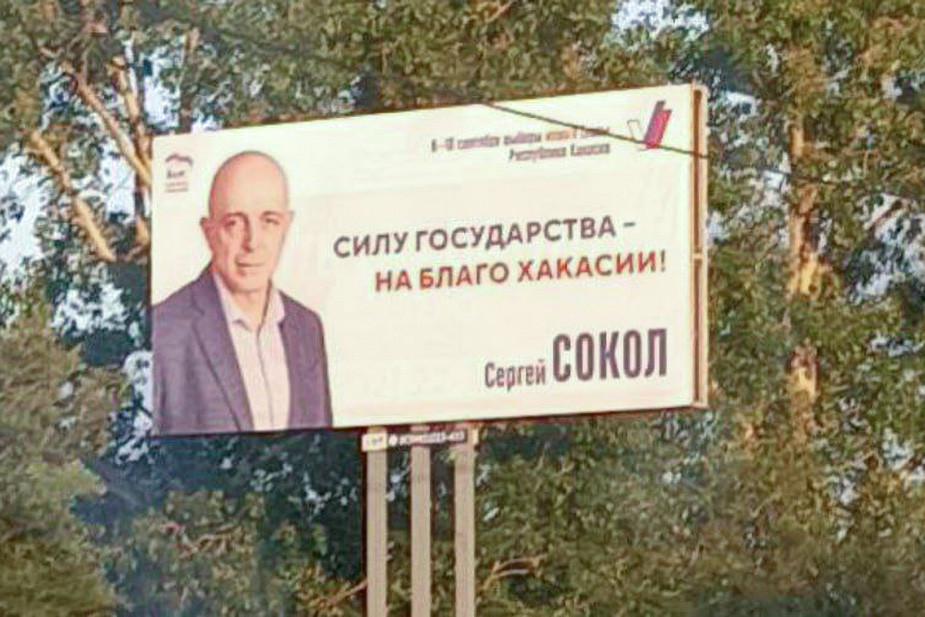 Billboard with Sergey Sokol, United Russia. "The power of the state - for the good of Khakassia!" Source: https://t.me/agituha
Party Campaigns: What Candidates Talk About
An analysis of the main political parties' pre-election campaigns reveals an evident ideational crisis. The promotional efforts of the Just Russia party come across as notably vague. In Smolensk (Central Russia, bordering Belarus, population 870 000), party banners feature classic literary quotes rather than distinct slogans. Yakutia (Siberia, population 1 million) saw party members displaying a poster boldly declaring "Against traitors and scoundrels". Meanwhile, in Arkhangelsk (Northwest Russia, population 1 million), the Just Russia candidates' banners for the regional parliament are strikingly similar, all echoing the sentiment "For the fair ones and that's it!". This phrase has emerged as the central theme of the party's pre-election campaigns across all regions.
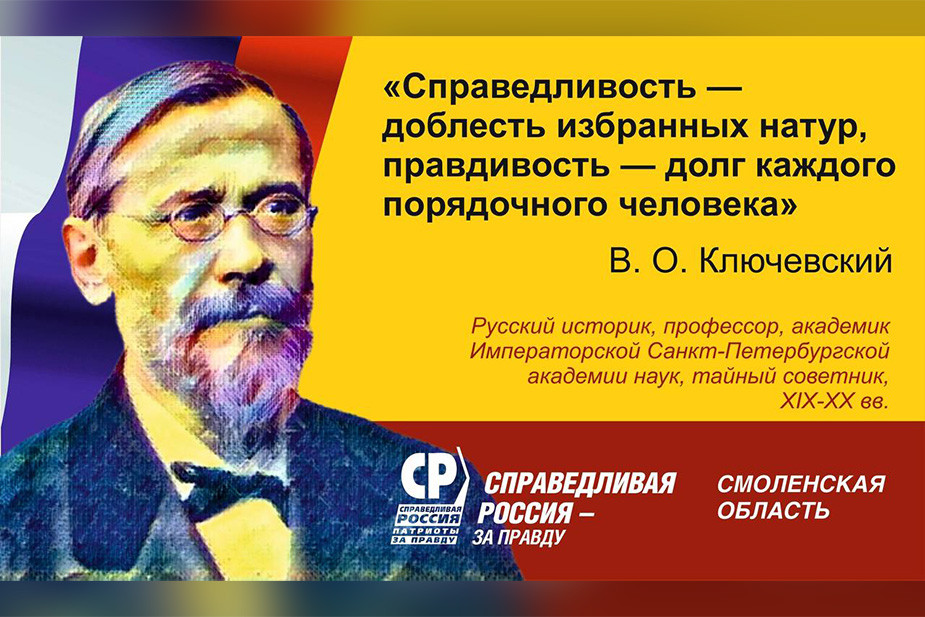 Just Russia's billboard in the Smolensk region features the quote of historian Vasily Kluchevsky: "Justice is the valor of the chosen few, truthfulness is the duty of every decent human". Source: semnasem.org
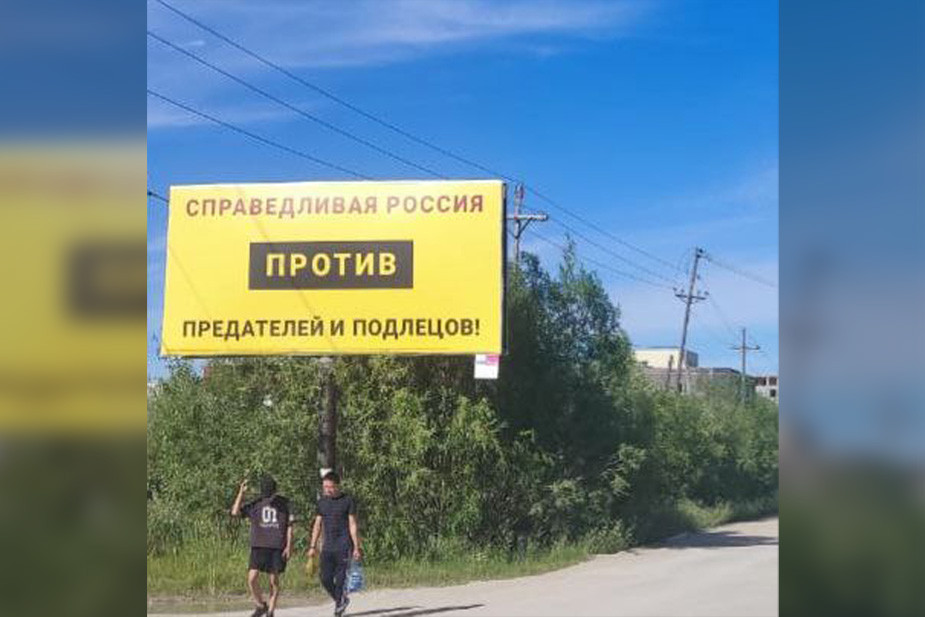 Just Russia in Yakutia: "Just Russia is Against Traitors and Scoundrels". Source: semnasem.org
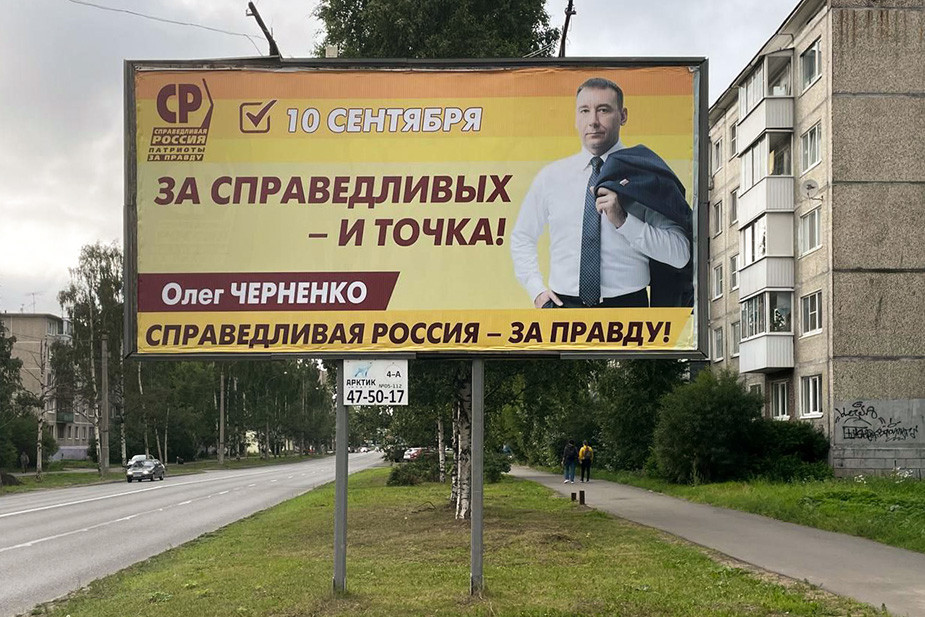 Oleg Chernenko, Just Russia in Arkhangelsk: "For The Fair Ones and That's It!" Source: semnasem.org
Alexander Kynev observes: "Effective campaigning should resonate with a specific audience. The pre-election strategy of Just Russia, however, seems entirely aimless". To gain a better understanding of the internal crisis of the Just Russia party, read our article “The Just Russia party distances itself from regional elections following the Wagner mutiny”.
The Communist Party's campaign materials notably lack innovation. While they have historically positioned themselves in opposition to the ruling party, only occasionally do they employ a more aggressive tone. For example, in Severodvinsk, located in the Arkhangelsk region, the Communist Party displayed posters featuring a pre-war slogan: "Tired of the lords? Choose comrades!"
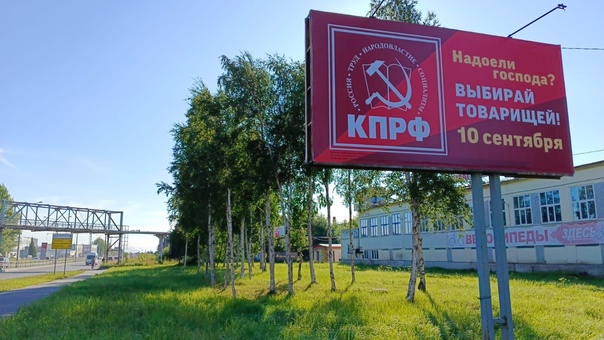 "Tired of lords? Choose comrades! 10 September". CPRF's billboard in Severodvinsk. Source: https://vk.com/id458143089
"The party finds itself in a particularly ambiguous position after the onset of the Special Military Operation. In this context, it's not in a position to voice any stringent criticism. While in certain regions, grassroots communist representatives are making commendable efforts, such as opposing the closure of hospitals or specific enterprises and resisting staff layoffs. These actions, however, are localized and relatively minor in scale. Overall, the party appears to be missing any notable ideas," added Alexander Kynev.
The political scientist observed that, compared to the members of the Just Russia party and communists, the campaign efforts of the Liberal Democratic Party of Russia (LDPR) stand out in the regions. However, they often address less pressing issues, such as leveraging maternity capital for investments and proposing state registration for electric scooters, etc.
The New People party also showcases striking campaign tactics, even though this "parliamentary" party has chosen a more reserved approach to the current gubernatorial elections, fielding candidates in just six of the 21 regions. The party's regional chapter in Yekaterinburg, which is gearing up for city council elections in September, is taking a more inventive approach. Notably, their campaign material featuring the slogan, "Think they'll bring change? No... Then we're heading to the city council!" is quite eye-catching. Another audacious banner reads, "Restrictions, denunciations, fears ⚡ Freedom - the New People party".
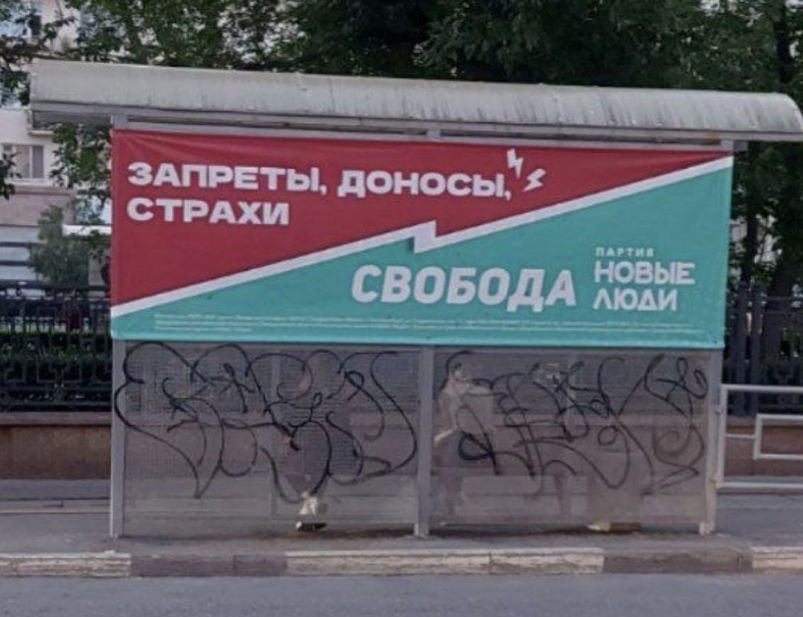 "Restrictions, denunciations, fears ⚡ Freedom - the New People party". Source: https://t.me/cikrf
The Yabloko party, which sharply condemned military actions in Ukraine last year, is now making efforts to participate in the upcoming elections. Their primary campaigns are centered in Yekaterinburg and Veliky Novgorod, both of which are preparing for city council elections.
The party is trying to push an anti-war agenda in Veliky Novgorod. The Yabloko members designed a newspaper bearing the slogan "I am for peace", but faced challenges when two St. Petersburg printing houses declined to produce it. Only in Moscow did the party succeed in printing the newspaper, which prominently features articles on censorship and repression on its front page. Meanwhile, in Yekaterinburg, the party's rallying slogan is "For Peace and Freedom!".
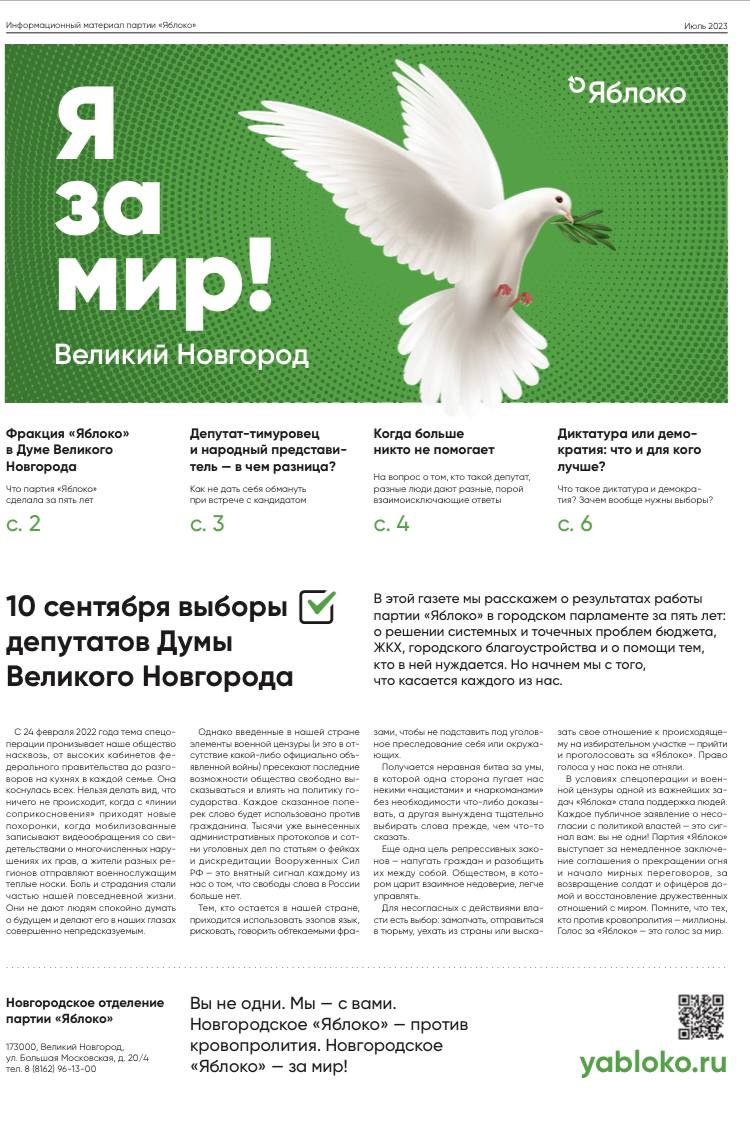 "You are not alone. We are with you. The Novgorod Yabloko is against bloodshed. The Novgorod Yabloko - for peace". Source: Yabloko
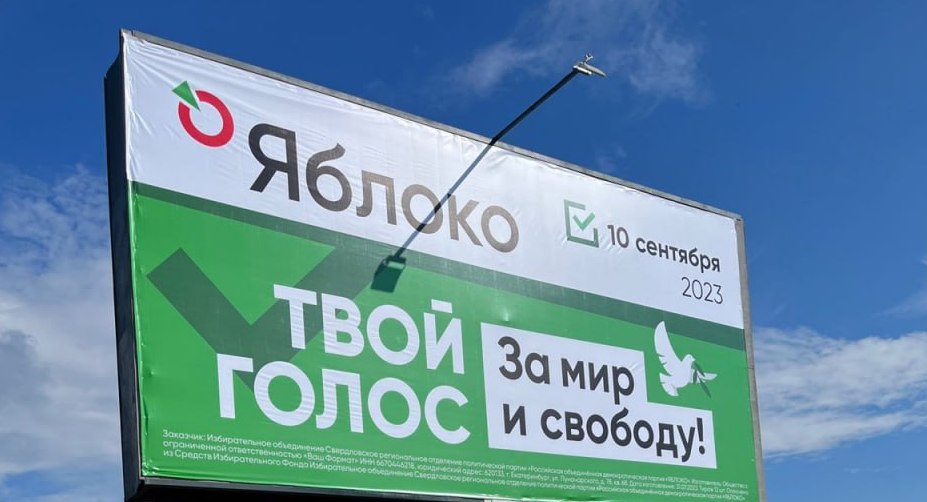 "Yabloko. Your voice for peace and freedom". Source: Yabloko
Alexander Kynev believes that the current pre-election campaign's idea crisis among parties stems largely from self-censorship and apprehension about crossing certain boundaries.
The United Russia Party distinctly highlights regional development and social issues in its political outdoor campaigns, emphasizing the urgency of addressing local challenges. For instance, Shamil Shaydullin, a candidate for the Legislative Assembly of the Ulyanovsk region, underscores the significance of developing villages within the region in his campaign messages. Similarly, Vyacheslav Kovel, another candidate from the ruling party, aligns with this approach, advocating the slogan: "Done by the deputy — backed by the village".
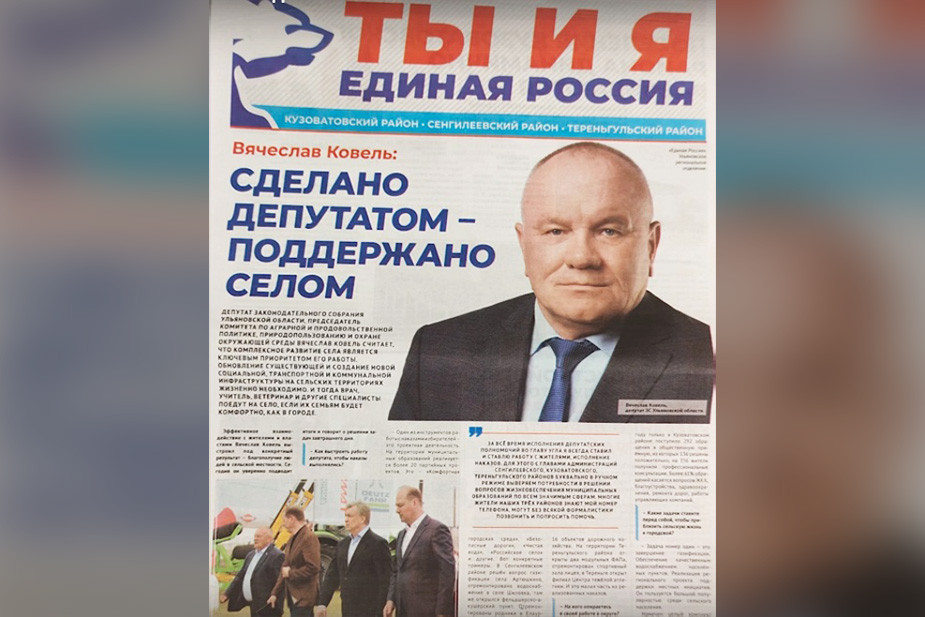 United Russia's agitation newspaper in Ulyanovsk. "Vyacheslav Kovel: Done by the deputy — backed by the village". Source: semnasem.org
In the Vladimir region, United Russia candidates vying for the Legislative Assembly are campaigning under the banner "Team for the Region's Development".
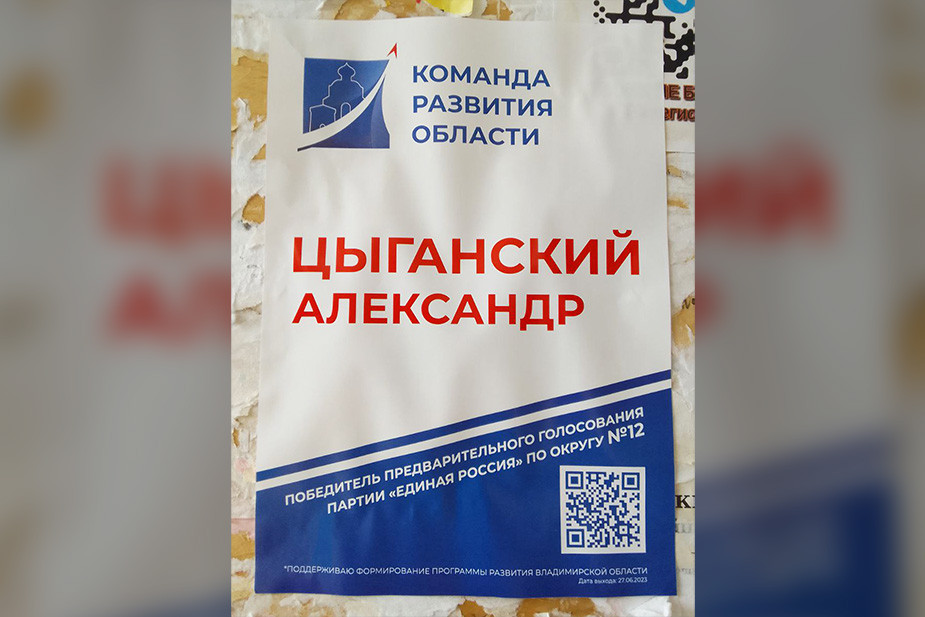 "Team for the Region's Development. Tsygansky Alexander". Source: semnasem.org
Journalists from Verstka have observed that in certain regions, both incumbent officials and deputy candidates from United Russia have entirely abstained from active campaigning, instead leaning on administrative resources. In the Voronezh region (Central Russia, population 2.3 million), Governor Alexander Gusev's team, as he seeks re-election for a second term, has opted not to allocate a distinct media budget. Instead, the campaign is limited to state media outlets and is driven by the publicity of ongoing activities.
Remarkably, with only a few exceptions, the military theme hasn't held a significant or even discernible position in the pre-election campaigns of either political parties or individual candidates. This trend is evident not just in the ruling party but also among the so-called systemic opposition. Furthermore, topics centered around peace aren't gaining much traction either. Alexander Kynev, who has been keenly observing the campaign from within Russia, believes that the Russian electorate, for better or worse, is more preoccupied with tangible daily challenges. Interestingly, many Russians do not directly correlate these challenges with the ongoing war.
The emphasis on the ongoing war was absent last year, and it remains so now. This topic holds little relevance at a grassroots level. People are preoccupied with social issues: increasing prices, diminished incomes, unemployment, medication shortages, and so on. While the list of concerns might differ from one region to another, it consistently has a pronounced social emphasis, concludes Kynev.