Operation “Legitimacy”: Inside Russia’s Governor Elections
01.10.2025





An anonymous source from Insiders’ Chronicle published internal correspondence between officials from the Irkutsk regional government and local media managers. The documents reveal that the re-election campaign of incumbent governor and United Russia candidate Igor Kobzev was built on systematic violations of electoral rules — ranging from the illegal use of regional budget funds to pay Moscow-based political consultants and pseudo-independent observers, to large-scale propaganda in the media and on social networks.
The scale and structure of funding uncovered in the Irkutsk region suggest that this is not a regional exception but rather part of a nationwide model for conducting gubernatorial campaigns. Instead of strengthening trust in elections and reinforcing their legitimacy, the authorities’ strategy resulted in the direct discrediting of the electoral process, once again highlighting its fictitious and manipulative nature.
REM examined the details of the funding schemes, administrative technologies, and propaganda support behind Igor Kobzev’s campaign.
Illegal expenses
Budget allocations for the election campaign and its media support are of particular interest.
According to figures published in official Russian media two weeks before the election, Kobzev spent 28 million rubles (€280,000) out of the 37 million rubles (€370,000) raised in his official campaign fund.
However, leaked expenditure records suggest that the real cost of securing Kobzev’s re-election may have been ten times more — over 306 million rubles (over €3 million). This amount is three times higher than the legal limit for campaign funds in the Irkutsk region, which is capped at 120 million rubles (€1.2 million). Meanwhile, exceeding this limit by more than 10% should result in the candidate’s disqualification or the annulment of the election results.
Russian electoral legislation also prohibits candidates from using the advantages of their official position and bans civil servants from exploiting their offices to support particular political forces. However, all these provisions were violated in the Irkutsk region.
Moscow political consultants
A third of all expenses — 136 million rubles (€1.36 million, already more than the maximum legally permitted campaign fund) — was allocated to Moscow-based political consultants. The practice of hiring external consultants is typical in most Russian regions that hold important elections. In many cases, even several consultant groups from Moscow work in parallel.
Kobzev’s re-election campaign was managed by CROS, a PR firm ranked “among the world’s top PR consultancies”. The company has an extensive history of working with the Russian state across various sectors, listing dozens of government agencies as clients. According to public records, CROS has secured government contracts worth over €29 million.
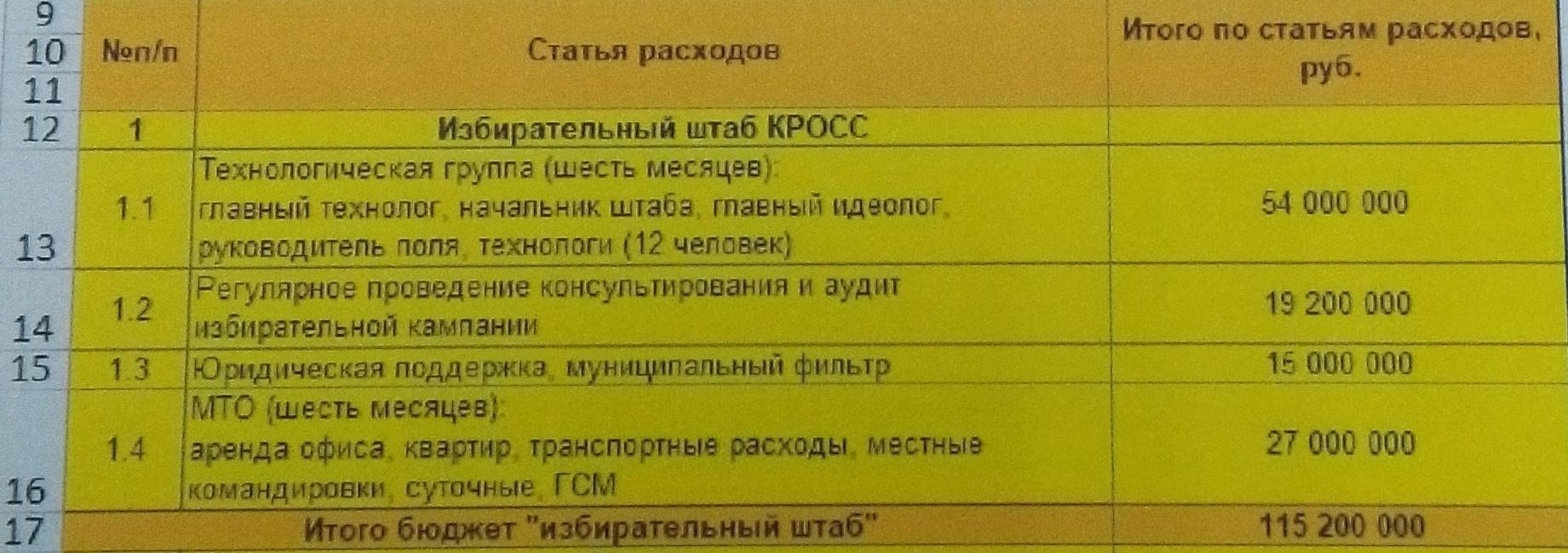
Key spending items (see Figure 1) included six months of salaries for 12 campaign staff members — among them a “chief ideologist” — totaling €540,000. Additional costs included a “campaign audit” (€192,000), “legal support”, and the “municipal filter” (€150,000). The latter refers to the process of securing signatures from municipal deputies to endorse Kobzev’s candidacy — while also managing which other candidates could access similar support. Material and technical costs of running the campaign headquarters accounted for another €270,000.
Figure 1. Campaign headquarters budget (in Russian)
The budget also included funding for street pickets (€150,000), a sociological survey (€20,000), and “counter-propaganda” (€30,000).
Special project “Legitimacy”
More than 40 million rubles (€400,000) of the campaign budget was allocated to a federal special project called “Legitimacy.” These funds were used to finance a network of so-called “public observers”. “Public observers” first appeared in 2018, when the state built an administrative vertical of government-controlled election monitoring. Their primary role has been to displace independent civic monitoring efforts, while reinforcing a narrative of transparency by reporting “no violations” and staging the appearance of broad public oversight.
Figure 2. Excerpt from the budget of the “Legitimacy” project (in Russian)
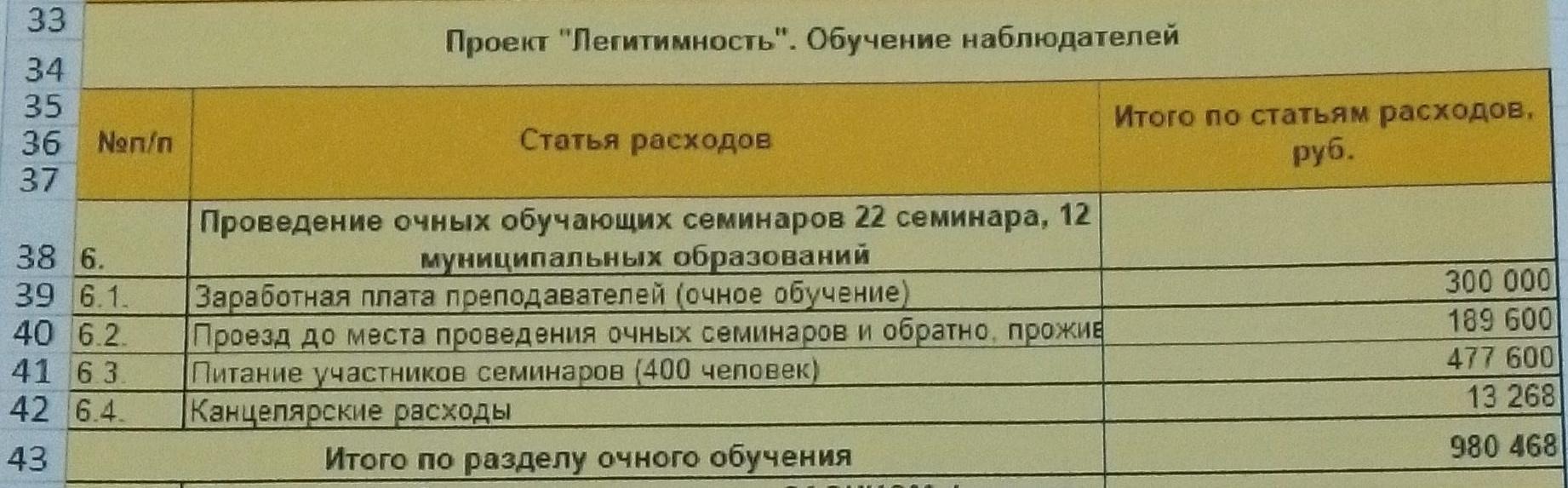
The project’s name is no accident. These “public observers” were tasked with creating a positive narrative around Kobzev’s re-election by posting on social media claims that the elections were conducted without violations. The training of “public observers” took place within the sub-project “Observer-Bloggers”, part of the “Legitimacy” project.
Both initiatives were federal projects, funded and operated uniformly across Russian regions holding elections. During the 2025 Unified Election Day (UED), election monitors documented a flood of nearly identical social media posts praising the smooth conduct of elections. In the analysis How Kremlin uses social media to control and boost turnout, REM had previously detailed how this orchestrated system of election legitimization via social media functioned during the 2024 presidential election.
A million-euro image
Yet creating the appearance of electoral legitimacy was not the campaign’s most expensive undertaking. Far more was spent on media operations and shaping a favorable public image of the incumbent governor. In total, Kobzev’s campaign allocated over 130 million rubles (€1.3 million) to paid content in traditional media and Telegram channels — effectively, articles and posts promoting the candidate.
Two Moscow-based organizations were responsible for coordinating this work. The Kremlin-linked Social Research Expert Institute (Ekspertnyi Institut Sotsial’nykh Issledovanii, or EISI) oversaw the campaign’s media support, with a budget exceeding 80 million rubles (€800,000).
EISI was founded in 2017 by Sergey Kiriyenko, First Deputy Chief of Staff of the Presidential Administration and head of the Kremlin’s internal politics division. Conceived as a Kremlin “think tank” tasked with developing a vision of Russia’s future, the institute quickly became a major recipient of state funding — in 2018 alone, it received around 1 billion rubles (€13 million at the time) from state-owned companies.
Despite substantial financial backing, EISI never evolved into an influential ideological player. Following Russia’s full-scale invasion of Ukraine, the institute pivoted toward overt war propaganda. According to Inca Digital — a database tracking over 6,000 entities linked to the Putin regime — EISI has ties to prominent pro-Kremlin artists and musicians, including those featured in the institute’s state-sponsored concert tour “Za Rossiyu”. Apart from propaganda activities, EISI experts continue to play a key role in managing electoral campaigns across Russia.
In addition to payments for campaign coordination — including analytics, press events, consulting, and strategic planning — 17 million rubles (€170,000) were allocated specifically to “writing”, referring to the production of favorable media content. Leaked documents include article drafts that were approved by Kobzev’s administration before publication in regional outlets. The earliest of these are dated February 2025, suggesting that the effort to shape a positive public image began well before the official campaign period.
“Dialog” in Telegram
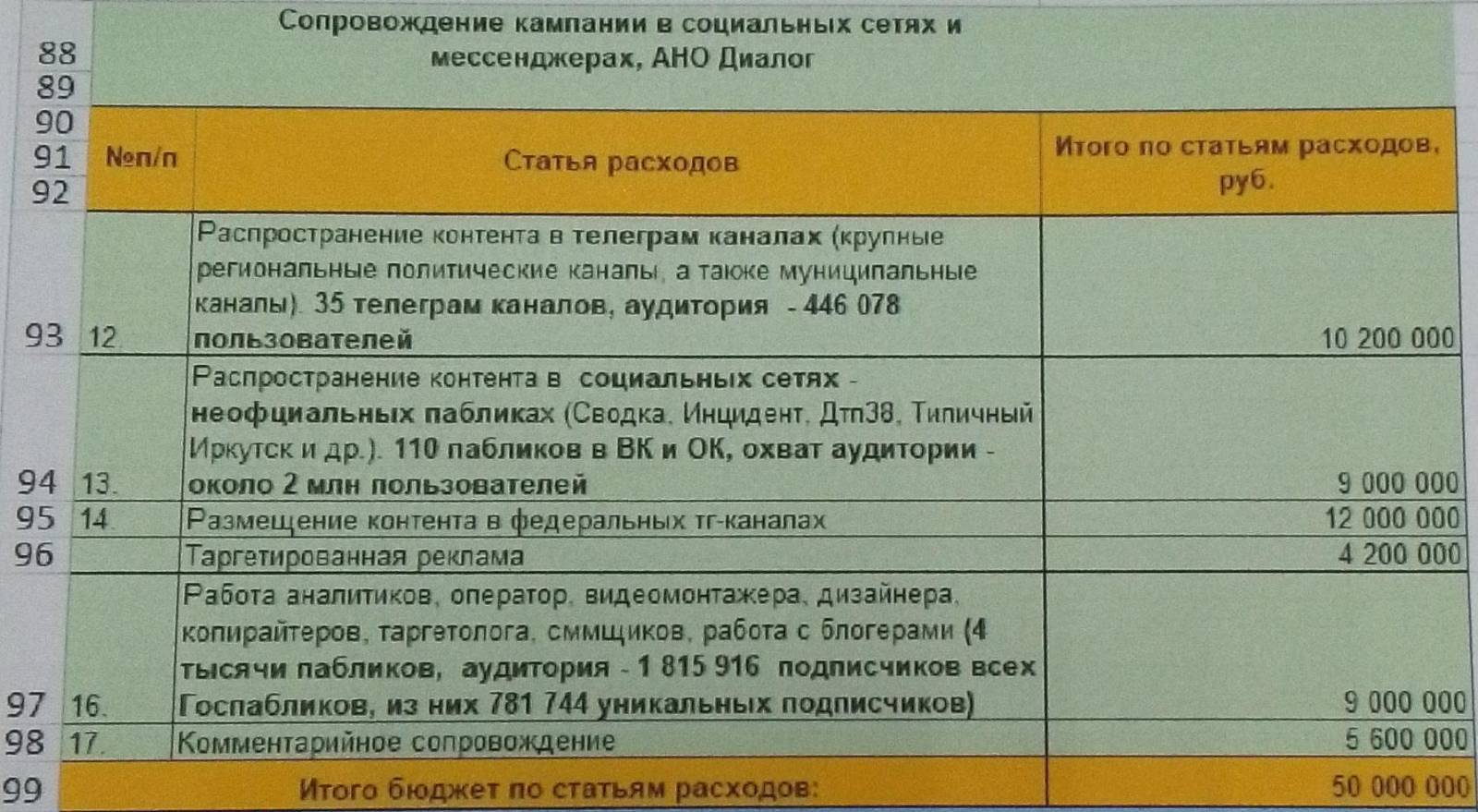
Some 50 million rubles (€500,000) were allocated to Dialog, a state-controlled NGO, for work in social networks and messengers, primarily Telegram.
Dialog, which is supervised by the Russian Presidential Administration, serves as the state’s main coordinator of social media activities. According to a 2022 investigation by Meduza, Vazhnie Istorii and The Bell, Dialog employed more than 2,500 people. By 2024, approximately 24 billion rubles from the budget of the Ministry of Digital Development had been earmarked for the work of Dialog.
Dialog’s primary tasks include promoting the Russian Ministry of Defense and producing disinformation about Ukraine. However, Dialog also draws from regional budgets, particularly during pre-election periods. For regional campaigns, it operates a specialized subdivision called Dialog Regions. As previously reported by REM in the article Russia uses social media as a major campaigning tool in its presidential elections, Dialog has built an entire system for exploiting social media for political purposes.
As part of Kobzev’s election campaign, Dialog was responsible for placing paid content in 110 unofficial communities on Russia’s main social platforms, VKontakte and Odnoklassniki, reaching an audience of around 2 million users. According to leaked documents, 9 million rubles (€90,000) were earmarked specifically for “content distribution on social networks”. This figure did not include posts published in the official public pages of regional governments, educational institutions, or state-affiliated companies — those were managed directly by the governor’s administration and not listed as campaign expenses.
Work on Telegram turned out to be twice as costly, totaling 21 million rubles (€210,000). Roughly half of that amount went toward placing content in 35 regional and local Telegram channels, reaching an audience of about 450,000 users, while the other half was spent on federal-level channels.
Another 5.5 million rubles (€55,000) were allocated for “commentary support”. One of the leaked emails notes that Dialog operates “an extensive bot network across all social media and Telegram, which can be activated when needed to steer discussions in a government-friendly tone, neutralize criticism, and flood comment sections with positive reactions”.
Figure 3. Dialog’s budget for social media work (in Russian)
Avoiding a runoff at any cost
Ahead of the 2025 Unified Election Day, the elections in the Irkutsk region drew particular attention. It was the only one among 20 regions where the incumbent governor faced a serious challenger — former governor and Communist Party (CPRF) candidate Sergey Levchenko. Although Levchenko did not run an especially active campaign, official results still credited him with over 22 percent of the vote.
According to election analyst Ivan Shukshin, the Kremlin did everything possible to avoid runoff elections in gubernatorial races. The usual toolbox was deployed: restricting competition, using administrative resource, coercing voters, manipulating turnout figures, and more. Irkutsk was no exception in this regard.
Given these factors — along with the impressive resources poured into Governor Kobzev’s campaign — it is reasonable to assume that, under even minimally competitive conditions, the Irkutsk election should have proceeded to a second round. In such a runoff, Kobzev would almost certainly have lost to Levchenko. For the Kremlin, that outcome was unacceptable.
Despite months of intensive work by three teams of Moscow political consultants — supported by loyal media outlets, orchestrated social media campaigns, and an army of Telegram bots — Kobzev still failed to pull decisively ahead. With the campaign apparatus exhausted, only a “properly managed” vote count could ensure his victory. Officially, Kobzev secured 61 percent — but this was still the weakest result of all 20 governors elected in 2025.
Disclaimer
While the authenticity of the leaked data cannot be verified, experts familiar with the electoral process in the Irkutsk region have indicated that the figures appear credible. Following the publication of the leak, Communist Party candidate Sergey Levchenko submitted a formal complaint to the Prosecutor’s Office, calling for an investigation into the alleged illicit financing of Igor Kobzev’s re-election campaign. At the time of publication, the outcome of that review remains unknown.