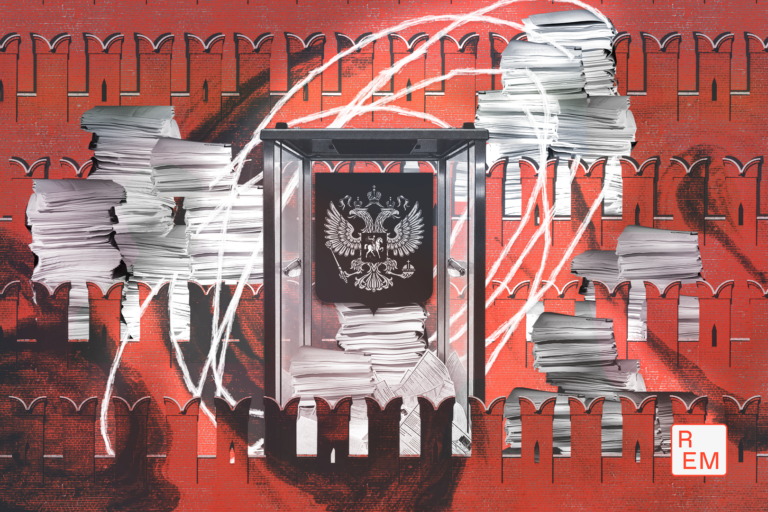
Without respect for fundamental freedoms: Ten reasons why Russian elections and their results cannot be considered democratic
22.09.2024





This is a translation of the article by Verstka. The text is published with permission. To access the original text, follow the link.
Regional and municipal elections took place in Russia on 6-8 September. 25 governors and members of 13 regional parliaments were elected. Many Russians have long had the feeling that voting was a mere formality and that election results were counted unfairly. With every election campaign the situation indeed is getting worse, as independent observers have repeatedly stated. Verstka lists ten main reasons why the September elections in Russia cannot be considered legitimate.
1. There is no way of establishing a political force
According to the Ministry of Justice, there are currently 25 registered political parties in Russia, however, only five of them actively participate in the political life of the country: these are United Russia, the CPRF, Just Russia - For Truth, the LDPR and New People, represented in the State Duma. Another five or so parties are active at the regional level and participate in elections for regional assemblies, but their activities are severely restricted by the Kremlin. For example, there were 14 parties on the Duma elections ballot in 2021. However, United Russia's visibility and total airtime on central TV channels were equal to the visibility and airtime of all other parties combined.
The Ministry of Justice refuses to register parties that are inconvenient for the authorities. Thus, Verstka wrote that the authorities would not register the oppositional party Rassvet of Ekaterina Duntsova. One month after the founding congress of the party Duntsova was declared a foreign agent, the activists face problems while organizing events, and the party still gets no registration. Legal nuances make it easy to refuse any political force of registration, which is why the founder of the Anti-Corruption-Foundation Alexei Navalny and his supporters have tried to register a party for at least nine times between 2012 and 2019 (People's Alliance, Progress Party, Russia of the Future) being each time rejected on formal grounds.
Even political forces that are quite loyal to the Kremlin sometimes fail to obtain registration – for example, the registration of businessman Konstantin Babkin's Party of Business was suspended. This party was not active at the federal level, but had small regional branches.
Another problem is related to the fact that it is very difficult to create a political alliance in terms of personnel and money. A party needs at least 500 potential members to be established, and its branches must be present in at least half of Russia's regions.
“There is an inherent resource disparity between administrative and opposition candidates – parties got used to existing without independent funding in recent years, businesspeople see no point in getting involved in politics and are afraid of it, serious crowdfunding is obviously not going to work because the elections are merely an imitation”, explained electoral expert Dmitry Nesterov.
Another option is to participate in elections as a self-nominated candidate, but it is mostly even more difficult than becoming a candidate from a party. For example, in order to run for a governor position, one has to pass the so-called “municipal filter”, which entails collecting a certain number of signatures of municipal deputies of the region in their support.
Most of them represent United Russia, and therefore they do not sign for independent candidates. Whereas self-nomination can sometimes be of advantage: for example, at the municipal level it’s a way to avoid holding a party congress. However, only 15% of self-nominated candidates succeed in becoming heads of municipalities.
2. The preparation period for the elections is used in favor of the candidates the authorities want to get elected
The electoral process begins not on the election day itself, even not on the day of its appointment, but long before that. There is, for example, a map of electoral districts which needs to be approved before each election. First manipulations of the authorities begin already at this stage: they use a political technology known as gerrymandering or “redistricting”. Let’s take two neighboring single-mandate districts as an example, provided that voters traditionally prefer the ruling party in one of them and the opposition in the other. Gerrymandering means that their boundary lines can be altered to increase the number of pro-government voters in the protest district. As a result, only few opposition votes remain in each of the districts, and the two candidates preferred by the government – meaning to say, candidates from United Russia – get elected to the parliament.
For the current elections, district boundary lines were redrawn in this way in Moscow before the elections to the City Duma. Among other things, the boundaries of District No. 16 have completely changed – a district represented by oppositional member of the city parliament Mikhail Timonov, recognized as a foreign agent. “Predictability of the results: in fact, the districts happen to be distributed between administrative candidates and approved candidates formally nominated by mainstream parties; the administrations do not hinder them from “winning” (and sometimes even help)”, Nesterov noted.
3. (Non-)admission of candidates
According to Golos' calculations, over 10 million people in Russia are deprived of their right to stand for election. “The worst thing is that anyone can be deprived of this right arbitrarily, without a court decision. For example, one can be recognized as a foreign agent. In fact, a court decision is mandatory to officially declare someone as an extremist, but in practice election commissions just need a letter from the police or prosecutor's office stating that a person is involved in an association recognized as extremist, even though there has been no such court decision”, comments Stanislav Andreychuk, co-chairman of the Movement in defense of Voter’s Rights “Golos”. The law prohibiting foreign agents from running in elections at all levels was adopted in May 2024.
The practice of candidates not being allowed to participate in the elections because of the collected signatures is also widespread. Handwriting experts working for the election commissions traditionally reject a high percentage of signatures collected by all opposition candidates (for example, over 20% of candidates were rejected because of allegedly low-quality signatures and thus could not participate in the last elections to the Moscow City Duma). There are also other formal grounds for rejection: e.g., until recently, it was forbidden to indicate business activity as “self-employed” on the ballot paper.
When it comes to regional and local elections, the authorities often seek approval of the candidate lists even for parliamentary parties, according to their political technologists.
“In Moscow, literally every single party coordinates the candidate lists with the administrations, or at the very least engages in strict self-censorship”, claims Nesterov. Thus, the voters are left to choose only between those politicians approved by the ruling authorities to run for office.
4. Campaigning became impossible
Opposition candidates have in general very limited opportunities for campaigning, there are almost no platforms left for it, says Nesterov. “Especially in the regions, there are practically no independent media left, which would be safe to contact, and campaigning in uncensored social networks is connected with risks or directly prohibited for candidates”, he said.
Moreover, if the incumbent representatives of the authorities (e.g., members of regional parliaments or governors in office) oppose the opposition in elections, they have administrative resources on their side. The media more willingly cover their activities, and it is easier for them to get on the TV screen of local channels.
The culture of pre-election debates has also degraded in recent decades: representatives of the authorities from the president to governor level just do not attend them, with rare exceptions. Candidates are in fact prohibited from debating: they only take turns answering questions from the moderators. As a result, the TV ratings of such debates are quite low, which is unsurprising; the viewing figures of the debates have not been published for several years. In 2016, only about 25% of viewers watched the debates before the Duma elections, and no more than 19% before the presidential elections in 2018.
The authorities can also put restrictions on candidates’ meetings with their constituents. In the regions, such meetings just don’t get approved and in several regions, including Moscow, the Covid restrictions are still in force, and public meetings with constituents are therefore banned. This happens despite the fact that in 2019 the Constitutional Court defined the right to meet with constituents as a form of peaceful constructive public dialog and admitted of the “protest nature” of such events.
Besides, the candidates are restricted in their choice of topics for campaigning in Russia. For example, they have no possibilities whatsoever to speak up against the war. If they did, their actions would fall under the laws on spreading fake information about the Russian army.
5. Voting by constraint
The practice of forcing employees of state-funded institutions to vote has existed in Russia for many years. As a rule, employers send messages in work-related chats calling for the employees to vote, and in recent years the requirements have become stricter - for example, to vote on a certain day or to vote using the remote e-voting system. Verstka journalists spoke to an employee of a state-funded institution in Moscow, who claimed to be forced to vote even in a certain time slot – from 11:00 to 13:00 Moscow time.
Mobilization of state-funded employees is an instrument to ensure the necessary turnout and election results. The more dependent voters are, the higher these figures are. That is why, as a rule, a hundred percent turnout with almost hundred percent votes in favor of the authorities is typical for military units, pre-trial detention centers or psychiatric hospitals. Also, national republics such as Ingushetia, Tyva, and Chechnya provide for abnormally high results.
The Golos movement noted in its latest report that this time the scale of administrative mobilization of voters before the Unified Election Day (UED) was far lower than in the spring before the presidential election 2024. Vladimir Putin received 87.28% of the vote – more than in previous campaigns.
“Apparently, this is due to the absence of a single control center, to which regional electoral machines constantly had to report on their work, as well as to the general understanding that excessive efforts would have been pointless in this situation”, said Andreychuk, co-chairman of Golos. At the September 2024 elections, the employees of the Russian State University of Humanities were called for bringing their friends and acquaintances to the elections.
6. Dependency of election commissions
There is no truly independent electoral system in Russia. The Central Election Commission is under the full control of the presidential administration: there have been no instances in the last decade of its members opposing the Kremlin, its decisions or pro-government candidates.
The electoral system does not resemble an ordinary federal agency, and its structure is designed to make it independent of the federal authorities. That is why each election commission of a constituent entity of the country is formed by the regional authorities. Theoretically, this ought to make the election commissions independent from Moscow, but in fact their work is controlled by administrations of the regional governors.
As a result, regional commissions are subordinate to the regional authorities, and not to the CEC, which leads to conflicts. For example, Ella Pamfilova, head of the Central Election Commission, has tried to get the St. Petersburg election commission dissolved for several years, harshly criticizing them for violations; however, she just could not succeed immediately.
Dependence on the authorities is a problem not only for the large regional election commissions but also for the lowest-level precincts and their members. In 2021, more than 50% of precinct electoral commissions were located in schools, and local teachers worked as commission members. It is easy for local administrations to exert pressure on them as teachers are public sector employees. That is why commission members from among teachers, as a rule, do not react to violations, and sometimes even stuff ballot boxes and rewrite protocols.
In recent years, however, such precedents have become fewer because the election results are now “corrected” online, in the state automated system “Vybory”, explains an interlocutor close to the election commission in Moscow in his interview to Verstka. The number of violations stays the same: according to Andreychuk, in the last presidential election Golos identified at least 22 million dubious votes.
7. Non-transparency of remote e-voting
The Remote e-voting system (REV) was introduced during the 2019 elections in Russia. The system encrypts the voters-related data with blockchain technology. Literally from the moment this system appeared, experts stated that it was impossible to find out whether any interventions in the blockchain took place. To challenge the assumption about REV-assisted ballot box stuffing, election commissions conduct a demonstrative “separation of the key” to the remote e-voting system. The key for decrypting the e-voting results is divided into seven parts and given to different people.
According to the organizers, it is supposedly impossible to find out the e-voting results without having the key assembled. The problem is that during the ceremony the key is separated and stored on a flash drive, however, it is impossible to make sure that the code didn’t stay on the source computer or elsewhere. “The election participants have no control whatsoever over the key generation software or over the ways of how cryptography is used in the system”, Nesterov explained.
Thus, one can hardly say for sure that the REV is secure: for example, it is impossible to find out whether bots voted in the system, whether the votes of deceased voters (so-called “dead souls”) were counted, and so on. At the same time, failures of the REV reveal signs of vote rigging.
“In Moscow, for example, the REV is responsible for all sorts of miracles, thus the fact alone of using REV during the elections does not allow a normal candidate to seriously count on winning. That's why the “opposition” candidates either turn into dummies or participate in the elections to get spotted, to increase the awareness”, says Nesterov, who has been researching on e-voting for many years. In the September elections, residents of 26 regions were able to vote using the REV, and in Moscow a separate platform was used for it.
In the last presidential election, more than two-thirds of Moscow residents voted online, being forced to do so. Many of them were offered to use e-voting terminals instead of paper ballots at polling stations. The processing of votes collected with e-voting terminals is just as non-transparent as the whole process with the REV.
In the current Moscow City Duma elections, the Moscow Election Commission, with the permission of the CEC, sharply limited the number of paper ballots – in order to receive one, a voter should have applied for it in advance. In August, a representative of the Moscow City Election Commission told Verstka that the commission did not even keep statistics on the number of those who applied for a paper ballot. Thus, the election transparency in the capital is under serious threat.
8. Lack of independent monitoring
In recent years, the authorities have consistently cut off independent monitoring organizations from the electoral process. First, the foreign agents were prohibited from the monitoring process (Golos was one of the first organizations to be included on the list), and currently only parties, candidates, and public chambers (regional and federal) that are dependent on the authorities are allowed to send observers to polling stations. The persecution of independent observers did not end there: in 2023, Grigory Melkonyants, co-chairman of Golos, was detained and put in custody on charges of participating in the activities of an “undesirable organization”.
International monitoring of Russian elections in recent years has been represented only by “friendly” countries such as Belarus, and the OSCE has not been engaged in monitoring in Russia since 2021. As a result, in the current campaign, most polling stations remained unobserved even during the day. The introduction of a three-day voting period also allows for ballot manipulations at night, when precinct electoral commissions stay unattended.
Monitoring the extraterritorial polling stations were complicated as well. For example, citizens evacuated from the Kursk region had a timeslot of 15 minutes to vote at a field polling station right in the temporary accommodation centers. Extraterritorial election commissions were formed without any representatives of political parties, and it was difficult to send observers there: only those citizens allowed to vote in these elections could become observers. Since the polling stations were located outside the region where the elections were held, it was very difficult to find such candidates.
Video surveillance consistently gets more and more limited: in 2021, the CEC canceled free access to cameras installed at the polling stations. “Video surveillance is not installed for the idle curiosity reasons so that anyone might lie on a couch and watch a kind of election movie”, CEC Chairwoman Ella Pamfilova stated at the time. This year, the CEC also gave the commissions of eight Russian regions bordering Ukraine the right to restrict photo and video recording during the elections referring to “security reasons”.
9. Election results can’t be challenged
Candidates don’t have any opportunity whatsoever to challenge the election results and other decisions made by the commissions, Andreychuk said. Dmitry Nesterov agrees.
“There is no state or public infrastructure that could protect the rights of independent candidates. Candidates can be removed from the list by the commission, state-controlled courts, or the police at any stage of the election process. That’s how vague the current legislation is as well as how liberal and selective its interpretation might be. I haven't seen a single case in a long time that undesirable candidates would manage to prove their point, get their names back on the candidates list etc.”, he says.
It is extremely rare that opposition candidates do manage to challenge the decisions of election commissions: so far, we know of only one such case during the current elections – in Buryatia, a court restored the registration of a CPRF candidate for the Ulan-Ude City Duma.
10. Elections during the ongoing war and repressions
International organizations are critical of the election results received during ongoing armed conflicts. An example being the Venice Commission of the Council of Europe, which defined that “holding referendums during wars and military threats is against European standards”. In the Kursk Region, the municipal-level elections were rescheduled because the territories were occupied by the Ukrainian Armed Forces, wrote Verstka.
“Democratic institutions, which act as a prerequisite for independent elections in the country, are just not there”, Andreychuk said. “Restrictions to free speech, freedom of assembly and freedom of association for political purposes. In general, it is impossible to hold free elections without observing the fundamental freedoms”, the expert summarized.
Nesterov is of the same opinion; according to him, “it is getting more and more difficult to apply the criteria of democratic elections to our procedures”. “The divergence and deviations from the model of democratic elections are far too big”, he notes.